Righteousness Is Good Character: Hadith 27 of an-Nawawi
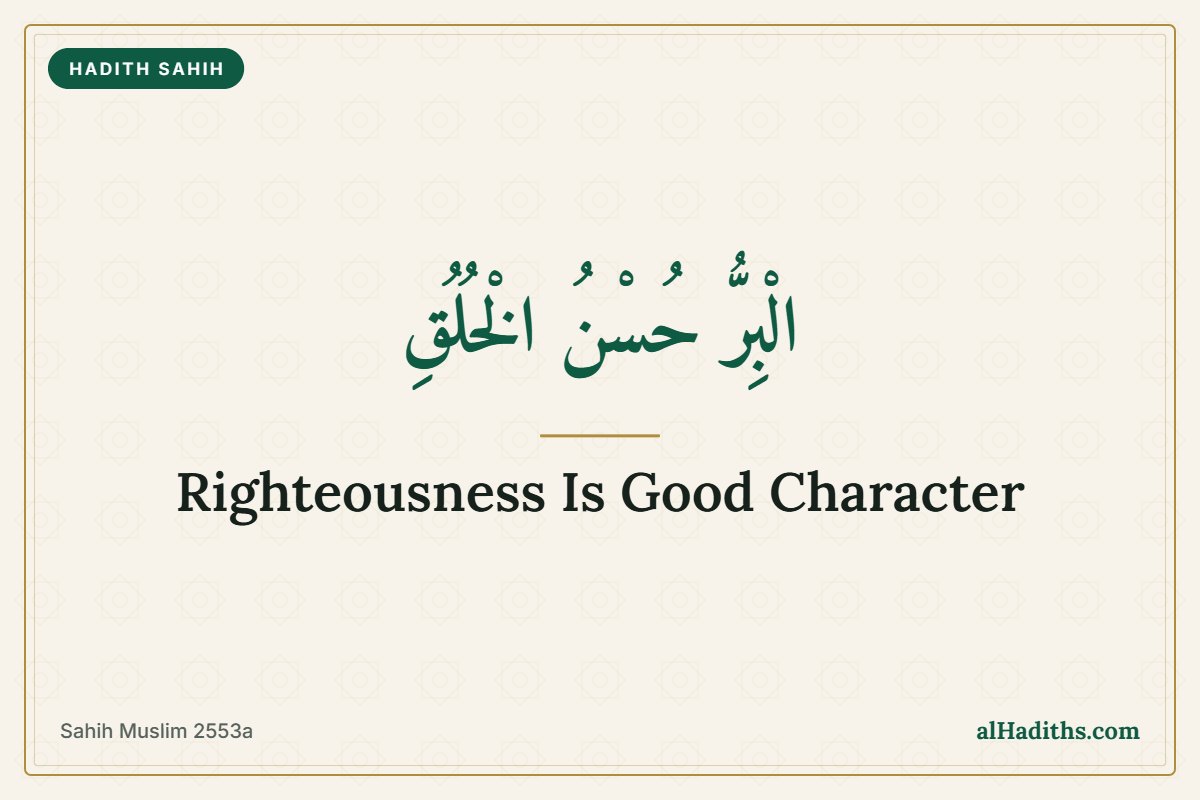
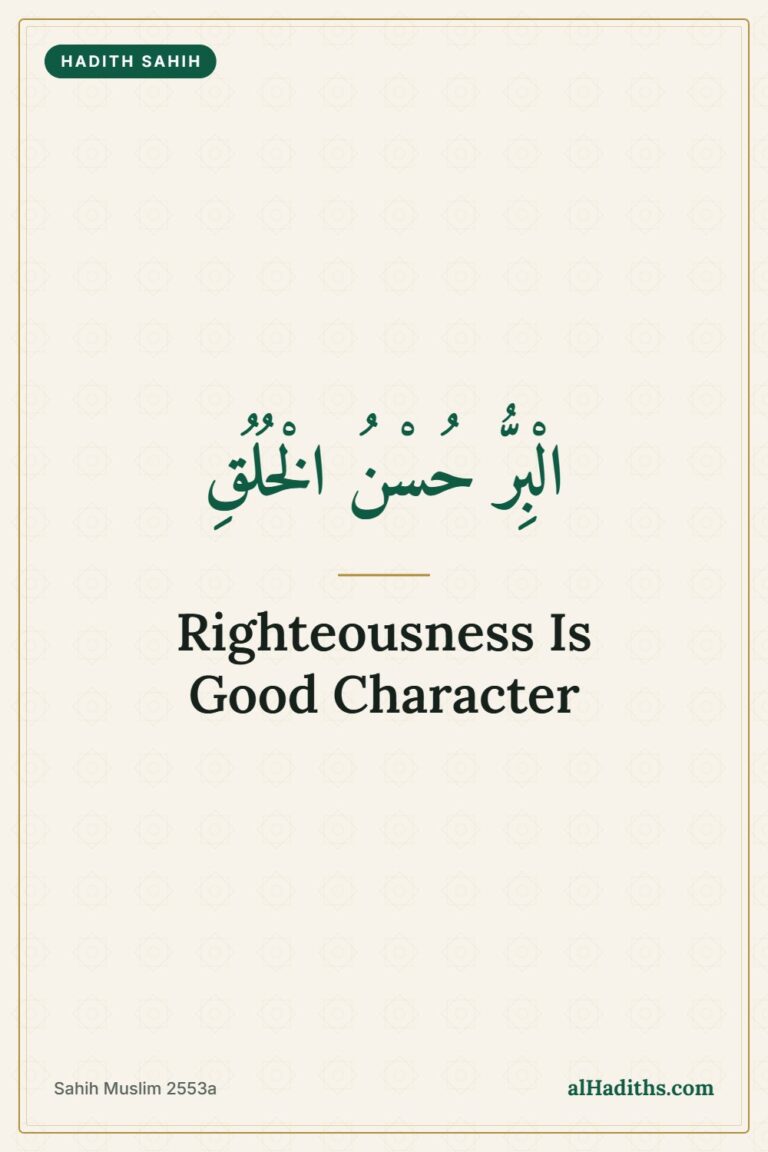
“Righteousness is good character.” In three Arabic words, the Prophet ﷺ answered a question many of us still ask: what does it really mean to be a good Muslim? This is Hadith 27 of Imam an-Nawawi’s collection, the righteousness is good character hadith. It also gives a simple inner test for sin, and a reminder of where that test stops.
At a glance
- Source: Sahih Muslim 2553a (Hadith 27 of an-Nawawi’s 40)
- Narrated by: an-Nawwas ibn Sam’an (may Allah be pleased with him)
- Grade: Sahih (Sahih Muslim)
- Topic: Righteousness is good character; sin is what unsettles the heart and what we would hide
- Put it into practice: Before you act, ask: would I be comfortable if people knew about this?
The hadith
An-Nawwas ibn Sam’an (may Allah be pleased with him) said that he asked the Messenger of Allah ﷺ about righteousness and sin, and he said:
الْبِرُّ حُسْنُ الْخُلُقِ وَالإِثْمُ مَا حَاكَ فِي صَدْرِكَ وَكَرِهْتَ أَنْ يَطَّلِعَ عَلَيْهِ النَّاسُ
“Virtue is a kind disposition and vice is what rankles in your heart and that you disapprove that people should come to know of it.”
Sahih Muslim 2553a · Narrated by an-Nawwas ibn Sam’an · Translation from Sunnah.com
The Arabic word الْبِرُّ (al-birr) is translated here as “virtue”; it is often rendered “righteousness”, and that is the word used in the rest of this article. Imam an-Nawawi gives this hadith as Hadith 27 of his 40 Hadith.
“Consult your heart”: the narration of Wabisah
Imam an-Nawawi places a second narration beside it. Wabisah ibn Ma’bad (may Allah be pleased with him) came to the Prophet ﷺ, who told him that he had come to ask about righteousness, and said to him, “Consult your heart”:
الْبِرُّ مَا اطْمَأَنَّتْ إلَيْهِ النَّفْسُ، وَاطْمَأَنَّ إلَيْهِ الْقَلْبُ، وَالْإِثْمُ مَا حَاكَ فِي النَّفْسِ وَتَرَدَّدَ فِي الصَّدْرِ، وَإِنْ أَفْتَاك النَّاسُ وَأَفْتَوْك
“Righteousness is that about which the soul feels at ease and the heart feels tranquil. And wrongdoing is that which wavers in the soul and causes uneasiness in the breast, even though people have repeatedly given their legal opinion [in its favour].”
40 Hadith an-Nawawi 27 · Narrated by Wabisah ibn Ma’bad · Reported by Ahmad and ad-Darimi · Translation from Sunnah.com
Both narrations say the same core thing: sin leaves the heart uneasy. The first adds the test of not wanting people to know; the second adds that the unease stays even when people say it is fine.
A note on its grading
The first narration is in Sahih Muslim and its authenticity is not in question. Scholars differ on Wabisah’s narration:
- Imam an-Nawawi called it a hasan (good) hadith with a hasan chain (Sunnah.com, 40 Hadith 27).
- The Encyclopedia of Translated Prophetic Hadiths (HadeethEnc) lists both narrations as authentic.
- Shaykh Shu’aib al-Arna’ut graded the chain in Musnad Ahmad weak (Musnad Ahmad 18006).
So the main lesson of this article rests on the narration in Sahih Muslim, and Wabisah’s narration is shown as a supporting one.
What “righteousness is good character” means
The Encyclopedia of Translated Prophetic Hadiths (HadeethEnc) explains the key phrases like this:
- Righteousness is good character. Good character is among the greatest kinds of righteousness: piety toward Allah, patience when people hurt us, holding back anger, a cheerful face, kind words, keeping family ties and being easy to deal with.
- What wavers in your chest. Sin leaves unease and hesitation; the heart does not settle on it and fears it may be wrong.
- You dislike people knowing. People naturally like their good deeds to be seen. If you would rather an act stayed hidden, that is a sign it may be sinful.
- Even if people give you a fatwa. A ruling from someone without knowledge does not remove real doubt. But when a ruling rests on sound evidence from the Shariah, it should be followed even if the heart is not fully at ease.
HadeethEnc also quotes as-Sindi: this inner test is for unclear matters. Where the Shariah is clear, its ruling comes before our feelings, and the test is meant for a sound heart, not one that has grown used to sin. For more on unclear matters, see leave what makes you doubt.
The best example of good character is the Prophet ﷺ himself, whom Allah praised:
وَإِنَّكَ لَعَلَىٰ خُلُقٍ عَظِيمٍ
“And indeed, you are of a great moral character.”
Surah Al-Qalam 68:4 · Translation: Saheeh International, from Quran.com
Reflection: I find it striking that when asked about righteousness, the Prophet ﷺ did not begin with a list of acts of worship, but with character. The second half is just as practical: most of us already know the feeling of wanting to hide something. This hadith teaches us to listen to that feeling, and to stop before we act.
How to put it into practice
These are suggestions drawn from the explanation above:
- Pick one trait of good character to work on this week, such as holding back anger, a cheerful face, or kind words at home.
- Use the “would I hide it?” test before doing something you are unsure about.
- Watch your words, since speech is where character shows most; see speak good or remain silent.
- Do not use “consult your heart” against a clear ruling. For clear halal and haram, see halal is clear and haram is clear; for your own situation, ask a qualified local scholar.
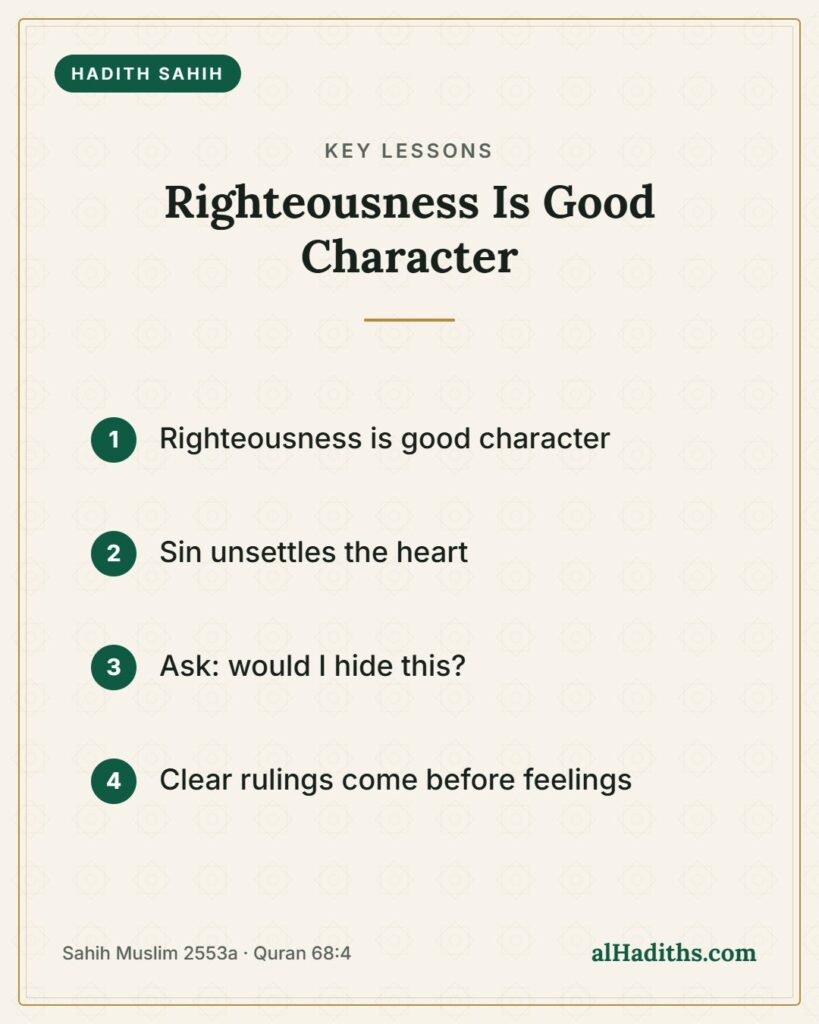
Key lessons
- Righteousness is good character, toward Allah and toward people.
- Sin leaves the heart uneasy and makes us want to hide it.
- The inner test is for unclear matters; clear rulings come first.
- The Prophet ﷺ is the best example of good character (Quran 68:4).
Questions people ask
What does “righteousness is good character” mean?
In Sahih Muslim 2553a the Prophet ﷺ said that righteousness is good character. The Encyclopedia of Translated Prophetic Hadiths (HadeethEnc) explains that good character, such as patience, holding back anger, a cheerful face and kind words, is among the greatest kinds of righteousness.
What does “consult your heart” mean in the hadith?
In Wabisah’s narration the Prophet ﷺ told him to consult his heart: righteousness is what the soul feels at ease with, and sin is what unsettles it. Scholars explain that this applies to unclear matters; a clear ruling of the Shariah comes before our feelings.
Is the hadith “consult your heart” authentic?
Imam an-Nawawi graded Wabisah’s narration hasan, and HadeethEnc lists it as authentic, while Shaykh Shu’aib al-Arna’ut graded its chain in Musnad Ahmad weak. The related narration “righteousness is good character” is in Sahih Muslim.
May Allah beautify our character, and give us hearts that feel at ease with what is good and uneasy with what is wrong.
Save this to Pinterest so you can come back to this hadith later.
Share the reward. Send this article to someone who needs it today — teaching a hadith or dua can become a lasting good deed for you, in shaa Allah.