Ramadan 2027: Expected Dates and 7 Authentic Hadith to Prepare
Contents
Ramadan 2027 is expected to begin on Monday, 8 February 2027, with the first tarawih on the night before, and Eid al-Fitr on Tuesday 9 or Wednesday 10 March. These are astronomical forecasts: the sighting of the new moon decides the actual dates where you live. Below are the key dates in one place, then seven authentic hadith that show how the Prophet ﷺ approached this month, so we can prepare for it with more than a calendar.
At a glance
- Ramadan 2027 (expected): Monday 8 February to Monday 8 or Tuesday 9 March 2027
- Eid al-Fitr 2027 (expected): Tuesday 9 or Wednesday 10 March 2027
- Authentic hadith here: 7, from Bukhari and at-Tirmidhi, plus Quran 2:185
- Grade: Sahih al-Bukhari; at-Tirmidhi 807 Sahih (Darussalam)
- One thing to do today: Pick one habit from this list and start it now, so it is steady by the first night
When is Ramadan 2027?
Here are the expected dates for Ramadan 1448 and the two Eids, based on the International Astronomical Center’s forecast (Gulf News). Some countries may start a day later, and then every date below moves by a day.
- Moon sighting for Ramadan: evening of Sunday 7 February 2027 (29 Sha‘ban)
- First night of Ramadan (first tarawih): evening of Sunday 7 February
- First day of fasting (1 Ramadan 1448): Monday 8 February 2027
- Last ten nights begin: evening of Saturday 27 February (the 21st night)
- Odd nights to seek Laylatul Qadr: evenings of 27 February and 1, 3, 5 and 7 March
- Eid al-Fitr 2027: Tuesday 9 March if Ramadan has 29 days, or Wednesday 10 March if it has 30
- Eid al-Adha 2027: around Sunday 16 May (Day of Arafah around Saturday 15 May)
Our Islamic calendar lists the other key dates of the year. Why does every calendar say “expected”? The first hadith answers that.
1. Start when the crescent is seen
Abu Hurayrah (may Allah be pleased with him) reported how the month begins and ends:
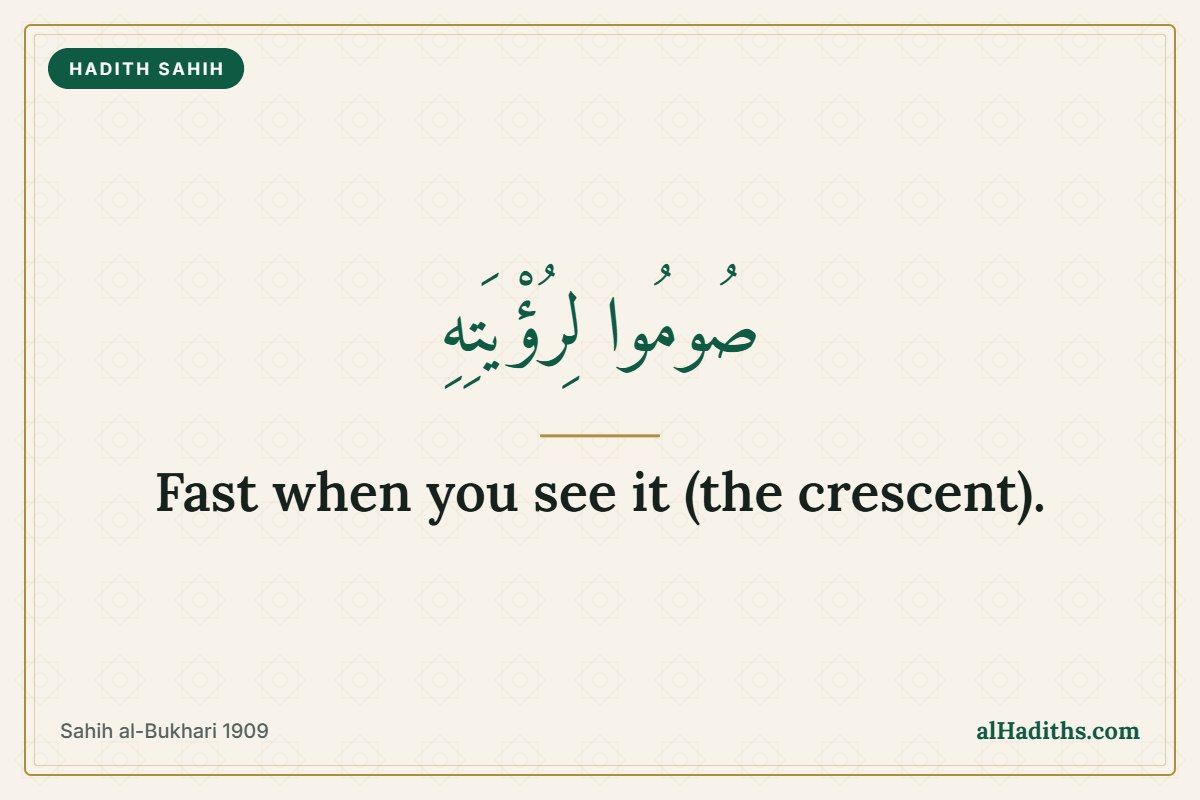
صُومُوا لِرُؤْيَتِهِ، وَأَفْطِرُوا لِرُؤْيَتِهِ، فَإِنْ غُبِّيَ عَلَيْكُمْ فَأَكْمِلُوا عِدَّةَ شَعْبَانَ ثَلاَثِينَ
“Start fasting on seeing the crescent (of Ramadan), and stop fasting on seeing the crescent (of Shawwal), and if the sky is overcast (and you cannot see it), complete thirty days of Sha‘ban.”
Sahih al-Bukhari 1909 · Narrated by Abu Hurayrah · Translation adapted from Sunnah.com
HadeethEnc explains the same teaching from Ibn ‘Umar’s narration: the crescent marks the start and the end of Ramadan, and if clouds hide it, Sha‘ban is counted as thirty days. A lunar month is either 29 or 30 days (HadeethEnc 4549). Sahih Muslim records it too (Sahih Muslim 1081). This is why no one can fix the date of Ramadan 2027 today. How each country decides, by local sighting, a national authority or calculation, is a question scholars differ on, so follow your local authority.
Try this: find out now how your mosque or national authority announces the start of Ramadan, so the evening of 7 February does not catch you guessing.
2. Give more, and spend time with the Quran
Ibn ‘Abbas (may Allah be pleased with him) described what changed in the Prophet ﷺ when Ramadan came:
كَانَ رَسُولُ اللَّهِ صلى الله عليه وسلم أَجْوَدَ النَّاسِ، وَكَانَ أَجْوَدُ مَا يَكُونُ فِي رَمَضَانَ حِينَ يَلْقَاهُ جِبْرِيلُ، وَكَانَ يَلْقَاهُ فِي كُلِّ لَيْلَةٍ مِنْ رَمَضَانَ فَيُدَارِسُهُ الْقُرْآنَ، فَلَرَسُولُ اللَّهِ صلى الله عليه وسلم أَجْوَدُ بِالْخَيْرِ مِنَ الرِّيحِ الْمُرْسَلَةِ
“Allah’s Messenger ﷺ was the most generous of people, and he was at his most generous in Ramadan when Jibril met him. Jibril used to meet him every night of Ramadan and study the Quran with him. Allah’s Messenger ﷺ was more generous in doing good than the wind that is sent out.”
Sahih al-Bukhari 6 · Narrated by Ibn ‘Abbas · Translation adapted from Sunnah.com
HadeethEnc explains that he was generous with his wealth, his knowledge, his advice and everything that benefits people, and that this grew in Ramadan; so we are encouraged to give more and recite more in this month (HadeethEnc 6179). The two go together here: nights with the Quran, days of giving.
Try this: set aside your Ramadan sadaqah now, and choose a daily portion of Quran you can keep up for thirty days.
3. Eat suhur, even a little
Anas ibn Malik (may Allah be pleased with him) reported a short command with a reason attached:
تَسَحَّرُوا فَإِنَّ فِي السَّحُورِ بَرَكَةً
“Take suhur, for there is a blessing in it.”
Sahih al-Bukhari 1923 · Narrated by Anas ibn Malik · Translation adapted from Sunnah.com
IslamQA explains that part of this blessing is getting up at the end of the night, a time for dua and seeking forgiveness, and that suhur also helps people pray Fajr on time (IslamQA). The hadith gives no amount: a few dates and water still count.
Try this: as a suggestion, set your suhur alarm about fifteen minutes earlier than you need, and use that time for dua before Fajr.
4. Feed someone’s iftar
Zayd ibn Khalid al-Juhani (may Allah be pleased with him) reported one of the easiest rewards of the month:
مَنْ فَطَّرَ صَائِمًا كَانَ لَهُ مِثْلُ أَجْرِهِ غَيْرَ أَنَّهُ لاَ يَنْقُصُ مِنْ أَجْرِ الصَّائِمِ شَيْئًا
“Whoever gives food to a fasting person to break his fast with will have the same reward as him, without anything being taken from the reward of the fasting person.”
Jami‘ at-Tirmidhi 807 · Sahih (Darussalam) · Narrated by Zayd ibn Khalid al-Juhani · Translation adapted from Sunnah.com
HadeethEnc notes that the apparent meaning is that even a single date given to a fasting person is enough to earn this reward (HadeethEnc 6271). Our guide to the dua for breaking fast covers what to say at that moment.
Try this: plan to share iftar at least once a week: a neighbor, a colleague, or the iftar at your mosque.
5. Work hardest in the last ten nights
‘A’ishah (may Allah be pleased with her) described the Prophet ﷺ when the final ten nights came:
كَانَ النَّبِيُّ صلى الله عليه وسلم إِذَا دَخَلَ الْعَشْرُ شَدَّ مِئْزَرَهُ، وَأَحْيَا لَيْلَهُ، وَأَيْقَظَ أَهْلَهُ
“When the last ten nights began, the Prophet ﷺ would tighten his waist-wrapper, stay up the night in worship and wake his family.”
Sahih al-Bukhari 2024 · Narrated by ‘A’ishah · Translation adapted from Sunnah.com
HadeethEnc explains that he would spend the whole night in different acts of worship and wake his family to pray, and that tightening the waist-wrapper means he exerted himself (HadeethEnc 4944). In 2027 the last ten nights are expected to begin on the evening of Saturday 27 February.
Try this: block out 27 February to 8 March now: ask for leave if you can, and keep those evenings light.
6. Seek Laylatul Qadr
Abu Hurayrah (may Allah be pleased with him) reported the reward for standing on this one night:
مَنْ يَقُمْ لَيْلَةَ الْقَدْرِ إِيمَانًا وَاحْتِسَابًا غُفِرَ لَهُ مَا تَقَدَّمَ مِنْ ذَنْبِهِ
“Whoever stands in prayer on the Night of Qadr out of faith and hoping for reward, his past sins will be forgiven.”
Sahih al-Bukhari 35 · Narrated by Abu Hurayrah · Translation adapted from Sunnah.com
HadeethEnc explains the two conditions: believing in the night and its merit, and seeking Allah’s reward, not to be seen by people (HadeethEnc 4202). The Prophet ﷺ told us to look for it in the odd nights of the last ten (Sahih al-Bukhari 2017); no authentic hadith fixes it on one night every year.
Try this: write the five odd-night dates in your calendar (27 February, 1, 3, 5 and 7 March) and plan for each one, not only the 27th night.
7. Pay zakat al-fitr before the Eid prayer
Ibn ‘Umar (may Allah be pleased with him and his father) reported how the month closes:
فَرَضَ رَسُولُ اللَّهِ صلى الله عليه وسلم زَكَاةَ الْفِطْرِ صَاعًا مِنْ تَمْرٍ، أَوْ صَاعًا مِنْ شَعِيرٍ عَلَى الْعَبْدِ وَالْحُرِّ، وَالذَّكَرِ وَالأُنْثَى، وَالصَّغِيرِ وَالْكَبِيرِ مِنَ الْمُسْلِمِينَ، وَأَمَرَ بِهَا أَنْ تُؤَدَّى قَبْلَ خُرُوجِ النَّاسِ إِلَى الصَّلاَةِ
“Allah’s Messenger ﷺ made zakat al-fitr obligatory, one sa‘ of dates or one sa‘ of barley, on the slave and the free, male and female, young and old among the Muslims, and he ordered that it be paid before the people go out to the prayer.”
Sahih al-Bukhari 1503 · Narrated by Ibn ‘Umar · Translation adapted from Sunnah.com
HadeethEnc explains that it is due from anyone who has more than he needs for the day and night of Eid for himself and those he supports, and that it is given before the Eid prayer (HadeethEnc 4520). Its amount in today’s money, and whether it may be paid in cash, are questions scholars differ on, so follow your local zakat authority. Our guide to the Eid prayer covers the morning itself.
Try this: find out how your mosque or zakat body collects zakat al-fitr, so it is paid well before the morning of 9 or 10 March.
Bringing it together
All seven hadith point back to the verse that names this month and gives its purpose:
شَهْرُ رَمَضَانَ ٱلَّذِىٓ أُنزِلَ فِيهِ ٱلْقُرْءَانُ هُدًى لِّلنَّاسِ وَبَيِّنَـٰتٍ مِّنَ ٱلْهُدَىٰ وَٱلْفُرْقَانِ ۚ فَمَن شَهِدَ مِنكُمُ ٱلشَّهْرَ فَلْيَصُمْهُ ۖ وَمَن كَانَ مَرِيضًا أَوْ عَلَىٰ سَفَرٍ فَعِدَّةٌ مِّنْ أَيَّامٍ أُخَرَ ۗ يُرِيدُ ٱللَّهُ بِكُمُ ٱلْيُسْرَ وَلَا يُرِيدُ بِكُمُ ٱلْعُسْرَ وَلِتُكْمِلُوا۟ ٱلْعِدَّةَ وَلِتُكَبِّرُوا۟ ٱللَّهَ عَلَىٰ مَا هَدَىٰكُمْ وَلَعَلَّكُمْ تَشْكُرُونَ
The month of Ramaḍān [is that] in which was revealed the Qur’ān, a guidance for the people and clear proofs of guidance and criterion. So whoever sights [the crescent of] the month, let him fast it; and whoever is ill or on a journey – then an equal number of other days. Allāh intends for you ease and does not intend for you hardship and [wants] for you to complete the period and to glorify Allāh for that [to] which He has guided you; and perhaps you will be grateful.
Surah al-Baqarah 2:185 · Translation: Saheeh International, from Quran.com
Reflection: a calendar tells us when Ramadan arrives; these hadith tell us how to arrive ready. Generosity, the Quran, the night prayer and charity were not new to the Prophet ﷺ in Ramadan; the month raised what was already there. With about three months to go, building one of these habits now means it is not brand new on the first night.
Questions people ask
When is Ramadan 2027?
Ramadan 1448 is expected to begin on Monday 8 February 2027, with the first tarawih on the evening of Sunday 7 February, and to end on Monday 8 or Tuesday 9 March. The sighting of the new moon decides the exact dates, so follow your local authority.
When is Eid 2027?
Eid al-Fitr 2027 is expected on Tuesday 9 or Wednesday 10 March, depending on whether Ramadan has 29 or 30 days. Eid al-Adha 2027 is expected around Sunday 16 May. Both depend on the moon sighting.
When is Laylatul Qadr 2027?
The Prophet ﷺ told us to seek it in the odd nights of the last ten (Sahih al-Bukhari 2017). In 2027 these are expected on the evenings of 27 February and 1, 3, 5 and 7 March. No authentic hadith fixes it on one night every year.
How many days is Ramadan 2027?
29 or 30 days. A lunar month is one or the other, and the crescent of Shawwal decides when Ramadan ends; if it cannot be seen, Ramadan is completed as thirty days.
Is there a dua for seeing the new moon of Ramadan?
The well-known “Allahumma ahlilhu ‘alayna bil-yumni wal-iman” is reported in Jami‘ at-Tirmidhi 3451, but Sunnah.com shows it graded Da‘if (Darussalam), so we have not given it a hadith card here. Any sincere dua in your own words is fine at that moment.
Key lessons
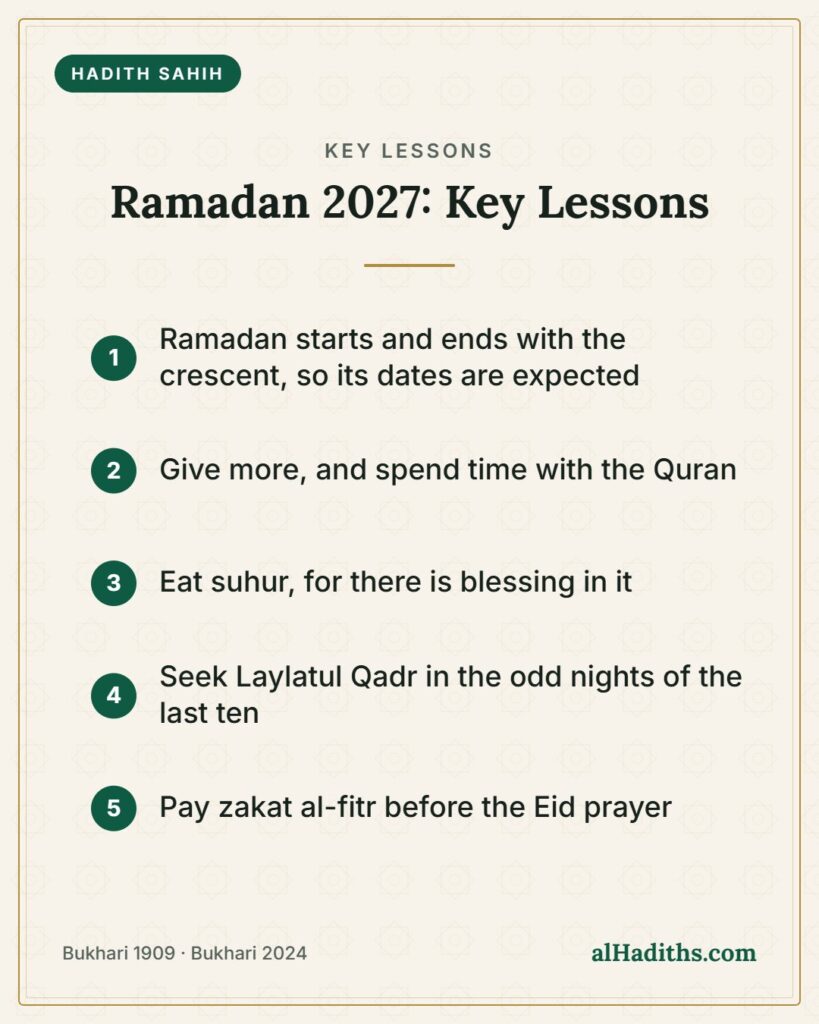
- Ramadan starts and ends with the crescent, so its dates are expected (Bukhari 1909).
- The Prophet ﷺ gave most and studied the Quran with Jibril in Ramadan (Bukhari 6).
- Suhur has blessing, and feeding a fasting person earns their reward (Bukhari 1923, Tirmidhi 807).
- The last ten nights call for extra effort; seek Laylatul Qadr in the odd nights (Bukhari 2024, 35).
- Zakat al-fitr is paid before the Eid prayer (Bukhari 1503).
May Allah let us reach Ramadan in good health, accept our fasting and standing, and let us arrive ready for it.
Save this to Pinterest so you have the Ramadan 2027 dates and hadith ready
Share the reward. Send this article to someone who needs it today — teaching a hadith or dua can become a lasting good deed for you, in shaa Allah.