Laylatul Qadr Dua: Arabic, Meaning and the Authentic Wording
Contents
Aisha (may Allah be pleased with her) once asked the Prophet ﷺ a question many of us ask every Ramadan: if I find Laylatul Qadr, what should I say? His answer was a short dua for pardon. This is the Laylatul Qadr dua, in the exact words he taught her.
At a glance
- Source: Sunan Ibn Majah 3850 (also Jami‘ at-Tirmidhi 3513)
- Narrated by: Aisha
- Grade: Sahih (Darussalam)
- Topic: Laylatul Qadr, asking Allah for pardon
- Practise it: Say it often in the last ten nights of Ramadan
The Laylatul Qadr dua in Arabic
Aisha asked: “O Messenger of Allah, what do you think I should say in my supplication, if I come upon Laylatul Qadr?” He said: “Say:”
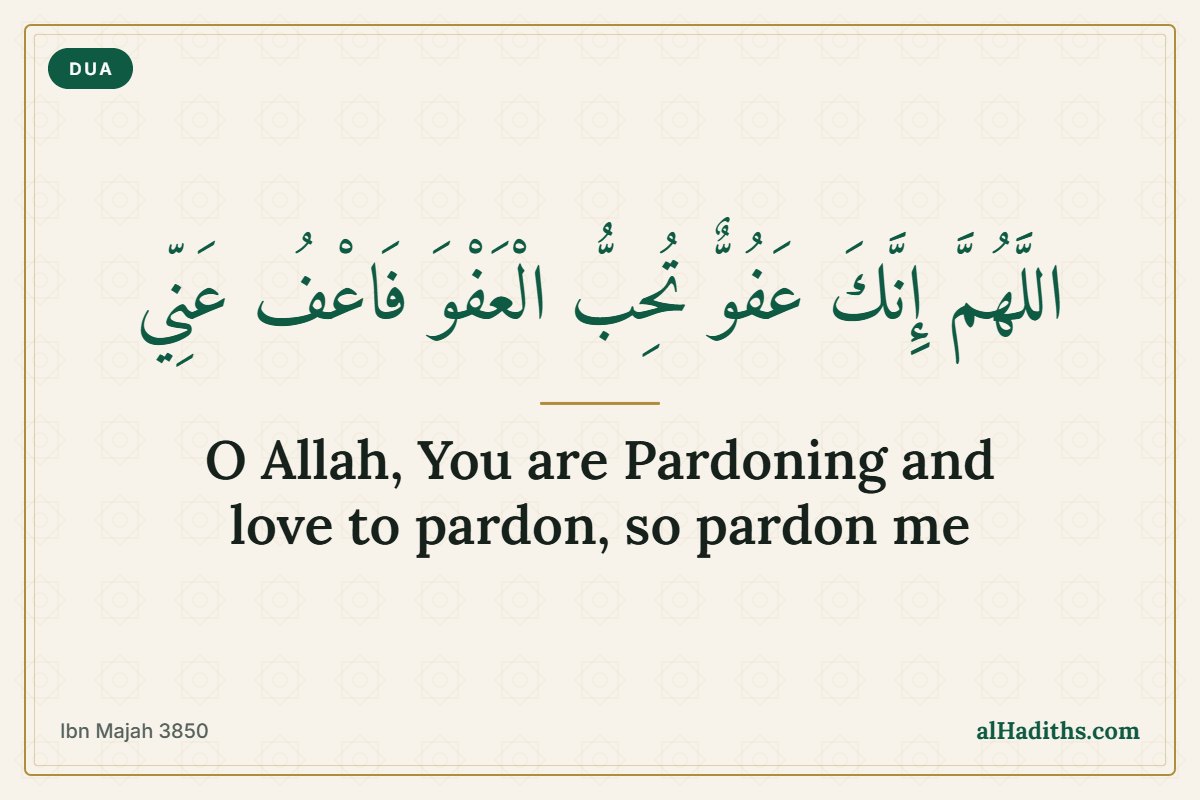
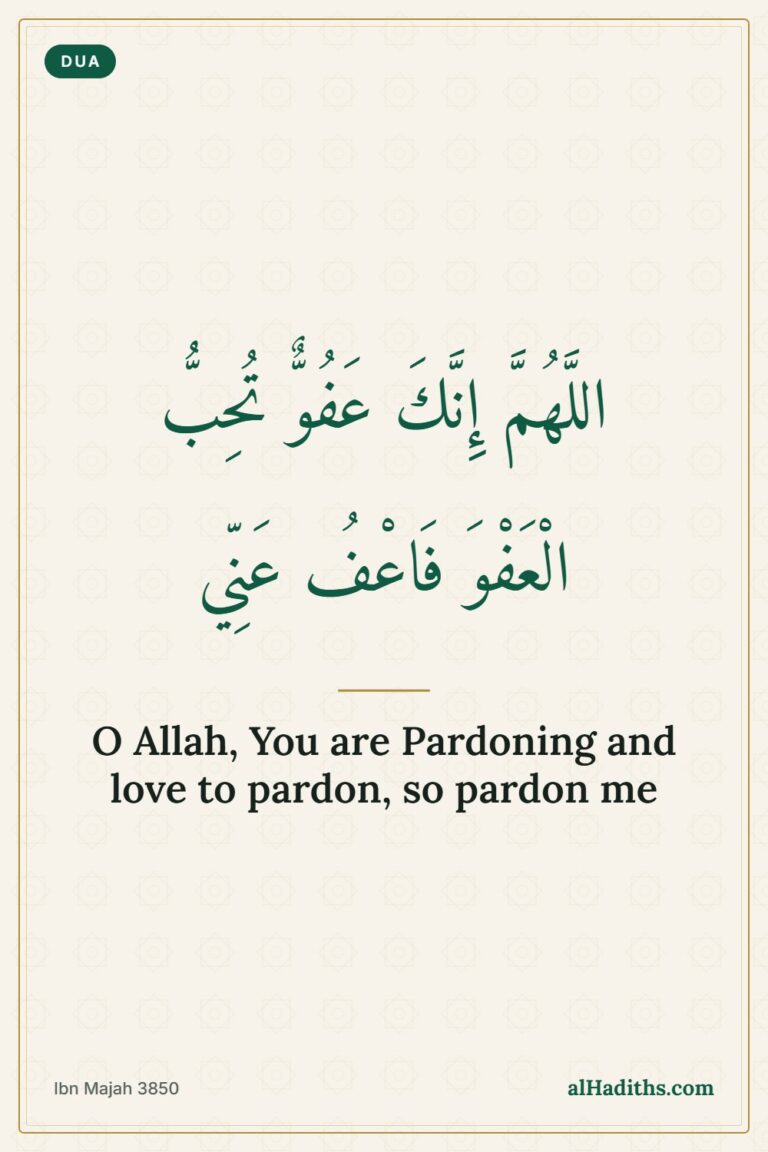
اللَّهُمَّ إِنَّكَ عَفُوٌّ تُحِبُّ الْعَفْوَ فَاعْفُ عَنِّي
Allahumma innaka ‘afuwwun tuhibbul-‘afwa fa‘fu ‘anni
“O Allah, You are Pardoning and You love to pardon, so pardon me.”
Ibn Majah 3850 · Sahih (Darussalam) · Narrated by Aisha · Translation adapted from Sunnah.com
At-Tirmidhi narrates the same conversation. In his version, Aisha asks: “If I know which night is Laylatul Qadr, what should I say in it?” and the Prophet ﷺ answers:
قُولِي اللَّهُمَّ إِنَّكَ عَفُوٌّ كَرِيمٌ تُحِبُّ الْعَفْوَ فَاعْفُ عَنِّي
“Say: ‘O Allah, indeed You are Pardoning, [Generous,] You love pardon, so pardon me.’”
Tirmidhi 3513 · Sahih (Darussalam) · Narrated by Aisha · Translation adapted from Sunnah.com
At-Tirmidhi called it hasan sahih. The only difference between the two texts is one word, which is explained next.
A note on the word “karim”
Many books, posters and websites give the dua with one extra word: karim (Generous), as in “Allahumma innaka ‘afuwwun karim…”. The Sunnah.com text of Tirmidhi 3513 has it too.
IslamQA (answer 260806) explains that al-Albani graded the Tirmidhi narration with this word in Sahih at-Tirmidhi, but later wrote in as-Silsilah as-Sahihah that it was probably added by a copyist or typist and has no basis in the early sources. The answer also notes that an-Nasa’i narrated the hadith through the same chain without it, and that the editions of at-Tirmidhi checked by Bashshar ‘Awwad and Shu‘ayb al-Arna’ut do not have it.
So on this site we teach the dua as Ibn Majah 3850 has it, without karim. Allah is al-Karim, so the word is not wrong in meaning; the aim is simply to keep to the wording that was passed down.
What the dua means
The dua has three short parts: a name of Allah, something Allah loves, and one request.
- Allahumma innaka ‘afuwwun: O Allah, You are al-‘Afuw, the One who pardons.
- tuhibbul-‘afwa: You love to pardon.
- fa‘fu ‘anni: so pardon me.
Ibn Kathir recommends saying this dua often in Ramadan, especially in the last ten nights and more so in the odd nights, and notes that at-Tirmidhi called the hadith hasan sahih (Tafsir Ibn Kathir, Surah al-Qadr).
Reflection: It is striking what Aisha was not told to ask for. On the greatest night of the year, the Prophet ﷺ did not point her to wealth, health or success, though asking for those is allowed. He taught her to ask for pardon. Perhaps that is because once Allah pardons a person, nothing is left standing between them and His mercy, and every other good follows from that.
When is Laylatul Qadr?
The Prophet ﷺ did not fix one date for the night. Aisha reports that he told us where to look:
تَحَرَّوْا لَيْلَةَ الْقَدْرِ فِي الْوِتْرِ مِنَ الْعَشْرِ الأَوَاخِرِ مِنْ رَمَضَانَ
“Search for the Night of Qadr in the odd nights of the last ten days of Ramadan.”
Bukhari 2017 · Narrated by Aisha · Translation from Sunnah.com
So the night falls on one of the odd nights of the last ten: the 21st, 23rd, 25th, 27th or 29th. Many people focus on the 27th, and the companion Ubayy ibn Ka‘b (may Allah be pleased with him) swore that it was that night:
هِيَ اللَّيْلَةُ الَّتِي أَمَرَنَا بِهَا رَسُولُ اللَّهِ صلى الله عليه وسلم بِقِيَامِهَا هِيَ لَيْلَةُ صَبِيحَةِ سَبْعٍ وَعِشْرِينَ وَأَمَارَتُهَا أَنْ تَطْلُعَ الشَّمْسُ فِي صَبِيحَةِ يَوْمِهَا بَيْضَاءَ لاَ شُعَاعَ لَهَا
“It is the night on which the Messenger of Allah ﷺ commanded us to pray. It is the night before the morning of the twenty-seventh, and its sign is that the sun rises on the morning of that day white, without rays.”
Muslim 762a · Narrated by Ubayy ibn Ka‘b · Translation adapted from Sunnah.com
This is Ubayy’s own view of the 27th. Other reports point to other nights: Abu Sa‘id al-Khudri (may Allah be pleased with him) described it falling on the 21st one year (Muslim 1167a). The sign Ubayy gives is seen the morning after, so the safest way is to seek the night across all ten.
Why this night is worth staying up for
Allah tells us its worth in Surah al-Qadr:
لَيْلَةُ ٱلْقَدْرِ خَيْرٌ مِّنْ أَلْفِ شَهْرٍ
“The Night of Decree is better than a thousand months.”
Surah al-Qadr 97:3 · Translation: Saheeh International, from Quran.com
What does “better than a thousand months” mean? Al-Tabari reports that Mujahid explained it as the night’s deeds, its fasting and its standing in prayer being better than a thousand months, and that Qatadah said: a thousand months in which there is no Laylatul Qadr. Al-Tabari judged the meaning closest to the verse to be that a deed done on this night is better than the deeds of a thousand months without it (Tafsir al-Tabari on 97:3). Ibn Kathir likewise explains that worship on this night is like worship done over a thousand months (Tafsir Ibn Kathir, Surah al-Qadr).
A thousand months is about 83 years, longer than many people live. That is the reward one night can hold.
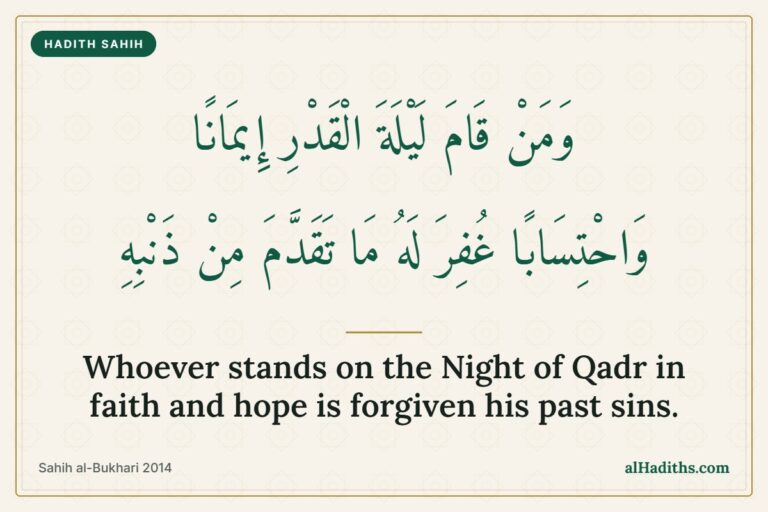
And Abu Hurairah (may Allah be pleased with him) reports that the Prophet ﷺ said:
مَنْ قَامَ لَيْلَةَ الْقَدْرِ إِيمَانًا وَاحْتِسَابًا غُفِرَ لَهُ مَا تَقَدَّمَ مِنْ ذَنْبِهِ، وَمَنْ صَامَ رَمَضَانَ إِيمَانًا وَاحْتِسَابًا غُفِرَ لَهُ مَا تَقَدَّمَ مِنْ ذَنْبِهِ
“Whoever stands in prayer on Laylatul Qadr out of faith and hoping for reward, his past sins will be forgiven; and whoever fasts Ramadan out of faith and hoping for reward, his past sins will be forgiven.”
Bukhari 1901 · Narrated by Abu Hurairah · Translation adapted from Sunnah.com
The reward of standing in prayer and the dua Aisha was taught point the same way: this is a night for being forgiven.
How to practise it
- Learn the dua by heart before Ramadan, so it comes easily at night.
- In the last ten nights, say it in your sujud, in the last part of the night and between your other duas. The hadith gives no set number, so say it as often as you can.
- Pair it with night prayer, as in Bukhari 1901: even a few rak‘ahs of tarawih or tahajjud.
- Don’t pin your hopes on the 27th alone; spread your effort across all ten nights.
- On nights you cannot pray, you can still make this dua and remember Allah.
Questions people ask
Is the Laylatul Qadr dua “afuwwun karim” or just “afuwwun”?
The wording in Ibn Majah 3850 is “Allahumma innaka ‘afuwwun tuhibbul-‘afwa fa‘fu ‘anni”, without karim. The Sunnah.com text of Tirmidhi 3513 adds karim, but al-Albani later said the word was probably added by a copyist (see the note above).
Is worship on Laylatul Qadr better than 1,000 months?
Yes. Allah says the night is better than a thousand months (Quran 97:3). Al-Tabari explains this as a deed done on that night being better than the deeds of a thousand months that do not contain it. A thousand months is about 83 years.
How many times should I say the dua for Laylatul Qadr?
The hadith gives no number. Say it as often as you can during the last ten nights, especially in sujud and in the last part of the night.
What are the signs of Laylatul Qadr?
The sign in Sahih Muslim 762a, from Ubayy ibn Ka‘b, is that the sun rises the morning after it white, without rays. Many other signs are shared online; here we only mention what is in authentic hadith.
Can I make other duas on Laylatul Qadr?
Yes. This hadith teaches the dua to focus on, but you can ask Allah for anything good, in Arabic or in your own language.
Key lessons
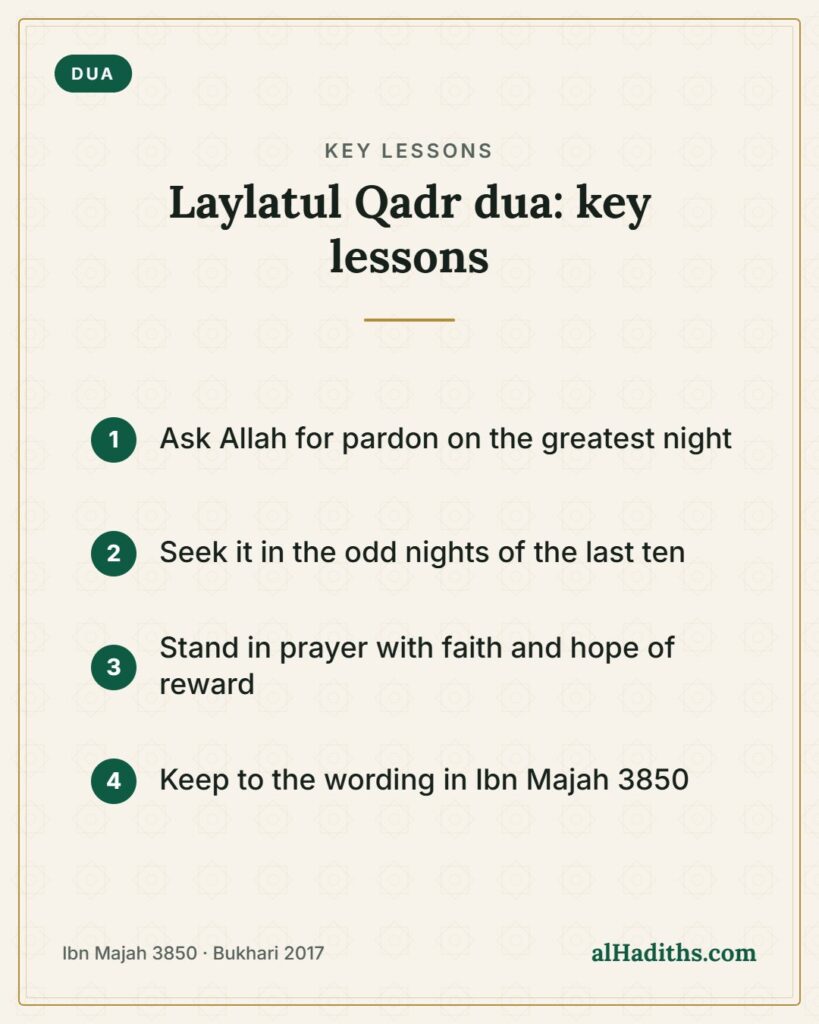
- The Prophet ﷺ taught Aisha to ask for pardon on Laylatul Qadr.
- The authentic wording is “Allahumma innaka ‘afuwwun tuhibbul-‘afwa fa‘fu ‘anni”, without karim.
- Seek the night in the odd nights of the last ten of Ramadan, not on one night only.
- Standing in prayer that night with faith and hope of reward brings forgiveness of past sins.
Part of our Dua series: see all our dua articles in one place.
May Allah let us reach Ramadan and its last ten nights, and may He pardon every one of us.
Save this to Pinterest so you can learn it before the last ten nights
Share the reward. Send this article to someone who needs it today — teaching a hadith or dua can become a lasting good deed for you, in shaa Allah.