Zakat al-Fitr in the Hadith: Amount, Who Pays and When
Contents
Every Ramadan ends with a small gift that carries a big meaning. Zakat al-Fitr is the charity the Prophet ﷺ set for the end of the fast, so that no poor family goes without food on the day of Eid. What exactly do the hadith say about its amount, who pays it and when? Here are four authentic hadith, each checked on Sunnah.com.
At a glance
- Hadith: 4, all authentic
- Collections: Sahih al-Bukhari, Sunan Abi Dawud
- Grade: Sahih (Bukhari); Hasan (al-Albani) for Abu Dawud 1609
- Topic: Zakat al-Fitr (also called sadaqat al-fitr or fitrana)
- Do today: Find out who collects Zakat al-Fitr in your area, so you are ready before Eid
Some people call it zakat ul fitr, sadaqat al-fitr or fitrana, but they all mean the same charity. This article shows what the hadith say. Scholars explain the details, such as paying in money or the exact amount in your country, and they differ on some of them. For those questions, please follow a qualified scholar or your local zakat authority.
1. Zakat al-Fitr is one sa’ on every Muslim
Abdullah ibn Umar (may Allah be pleased with him) reported:
فَرَضَ رَسُولُ اللَّهِ صلى الله عليه وسلم زَكَاةَ الْفِطْرِ صَاعًا مِنْ تَمْرٍ، أَوْ صَاعًا مِنْ شَعِيرٍ عَلَى الْعَبْدِ وَالْحُرِّ، وَالذَّكَرِ وَالأُنْثَى، وَالصَّغِيرِ وَالْكَبِيرِ مِنَ الْمُسْلِمِينَ، وَأَمَرَ بِهَا أَنْ تُؤَدَّى قَبْلَ خُرُوجِ النَّاسِ إِلَى الصَّلاَةِ
Allah’s Messenger ﷺ enjoined the payment of one Sa’ of dates or one Sa’ of barley as Zakat-ul-Fitr on every Muslim slave or free, male or female, young or old, and he ordered that it be paid before the people went out to offer the ‘Id prayer.
Sahih al-Bukhari 1503 · Narrated by Abdullah ibn Umar · Translation adapted from Sunnah.com
This is the main hadith on Zakat al-Fitr. It answers three questions in one go. The amount is one sa’, a measure of volume used in Madinah. It is due on every Muslim, young and old, male and female. And it is given before the Eid prayer. The Sunnah.com translator adds a note that one sa’ is about 3 kilograms; that is the translator’s estimate, not part of the hadith.
The list in the hadith is wide on purpose. A baby born before Eid, an elderly parent, a child too young to fast: each one is counted. Zakat al-Fitr is not only for those who fasted, but for every member of the Muslim household.
The explanation on HadeethEnc (4520) adds that one sa’ is four mudd, a mudd being two handfuls of an average person, and that it is due on the one who has more than he needs for the day and night of Eid, for himself and those he supports.
Try this: before Ramadan ends, count everyone in your home you provide for, so you know how many portions to give.
2. What the Companions gave
Abu Sa’id al-Khudri (may Allah be pleased with him) said:
كُنَّا نُخْرِجُ زَكَاةَ الْفِطْرِ صَاعًا مِنْ طَعَامٍ، أَوْ صَاعًا مِنْ شَعِيرٍ، أَوْ صَاعًا مِنْ تَمْرٍ، أَوْ صَاعًا مِنْ أَقِطٍ، أَوْ صَاعًا مِنْ زَبِيبٍ
“We used to give one Sa’ of meal or one Sa’ of barley or one Sa’ of dates, or one Sa’ of cottage cheese or one Sa’ of raisins (dried grapes) as Zakat-ul-Fitr.”
Sahih al-Bukhari 1506 · Narrated by Abu Sa’id al-Khudri · Translation adapted from Sunnah.com
The Companions gave the everyday food of their time: grain, dates, dried cheese and raisins. The measure stayed the same, one sa’, whatever the food was. This is why Zakat al-Fitr is often described as a charity of food: it was meant to fill plates on the day of Eid.
Try this: when you give, think of the family who will cook with it on Eid morning, and make dua for them.
3. Why Zakat al-Fitr was prescribed
Abdullah ibn Abbas (may Allah be pleased with him) said:
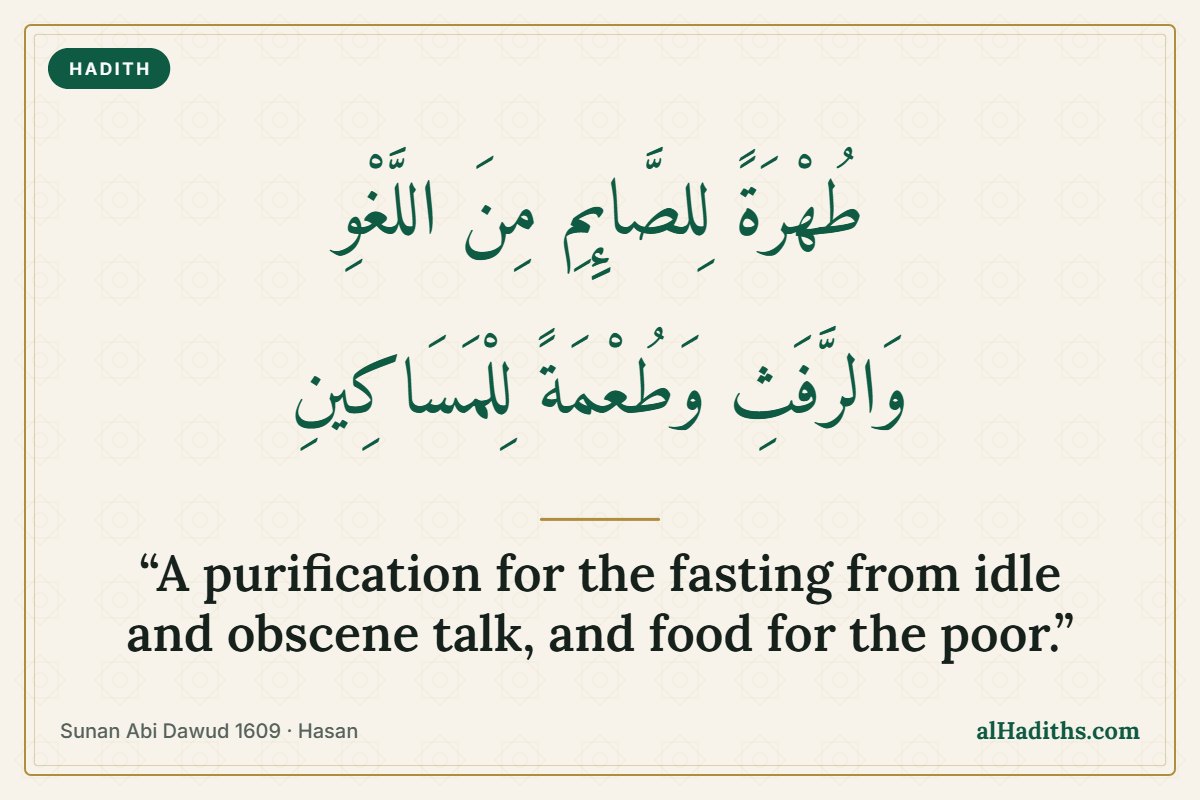
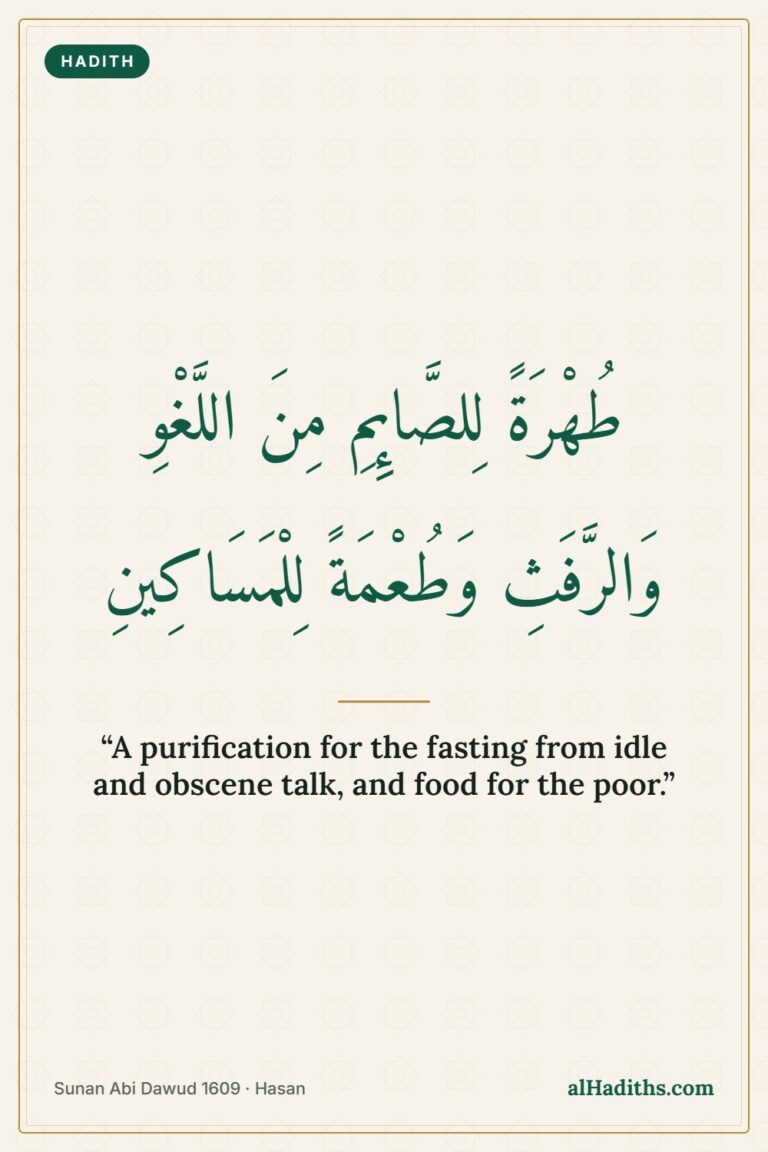
فَرَضَ رَسُولُ اللَّهِ صلى الله عليه وسلم زَكَاةَ الْفِطْرِ طُهْرَةً لِلصَّائِمِ مِنَ اللَّغْوِ وَالرَّفَثِ وَطُعْمَةً لِلْمَسَاكِينِ مَنْ أَدَّاهَا قَبْلَ الصَّلاَةِ فَهِيَ زَكَاةٌ مَقْبُولَةٌ وَمَنْ أَدَّاهَا بَعْدَ الصَّلاَةِ فَهِيَ صَدَقَةٌ مِنَ الصَّدَقَاتِ
“The Messenger of Allah ﷺ prescribed Zakat al-Fitr as a purification of the fasting from empty and obscene talk and as food for the poor. If anyone pays it before the prayer (of ‘Id), it will be accepted as zakat. If anyone pays it after the prayer, that will be a sadaqah like other sadaqahs.”
Sunan Abi Dawud 1609 · Hasan (al-Albani) · Narrated by Abdullah ibn Abbas · Translation adapted from Sunnah.com
Here the purpose is clear, and it has two sides. For the one who fasted, it cleans up the small slips of the tongue that crept into the fast. For the poor, it is food. The hadith also explains the timing: given before the Eid prayer it counts as Zakat al-Fitr; after the prayer it is still charity, but ordinary charity.
Notice who the hadith names as the receivers: al-masakin, the poor and needy. Zakat al-Fitr was not meant to sit in a fund for months. It was meant to reach hungry people in time for Eid, so that the whole community could celebrate together.
Try this: do not leave it to Eid morning. Set a reminder for the last days of Ramadan so it is never late.
4. When to give it
Nafi’, the freed slave of Ibn Umar, described how Ibn Umar (may Allah be pleased with him) and the people gave it:
وَكَانَ ابْنُ عُمَرَ ـ رضى الله عنهما ـ يُعْطِيهَا الَّذِينَ يَقْبَلُونَهَا، وَكَانُوا يُعْطُونَ قَبْلَ الْفِطْرِ بِيَوْمٍ أَوْ يَوْمَيْنِ
Ibn ‘Umar used to give Sadaqat-ul-Fitr to those who had been officially appointed for its collection. People used to give Sadaqat-ul-Fitr (even) a day or two before the ‘Id.
Sahih al-Bukhari 1511 · Narrated by Nafi’ from Ibn Umar · Translation adapted from Sunnah.com (end of the hadith)
Two practical points come from this report. Zakat al-Fitr was handed to people appointed to collect it, and it could be given a day or two before Eid, which gave time to pass it on to the poor. In many places today a mosque or a zakat office does this collecting. Earlier in the same hadith, Ibn Umar also gave it for the young as well as the old.
Try this: give it to your local mosque or zakat office a day or two before Eid, so it reaches the poor in time.
Bringing it together: Zakat al-Fitr in a nutshell
- Amount: one sa’ of food per person (Bukhari 1503, 1506).
- Who pays: it is due for every Muslim, young or old, male or female; the head of the home gives it for those he supports (HadeethEnc 4520).
- When: before the Eid prayer; the Companions gave it a day or two early (Bukhari 1511).
- Why: to purify the fast and to feed the poor (Abu Dawud 1609).
How is this different from the zakat paid on savings? That zakat has minimum amounts below which nothing is due, such as five camels or five awaq of silver (Sahih al-Bukhari 1447), and scholars explain when it falls due. Zakat al-Fitr is counted per person, not per amount of wealth, and it has one set time: the end of Ramadan, before the Eid prayer. Both are obligatory, and both are aimed at the poor.
Reflection: I find it beautiful that a month of hunger ends with feeding someone else. We spend Ramadan learning what an empty stomach feels like, and the last thing we do before Eid is make sure another family does not feel it on that day.
Questions people ask
How much is Zakat al-Fitr?
The hadith set it at one sa’ of food per person (Sahih al-Bukhari 1503). The Sunnah.com translator estimates one sa’ at about 3 kilograms. The amount in your local currency, if you pay in money, is set by your local zakat authority or mosque, so please check with them.
Who has to pay Zakat al-Fitr?
It is due for every Muslim, young or old, male or female. The explanation on HadeethEnc says it applies to the one who has more than he needs for the day and night of Eid, for himself and his dependants.
When should Zakat al-Fitr be paid?
Before the Eid prayer. The Companions gave it a day or two before Eid (Sahih al-Bukhari 1511). If it is given after the prayer, it counts as ordinary charity (Sunan Abi Dawud 1609).
Who receives Zakat al-Fitr?
The hadith describes it as food for al-masakin, the poor and needy (Sunan Abi Dawud 1609). Ibn Umar gave it to those appointed to collect it (Sahih al-Bukhari 1511). For who counts as eligible where you live, ask your local zakat authority.
Can Zakat al-Fitr be paid in cash?
The hadith mention food, and scholars differ on paying its value in money. Many zakat offices set an amount in local currency each year. Please follow a qualified scholar or your local zakat authority.
Key lessons
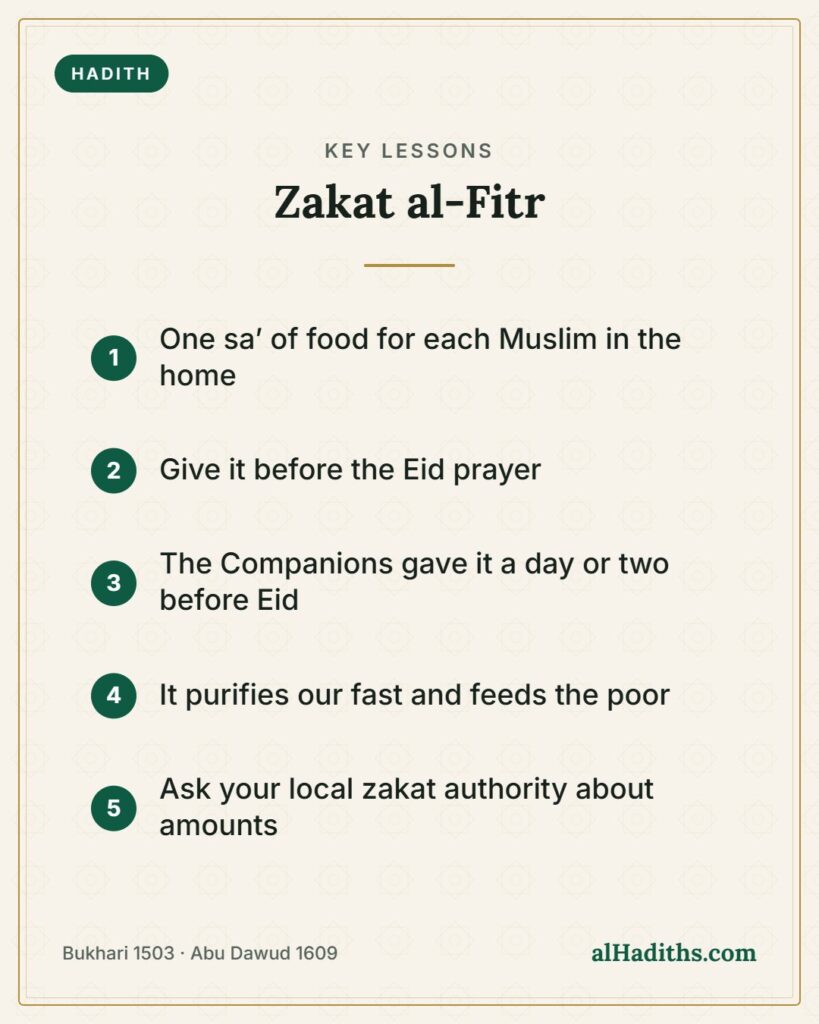
- Zakat al-Fitr is one sa’ of food for every Muslim in the home.
- Give it before the Eid prayer; a day or two early is from the practice of the Companions.
- It purifies the fast and feeds the poor on Eid.
- After the Eid prayer it becomes ordinary charity, so do not leave it late.
- For amounts in money and local rules, follow your local zakat authority.
May Allah accept our fasting and our giving, and let our Zakat al-Fitr reach a family that needs it.
Save this to Pinterest so you have the Zakat al-Fitr hadith ready before Eid.
Share the reward. Send this article to someone who needs it today — teaching a hadith or dua can become a lasting good deed for you, in shaa Allah.