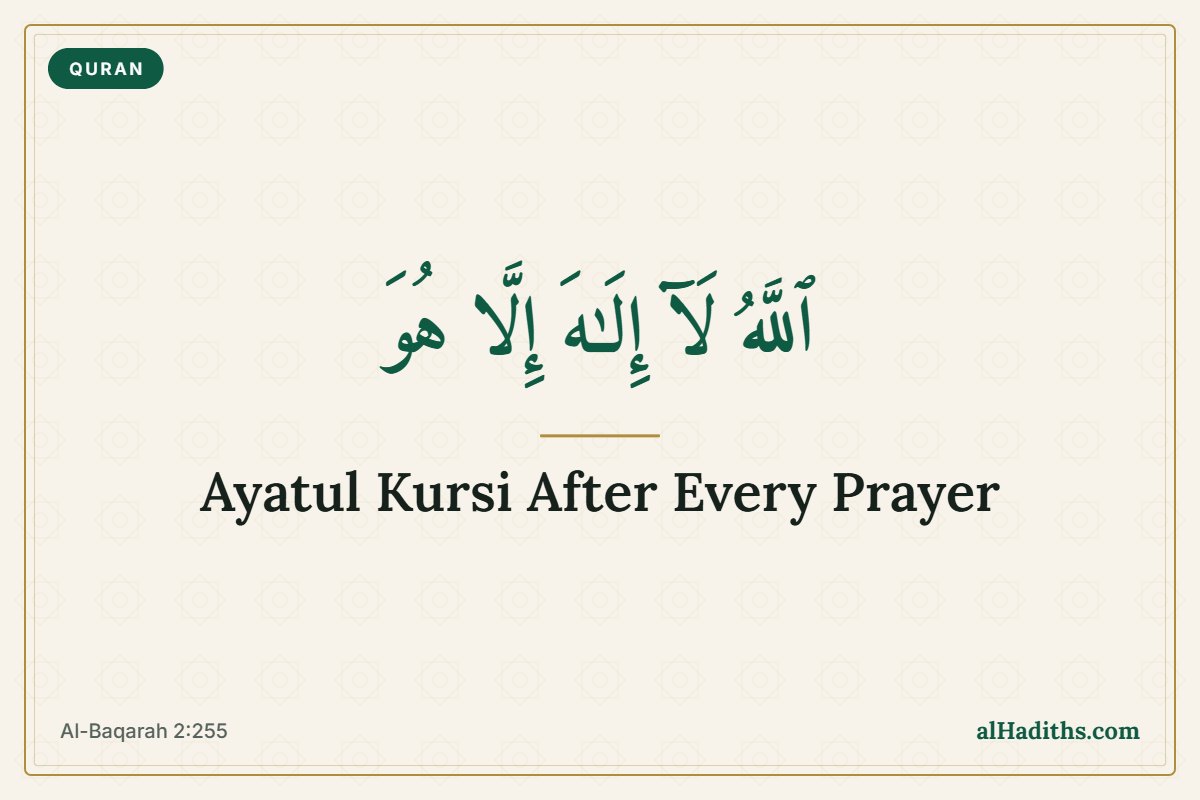
Ayatul Kursi After Every Prayer: The Hadith and Its Reward
This hadith was my first entry on alHadiths, and I chose it because I find solace in it. There are many roads to Paradise, and the promise for reciting Ayatul Kursi after every prayer is one of the most comforting: only death stands in between. Here is the hadith, how strong it is, and the verse itself with its meaning.
At a glance
- Source: Bulugh al-Maram 2/220 (reported by an-Nasa’i)
- Narrated by: Abu Umamah (may Allah be pleased with him)
- Grade: Sahih (Ibn Hibban, as cited in Bulugh al-Maram)
- Topic: Ayatul Kursi after the obligatory prayers
- Practise it: Recite Ayatul Kursi once after each of the five obligatory prayers
The hadith
مَنْ قَرَأَ آيَةَ اَلْكُرْسِيِّ دُبُرَ كُلِّ صَلَاةٍ مَكْتُوبَةٍ لَمْ يَمْنَعْهُ مِنْ دُخُولِ اَلْجَنَّةِ إِلَّا اَلْمَوْتُ
Allah’s Messenger ﷺ said: “Whoever recites Ayatul Kursi after every obligatory prayer, nothing will prevent him from entering Paradise except death.”
Bulugh al-Maram 2/220 · Reported by an-Nasa’i; Ibn Hibban graded it Sahih · Narrated by Abu Umamah · Also Special Virtues of the Qur’an 13 · Translation adapted from Sunnah.com
A word of caution: a similar narration attributed to ‘Ali (may Allah be pleased with him), which also mentions protection at bedtime, is graded mawdu’ (fabricated) by al-Albani (Mishkat al-Masabih 974). The narration of Abu Umamah above is the one to rely on.
Ayatul Kursi in Arabic and English
ٱللَّهُ لَآ إِلَـٰهَ إِلَّا هُوَ ٱلْحَىُّ ٱلْقَيُّومُ ۚ لَا تَأْخُذُهُۥ سِنَةٌ وَلَا نَوْمٌ ۚ لَّهُۥ مَا فِى ٱلسَّمَـٰوَٰتِ وَمَا فِى ٱلْأَرْضِ ۗ مَن ذَا ٱلَّذِى يَشْفَعُ عِندَهُۥٓ إِلَّا بِإِذْنِهِۦ ۚ يَعْلَمُ مَا بَيْنَ أَيْدِيهِمْ وَمَا خَلْفَهُمْ ۖ وَلَا يُحِيطُونَ بِشَىْءٍ مِّنْ عِلْمِهِۦٓ إِلَّا بِمَا شَآءَ ۚ وَسِعَ كُرْسِيُّهُ ٱلسَّمَـٰوَٰتِ وَٱلْأَرْضَ ۖ وَلَا يَـُٔودُهُۥ حِفْظُهُمَا ۚ وَهُوَ ٱلْعَلِىُّ ٱلْعَظِيمُ
Allāh – there is no deity except Him, the Ever-Living, the Self-Sustaining. Neither drowsiness overtakes Him nor sleep. To Him belongs whatever is in the heavens and whatever is on the earth. Who is it that can intercede with Him except by His permission? He knows what is [presently] before them and what will be after them, and they encompass not a thing of His knowledge except for what He wills. His Kursī extends over the heavens and the earth, and their preservation tires Him not. And He is the Most High, the Most Great.
Al-Baqarah 2:255 · Translation: Saheeh International (Quran.com)
The greatest verse in the Quran
يَا أَبَا الْمُنْذِرِ أَتَدْرِي أَىُّ آيَةٍ مِنْ كِتَابِ اللَّهِ مَعَكَ أَعْظَمُ ” . قَالَ قُلْتُ اللَّهُ وَرَسُولُهُ أَعْلَمُ . قَالَ ” يَا أَبَا الْمُنْذِرِ أَتَدْرِي أَىُّ آيَةٍ مِنْ كِتَابِ اللَّهِ مَعَكَ أَعْظَمُ ” . قَالَ قُلْتُ اللَّهُ لاَ إِلَهَ إِلاَّ هُوَ الْحَىُّ الْقَيُّومُ . قَالَ فَضَرَبَ فِي صَدْرِي وَقَالَ ” وَاللَّهِ لِيَهْنِكَ الْعِلْمُ أَبَا الْمُنْذِرِ
The Messenger of Allah ﷺ said: “Abu al-Mundhir, do you know which verse of the Book of Allah that you have with you is the greatest?” I said: “Allah and His Messenger know best.” He asked again, and I said: “Allah, there is no god but He, the Ever-Living, the Self-Sustaining.” He struck me on my chest and said: “By Allah, may knowledge be a joy for you, Abu al-Mundhir!”
Sahih Muslim 810 · Narrated by Ubayy ibn Ka’b (may Allah be pleased with him) · Translation adapted from Sunnah.com
What the verse says
- Allah, there is no god but He: the verse opens with tawhid, the oneness of Allah.
- The Ever-Living, the Self-Sustaining: He has no beginning or end, and everything depends on Him.
- Neither drowsiness nor sleep overtakes Him: He never stops watching over His creation.
- No one intercedes with Him except by His permission: all intercession is in His hands.
- He knows what is before them and what is after them: nothing is hidden from His knowledge.
- His Kursi extends over the heavens and the earth, and guarding them does not tire Him: the verse ends with His greatness: the Most High, the Most Great.
A personal note from me: the promise of Jannah for reciting Ayatul Kursi after each compulsory prayer is very comforting to me, and the only thing that stands in between is death itself. The grave is a frightening place. It reminds me of ‘Uthman ibn ‘Affan (may Allah be pleased with him), who would weep until his beard was wet whenever he stood by a grave (Jami’ at-Tirmidhi 2308, Hasan).
How to practise it
- After every obligatory prayer. The hadith says “every obligatory prayer”, so all five, before you get up from your place.
- Learn it in parts. Use the pause marks in the Arabic and memorise one part at a time, following the recitation above.
- Before sleep as well. In Sahih al-Bukhari 5010, the Prophet ﷺ confirmed that whoever recites it on going to bed has a guardian from Allah until the morning. See the surahs to recite before sleeping.
- Make it part of your post-prayer dhikr. See the dhikr after salah from the hadith.
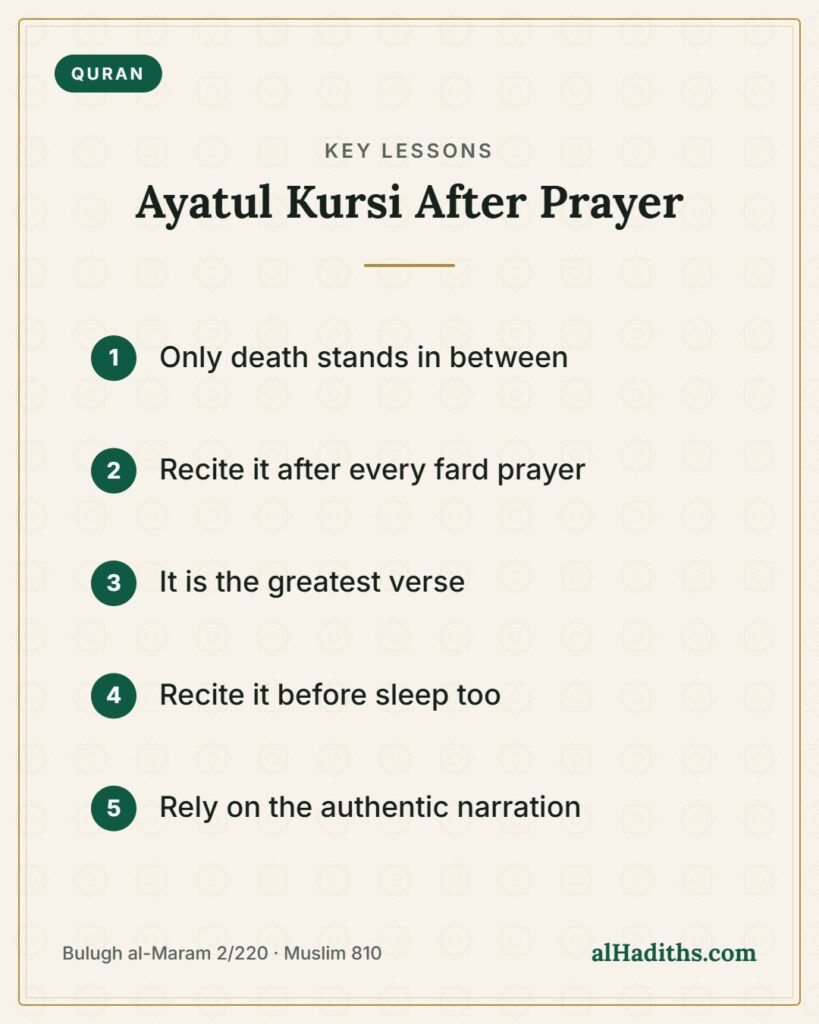
Key lessons
- Only death stands between the one who recites it after every prayer and Jannah.
- Recite it after all five obligatory prayers.
- Ayatul Kursi is the greatest verse in the Quran.
- Reciting it before sleep brings a guardian from Allah until morning.
- Rely on the authentic narration of Abu Umamah, not the fabricated one.
Questions people ask
Is the hadith about Ayatul Kursi after every prayer authentic?
Yes. The narration of Abu Umamah was reported by an-Nasa’i and graded Sahih by Ibn Hibban (Bulugh al-Maram 2/220). A similar narration from ‘Ali is graded fabricated by al-Albani (Mishkat al-Masabih 974).
Should I recite Ayatul Kursi after all five prayers?
The hadith says “after every obligatory prayer”, so it covers all five daily prayers.
Which is the greatest verse in the Quran?
Ayatul Kursi (Al-Baqarah 2:255), as the Prophet ﷺ confirmed to Ubayy ibn Ka’b in Sahih Muslim 810.
Next time you finish a fard prayer, before you stand up, recite Ayatul Kursi once. One verse, five times a day, and a promise that only death stands in between.
Save this to Pinterest so you remember it after every prayer.
Share the reward. Send this article to someone who needs it today — teaching a hadith or dua can become a lasting good deed for you, in shaa Allah.

One Comment