Dua After Wudu: The Authentic Dua That Opens 8 Gates of Jannah
Contents
Most of us make wudu several times a day, often in a hurry. The Prophet ﷺ taught that a few words said at the end of it can open all eight gates of Jannah. This is the authentic dua after wudu from Sahih Muslim, with its Arabic, transliteration and meaning, the story behind it, and a clear note on the popular additions that are weak.
At a glance
- Source: Sahih Muslim 234 (also Abu Dawud 169)
- Narrated by: ‘Uqbah ibn ‘Amir, from ‘Umar ibn al-Khattab
- Grade: Sahih (Muslim); Sahih (al-Albani) for Abu Dawud 169
- Topic: What to say after finishing wudu, and its reward
- Practise it: Say it at the sink after your next wudu, before you walk away
The dua after wudu
In one wording of the hadith in Sahih Muslim, the Prophet ﷺ said that whoever makes wudu and then says:
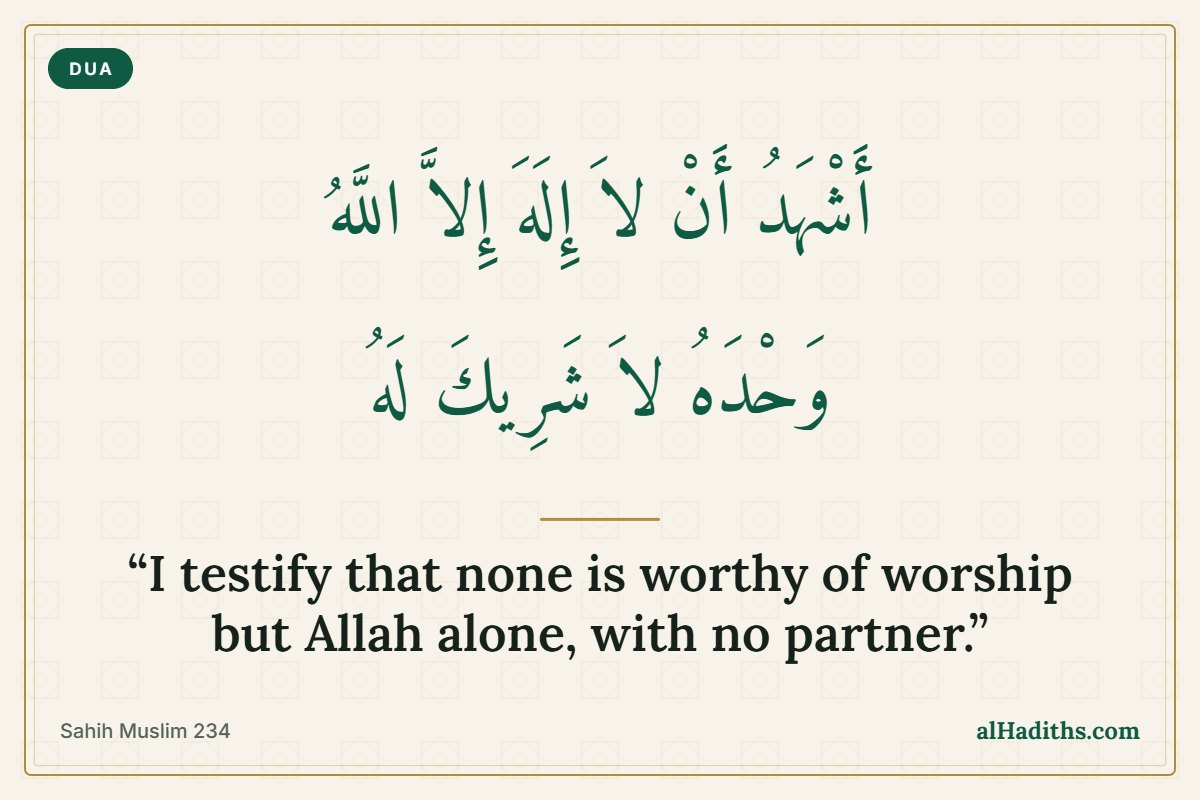
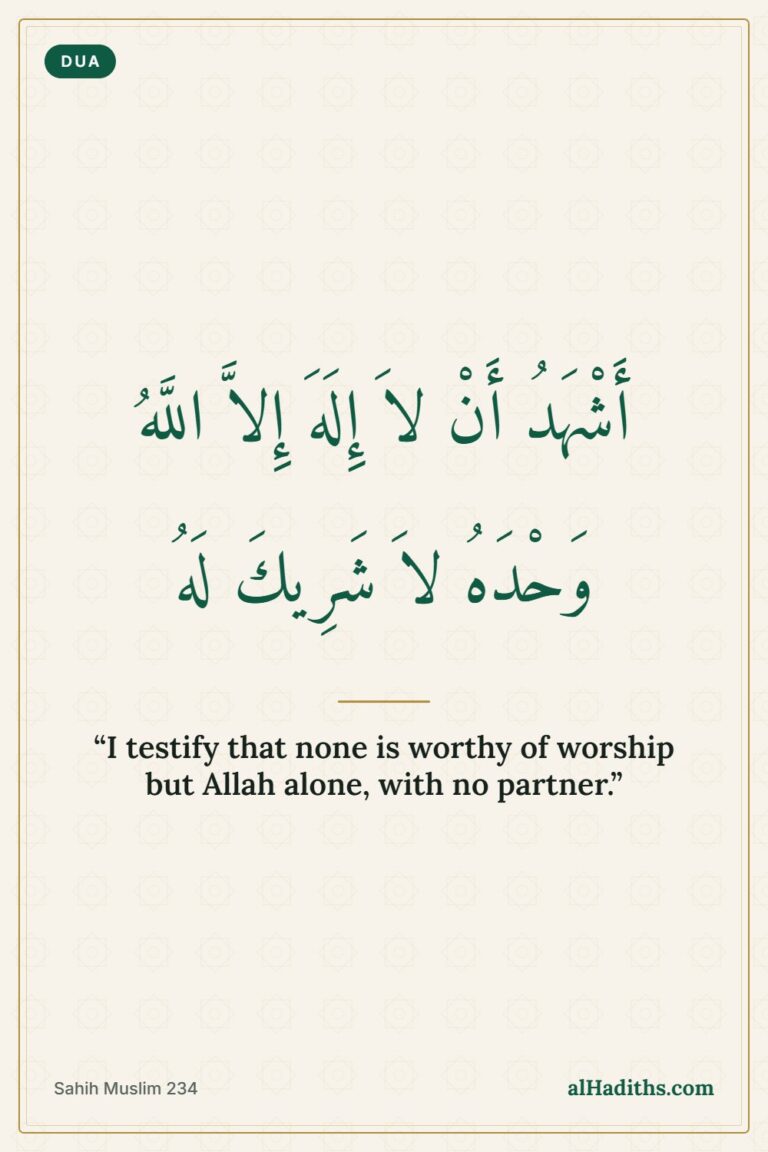
أَشْهَدُ أَنْ لاَ إِلَهَ إِلاَّ اللَّهُ وَحْدَهُ لاَ شَرِيكَ لَهُ وَأَشْهَدُ أَنَّ مُحَمَّدًا عَبْدُهُ وَرَسُولُهُ
Ash-hadu an la ilaha illallahu wahdahu la sharika lah, wa ash-hadu anna Muhammadan ‘abduhu wa rasuluh
“I bear witness that none has the right to be worshipped but Allah alone, with no partner, and I bear witness that Muhammad is His servant and His Messenger.”
Muslim 234b · Narrated by ‘Uqbah ibn ‘Amir · Translation adapted from Sunnah.com
The main wording of the same hadith gives the reward. ‘Umar ibn al-Khattab (may Allah be pleased with him) reported that the Prophet ﷺ said:
مَا مِنْكُمْ مِنْ أَحَدٍ يَتَوَضَّأُ فَيُبْلِغُ – أَوْ فَيُسْبِغُ – الْوُضُوءَ ثُمَّ يَقُولُ أَشْهَدُ أَنْ لاَ إِلَهَ إِلاَّ اللَّهُ وَأَنَّ مُحَمَّدًا عَبْدُ اللَّهِ وَرَسُولُهُ إِلاَّ فُتِحَتْ لَهُ أَبْوَابُ الْجَنَّةِ الثَّمَانِيَةُ يَدْخُلُ مِنْ أَيِّهَا شَاءَ
“There is none among you who makes wudu and completes it well, then says: ‘I bear witness that none has the right to be worshipped but Allah, and that Muhammad is the servant of Allah and His Messenger,’ except that the eight gates of Paradise are opened for him, and he may enter by whichever of them he wishes.”
Muslim 234a · Narrated by ‘Uqbah ibn ‘Amir, from ‘Umar · Translation adapted from Sunnah.com
Abu Dawud records the same hadith with the fuller wording, and adds that it is said “when he finishes his wudu”:
مَا مِنْكُمْ مِنْ أَحَدٍ يَتَوَضَّأُ فَيُحْسِنُ الْوُضُوءَ ثُمَّ يَقُولُ حِينَ يَفْرُغُ مِنْ وُضُوئِهِ أَشْهَدُ أَنْ لاَ إِلَهَ إِلاَّ اللَّهُ وَحْدَهُ لاَ شَرِيكَ لَهُ وَأَنَّ مُحَمَّدًا عَبْدُهُ وَرَسُولُهُ إِلاَّ فُتِحَتْ لَهُ أَبْوَابُ الْجَنَّةِ الثَّمَانِيَةُ يَدْخُلُ مِنْ أَيِّهَا شَاءَ
“There is none among you who makes wudu and does it well, then says when he finishes his wudu: ‘I bear witness that none has the right to be worshipped but Allah alone, with no partner, and that Muhammad is His servant and His Messenger,’ except that the eight gates of Paradise are opened for him, and he may enter through whichever of them he wishes.”
Abu Dawud 169 · Sahih (al-Albani) · Narrated by ‘Uqbah ibn ‘Amir, from ‘Umar · Translation adapted from Sunnah.com
Both wordings are authentic, so either one follows the Sunnah. The longer one, with “wahdahu la sharika lah”, is the one most people learn.
The context: a Companion back from tending camels
‘Uqbah ibn ‘Amir (may Allah be pleased with him) explained how he came to hear it. The Companions took turns looking after their camels. When his turn ended, he brought the camels back in the evening and found the Prophet ﷺ standing and talking to the people. He arrived in time to hear that whoever makes wudu well and prays two rak‘ahs with full focus has earned Paradise.
“How excellent this is!” ‘Uqbah said. A man in front of him replied that what came just before it was even better. It was ‘Umar, who had seen him arrive late and passed on the part he had missed: the words after wudu and the eight gates (Muslim 234a, Abu Dawud 169). It is a small picture of how the Companions helped each other learn.
What it means
The dua is the two testimonies of faith: that only Allah is worshipped, and that Muhammad ﷺ is His servant and Messenger. They are the first words of Islam, and here they become the last words of wudu.
HadeethEnc explains the hadith as two virtues: a thorough wudu followed by these words opens the eight gates of Paradise, and the same wudu followed by two rak‘ahs prayed with focus earns Paradise. Among its benefits it notes that this dhikr purifies the heart from shirk just as wudu cleans the body from dirt, and that it is also recommended after a ghusl (full bath).
Reflection: The hadith asks for a wudu done well and then a sentence of faith, nothing more. Water reaches the hands, face and feet; the testimony reaches what water cannot. It is easy to leave the sink thinking only about the prayer ahead, but these few seconds are the moment the Prophet ﷺ chose to remind us who we are standing up to pray for.
How to practise it
- Learn one wording. Start with “Ash-hadu an la ilaha illallahu wahdahu la sharika lah, wa ash-hadu anna Muhammadan ‘abduhu wa rasuluh”.
- Make the wudu itself complete. The reward is tied to a wudu done well; see our step-by-step guide to how to make wudu.
- Say it straight after you finish, as Abu Dawud 169 says, before drying off or walking away.
- Follow it with two rak‘ahs when you can. The same hadith promises Paradise for them; read more in prayer after wudu.
- Teach it to a child at their next wudu: it is short, and it is the shahadah they already know.
Questions people ask
What is the dua after wudu in English?
“I bear witness that none has the right to be worshipped but Allah alone, with no partner, and I bear witness that Muhammad is His servant and His Messenger” (Muslim 234). Whoever says it after a complete wudu has the eight gates of Jannah opened for him.
Is “Allahumma-j‘alni minat-tawwabin” part of the dua after wudu?
That addition (“O Allah, make me among those who repent and make me among those who purify themselves”) is reported in Jami‘ at-Tirmidhi 55. Sunnah.com lists it as Da‘if (Darussalam), and at-Tirmidhi himself noted that its chain is inconsistent, although some scholars graded it authentic. We stick to the wording in Sahih Muslim. If you want to know whether to add it, ask a qualified scholar.
Should I look up at the sky when I say it?
A narration in Abu Dawud 170 mentions raising the eyes to the sky. Sunnah.com lists it as Da‘if (al-Albani), so it is not used here. We have also not found any authentic hadith for the separate duas some people say while washing each limb; the authentic dua is the one said after finishing.
Key lessons
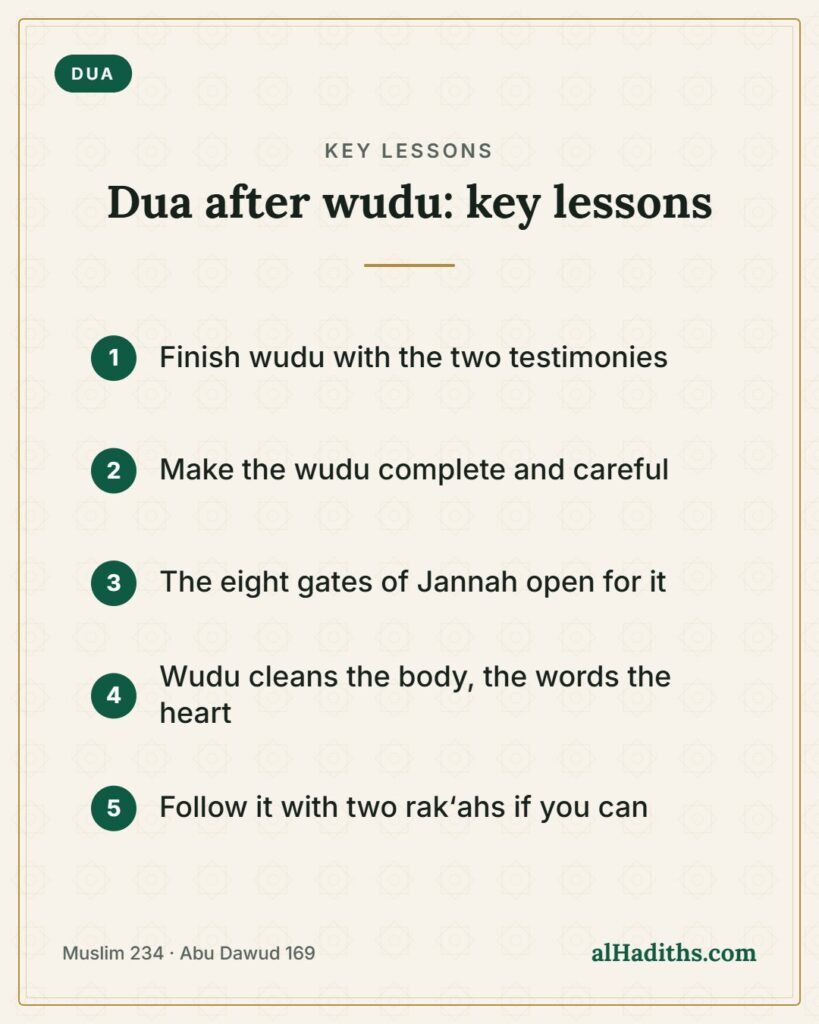
- The dua after wudu is the two testimonies of faith (Muslim 234).
- Its reward is that all eight gates of Jannah are opened.
- The reward is tied to a wudu done well, not a rushed one.
- Two rak‘ahs after wudu, prayed with focus, also earn Paradise.
Part of our Dua series: see all our dua articles in one place.
Your next wudu is probably only a few hours away. Try ending it with these words, and let the last thing you do at the sink be a testimony of faith.
Save this to Pinterest so you can learn the dua after wudu and say it at your next prayer.
Share the reward. Send this article to someone who needs it today — teaching a hadith or dua can become a lasting good deed for you, in shaa Allah.