Dua for Cemetery Visits: 3 Authentic Duas at the Graves
Contents
You stand at the gate of the cemetery, maybe at a parent’s grave, and you are not sure what to say. The Prophet ﷺ did not leave us guessing. He taught his companions a dua for cemetery visits, and he taught Aisha another when she asked him directly. Here are three authentic duas from Sahih Muslim, with their Arabic, meaning and when to say them.
At a glance
- Duas: 3, all from Sahih Muslim
- Also: Why to visit (Ibn Majah 1569) and a Quranic dua for parents
- Grade: Sahih
- Topic: What to say when visiting the graveyard
- Today: Learn the first line: “As-salamu ʿalaykum ahlad-diyar”
1. The dua for cemetery visits the Prophet ﷺ taught
Buraydah (may Allah be pleased with him) reported that the Prophet ﷺ used to teach his companions what to say when they went out to the graveyard:
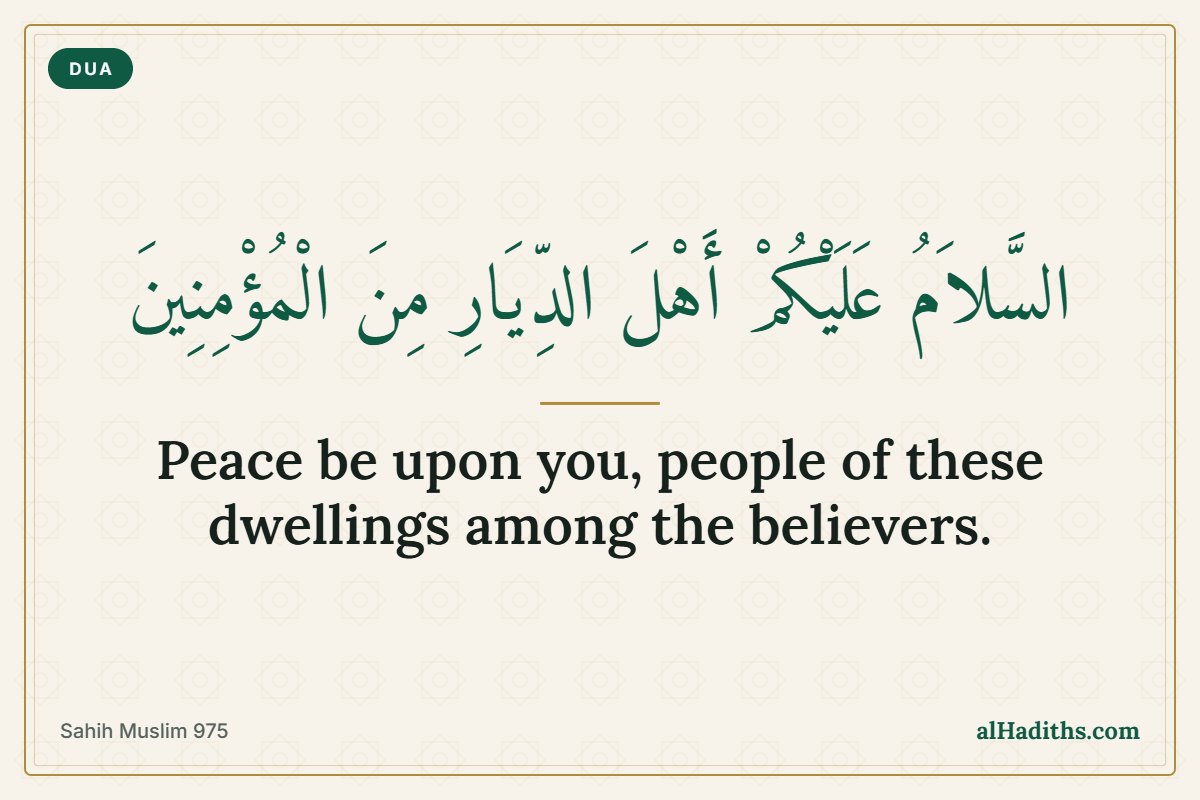
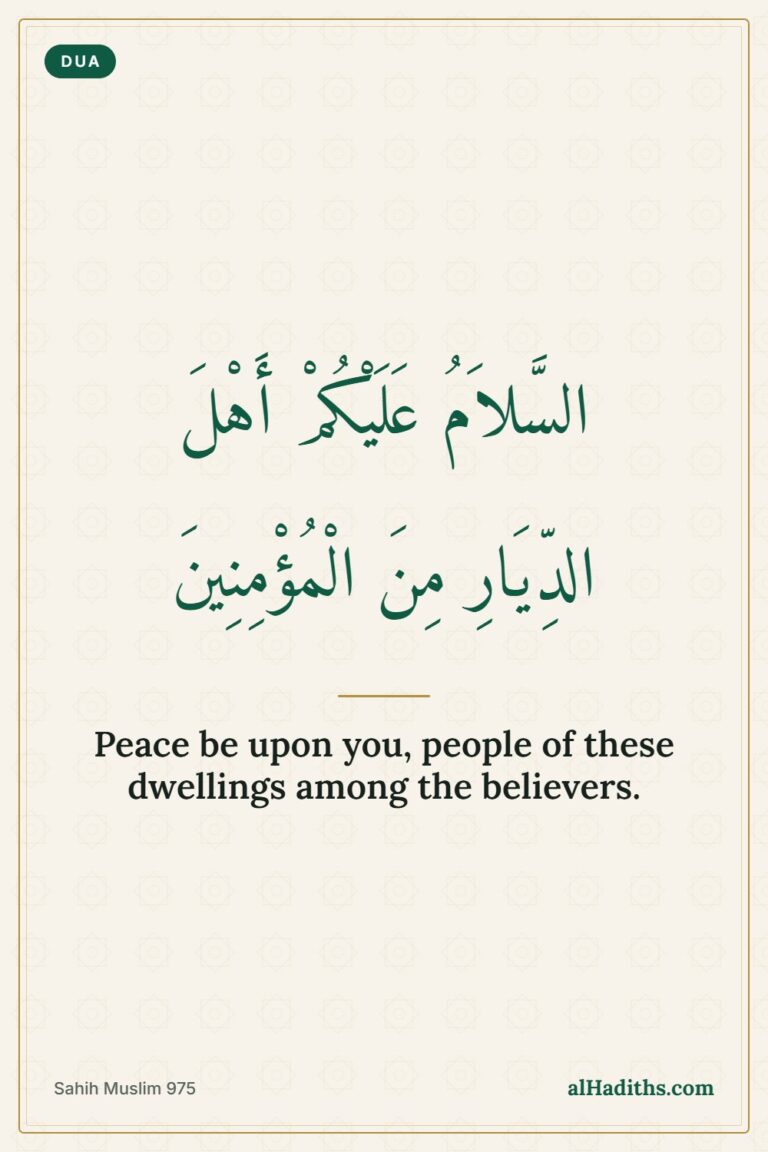
السَّلاَمُ عَلَيْكُمْ أَهْلَ الدِّيَارِ مِنَ الْمُؤْمِنِينَ وَالْمُسْلِمِينَ وَإِنَّا إِنْ شَاءَ اللَّهُ لَلَاحِقُونَ أَسْأَلُ اللَّهَ لَنَا وَلَكُمْ الْعَافِيَةَ
As-salāmu ʿalaykum ahlad-diyāri minal-muʾminīna wal-muslimīn, wa innā in shāʾa Allāhu la-lāḥiqūn, asʾalullāha lanā wa lakumul-ʿāfiyah
“Peace be upon you, inhabitants of the dwellings, among the believers and the Muslims. If Allah wills, we shall join you. I ask Allah for well-being for us and for you.”
Sahih Muslim 975 · Narrated by Buraydah · Translation adapted from Sunnah.com
The same dua is in Sunan Ibn Majah 1547 and Sunan an-Nasa’i 2040, both graded Sahih by Darussalam. It does three things: it greets the believers in their graves, it reminds us that we will join them, and it asks Allah for well-being for both the living and the dead.
Try this: say it as you enter, before you reach the grave you came for.
2. Aisha’s dua: mercy for those before and after us
Aisha (may Allah be pleased with her) asked the Prophet ﷺ how she should pray for the people buried in al-Baqi’, the graveyard of Madinah. He said, “Say:”
السَّلاَمُ عَلَى أَهْلِ الدِّيَارِ مِنَ الْمُؤْمِنِينَ وَالْمُسْلِمِينَ وَيَرْحَمُ اللَّهُ الْمُسْتَقْدِمِينَ مِنَّا وَالْمُسْتَأْخِرِينَ وَإِنَّا إِنْ شَاءَ اللَّهُ بِكُمْ لَلاَحِقُونَ
As-salāmu ʿalā ahlid-diyāri minal-muʾminīna wal-muslimīn, wa yarḥamullāhul-mustaqdimīna minnā wal-mustaʾkhirīn, wa innā in shāʾa Allāhu bikum la-lāḥiqūn
“Peace be upon the inhabitants of the dwellings among the believers and the Muslims. May Allah have mercy on those of us who have gone ahead and those who come later. And we shall, if Allah wills, join you.”
Sahih Muslim 974b · Narrated by Aisha · Translation adapted from Sunnah.com
This wording adds mercy for “those who have gone ahead and those who come later”: the dead in front of you, and you and everyone still to come. The HadeethEnc entry for this hadith gives the full story and its explanation.
Try this: if a long dua is hard to remember, start with this one. It is the answer to the exact question most of us have.
3. The Prophet’s ﷺ dua at al-Baqi’
Aisha also reported that on the nights the Prophet ﷺ spent with her, he would go out at the end of the night to al-Baqi’ and say:
السَّلاَمُ عَلَيْكُمْ دَارَ قَوْمٍ مُؤْمِنِينَ وَأَتَاكُمْ مَا تُوعَدُونَ غَدًا مُؤَجَّلُونَ وَإِنَّا إِنْ شَاءَ اللَّهُ بِكُمْ لاَحِقُونَ اللَّهُمَّ اغْفِرْ لأَهْلِ بَقِيعِ الْغَرْقَدِ
“Peace be upon you, abode of a believing people. What you were promised has come to you, deferred until tomorrow, and we shall, if Allah wills, join you. O Allah, forgive the people of Baqi’ al-Gharqad.”
Sahih Muslim 974a · Narrated by Aisha · Translation adapted from Sunnah.com
He ended by asking Allah to forgive the people buried there by name. Many people do the same at a family grave, asking forgiveness for the person they are visiting. Naming them is an adaptation, not a wording stated in the hadith.
Try this: after greeting the dead, make a short dua of forgiveness for the person you came to visit.
Why visit the graves
At first the Prophet ﷺ forbade visiting graves, then he allowed it (Sahih Muslim 977a). Abu Hurayrah (may Allah be pleased with him) reported that he said:
زُورُوا الْقُبُورَ فَإِنَّهَا تُذَكِّرُكُمُ الآخِرَةَ
“Visit the graves, for they will remind you of the Hereafter.”
Sunan Ibn Majah 1569 · Sahih (Darussalam) · Narrated by Abu Hurayrah · Translation from Sunnah.com
Reflection: the visit helps the visitor as much as the visited. We come to ask mercy for them, and we leave remembering that our own day is coming. That is why the duas above say “we shall join you”.
Visiting your parents’ graves
For a mother or father, many people add the dua for parents that Allah taught in the Quran. It is a dua for parents at any time and place, not a dua made only for the graveyard:
وَٱخْفِضْ لَهُمَا جَنَاحَ ٱلذُّلِّ مِنَ ٱلرَّحْمَةِ وَقُل رَّبِّ ٱرْحَمْهُمَا كَمَا رَبَّيَانِى صَغِيرًا
“And lower to them the wing of humility out of mercy and say, ‘My Lord, have mercy upon them as they brought me up [when I was] small.’”
Surah Al-Isra 17:24 · Translation: Saheeh International, from Quran.com
Your dua also reaches them after you leave the cemetery: a righteous child who prays for them is one of the three things that continue after death (see Sadaqah Jariyah).
What do I say when visiting my parents’ grave?
Greet them with the dua in Sahih Muslim 975 or Sahih Muslim 974b, then ask Allah to forgive them and have mercy on them in your own words. The Quranic dua “Rabbirhamhuma kama rabbayani saghira” (17:24) is a dua for parents you can add.
Can women visit the graveyard?
When Aisha asked the Prophet ﷺ what to say for the people of al-Baqi’, he taught her this dua (Sahih Muslim 974b). Scholars differ on the ruling for women’s visits and how often; ask a qualified local scholar.
Is “As-salamu alaykum ya ahlal qubur” authentic?
That wording is in Jami’ at-Tirmidhi 1053, graded Da’if (Darussalam) on Sunnah.com, so we do not use it. The duas in Sahih Muslim 975 and 974 are the authentic wordings.
Key lessons
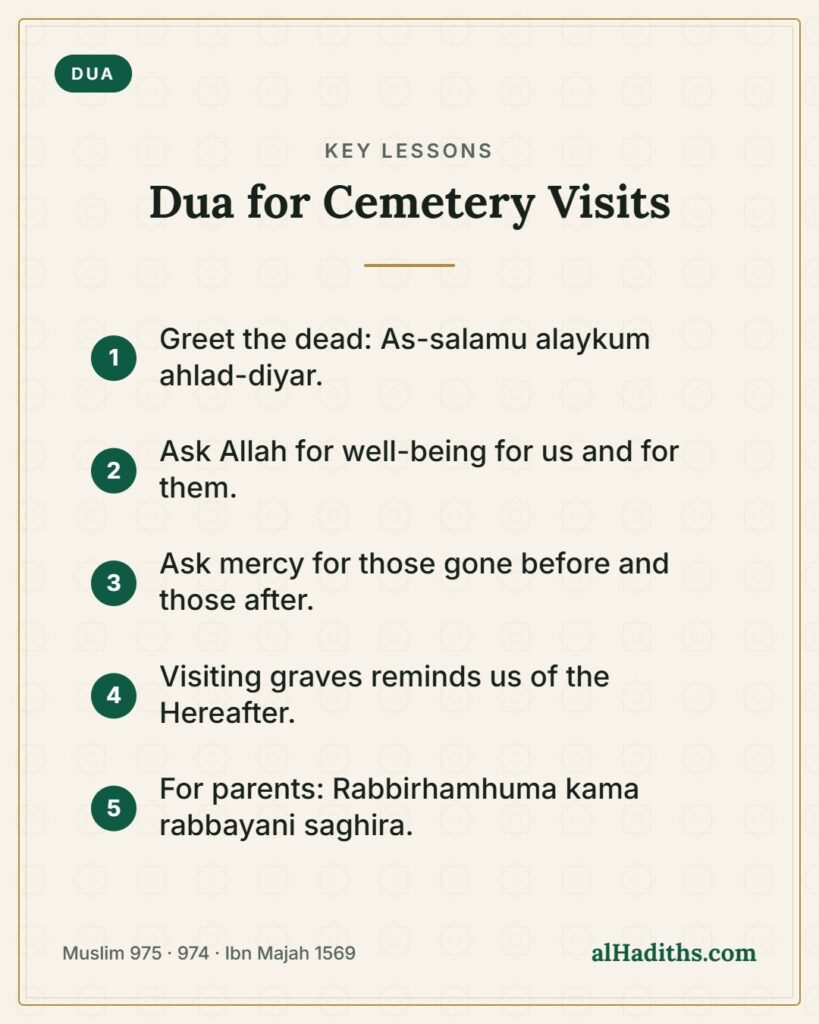
- The Prophet ﷺ taught a dua for cemetery visits: “As-salamu ʿalaykum ahlad-diyar…”
- Aisha’s wording asks mercy for those who went before and those who come after.
- He asked forgiveness for the people of al-Baqi’ by name.
- Visiting graves reminds us of the Hereafter.
- For parents, add the Quran’s “Rabbirhamhuma kama rabbayani saghira”.
Part of our Dua series: see all our dua articles in one place.
May Allah have mercy on those we have lost, and on us when our turn comes.
Save this to Pinterest so you have the words ready on your next visit
Share the reward. Send this article to someone who needs it today — teaching a hadith or dua can become a lasting good deed for you, in shaa Allah.