Dua for New Moon: Is the Crescent Moon Dua Authentic?
Contents
Every month, a message goes round as the crescent appears: here is the dua for new moon sighting, “Allahumma ahlilhu ‘alayna…”. Many of us learned it as children. But how strong is it? The short answer: both new-moon duas are graded weak on Sunnah.com, though some scholars accept one of them. Below we show the gradings, then the authentic hadith about the crescent that we can act on with confidence.
At a glance
- Popular claim: A dua the Prophet ﷺ said on seeing the new moon
- Status: Graded weak on Sunnah.com: Tirmidhi 3451 Da’if (Darussalam), Abu Dawud 5092 Da’if in chain (al-Albani)
- Authentic instead: Sahih al-Bukhari 1906 (the Ramadan crescent), Jami‘ at-Tirmidhi 3366 (seeking refuge at night)
- Topic: Dua, the Islamic calendar
- Do today: Remember Allah in your own words when the next month begins
Dua for new moon: what Sunnah.com shows
Two narrations are usually shared. Because both are graded weak on Sunnah.com, we give them in English only, with no Arabic card:
- Jami‘ at-Tirmidhi 3451 · Da’if (Darussalam). From Talhah ibn ‘Ubaydullah (may Allah be pleased with him): when the Prophet ﷺ saw the crescent he would say, “O Allah, bring it over us with blessing and faith, and security and Islam. My Lord and your Lord is Allah.”
- Sunan Abi Dawud 5092 · Da’if in chain (al-Albani). From Qatadah: on seeing the new moon the Prophet ﷺ would say three times, “A new moon of good and right guidance”, then “I believe in Him who created you”, and then praise Allah for bringing the new month.
If grading terms are new to you, our guide to sahih, hasan and weak hadith explains them.
A note on the grading
Scholars differ on Tirmidhi 3451. In the Arabic text on Sunnah.com, Imam at-Tirmidhi himself calls it hasan gharib, and some scholars rely on that verdict: HadithAnswers, for example, lists it as sound. The Darussalam grading shown on Sunnah.com, however, is Da’if. On this site we follow the Sunnah.com gradings, so we list it as weak and do not present it as a confirmed sunnah. If you want to know whether to keep saying it, ask a qualified local scholar.
What is not in doubt is that the Prophet ﷺ paid attention to the crescent and to the night sky. The authentic hadith below show how.
1. The crescent opens and closes Ramadan
‘Abdullah ibn ‘Umar (may Allah be pleased with him) narrated that the Prophet ﷺ mentioned Ramadan and said:
لاَ تَصُومُوا حَتَّى تَرَوُا الْهِلاَلَ، وَلاَ تُفْطِرُوا حَتَّى تَرَوْهُ، فَإِنْ غُمَّ عَلَيْكُمْ فَاقْدُرُوا لَهُ
“Do not fast until you see the crescent, and do not stop fasting until you see it. If the sky is overcast, then estimate it.”
Sahih al-Bukhari 1906 · Narrated by ‘Abdullah ibn ‘Umar · Translation adapted from Sunnah.com
The English on Sunnah.com explains “estimate it” as completing the month at 30 days. Sighting the crescent, not a printed date, is what this hadith ties the start and end of Ramadan to. How each country decides the sighting is a fiqh question for local scholars and authorities.
Try this: on the 29th evening of Sha‘ban or Ramadan, step outside at sunset with your family and look for the crescent together.
2. Seeking refuge when the moon rises
‘Aishah (may Allah be pleased with her) narrated that the Prophet ﷺ looked at the moon and said to her:
يَا عَائِشَةُ اسْتَعِيذِي بِاللَّهِ مِنْ شَرِّ هَذَا فَإِنَّ هَذَا الْغَاسِقُ إِذَا وَقَبَ
“O ‘Aishah, seek refuge with Allah from the evil of this, for this is al-ghasiq idha waqab (the darkness when it settles).”
Jami‘ at-Tirmidhi 3366 · Hasan (Darussalam) · Narrated by ‘Aishah · Translation adapted from Sunnah.com
The words al-ghasiq idha waqab come from Surah al-Falaq 113:3, where we seek refuge “from the evil of darkness when it settles”. So the authentic way to respond to the moon at night is to seek refuge in Allah, and Surah al-Falaq gives us the words. Imam at-Tirmidhi calls this hadith hasan sahih.
Try this: recite Surah al-Falaq when you see the moon at night, or as part of your evening dhikr.
3. Remember Allah as each month begins
Even without a fixed new-moon dua, every new month is a reminder that time is passing and that Allah is the One who sets it in order. Any sincere dhikr, praise or dua in your own words is open to you at that moment, as long as we do not claim a set wording is from the Prophet ﷺ when it is not established.
Try this: when you hear that a new month has started, check our Islamic calendar for what it holds and make one intention for it.
Bringing it together
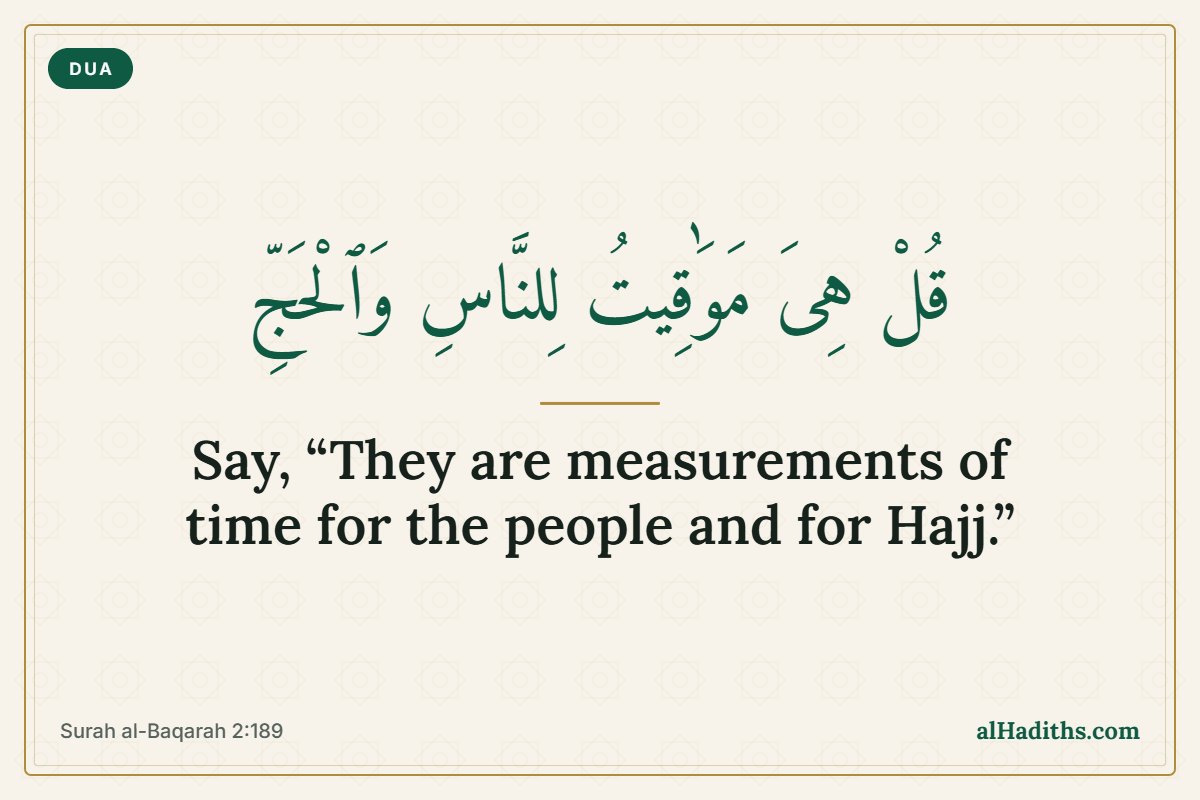
The Quran tells us what the crescent moons are for:
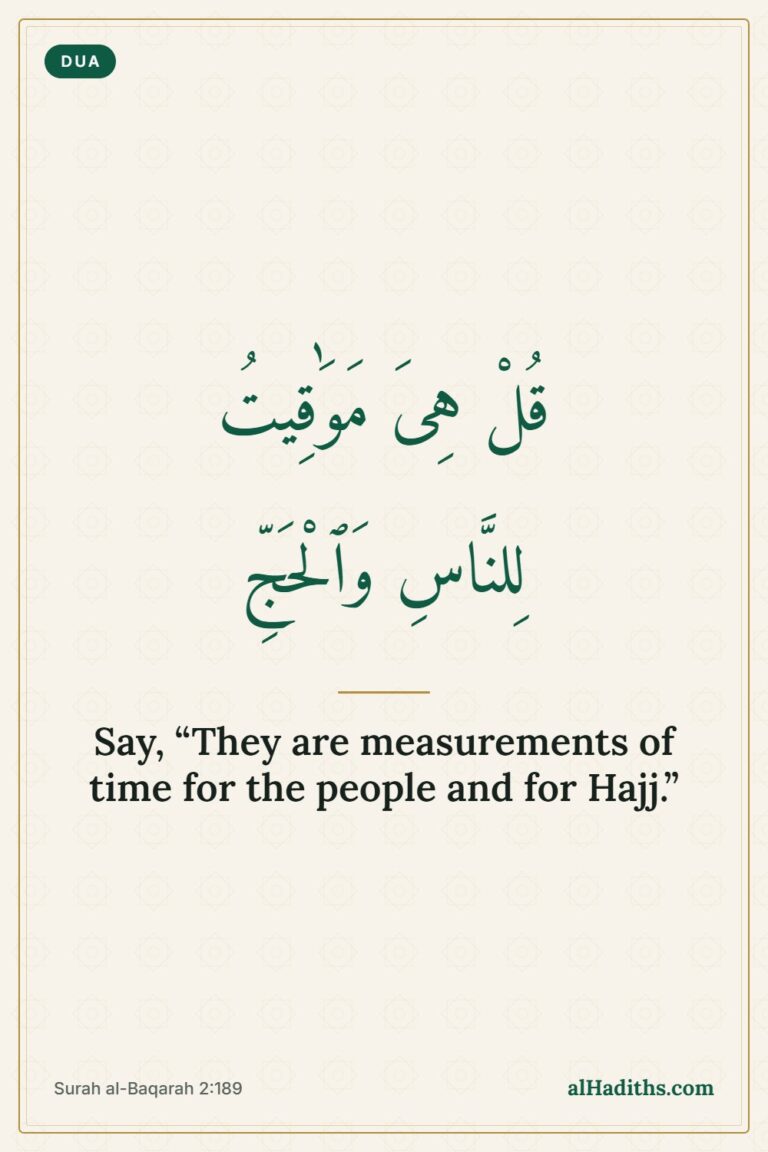
۞ يَسْـَٔلُونَكَ عَنِ ٱلْأَهِلَّةِ ۖ قُلْ هِىَ مَوَٰقِيتُ لِلنَّاسِ وَٱلْحَجِّ ۗ وَلَيْسَ ٱلْبِرُّ بِأَن تَأْتُوا۟ ٱلْبُيُوتَ مِن ظُهُورِهَا وَلَـٰكِنَّ ٱلْبِرَّ مَنِ ٱتَّقَىٰ ۗ وَأْتُوا۟ ٱلْبُيُوتَ مِنْ أَبْوَٰبِهَا ۚ وَٱتَّقُوا۟ ٱللَّهَ لَعَلَّكُمْ تُفْلِحُونَ
“They ask you, [O Muḥammad], about the crescent moons. Say, “They are measurements of time for the people and for ḥajj [pilgrimage].” And it is not righteousness to enter houses from the back, but righteousness is [in] one who fears Allāh. And enter houses from their doors. And fear Allāh that you may succeed.”
Surah al-Baqarah 2:189 · Translation: Saheeh International, from Quran.com
Reflection: I think the new-moon dua is loved because it turns a small sight into a moment with Allah. We do not lose that by being honest about its grading. The crescent still tells us when to fast, when to celebrate and when to go for Hajj, and the night sky still reminds us to seek refuge in Allah.
Questions people ask
Can I still say “Allahumma ahlilhu ‘alayna…” when I see the new moon?
It is graded Da’if (Darussalam) on Sunnah.com, while Imam at-Tirmidhi called it hasan gharib and some scholars accept it. Making dua in your own words is always allowed; whether to say this wording as a sunnah is a question for a qualified local scholar.
Is there a special dua for seeing the Ramadan moon?
We found no separate authentic dua for the Ramadan crescent. The narrations above are the ones usually shared for every month. What is authentic is the instruction to start and end the fast by the crescent (Sahih al-Bukhari 1906). See our guide to Ramadan 2027.
What does hilal mean?
Hilal is the Arabic word for the new crescent moon. Each Islamic month begins when it is sighted after sunset, or when the previous month completes 30 days.
Key lessons
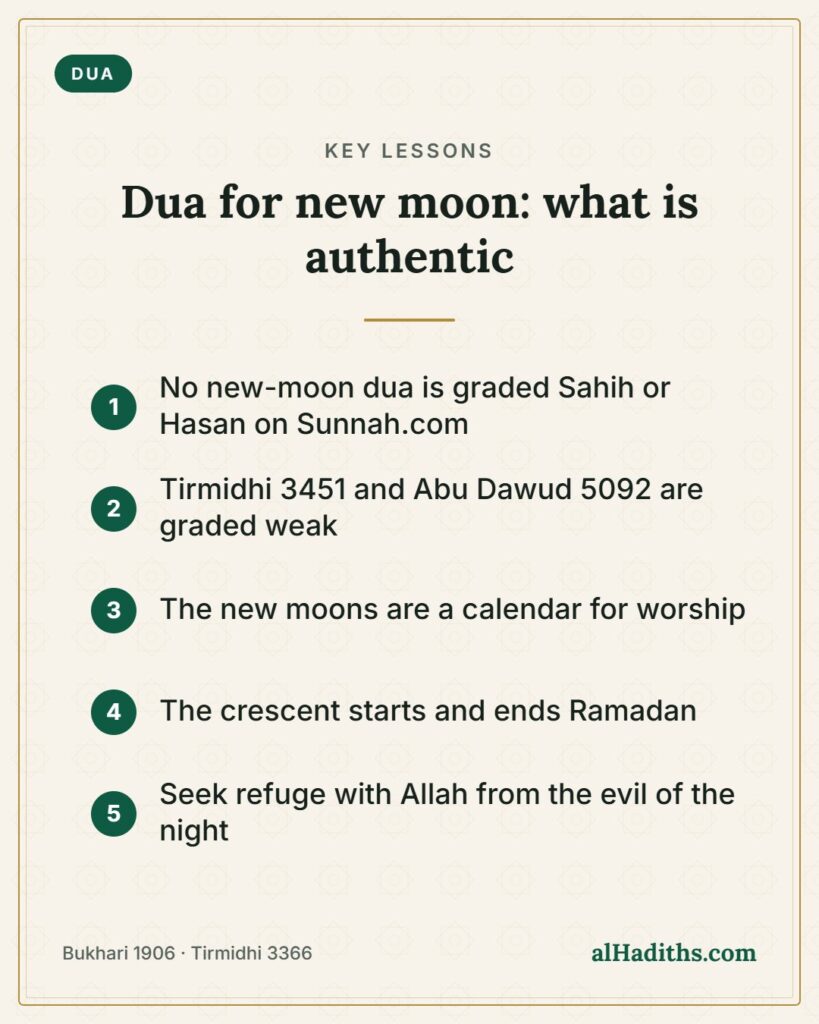
- No dua for new moon sighting is graded Sahih or Hasan on Sunnah.com.
- Tirmidhi 3451 is graded Da’if (Darussalam), though at-Tirmidhi called it hasan gharib.
- The crescent decides the start and end of Ramadan (Sahih al-Bukhari 1906).
- When the Prophet ﷺ looked at the moon, he taught ‘Aishah to seek refuge with Allah.
- Any sincere dhikr or dua in our own words is open to us when a new month begins.
Part of our Dua and Weak Hadith series: see all our dua articles and weak hadith articles in one place.
Next time you spot a thin crescent at sunset, pause for a moment: say Surah al-Falaq, thank Allah for another month, and ask Him to fill it with good.
Save this to Pinterest so you know what the hadith say before the next new moon.
Share the reward. Send this article to someone who needs it today — teaching a hadith or dua can become a lasting good deed for you, in shaa Allah.