Hadith About Patience: 7 Authentic Hadith on Sabr
Contents
Bad news rarely waits for a good moment. A phone call, a test result, a loss we did not expect. In those first minutes, what we say and do matters more than we think. Every hadith about patience in this article comes back to that moment. Here are seven authentic hadith on sabr, with a dua to say when a calamity strikes.
At a glance
- Hadith: 7 (Bukhari, Muslim, Tirmidhi)
- Grades: Sahih or Hasan, graders named
- Topic: Patience (sabr), trials, calamity
- Key hadith: Patience is at the first stroke of a calamity (Bukhari 1283)
- Do today: Learn the dua for a calamity from Sahih Muslim 918
1. Patience is at the first stroke
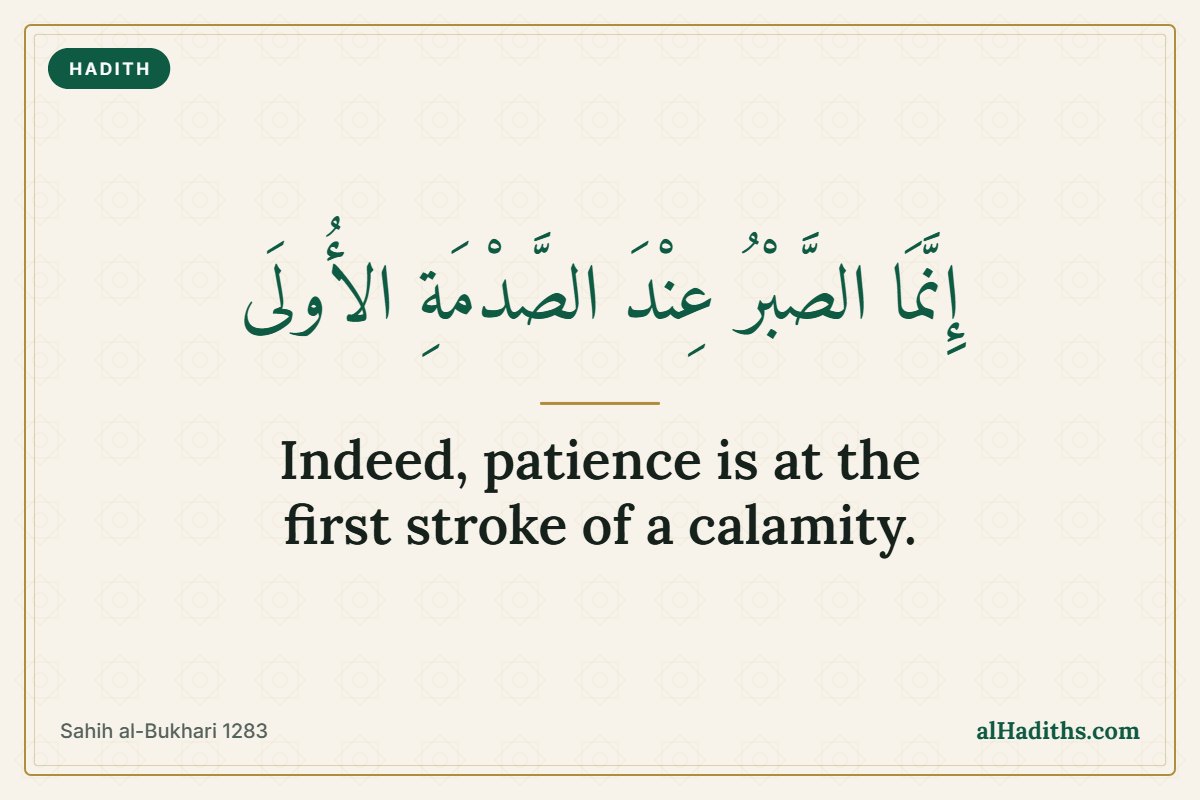
Anas ibn Malik (may Allah be pleased with him) narrated that the Prophet ﷺ passed by a woman weeping at a grave and told her to fear Allah and be patient. Not knowing who he was, she told him to go away, since he had not suffered her loss. When she was told it was the Prophet ﷺ, she went to his house to apologize, and he said:
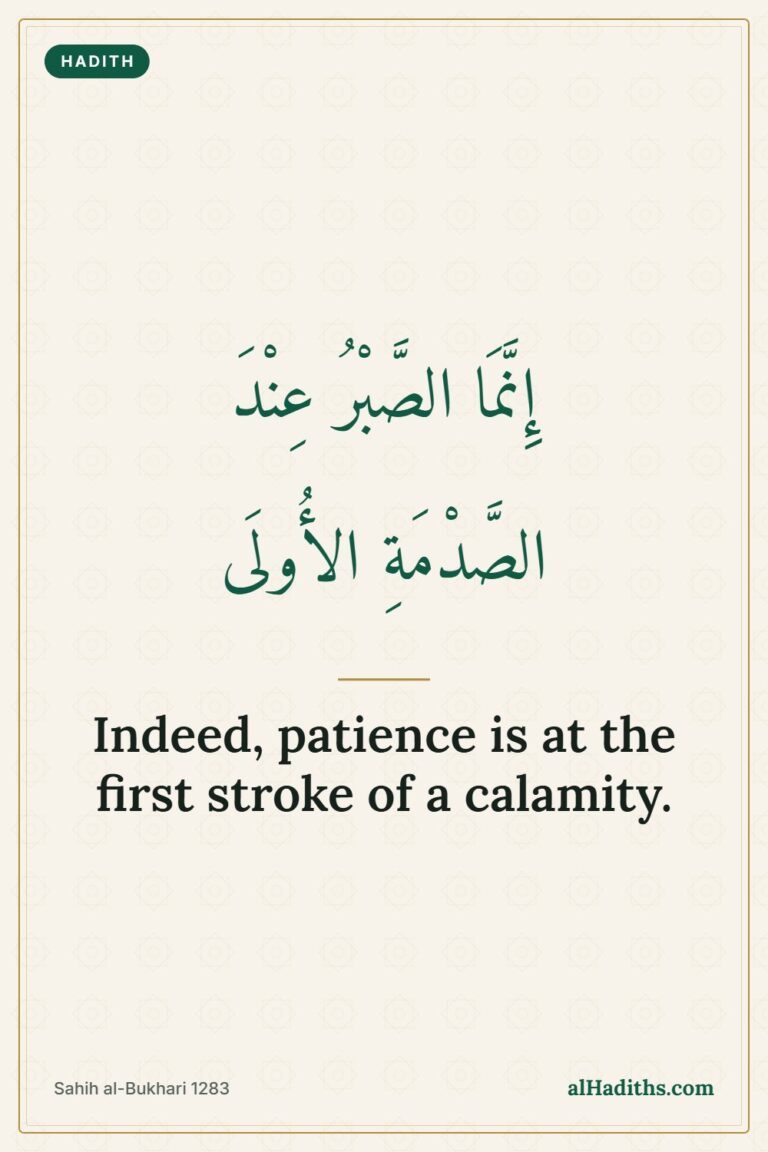
إِنَّمَا الصَّبْرُ عِنْدَ الصَّدْمَةِ الأُولَى
“Indeed, patience is at the first stroke of a calamity.”
Sahih al-Bukhari 1283 · Narrated by Anas ibn Malik · Translation adapted from Sunnah.com
Muslim reports it too (Sahih Muslim 926). Anyone becomes calm after some time has passed. The patience that is rewarded is the one we show at the first shock, before the pain fades. Notice also that the Prophet ﷺ did not scold her when she came back: he only taught her. HadeethEnc explains it further.
Try this: decide now what you will say the next time bad news comes, so the first words are ready (see hadith 3).
2. How amazing is the believer’s affair
Suhaib (may Allah be pleased with him) narrated why a believer never loses.
عَجَبًا لأَمْرِ الْمُؤْمِنِ إِنَّ أَمْرَهُ كُلَّهُ خَيْرٌ وَلَيْسَ ذَاكَ لأَحَدٍ إِلاَّ لِلْمُؤْمِنِ إِنْ أَصَابَتْهُ سَرَّاءُ شَكَرَ فَكَانَ خَيْرًا لَهُ وَإِنْ أَصَابَتْهُ ضَرَّاءُ صَبَرَ فَكَانَ خَيْرًا لَهُ
“How amazing is the affair of the believer! All of his affairs are good, and this is for no one except the believer. If something good happens to him, he is grateful, and that is good for him. If something bad befalls him, he is patient, and that is good for him.”
Sahih Muslim 2999 · Narrated by Suhaib · Translation adapted from Sunnah.com
Patience and gratitude are two sides of the same faith. We look at gratitude more closely in our article on the hadith about gratitude.
Try this: tonight, name one blessing to thank Allah for and one difficulty to be patient with.
3. The dua when a calamity strikes
Umm Salamah (may Allah be pleased with her) heard the Prophet ﷺ say that any Muslim struck by a calamity who says what Allah commanded, these words, will be given something better in exchange.
إِنَّا لِلَّهِ وَإِنَّا إِلَيْهِ رَاجِعُونَ اللَّهُمَّ أْجُرْنِي فِي مُصِيبَتِي وَأَخْلِفْ لِي خَيْرًا مِنْهَا
Inna lillahi wa inna ilayhi raji‘un. Allahumma’jurni fi musibati, wa akhlif li khayran minha
“We belong to Allah and to Him we shall return. O Allah, reward me in my affliction and give me something better than it in exchange.”
Sahih Muslim 918 · Narrated by Umm Salamah · Translation adapted from Sunnah.com
In the same hadith, Umm Salamah said that when her husband Abu Salamah died, she wondered which Muslim could be better than him. She said the dua anyway, and Allah gave her the Prophet ﷺ himself as her husband.
Try this: learn the dua by heart this week, even before you need it.
4. A sign that Allah wants good for you
Abu Hurairah (may Allah be pleased with him) narrated this short hadith.
مَنْ يُرِدِ اللَّهُ بِهِ خَيْرًا يُصِبْ مِنْهُ
“If Allah wants good for someone, He afflicts him with trials.”
Sahih al-Bukhari 5645 · Narrated by Abu Hurairah · Translation adapted from Sunnah.com
A trial is not always a sign of Allah’s anger. For a believer who is patient, it can be a sign of His care: a way to raise him and wipe away his sins.
Try this: when you face a hardship, ask yourself what good Allah may be bringing through it, and make dua for it.
5. Greater reward comes with greater trial
Anas ibn Malik (may Allah be pleased with him) narrated it.
إِنَّ عِظَمَ الْجَزَاءِ مَعَ عِظَمِ الْبَلاَءِ وَإِنَّ اللَّهَ إِذَا أَحَبَّ قَوْمًا ابْتَلاَهُمْ فَمَنْ رَضِيَ فَلَهُ الرِّضَا وَمَنْ سَخِطَ فَلَهُ السَّخَطُ
“Indeed, the greatness of the reward comes with the greatness of the trial. And when Allah loves a people, He tests them. Whoever is content, for him is pleasure, and whoever is discontent, for him is anger.”
Jami‘ at-Tirmidhi 2396 · Hasan (Darussalam) · Narrated by Anas ibn Malik · Translation adapted from Sunnah.com
The trial is the same for both people; what differs is how they meet it. Contentment does not mean we stop feeling pain. It means we do not turn against Allah’s decree. HadeethEnc explains this hadith in more detail.
Take heed: complaining to Allah in dua is not discontent. Complaining about Allah is.
6. The prophets were tested the most
Sa‘d ibn Abi Waqqas (may Allah be pleased with him) narrated that a man asked the Prophet ﷺ which people are tested most severely. He said:
الأَنْبِيَاءُ ثُمَّ الأَمْثَلُ فَالأَمْثَلُ فَيُبْتَلَى الرَّجُلُ عَلَى حَسَبِ دِينِهِ فَإِنْ كَانَ دِينُهُ صُلْبًا اشْتَدَّ بَلاَؤُهُ وَإِنْ كَانَ فِي دِينِهِ رِقَّةٌ ابْتُلِيَ عَلَى حَسَبِ دِينِهِ فَمَا يَبْرَحُ الْبَلاَءُ بِالْعَبْدِ حَتَّى يَتْرُكَهُ يَمْشِي عَلَى الأَرْضِ مَا عَلَيْهِ خَطِيئَةٌ
“The Prophets, then the next best, then the next best. A man is tested according to his religion. If his religion is firm, his trials are more severe, and if there is weakness in his religion, he is tested according to his religion. Trials keep coming to a servant until they leave him walking on the earth with no sin on him.”
Jami‘ at-Tirmidhi 2398 · Hasan (Darussalam) · Narrated by Sa‘d ibn Abi Waqqas · Translation adapted from Sunnah.com
If the best of people faced the hardest trials, then our own trials do not mean Allah has forgotten us. They are part of the path every believer walks.
Try this: read about the trials of a prophet this week, such as Ayyub or Yusuf (peace be upon them), and notice how they stayed patient.
7. No gift is better than patience
Abu Sa‘id al-Khudri (may Allah be pleased with him) narrated that some of the Ansar kept asking the Prophet ﷺ until he had nothing left to give. Then he said, as part of a longer hadith:
وَمَنْ يَتَصَبَّرْ يُصَبِّرْهُ اللَّهُ، وَمَا أُعْطِيَ أَحَدٌ عَطَاءً خَيْرًا وَأَوْسَعَ مِنَ الصَّبْرِ
“And whoever tries to be patient, Allah will make him patient. And no one is given a gift better and greater than patience.”
Sahih al-Bukhari 1469 · Narrated by Abu Sa‘id al-Khudri · Translation adapted from Sunnah.com
Muslim reports it too (Sahih Muslim 1053). Patience is not only something we are born with: it grows when we try. The first part of the same hadith, about contentment, is in our article on qana’ah.
Try this: the next time you feel impatient, hold back your first reaction for a minute and ask Allah to make you patient.
Bringing it together: good news for the patient
The Quran tells us that trials will come, and who receives the good news:
وَلَنَبْلُوَنَّكُم بِشَىْءٍ مِّنَ ٱلْخَوْفِ وَٱلْجُوعِ وَنَقْصٍ مِّنَ ٱلْأَمْوَٰلِ وَٱلْأَنفُسِ وَٱلثَّمَرَٰتِ ۗ وَبَشِّرِ ٱلصَّـٰبِرِينَ ٱلَّذِينَ إِذَآ أَصَـٰبَتْهُم مُّصِيبَةٌ قَالُوٓا۟ إِنَّا لِلَّهِ وَإِنَّآ إِلَيْهِ رَٰجِعُونَ
“And We will surely test you with something of fear and hunger and a loss of wealth and lives and fruits, but give good tidings to the patient, Who, when disaster strikes them, say, “Indeed we belong to Allāh, and indeed to Him we will return.””
Surah al-Baqarah 2:155–156 · Translation: Saheeh International, from Quran.com
Reflection: I notice that the words in the verse are the same words in the dua of Umm Salamah. The Quran tells us what the patient say, and the Sunnah teaches us to add: “O Allah, reward me, and give me something better.” Patience in Islam is not silent endurance. It is turning to Allah at the very moment it hurts.
Questions people ask
What is sabr in Islam?
Sabr means patience: holding yourself back from despair and from complaining against Allah, while you keep doing what is right. The hadith above show it at its most important moment, the first shock of a calamity (Bukhari 1283), and promise that whoever tries to be patient, Allah will make him patient (Bukhari 1469).
Is crying allowed when someone dies?
Crying is not a lack of patience. When his son Ibrahim was dying, the eyes of the Prophet ﷺ filled with tears. He called it mercy and said that the eye weeps and the heart grieves, but we say only what pleases our Lord (Sahih al-Bukhari 1303). What patience asks us to avoid is words and actions of protest against Allah’s decree.
How do patience and gratitude go together?
The believer is grateful in good times and patient in hard times, and both are good for him (Sahih Muslim 2999). Read more in our article on gratitude.
Key lessons
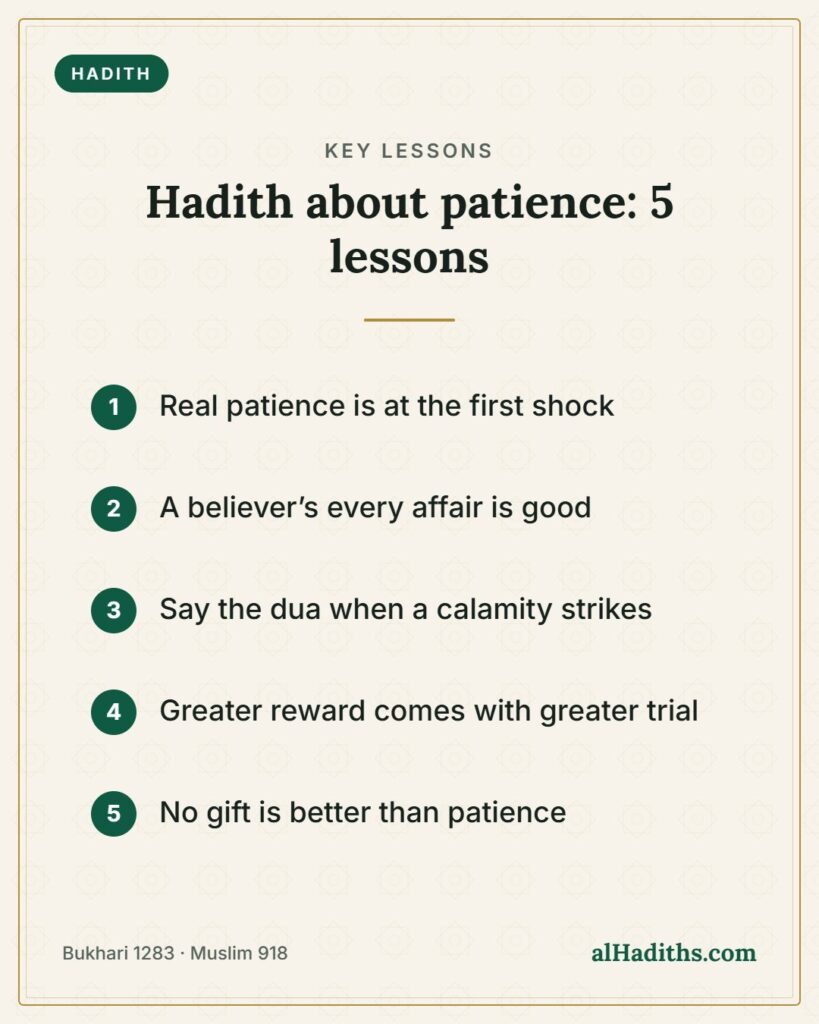
- Patience that counts is shown at the first shock of a calamity (Bukhari 1283).
- A believer gains in good times and bad: gratitude in one, patience in the other (Muslim 2999).
- When a calamity strikes, say: “We belong to Allah and to Him we shall return. O Allah, reward me and give me better” (Muslim 918).
- Greater reward comes with greater trial, and the prophets were tested most (Tirmidhi 2396, 2398).
- Whoever tries to be patient, Allah makes him patient (Bukhari 1469).
If you are going through something hard today, may Allah give you patience at the first stroke, reward you for it, and replace it with something better.
Save this to Pinterest so you can remember what the Prophet taught about patience in hard times
Share the reward. Send this article to someone who needs it today — teaching a hadith or dua can become a lasting good deed for you, in shaa Allah.