What Breaks Wudu? The Authentic Hadith, and Where Scholars Differ
You are halfway through your prayer and a thought creeps in: did my wudu just break? Or you wake from a short nap before ‘Asr and wonder whether you need to make it again. What breaks wudu is one of the most common questions about salah, and the Prophet ﷺ answered much of it directly. This article gathers those authentic hadith, and is open about the points where scholars read them differently.
In this article
- What all scholars agree breaks wudu, and why doubt alone does not
- Sleep, camel meat and touching: the hadith on each side
- A short summary to take to your local scholar
At a glance
- Hadith: 11 hadith cards, plus Surah An-Nisa 4:43
- Collections: Sahih al-Bukhari, Sahih Muslim, Jami` at-Tirmidhi and Sunan Abi Dawud
- Grade: Sahih and Hasan, grader named on each card; two notes on grading
- Topic: Wudu (ablution): what breaks it and what does not
- Put it into practice: Next time you doubt your wudu in salah, carry on unless you are sure
1. Passing wind, urine or stool breaks wudu
Abu Hurairah (may Allah be pleased with him) reported that the Messenger of Allah ﷺ said:
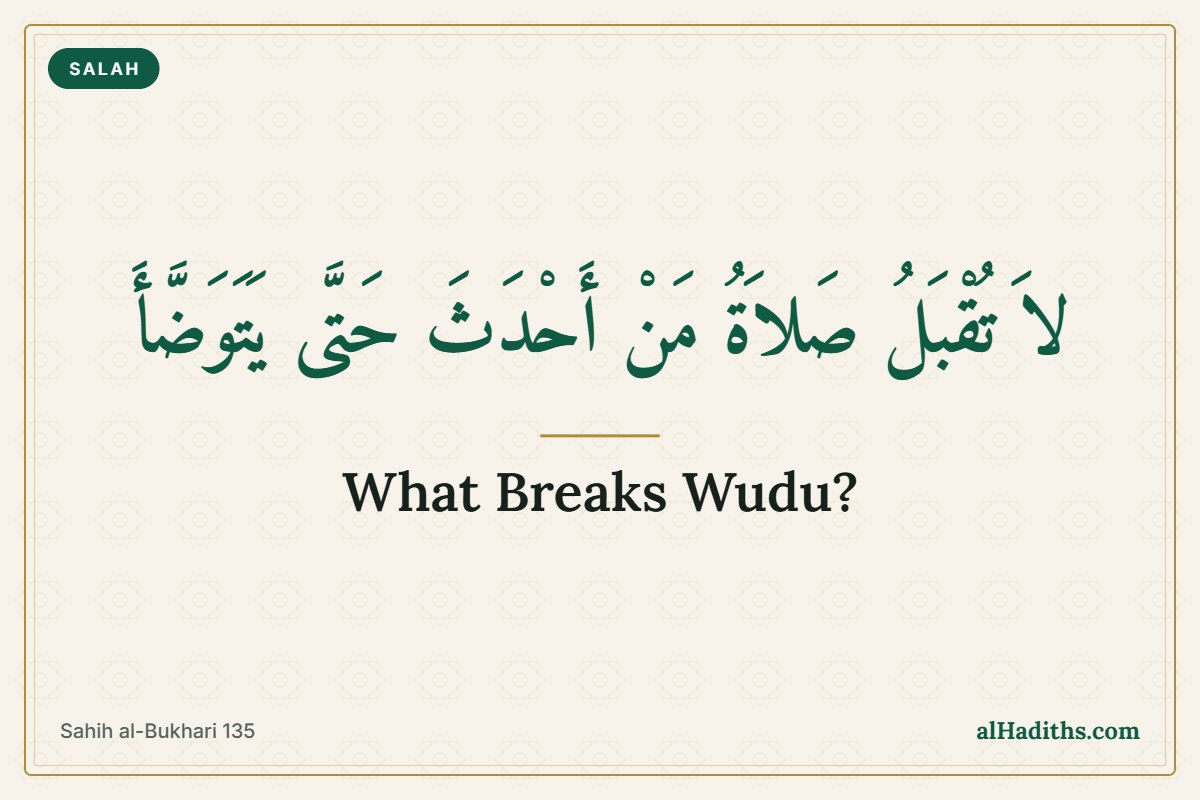
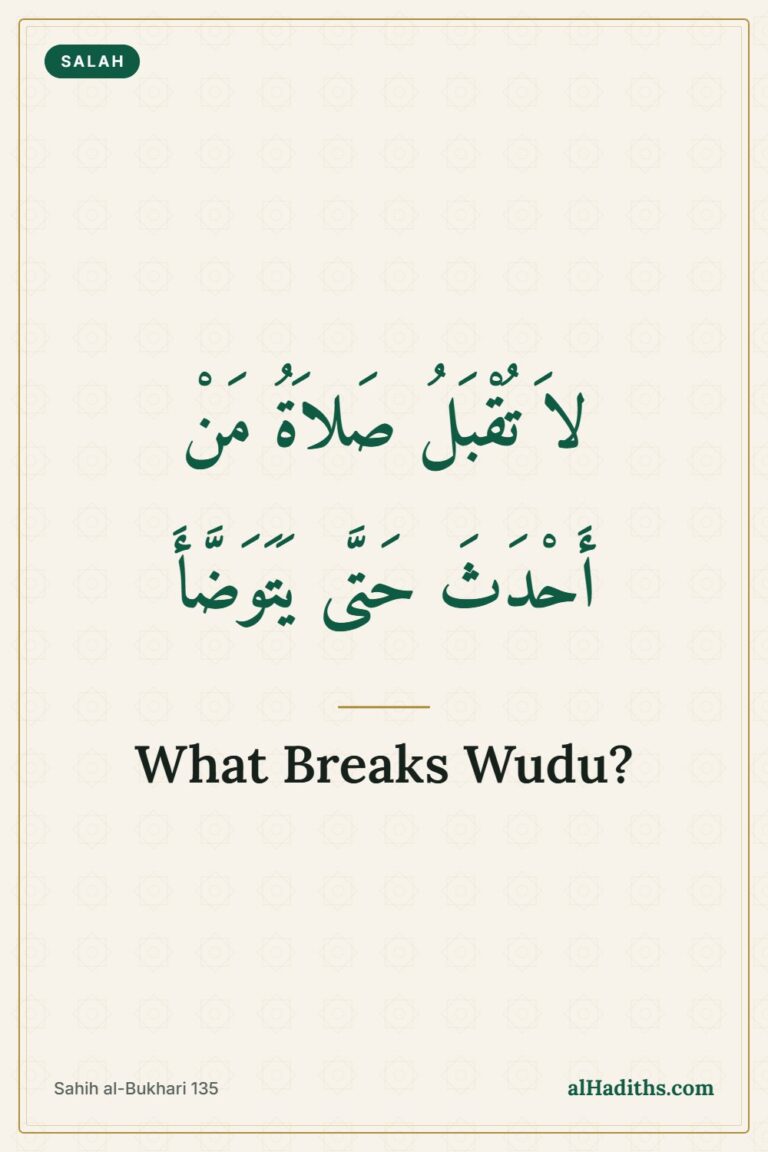
لاَ تُقْبَلُ صَلاَةُ مَنْ أَحْدَثَ حَتَّى يَتَوَضَّأَ
“The prayer of a person who does Hadath (passes urine, stool or wind) is not accepted till he performs the ablution.”
Sahih al-Bukhari 135 · Narrated by Abu Hurairah · Translation from Sunnah.com
Hadath is the state that wudu removes. In the same hadith, a man from Hadramawt asked Abu Hurairah what hadath means, and he answered that it is passing wind, with or without a sound. HadeethEnc explains that wudu is a condition for salah, so whoever has lost it, for example by using the toilet or by sleeping, must make wudu again before praying.
This is the part all scholars agree on: anything that leaves the body from the front or back passage breaks wudu. Things that need a full bath (ghusl), such as janabah, are a separate topic.
2. Doubt alone does not break wudu
‘Abdullah ibn Zaid (may Allah be pleased with him) complained to the Prophet ﷺ about a man who imagines, during the prayer, that something has come out of him. He said:
لاَ يَنْفَتِلْ ـ أَوْ لاَ يَنْصَرِفْ ـ حَتَّى يَسْمَعَ صَوْتًا أَوْ يَجِدَ رِيحًا
“He should not leave his prayer (or: he should not turn away) unless he hears a sound or notices a smell.”
Sahih al-Bukhari 137 · Narrated by ‘Abbad ibn Tamim, from his uncle · Translation adapted from Sunnah.com
Sahih Muslim 362 gives the same answer for someone who feels something in his stomach and cannot tell whether anything came out: he should not leave the mosque unless he hears a sound or notices a smell. HadeethEnc draws the rule from it: certainty is not removed by doubt, so if you are sure you made wudu, you stay in wudu until you are sure it broke.
This is a mercy for anyone who struggles with whispers (waswas) in their wudu and salah. Allah does not hold us to account for what we cannot be sure of; see also Mistakes, Forgetting and Coercion.
Try this: when the doubt comes in salah, keep praying unless you are certain.
3. Madhi (pre-seminal fluid) breaks wudu
‘Ali ibn Abi Talib (may Allah be pleased with him) said:
كُنْتُ رَجُلاً مَذَّاءً، فَاسْتَحْيَيْتُ أَنْ أَسْأَلَ رَسُولَ اللَّهِ صلى الله عليه وسلم فَأَمَرْتُ الْمِقْدَادَ بْنَ الأَسْوَدِ فَسَأَلَهُ فَقَالَ فِيهِ الْوُضُوءُ
“I was a man who often had madhi (pre-seminal fluid), and I felt shy to ask the Messenger of Allah ﷺ about it. So I asked al-Miqdad ibn al-Aswad, and he asked him. He replied: ‘Wudu is due for it.’”
Sahih al-Bukhari 178 · Narrated by ‘Ali ibn Abi Talib · Translation adapted from Sunnah.com
In Sahih Muslim 303a, ‘Ali explains that he was shy because he was married to the Prophet’s daughter, and the answer is: he should wash his private part and make wudu. So madhi needs washing and wudu, not a full ghusl.
‘Ali’s shyness did not stop him from finding out. He sent someone to ask, which is a good example for questions about purity that feel awkward to ask in person.
4. Sleep: deep sleep and light dozing
Safwan ibn ‘Assal (may Allah be pleased with him) described what the Prophet ﷺ taught them about wiping over leather socks (khuff) on a journey:
كَانَ رَسُولُ اللَّهِ صلى الله عليه وسلم يَأْمُرُنَا إِذَا كُنَّا سَفْرًا أَنْ لاَ نَنْزِعَ خِفَافَنَا ثَلاَثَةَ أَيَّامٍ وَلَيَالِيَهُنَّ إِلاَّ مِنْ جَنَابَةٍ وَلَكِنْ مِنْ غَائِطٍ وَبَوْلٍ وَنَوْمٍ
“When we were traveling, Allah’s Messenger would order us not to remove our khuff for three days and nights, except for janabah, but not for defecating, urinating, and sleep.”
Jami` at-Tirmidhi 96 · Hasan (Darussalam) · Translation adapted from Sunnah.com
In other words, after janabah they had to take the socks off and bathe, but after the toilet or sleep they only renewed their wudu and wiped over the socks. Sleep is named together with urine and stool. At-Tirmidhi called this hadith hasan sahih.
Yet Anas ibn Malik (may Allah be pleased with him) said about the Companions:
كَانَ أَصْحَابُ رَسُولِ اللَّهِ صلى الله عليه وسلم يَنَامُونَ ثُمَّ يُصَلُّونَ وَلاَ يَتَوَضَّئُونَ
“The Companions of the Messenger of Allah ﷺ dozed off, then offered prayer and did not perform ablution.”
Sahih Muslim 376c · Narrated by Anas ibn Malik · Translation adapted from Sunnah.com
When Qatadah was asked whether he really heard this from Anas, he said: “Yes, by Allah.” Sunan Abi Dawud 200 (Sahih, al-Albani) adds that this happened while they waited for ‘Isha, until their heads nodded.
A third narration links sleep to wudu directly. ‘Ali reported that the Messenger of Allah ﷺ said:
وِكَاءُ السَّهِ الْعَيْنَانِ فَمَنْ نَامَ فَلْيَتَوَضَّأْ
“The eyes are the leather strap of the anus, so one who sleeps should perform ablution.”
Sunan Abi Dawud 203 · Hasan (al-Albani) · Translation from Sunnah.com
Note on its grading: al-Albani graded this hadith Hasan, as Sunnah.com shows, while Zubair Ali Zai graded it Da’if (weak) (Tohed). Its meaning is that while we are awake our eyes act like a drawstring: we would notice if anything came out. In sleep, we would not.
HadeethEnc brings these together: deep sleep, in which a person loses awareness, breaks wudu, while light dozing like the Companions’ does not. It adds that if you are unsure how deeply you slept, your wudu stands, though making it again before salah is the safer choice. The madhhabs describe the line between the two in different ways, for example by how the person was sitting, so ask a qualified local scholar about yours.
5. Camel meat
Jabir ibn Samurah (may Allah be pleased with him) reported:
أَأَتَوَضَّأُ مِنْ لُحُومِ الْغَنَمِ قَالَ إِنْ شِئْتَ فَتَوَضَّأْ وَإِنْ شِئْتَ فَلاَ تَوَضَّأْ . قَالَ أَتَوَضَّأُ مِنْ لُحُومِ الإِبِلِ قَالَ نَعَمْ فَتَوَضَّأْ مِنْ لُحُومِ الإِبِلِ
“A man asked the Messenger of Allah ﷺ: Should I perform ablution after eating mutton? He said: If you wish, perform ablution, and if you wish, do not. He asked: Should I perform ablution after eating camel’s flesh? He said: Yes, perform ablution after eating camel’s flesh.”
Sahih Muslim 360a · Narrated by Jabir ibn Samurah · Translation adapted from Sunnah.com
Al-Bara’ ibn ‘Azib reported the same answer in Jami` at-Tirmidhi 81 (Sahih, Darussalam). And Ibn ‘Abbas (may Allah be pleased with them both) reported that the Prophet ﷺ ate from a cooked shoulder of mutton and prayed without making wudu again (Sahih al-Bukhari 207), which fits the choice he gave about mutton.
Where scholars differ: IslamQA 7103 notes that most scholars hold that camel meat does not break wudu, mainly because they see this ruling as replaced by the later practice of not making wudu after cooked food. It quotes an-Nawawi listing Ahmad ibn Hanbal, Ishaq ibn Rahawayh, Ibn al-Mundhir and Ibn Khuzaymah among those who held that it does, and IslamQA itself takes that view. HadeethEnc also explains the hadith as requiring wudu after camel meat. If your madhhab follows the majority, ask your local scholar how they read this hadith.
6. Touching the private part
Busrah bint Safwan (may Allah be pleased with her) reported that the Prophet ﷺ said:
مَنْ مَسَّ ذَكَرَهُ فَلاَ يُصَلِّ حَتَّى يَتَوَضَّأَ
“Whoever touches his penis, then he is not to pray until he performs Wudu.”
Jami` at-Tirmidhi 82 · Sahih (Darussalam) · Translation from Sunnah.com
But Talq ibn ‘Ali (may Allah be pleased with him) reported that a Bedouin asked:
يَا نَبِيَّ اللَّهِ مَا تَرَى فِي مَسِّ الرَّجُلِ ذَكَرَهُ بَعْدَ مَا يَتَوَضَّأُ فَقَالَ هَلْ هُوَ إِلاَّ مُضْغَةٌ مِنْهُ
“Prophet of Allah, what do you think about a man who touches his penis after performing ablution? He ﷺ replied: It is only a part of his body.”
Sunan Abi Dawud 182 · Sahih (al-Albani) · Translation adapted from Sunnah.com
Both narrations are graded authentic, so scholars have had to reconcile them. HadeethEnc takes Busrah’s hadith to mean that touching it directly with the hand breaks wudu, with or without desire, while touching through clothing does not. HadeethEnc explains Talq’s hadith in two ways: either it came earlier and was replaced, or it is about touching through a barrier. At-Tirmidhi records that some Companions and Successors did not see wudu as needed for it (Jami` at-Tirmidhi 85), and that is the view some scholars took from Talq’s hadith.
7. Touching your wife, or the opposite sex
This question goes back to a phrase in Surah an-Nisa:
يَـٰٓأَيُّهَا ٱلَّذِينَ ءَامَنُوا۟ لَا تَقْرَبُوا۟ ٱلصَّلَوٰةَ وَأَنتُمْ سُكَـٰرَىٰ حَتَّىٰ تَعْلَمُوا۟ مَا تَقُولُونَ وَلَا جُنُبًا إِلَّا عَابِرِى سَبِيلٍ حَتَّىٰ تَغْتَسِلُوا۟ ۚ وَإِن كُنتُم مَّرْضَىٰٓ أَوْ عَلَىٰ سَفَرٍ أَوْ جَآءَ أَحَدٌ مِّنكُم مِّنَ ٱلْغَآئِطِ أَوْ لَـٰمَسْتُمُ ٱلنِّسَآءَ فَلَمْ تَجِدُوا۟ مَآءً فَتَيَمَّمُوا۟ صَعِيدًا طَيِّبًا فَٱمْسَحُوا۟ بِوُجُوهِكُمْ وَأَيْدِيكُمْ ۗ إِنَّ ٱللَّهَ كَانَ عَفُوًّا غَفُورًا
“O you who have believed, do not approach prayer while you are intoxicated until you know what you are saying or in a state of janābah, except those passing through [a place of prayer], until you have washed [your whole body]. And if you are ill or on a journey or one of you comes from the place of relieving himself or you have contacted women [i.e., had sexual intercourse] and find no water, then seek clean earth and wipe over your faces and your hands [with it]. Indeed, Allāh is ever Pardoning and Forgiving.”
Surah An-Nisa 4:43 · Translation: Saheeh International, from Quran.com
The Arabic phrase aw lamastumu an-nisa’ can mean “or you have touched women”. Saheeh International adds “[i.e., had sexual intercourse]” in brackets, which is one reading of it, from Ibn ‘Abbas. The Shafi’i school reads it as touching itself. We keep the translation as Quran.com shows it and set out both readings below.
‘A’ishah (may Allah be pleased with her) said:
فَقَدْتُ رَسُولَ اللَّهِ صلى الله عليه وسلم لَيْلَةً مِنَ الْفِرَاشِ فَالْتَمَسْتُهُ فَوَقَعَتْ يَدِي عَلَى بَطْنِ قَدَمَيْهِ وَهُوَ فِي الْمَسْجِدِ وَهُمَا مَنْصُوبَتَانِ
“One night I missed Allah’s Messenger ﷺ from the bed, and when I sought him, my hand touched the soles of his feet while he was in prostration; they were raised.”
Sahih Muslim 486 · Narrated by ‘A’ishah · Translation adapted from Sunnah.com
He was in sujud, and he carried on with his prayer and his dua. ‘A’ishah also reported that he kissed one of his wives and went out to pray:
أَنَّ النَّبِيَّ صلى الله عليه وسلم قَبَّلَ امْرَأَةً مِنْ نِسَائِهِ ثُمَّ خَرَجَ إِلَى الصَّلاَةِ وَلَمْ يَتَوَضَّأْ
“The Prophet ﷺ kissed one of his wives and went out to pray (salah). He did not perform ablution.”
Sunan Abi Dawud 179 · Sahih (al-Albani) · Translation from Sunnah.com
Note on its grading: al-Albani graded this hadith Sahih, as Sunnah.com shows, while Zubair Ali Zai graded its chain weak, because al-A’mash, one of its narrators, is known to obscure his sources and Habib did not hear from ‘Urwah (Tohed). HadeethEnc grades the narration authentic and takes it to mean that touching or kissing a wife does not break wudu unless something comes out.
Where scholars differ:
- Shafi’i school: skin contact between a man and a woman who are not mahram, including husband and wife, breaks wudu (SeekersGuidance). It reads lamastum as touching, and answers ‘A’ishah’s hadith by saying her hand may have touched his feet through a cloth, an answer it cites from Ibn Hajar (a Shafi’i compilation on IslamQA.org).
- Abu Hanifah: touching does not break wudu, even with desire (IslamOnline).
- Many other jurists: touching with desire breaks wudu, and touching without desire does not (also IslamOnline).
If you follow the Shafi’i school, as many Muslims in Southeast Asia do, ask your local scholar how it applies in daily life, for example in a crowded place or when touching a spouse.
Bringing it together
- Agreed: wind, urine, stool and madhi break wudu.
- Does not break it: a doubt you cannot confirm.
- Scholars differ: sleep (deep or light), camel meat, touching the private part, and touching the opposite sex.
Where the hadith point two ways, the scholars of each madhhab have weighed them carefully, and following your own madhhab is a sound choice. We are not giving a ruling here; please ask a qualified local scholar about your situation. To learn how to make wudu itself, see How to Make Wudu.
Questions people ask
Does sleeping break wudu?
Deep sleep, in which you lose awareness, breaks wudu, according to HadeethEnc’s explanation of Sunan Abi Dawud 200. Light dozing does not: the Companions dozed while waiting for ‘Isha and prayed without renewing wudu (Sahih Muslim 376c). The madhhabs differ on where the line falls.
Does touching your wife break wudu?
Scholars differ. In the Shafi’i school, skin contact between husband and wife breaks wudu. Abu Hanifah held that it does not, and many other jurists say it breaks only when there is desire. ‘A’ishah’s hand touched the Prophet’s feet while he was in sujud (Sahih Muslim 486).
Does bleeding break wudu?
Scholars differ. The Hanafi school holds that bleeding breaks wudu, while the Shafi’i school does not count it among the things that break wudu. Sunan Abi Dawud 198 (Hasan, al-Albani) tells of a Companion who kept praying while he was wounded and bleeding.
Does doubt break wudu?
No. If you are sure you made wudu, it stays valid until you are sure it broke. The Prophet ﷺ said to keep praying unless you hear a sound or notice a smell (Sahih al-Bukhari 137).
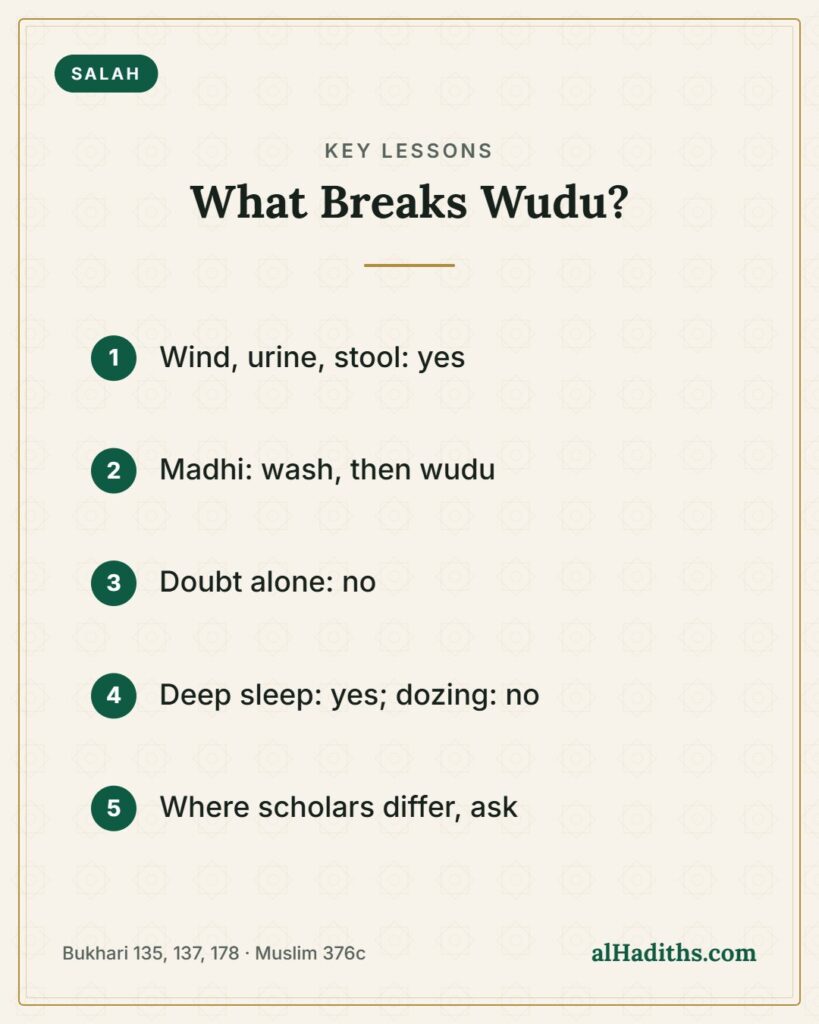
Key lessons
- Wind, urine, stool and madhi break wudu; all scholars agree.
- Certainty is not removed by doubt.
- Deep sleep breaks wudu; light dozing does not.
- On camel meat and touching, the hadith point two ways, and the madhhabs differ.
- Follow your madhhab and ask a qualified scholar.
May Allah make us among those who purify themselves, free our salah from needless doubts, and accept it from us.
Save this to Pinterest so you can check what breaks wudu before your next salah.
Share the reward. Send this article to someone who needs it today — teaching a hadith or dua can become a lasting good deed for you, in shaa Allah.