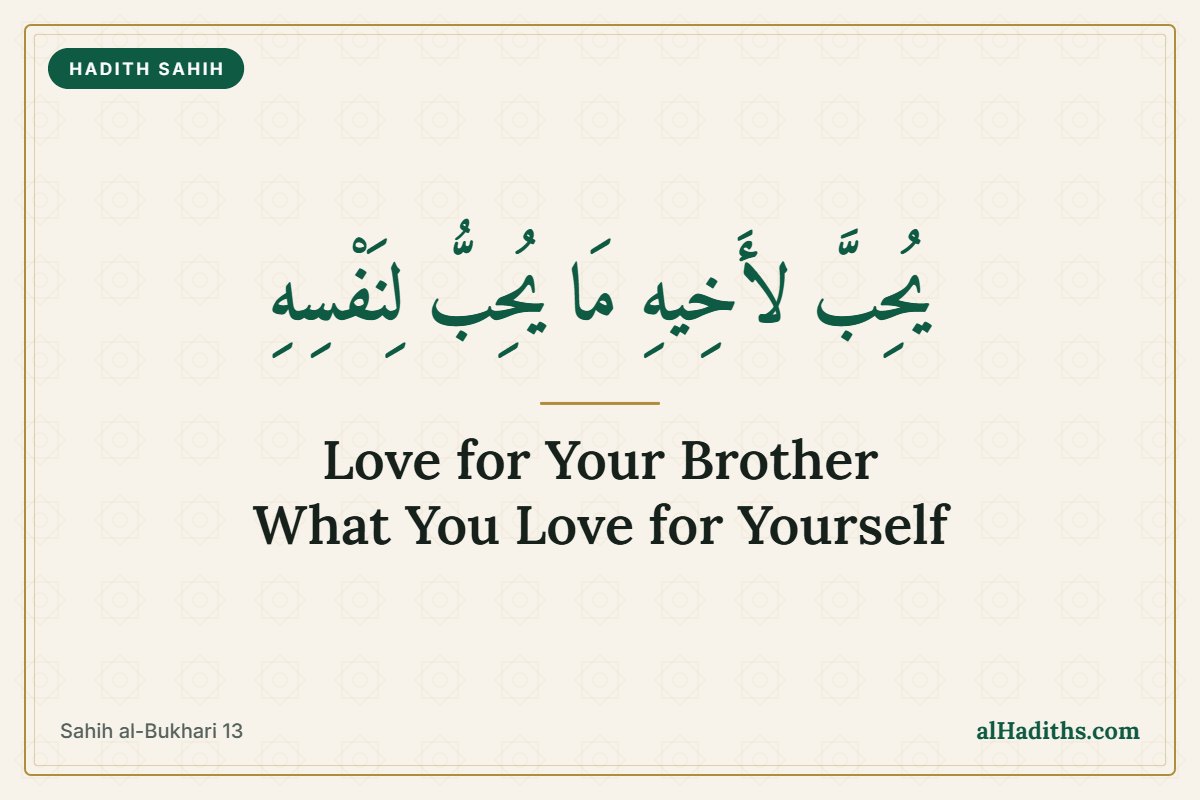
Love for Your Brother What You Love for Yourself: Hadith 13
It is one of the shortest hadiths in Imam an-Nawawi’s collection, and one of the hardest to live by. The Prophet ﷺ said that none of us truly believes until we want for others the good we want for ourselves. Put simply: love for your brother what you love for yourself. Here is the hadith, its wording in Bukhari, Muslim and an-Nasa’i, what it means, and simple ways to practice it.
At a glance
- Source: Sahih al-Bukhari 13 and Sahih Muslim 45 (Hadith 13 of an-Nawawi’s 40)
- Narrated by: Anas ibn Malik (may Allah be pleased with him), who served the Messenger of Allah ﷺ
- Grade: Sahih (recorded by both al-Bukhari and Muslim)
- Topic: Complete faith, brotherhood and wanting good for others
- Put it into practice: Make dua today for someone to receive a good you want for yourself
The hadith
Anas ibn Malik (may Allah be pleased with him), who served the Messenger of Allah ﷺ, reported that the Prophet ﷺ said:
لا يُؤْمِنُ أَحَدُكُمْ حَتَّى يُحِبَّ لأَخِيهِ مَا يُحِبُّ لِنَفْسِهِ
“None of you will have faith till he wishes for his (Muslim) brother what he likes for himself.”
Sahih al-Bukhari 13 · Narrated by Anas ibn Malik · Translation from Sunnah.com
Muslim recorded it too (Sahih Muslim 45a), and Imam an-Nawawi placed it as Hadith 13 of his 40 Hadith, where the Sunnah.com translation reads: “None of you [truly] believes until he loves for his brother that which he loves for himself.”
Brother or neighbor? Two other wordings
In one of Muslim’s narrations, the narrator was unsure whether the Prophet ﷺ said “his brother” or “his neighbor”:
لاَ يُؤْمِنُ أَحَدُكُمْ حَتَّى يُحِبَّ لأَخِيهِ – أَوْ قَالَ لِجَارِهِ – مَا يُحِبُّ لِنَفْسِهِ
“None amongst you believes (truly) until he loves for his brother” – or he said “for his neighbour” – “that which he loves for himself.”
Sahih Muslim 45a · Narrated by Anas ibn Malik · Translation from Sunnah.com
An-Nasa’i recorded a narration that ends with two extra words, min al-khayr, “of goodness”:
لَا يُؤْمِنُ أَحَدُكُمْ حَتَّى يُحِبَّ لِأَخِيهِ مَا يُحِبُّ لِنَفْسِهِ مِنْ الْخَيْرِ
“None of you has believed until he loves for his brother what he loves for himself of goodness.”
Sunan an-Nasa’i 5017 · Narrated by Anas ibn Malik · Grade: Sahih (Darussalam) · Translation adapted from Sunnah.com
Those two words make the meaning clear. The hadith is about goodness: wanting the good that we hope for to reach other people as well.
What it means to love for your brother what you love for yourself
The Encyclopedia of Translated Prophetic Hadiths (HadeethEnc) explains that a Muslim does not reach complete iman until he loves for his brother the acts of worship and kinds of good he loves for himself, in religion and in worldly life, and dislikes for him what he dislikes for himself. If he sees a shortcoming in his brother’s religion, he tries to help him put it right. If he sees good in him, he supports it and gives him sincere advice.
Among the benefits it lists:
- The hadith ties this love directly to faith, which shows how much it matters.
- Brotherhood for the sake of Allah is a strong bond, and it has rights that deserve to be fulfilled.
- Anything that goes against this love is forbidden, such as cheating, backbiting, envy, and harming a Muslim’s life, property or honor.
- Al-Kirmani said that loving good for your brother also means disliking harm for him, just as you dislike it for yourself.
Faith, love and spreading salam
Another hadith links faith and love in the same way. In Sahih Muslim 54a, the Prophet ﷺ told us that we will not truly believe until we love one another, and pointed to a simple way to build that love: spreading the greeting of salam. We look at it in Giving Salam in Islam.
Reflection: this hadith is easy to agree with and hard to practice. The real test usually comes when someone else receives the very thing we were hoping for: the job, the good result, the answered dua. In that moment, the hadith asks for more than staying quiet. It asks us to be glad for them, and to keep wanting good for them as we want it for ourselves.
How to put it into practice
The hadith does not give a routine, so these are suggestions:
- Make dua for others by name, asking Allah for them the same good you ask for yourself.
- Share what benefits you: a useful lesson, a good opportunity, a piece of knowledge.
- Advise gently, the way you would want to be advised. See the hadith of nasihah.
- Notice envy early. When someone receives a blessing you wanted, ask Allah to bless it for them, and ask Him for good for yourself too.
- Treat people as you want to be treated when you buy, sell, speak, and talk about them when they are not there.
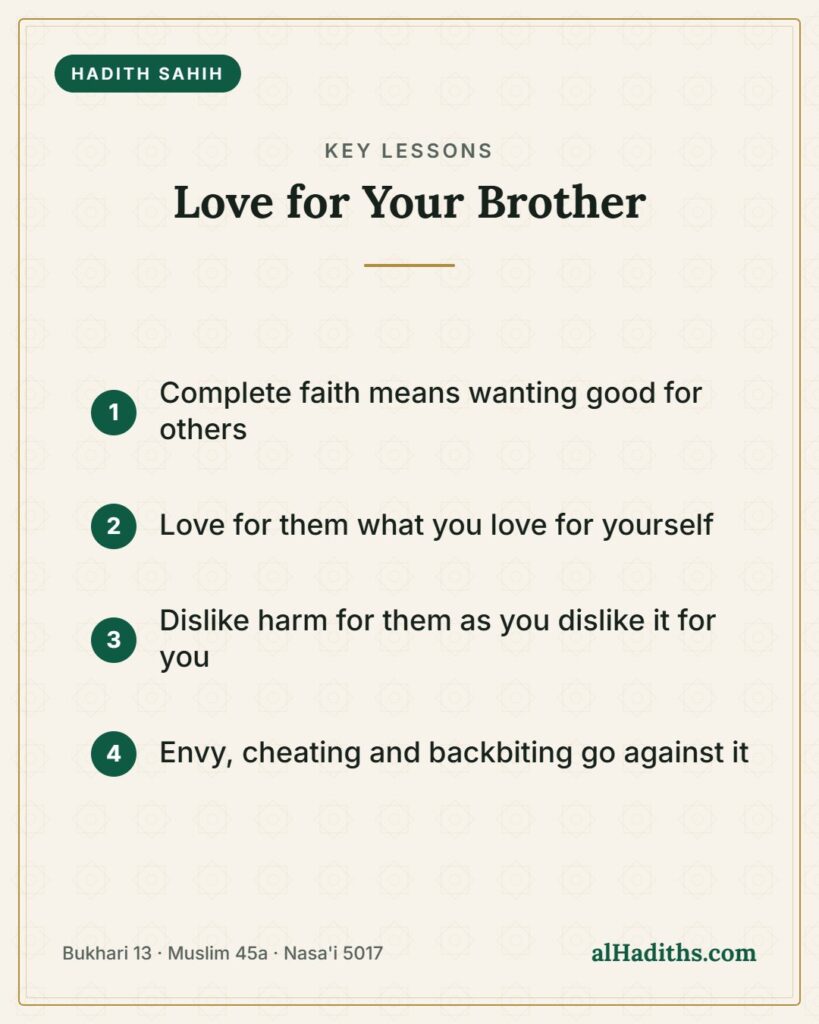
Key lessons
- Complete faith includes loving for others the good we love for ourselves.
- One narration in Muslim mentions the neighbor, and an-Nasa’i’s narration adds “of goodness”.
- Wanting good for others also means disliking harm for them.
- Envy, cheating and backbiting go against this love.
Questions people ask
What does “love for your brother what you love for yourself” mean?
It means wanting for other Muslims the good you want for yourself, in religion and in worldly life, and disliking for them what you dislike for yourself (Encyclopedia of Translated Prophetic Hadiths (HadeethEnc)).
Is the hadith “none of you truly believes” authentic?
Yes. It is narrated by Anas ibn Malik and recorded by both al-Bukhari (Sahih al-Bukhari 13) and Muslim (Sahih Muslim 45a). It is Hadith 13 of an-Nawawi’s 40.
Does “none of you believes” mean a person is not a Muslim?
HadeethEnc explains it as referring to complete faith: a Muslim does not reach the full level of iman until he loves for his brother what he loves for himself (Encyclopedia of Translated Prophetic Hadiths (HadeethEnc)). For questions about your own situation, ask a qualified scholar.
Before you close this page, think of one person whose good news would be hard for you to celebrate. Make dua for them today, asking Allah for the same good you want for yourself. That small dua can be a first step toward the faith this hadith describes.
Save this to Pinterest so you can come back to this hadith.
Share the reward. Send this article to someone who needs it today — teaching a hadith or dua can become a lasting good deed for you, in shaa Allah.