Dua for Rizq: 4 Authentic Duas for Provision and Barakah
Contents
Bills arrive faster than the salary, a job search drags on, or a business has a slow month. Many of us then search for a dua for rizq, hoping for one powerful phrase. The Sunnah gives us something better: short duas the Prophet ﷺ said himself every day, and a reminder that our provision is already written and will reach us.
This article brings together four authentic duas for rizq and barakah, two hadith about what widens provision, and one verse of the Quran. Each has its Arabic from Sunnah.com or Quran.com and its grade. It is what the Prophet ﷺ taught, not financial advice.
At a glance
- Duas: 4 authentic duas + 2 hadith + 1 Quran verse
- Collections: Sunan Ibn Majah, Jami‘ at-Tirmidhi, Sahih Muslim, Sahih al-Bukhari
- Grade: Sahih or Hasan (graders named on each card)
- Topic: Rizq (provision), debt and barakah
- Do it today: After Fajr, say “rizqan tayyiban” in the dua of hadith 1
1. The morning dua for rizq after Fajr
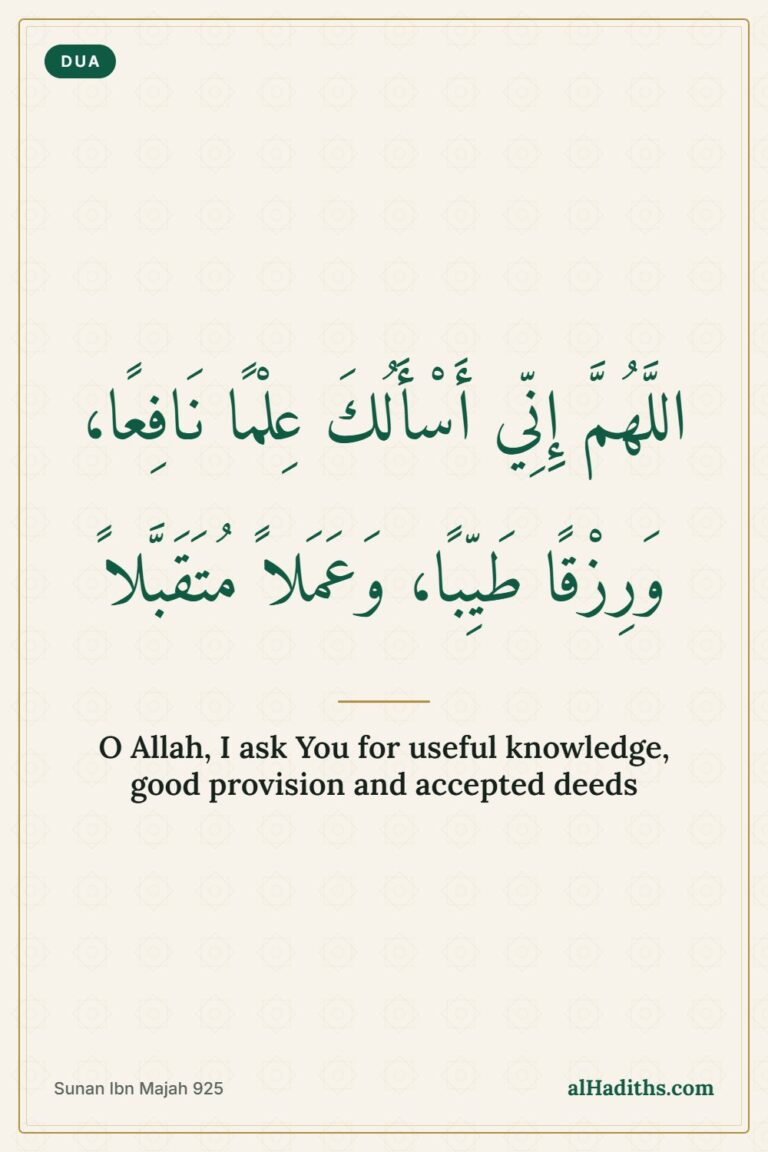
Umm Salamah (may Allah be pleased with her) said that when the Prophet ﷺ prayed Fajr, as he said the salam, he would say:
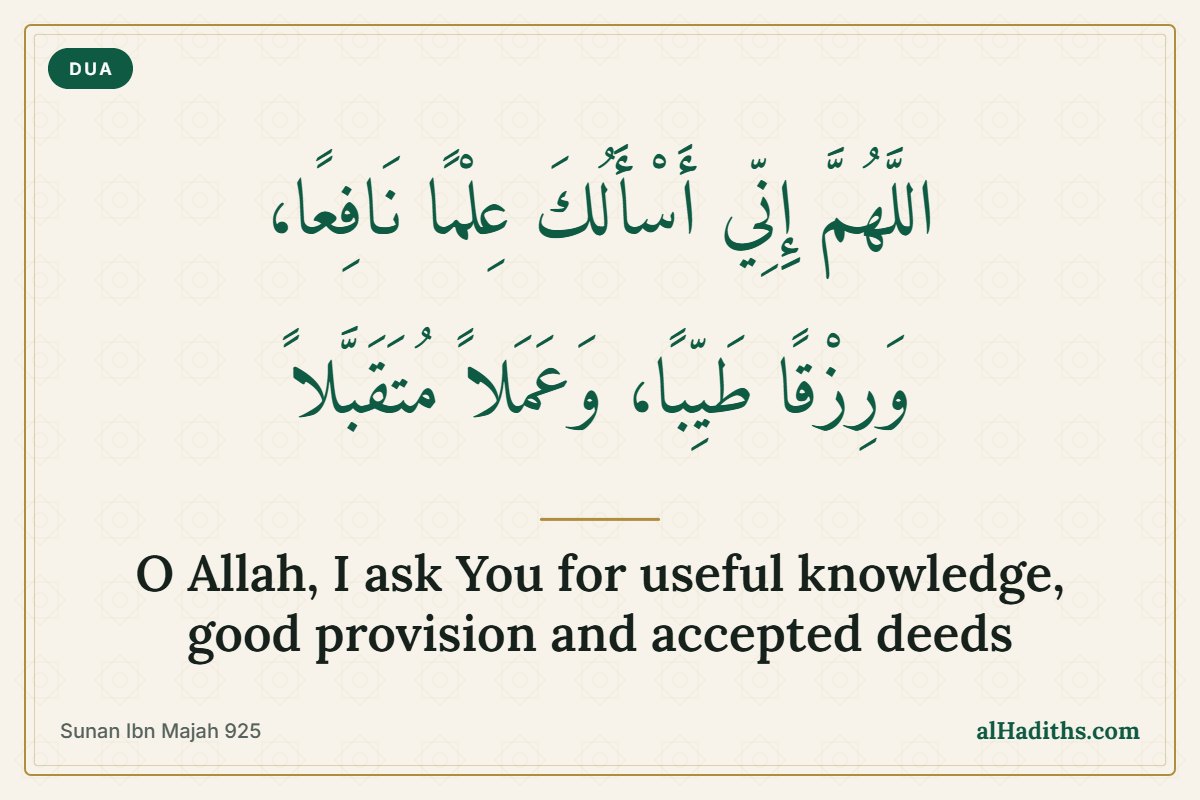
اللَّهُمَّ إِنِّي أَسْأَلُكَ عِلْمًا نَافِعًا، وَرِزْقًا طَيِّبًا، وَعَمَلاً مُتَقَبَّلاً
Allahumma inni as’aluka ‘ilman nafi‘an, wa rizqan tayyiban, wa ‘amalan mutaqabbalan.
“O Allah, I ask You for beneficial knowledge, good provision and accepted deeds.”
Sunan Ibn Majah 925 · Sahih (Darussalam) · Narrated by Umm Salamah · Translation adapted from Sunnah.com
This is the most practical dua for rizq to make a daily habit, because the Prophet ﷺ said it at a fixed time: right after Fajr. Notice the word tayyib: he did not ask simply for a lot of provision, but for good, pure and lawful provision. We also cover this dua for students in our dua for exam.
Try this: say this dua every morning this week straight after the Fajr salam, before you pick up your phone.
2. “Make the halal enough for me”
Ali ibn Abi Talib (may Allah be pleased with him) was asked for help by a man who could not pay what he owed for his freedom. Ali said he would teach him words the Prophet ﷺ had taught him, so that even with a debt like a mountain, Allah would settle it for him. He said:
اللَّهُمَّ اكْفِنِي بِحَلاَلِكَ عَنْ حَرَامِكَ وَأَغْنِنِي بِفَضْلِكَ عَمَّنْ سِوَاكَ
Allahummakfini bi halalika ‘an haramik, wa aghnini bi fadlika ‘amman siwak.
“O Allah, suffice me with what You have made lawful instead of what You have made unlawful, and make me independent, by Your bounty, of all besides You.”
Jami‘ at-Tirmidhi 3563 · Hasan (Darussalam) · Narrated by Ali ibn Abi Talib · Translation adapted from Sunnah.com
This dua asks for two kinds of rizq: enough halal that we never need the haram, and enough of Allah’s bounty that we never have to depend on people. For more on debt, see our dua for debt.
Try this: if you are under financial pressure, memorize this one first. It is short enough to repeat many times a day.
3. The bedtime dua: “settle our debt and free us from poverty”
Abu Salih used to teach that before sleeping one should lie on the right side and say the following dua, which he narrated from Abu Hurayrah (may Allah be pleased with him) from the Prophet ﷺ:
اللَّهُمَّ رَبَّ السَّمَوَاتِ وَرَبَّ الأَرْضِ وَرَبَّ الْعَرْشِ الْعَظِيمِ رَبَّنَا وَرَبَّ كُلِّ شَىْءٍ فَالِقَ الْحَبِّ وَالنَّوَى وَمُنْزِلَ التَّوْرَاةِ وَالإِنْجِيلِ وَالْفُرْقَانِ أَعُوذُ بِكَ مِنْ شَرِّ كُلِّ شَىْءٍ أَنْتَ آخِذٌ بِنَاصِيَتِهِ اللَّهُمَّ أَنْتَ الأَوَّلُ فَلَيْسَ قَبْلَكَ شَىْءٌ وَأَنْتَ الآخِرُ فَلَيْسَ بَعْدَكَ شَىْءٌ وَأَنْتَ الظَّاهِرُ فَلَيْسَ فَوْقَكَ شَىْءٌ وَأَنْتَ الْبَاطِنُ فَلَيْسَ دُونَكَ شَىْءٌ اقْضِ عَنَّا الدَّيْنَ وَأَغْنِنَا مِنَ الْفَقْرِ
“O Allah, Lord of the heavens, Lord of the earth and Lord of the Mighty Throne, our Lord and Lord of everything, Splitter of the grain and the date-stone, Revealer of the Torah, the Injil and the Furqan: I seek refuge in You from the evil of everything whose forelock You hold. O Allah, You are the First, there is nothing before You; You are the Last, there is nothing after You; You are the Manifest, there is nothing above You; You are the Hidden, there is nothing beneath You. Settle our debt for us and free us from poverty.”
Sahih Muslim 2713a · Narrated by Abu Hurayrah · Translation adapted from Sunnah.com
The dua spends almost all its words praising Allah, and only at the very end asks for two things: “settle our debt” (iqdi ‘annad-dayn) and “free us from poverty” (wa aghnina minal-faqr). It teaches a beautiful manner of asking: first recognize who you are asking.
Try this: if the whole dua is too long for now, start with its last line and add one more line each week.
4. Asking for self-sufficiency
Abdullah ibn Mas‘ud (may Allah be pleased with him) reported that the Prophet ﷺ used to say:
اللَّهُمَّ إِنِّي أَسْأَلُكَ الْهُدَى وَالتُّقَى وَالْعَفَافَ وَالْغِنَى
Allahumma inni as’alukal-huda wat-tuqa wal-‘afafa wal-ghina.
“O Allah, I ask You for guidance, piety, chastity and self-sufficiency.”
Sahih Muslim 2721 · Narrated by Abdullah ibn Mas‘ud · Translation adapted from Sunnah.com
Al-ghina is being free of need: having enough, and a heart that does not depend on people. It sits next to guidance and piety, a reminder that wealth is a blessing only when it comes with them. We explain this dua in full in our dua for guidance.
Try this: say it in sujud during your next sunnah prayer.
5. A deed that widens rizq: keeping family ties
Anas ibn Malik (may Allah be pleased with him) said he heard the Prophet ﷺ say:
مَنْ سَرَّهُ أَنْ يُبْسَطَ لَهُ رِزْقُهُ أَوْ يُنْسَأَ لَهُ فِي أَثَرِهِ فَلْيَصِلْ رَحِمَهُ
“Whoever would be pleased to have his provision expanded and his life extended, let him keep the ties of kinship.”
Sahih al-Bukhari 2067 · Narrated by Anas ibn Malik · Translation adapted from Sunnah.com
This is not a dua but a deed, and it is one of the clearest promises about rizq in the Sunnah. Visiting, calling and helping relatives is an act of worship that Allah links directly to wider provision.
Try this: this week, call or visit one relative you have drifted away from.
6. Your rizq will reach you: seek it in a good way
Jabir ibn Abdullah (may Allah be pleased with him) reported that the Prophet ﷺ said:
أَيُّهَا النَّاسُ اتَّقُوا اللَّهَ وَأَجْمِلُوا فِي الطَّلَبِ فَإِنَّ نَفْسًا لَنْ تَمُوتَ حَتَّى تَسْتَوْفِيَ رِزْقَهَا وَإِنْ أَبْطَأَ عَنْهَا فَاتَّقُوا اللَّهَ وَأَجْمِلُوا فِي الطَّلَبِ خُذُوا مَا حَلَّ وَدَعُوا مَا حَرُمَ
“O people, fear Allah and be moderate in seeking (provision), for no soul will die until it has received all of its provision, even if it is slow in coming. So fear Allah and be moderate in seeking: take what is lawful and leave what is unlawful.”
Sunan Ibn Majah 2144 · Sahih (Darussalam) · Narrated by Jabir ibn Abdullah · Translation adapted from Sunnah.com
This hadith takes away panic. Your provision is written and will not pass to anyone else, so there is no need to chase it through haram or to burn yourself out. It does not tell us to stop working; it tells us to work calmly and cleanly. Trust in Allah and effort go together, as in the hadith “tie your camel”.
Try this: if a deal or income source makes you uneasy, remember “take what is lawful and leave what is unlawful”, and ask a scholar before you go ahead.
Bringing it together: a dua for rizq and trust in Allah
The Quran joins these two ideas, taqwa and provision. The verse before this one ends: “And whoever fears Allāh – He will make for him a way out” (65:2). Then Allah says:
وَيَرْزُقْهُ مِنْ حَيْثُ لَا يَحْتَسِبُ ۚ وَمَن يَتَوَكَّلْ عَلَى ٱللَّهِ فَهُوَ حَسْبُهُۥٓ ۚ إِنَّ ٱللَّهَ بَـٰلِغُ أَمْرِهِۦ ۚ قَدْ جَعَلَ ٱللَّهُ لِكُلِّ شَىْءٍ قَدْرًا
“And will provide for him from where he does not expect. And whoever relies upon Allāh – then He is sufficient for him. Indeed, Allāh will accomplish His purpose. Allāh has already set for everything a [decreed] extent.”
Surah At-Talaq 65:3 · Translation: Saheeh International, from Quran.com
Reflection: the duas above rarely ask simply for “more”. They ask for good provision, halal that is enough, freedom from debt and independence from people. Barakah is in that kind of rizq: less worry, cleaner money and a heart that knows where provision really comes from.
Questions people ask
Does istighfar increase rizq?
A popular narration says that whoever keeps seeking forgiveness will be given a way out of every difficulty and provided for from where he does not expect (Sunan Abi Dawud 1518), but it is graded Da‘if (al-Albani), so we have not used it. The Quran does link seeking forgiveness with rain, wealth and children in Surah Nuh 71:10–12.
Is there a dua for a job?
There is no special authentic dua only for finding a job. You can say the duas above, especially “rizqan tayyiban” after Fajr, and ask Allah in your own words for a good, halal job. Asking in your own words is our suggestion, not a wording from the hadith.
What is the best time to make dua for rizq?
The hadith give one fixed time: after the Fajr salam (Ibn Majah 925). The bedtime dua in Sahih Muslim 2713a is another. Beyond that, any time of dua is good, such as in sujud.
Key lessons
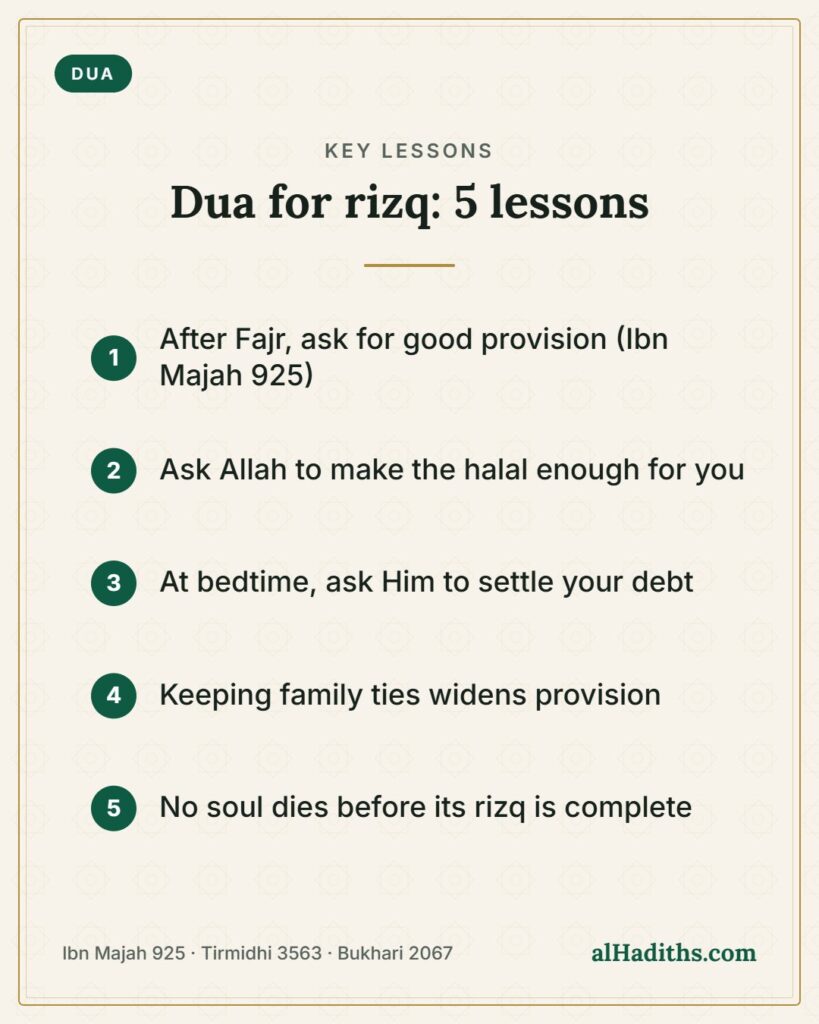
- After Fajr, ask for “rizqan tayyiban”, good and pure provision (Ibn Majah 925).
- Ask Allah to make the halal enough for you and to free you from depending on people (Tirmidhi 3563).
- Before sleeping, ask Him to settle your debt and free you from poverty (Muslim 2713a).
- Keeping family ties widens provision (Bukhari 2067).
- No soul dies before its provision is complete, so seek it in a lawful way (Ibn Majah 2144).
Part of our Dua series: see all our dua articles in one place.
May Allah give you provision that is good, lawful and blessed, and a heart that is content with it.
Save this to Pinterest so you have these duas for rizq ready every morning.
Share the reward. Send this article to someone who needs it today — teaching a hadith or dua can become a lasting good deed for you, in shaa Allah.