Dua When Waking Up: 3 Authentic Duas From the Sunnah
Contents
Before the phone, before the news, before the to-do list: what should the first words of the day be? The Prophet ﷺ answered that question every morning. This guide gives the dua when waking up that he said, two more authentic duas for waking, including one for waking in the night, and a short hadith that shows why those first words matter.
At a glance
- Count: 3 duas and 1 supporting hadith
- Collections: Sahih al-Bukhari, Jami‘ at-Tirmidhi
- Grade: Sahih (al-Bukhari); Sahih (Darussalam) for Tirmidhi 3401
- Topic: What to say when you wake up, by day or at night
- One thing today: Say “Al-hamdu lillah” before you reach for your phone tomorrow
1. The dua when waking up from sleep
Hudhayfah ibn al-Yaman (may Allah be pleased with him) described what the Prophet ﷺ said at both ends of the night. At bedtime he said “Bismika amutu wa ahya”, and when he got up he said:
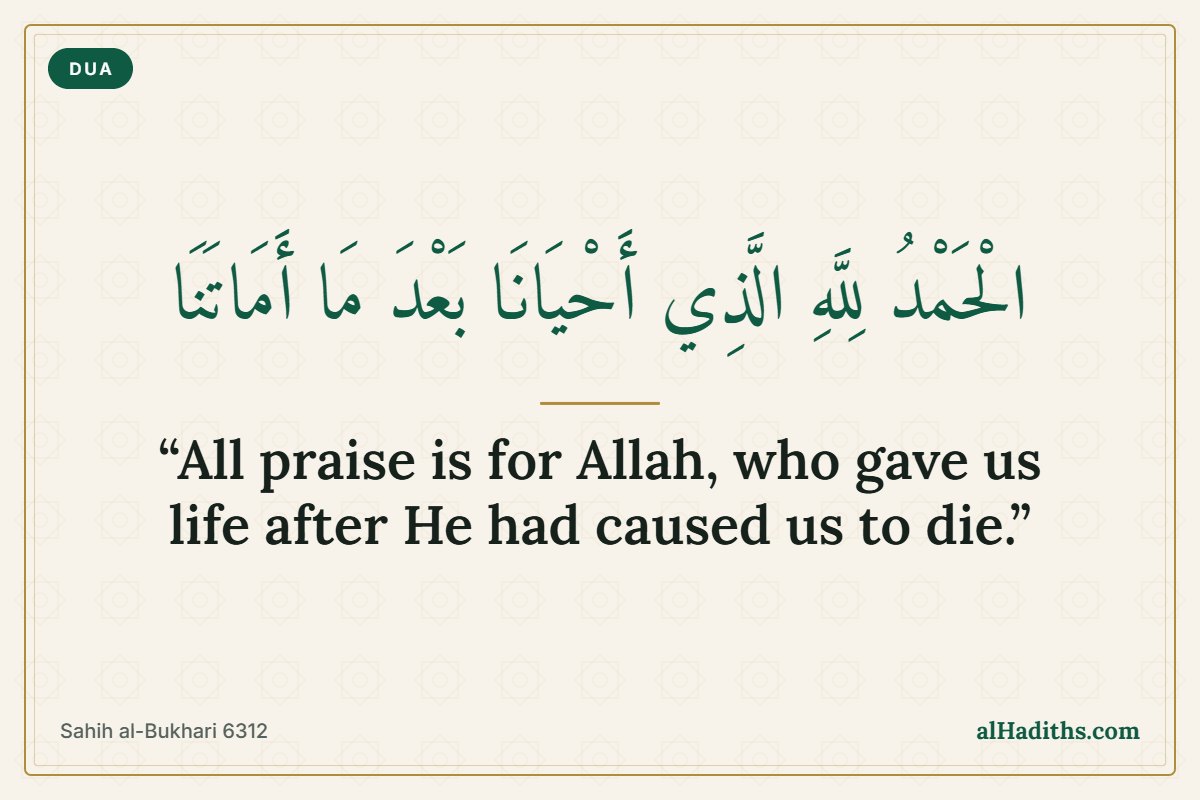
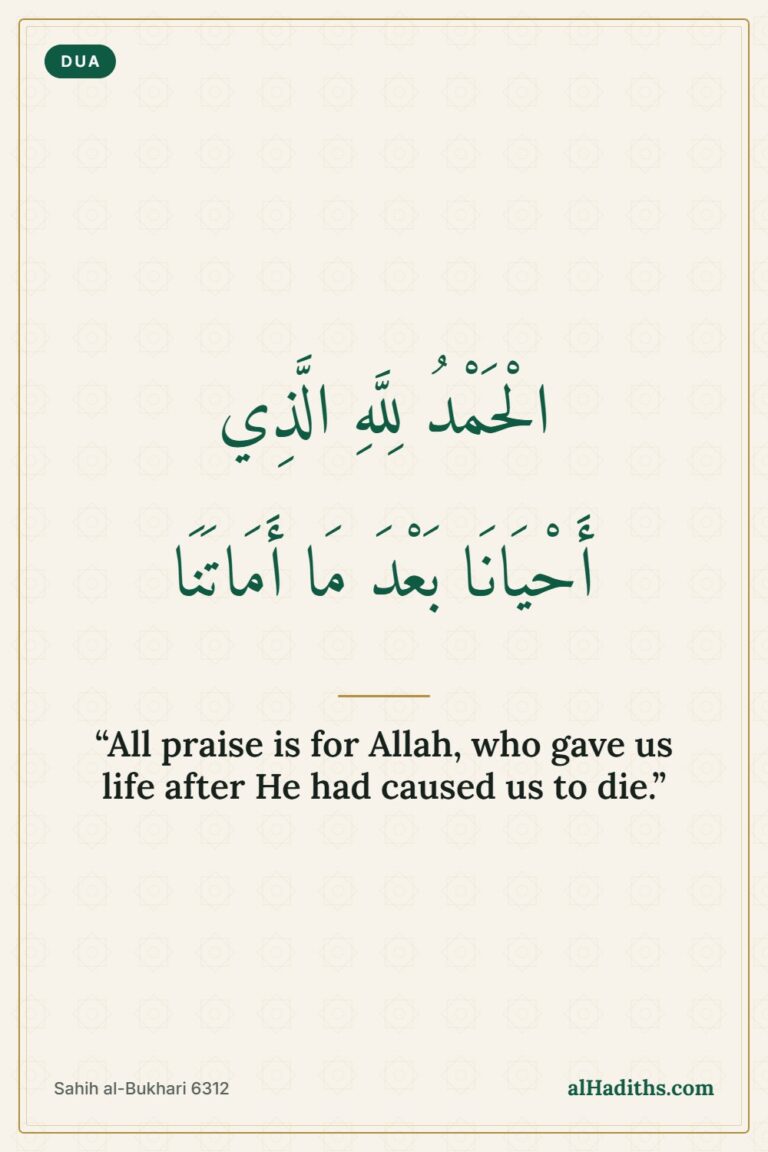
الْحَمْدُ لِلَّهِ الَّذِي أَحْيَانَا بَعْدَ مَا أَمَاتَنَا وَإِلَيْهِ النُّشُورُ
Al-hamdu lillahil-ladhi ahyana ba‘da ma amatana, wa ilayhin-nushur
“All praise is for Allah, who gave us life after He had caused us to die, and to Him is the resurrection.”
Bukhari 6312 · Narrated by Hudhayfah · Translation adapted from Sunnah.com
This is the main dua for waking up, short enough to learn in a minute. It calls sleep a kind of death and waking a return to life, and it ends with a reminder of the final waking: the resurrection. We cover the bedtime half of this hadith in our dua for sleeping guide.
Try this: put a small note by your bed or on your phone’s lock screen with “Al-hamdu lillahil-ladhi ahyana” until the words come by themselves.
2. Thanking Allah for your body and your soul
Abu Hurayrah (may Allah be pleased with him) narrated a longer bedtime teaching from the Prophet ﷺ, which ends with what to say on waking:
فَإِذَا اسْتَيْقَظَ فَلْيَقُلِ الْحَمْدُ لِلَّهِ الَّذِي عَافَانِي فِي جَسَدِي وَرَدَّ عَلَىَّ رُوحِي وَأَذِنَ لِي بِذِكْرِهِ
“And when he wakes up, let him say: ‘All praise is due to Allah, who healed me in my body, returned my soul to me, and permitted me to remember Him.’”
Tirmidhi 3401 · Sahih (Darussalam) · Narrated by Abu Hurayrah · Translation adapted from Sunnah.com
Transliteration: Al-hamdu lillahil-ladhi ‘afani fi jasadi, wa radda ‘alayya ruhi, wa adhina li bidhikrih. It thanks Allah for three things we usually take for granted: a body that works, a soul returned, and the chance to remember Him one more day. Both this dua and the first one are authentic, so you can say either, or both.
Try this: on a morning when you wake up tired or unwell, say this dua slowly and notice what is still working, rather than what aches.
3. Waking up at night: the dua that is answered
‘Ubadah ibn as-Samit (may Allah be pleased with him) narrated that the Prophet ﷺ said:
مَنْ تَعَارَّ مِنَ اللَّيْلِ فَقَالَ لاَ إِلَهَ إِلاَّ اللَّهُ وَحْدَهُ لاَ شَرِيكَ لَهُ، لَهُ الْمُلْكُ، وَلَهُ الْحَمْدُ، وَهُوَ عَلَى كُلِّ شَىْءٍ قَدِيرٌ. الْحَمْدُ لِلَّهِ، وَسُبْحَانَ اللَّهِ، وَلاَ إِلَهَ إِلاَّ اللَّهُ، وَاللَّهُ أَكْبَرُ، وَلاَ حَوْلَ وَلاَ قُوَّةَ إِلاَّ بِاللَّهِ. ثُمَّ قَالَ اللَّهُمَّ اغْفِرْ لِي. أَوْ دَعَا اسْتُجِيبَ، فَإِنْ تَوَضَّأَ وَصَلَّى قُبِلَتْ صَلاَتُهُ
“Whoever wakes up at night and says: ‘None has the right to be worshipped but Allah alone, without partner. His is the dominion and His is all praise, and He is able to do all things. All praise is for Allah, glory be to Allah, none has the right to be worshipped but Allah, Allah is the Greatest, and there is no might and no power except with Allah,’ and then says, ‘O Allah, forgive me,’ or makes any dua, he will be answered. And if he performs wudu and prays, his prayer will be accepted.”
Bukhari 1154 · Narrated by ‘Ubadah ibn as-Samit · Translation adapted from Sunnah.com
Transliteration of the dhikr: La ilaha illallahu wahdahu la sharika lah, lahul-mulku wa lahul-hamd, wa huwa ‘ala kulli shay’in qadir. Al-hamdu lillah, wa subhanallah, wa la ilaha illallah, wallahu akbar, wa la hawla wa la quwwata illa billah. This is for the moments we wake in the night without meaning to. The hadith turns that broken sleep into a chance: say these words, then ask Allah for what you need.
Try this: the next time you wake at night, before turning over, say the dhikr, then “Allahummaghfir li” and one thing you want from Allah. If you can, make wudu and pray two rak‘ahs, as in our Tahajjud hadith guide.
4. Why the first words matter: the three knots
Abu Hurayrah (may Allah be pleased with him) narrated that the Messenger of Allah ﷺ said:
يَعْقِدُ الشَّيْطَانُ عَلَى قَافِيَةِ رَأْسِ أَحَدِكُمْ إِذَا هُوَ نَامَ ثَلاَثَ عُقَدٍ، يَضْرِبُ كُلَّ عُقْدَةٍ مَكَانَهَا عَلَيْكَ لَيْلٌ طَوِيلٌ فَارْقُدْ. فَإِنِ اسْتَيْقَظَ فَذَكَرَ اللَّهَ انْحَلَّتْ عُقْدَةٌ، فَإِنْ تَوَضَّأَ انْحَلَّتْ عُقْدَةٌ، فَإِنْ صَلَّى انْحَلَّتْ عُقَدُهُ كُلُّهَا، فَأَصْبَحَ نَشِيطًا طَيِّبَ النَّفْسِ، وَإِلاَّ أَصْبَحَ خَبِيثَ النَّفْسِ كَسْلاَنَ
“Satan ties three knots at the back of the head of any of you when he sleeps, striking each knot with the words: ‘You have a long night, so sleep.’ If he wakes up and remembers Allah, one knot is undone; if he performs wudu, another knot is undone; and if he prays, all his knots are undone, and he begins the morning lively and in good spirits. Otherwise he begins the morning in low spirits and lazy.”
Bukhari 3269 · Narrated by Abu Hurayrah · Translation adapted from Sunnah.com
The hadith links the first moments of the day to how the rest of it feels. Remembering Allah on waking, which the duas above do, is the first step; wudu and salah finish the job.
Try this: keep the order of the hadith for one week: dua on waking, wudu straight after, then Fajr, and see how your mornings change.
Bringing it together
Each of these duas begins with praise. None of them asks for anything first; they simply thank Allah for being alive. Only the night dua goes on to ask, and even there the asking comes after the praise.
Reflection: Every morning is a small resurrection. We did nothing to earn it: we were asleep, unaware, unable to guard ourselves, and Allah gave our souls back. Saying “Al-hamdu lillah” first is simply recognising what happened. If we can make it a habit with the smallest waking of every day, it becomes easier to believe in the great waking these duas point to.
Questions people ask
What is the dua when waking up in English?
The main one means: “All praise is for Allah, who gave us life after He had caused us to die, and to Him is the resurrection” (Bukhari 6312). Another means: “All praise is due to Allah, who healed me in my body, returned my soul to me, and permitted me to remember Him” (Tirmidhi 3401, Sahih). It is best to learn the Arabic words, and understand the meaning so the dua comes from the heart.
What is the dua when waking up at night?
The Prophet ﷺ taught that whoever wakes at night and says “La ilaha illallahu wahdahu la sharika lah…” (the full dhikr is above), then asks for forgiveness or makes a dua, will be answered, and if he makes wudu and prays, his prayer is accepted (Bukhari 1154).
Is “La ilaha illa anta, subhanakallahumma…” an authentic dua on waking?
A narration in Abu Dawud 5061 says the Prophet ﷺ said this when he woke at night. Sunnah.com lists it as graded Da‘if (al-Albani), so we have not used it here. The authentic duas above are enough.
Key lessons
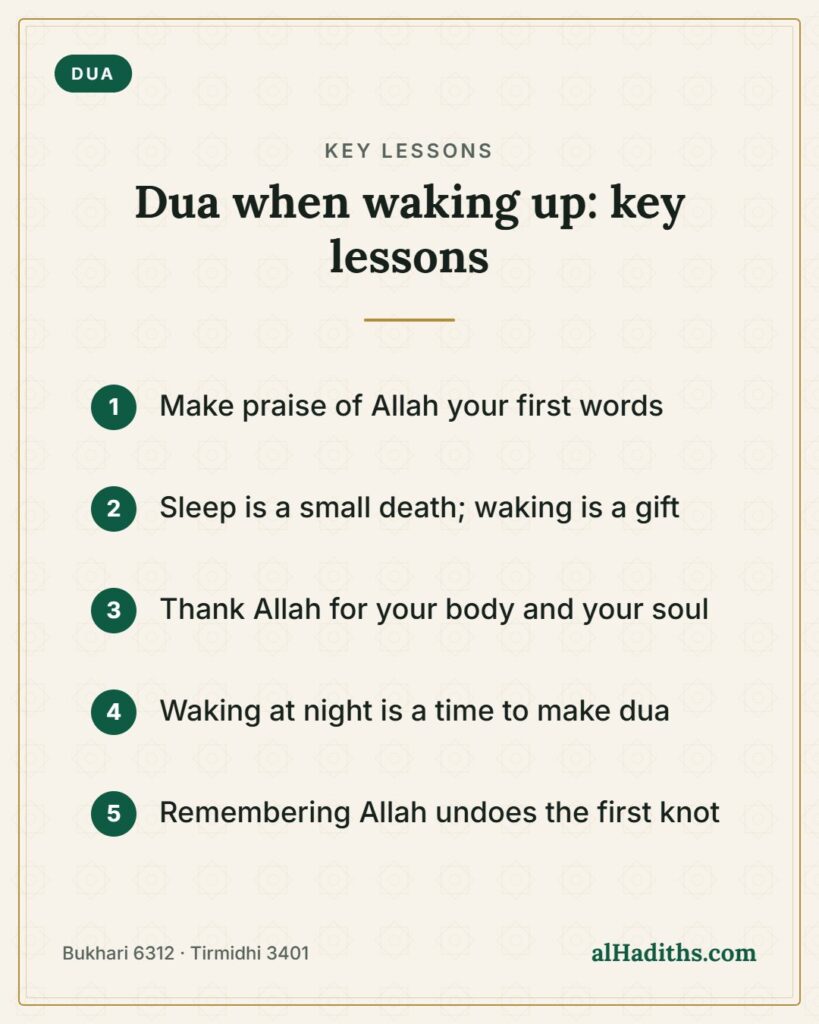
- The Prophet ﷺ began each day with praise of Allah (Bukhari 6312).
- Waking is a gift: a body healed, a soul returned, a chance to remember Allah (Tirmidhi 3401).
- Waking in the night is a moment when dua is answered (Bukhari 1154).
- Remembering Allah, wudu and salah undo Satan’s three knots (Bukhari 3269).
Part of our Dua series: see all our dua articles in one place.
Tomorrow morning, which will you say first: the phone’s notifications, or “Al-hamdu lillah”?
Save this to Pinterest so you can learn the dua when waking up and say it tomorrow morning.
Share the reward. Send this article to someone who needs it today — teaching a hadith or dua can become a lasting good deed for you, in shaa Allah.