Dua for Rain: 5 Authentic Duas When It Rains and After
Contents
Dark clouds roll in, the first drops hit the window, and most of us reach for a weather app. The Prophet ﷺ reached for a dua for rain: two short words asking that the rain be a benefit, not a harm. Here are that dua and four more from the Sunnah, for heavy rain, for after the rain and for a drought, with the Arabic, the meaning and the source.
At a glance
- Source: Sahih al-Bukhari 1032 (also Sunan an-Nasa’i 1523)
- Narrated by: Aisha
- Grade: Sahih (Bukhari)
- Topic: Rain, seeking Allah’s mercy
- Practise it: Say “Sayyiban nafi‘a” when the rain starts
The dua for rain: what the Prophet ﷺ said when it rained
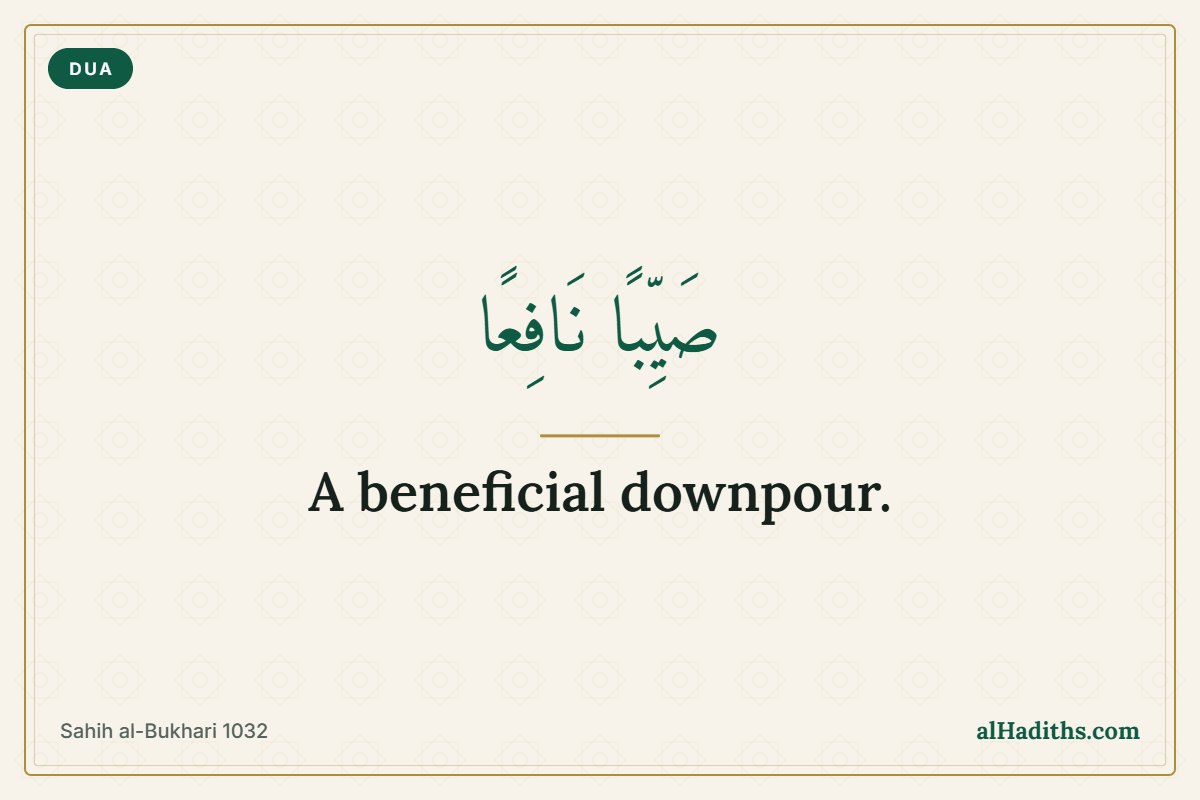
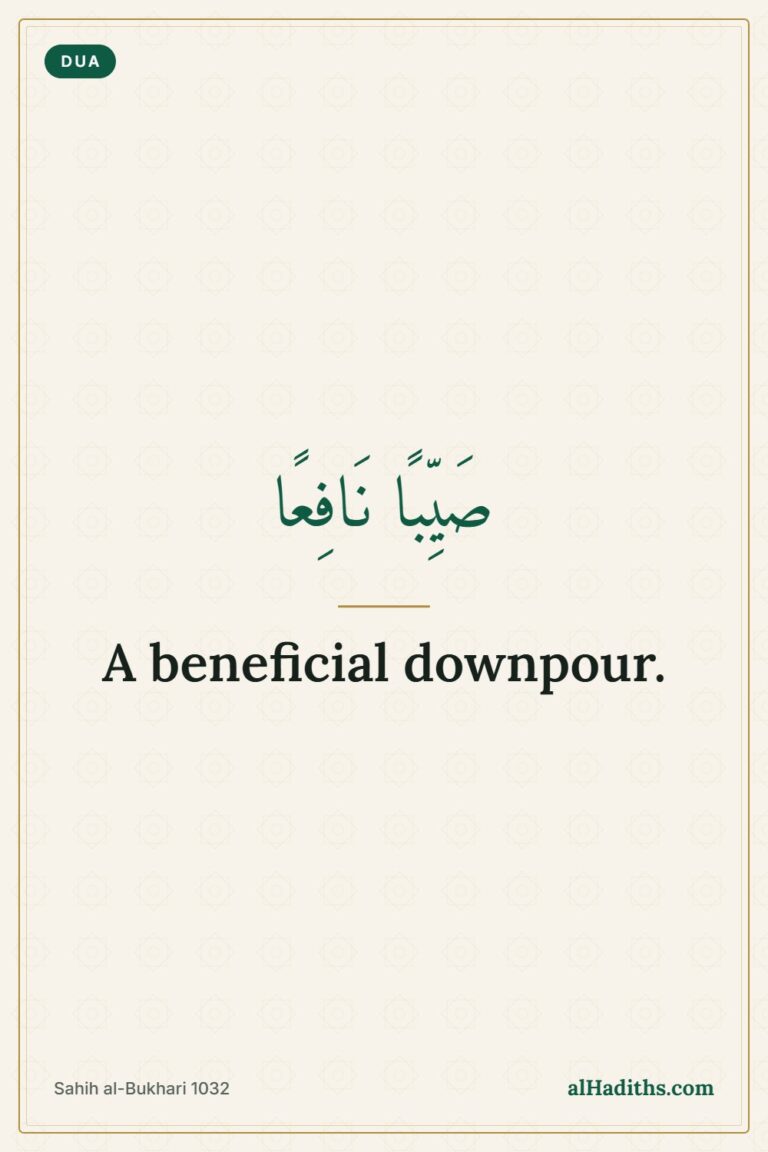
Aisha (may Allah be pleased with her) said that whenever the Messenger of Allah ﷺ saw rain, he would say:
صَيِّبًا نَافِعًا
Sayyiban nafi‘a.
“(O Allah, make it) a beneficial downpour.”
Sahih al-Bukhari 1032 · Narrated by Aisha · Translation adapted from Sunnah.com
In Bukhari’s Arabic the dua is only these two words; the English on Sunnah.com adds “O Allah” to make the sense clear. The fuller wording, which begins with Allahumma, is in Sunan an-Nasa’i 1523:
اللَّهُمَّ اجْعَلْهُ صَيِّبًا نَافِعًا
Allahumma-j‘alhu sayyiban nafi‘a.
“O Allah, make it a beneficial rain.”
Sunan an-Nasa’i 1523 · Sahih (Darussalam) · Narrated by Aisha · Translation adapted from Sunnah.com
A sayyib is rain that pours down. Asking for it to be nafi‘, beneficial, is asking for the good in it without the floods and damage that heavy rain can also bring.
Another wording: sayyiban hani’a
Aisha also described what the Prophet ﷺ did before the rain came. When he saw a cloud forming on the horizon, he would stop what he was doing, even if he was praying, and seek refuge in Allah from its harm. Then, if it rained, he would say:
اللَّهُمَّ صَيِّبًا هَنِيئًا
Allahumma sayyiban hani’a.
“O Allah, (send) a wholesome downpour.”
Sunan Abi Dawud 5099 · Sahih (al-Albani) · Narrated by Aisha · Translation adapted from Sunnah.com
The same wording is in Sunan Ibn Majah 3890 (Sahih, Darussalam). In Sahih Muslim 899a, Aisha adds that on windy, cloudy days the worry showed on his face, because he feared a punishment for his Ummah; when the rain fell, he was relieved and said, “A mercy.”
Dua after rain: credit it to Allah
Zayd ibn Khalid al-Juhani (may Allah be pleased with him) said the Prophet ﷺ led the Fajr prayer at al-Hudaybiyah after a night of rain, then told the people that Allah said some of His servants woke up believing in Him and some disbelieving. The one who says the following believes in Allah:
مُطِرْنَا بِفَضْلِ اللَّهِ وَرَحْمَتِهِ
Mutirna bi-fadlillahi wa rahmatih.
“We have been given rain by the grace of Allah and His mercy.”
Sahih al-Bukhari 846 · Narrated by Zayd ibn Khalid al-Juhani · Translation adapted from Sunnah.com
The HadeethEnc explanation says that whoever credits the rain to Allah’s grace and mercy affirms belief in Him, while believing a star brings the rain is disbelief. It adds that a believer should not say the rain came because of a certain star, even if only the timing is meant.
Dua for rain to stop, or for heavy rain
Anas ibn Malik (may Allah be pleased with him) described a week of rain in Madinah that began after a man asked the Prophet ﷺ, during the Friday sermon, to pray for rain. The next Friday a man complained that the roads were cut off and asked him to pray for it to be held back. The Prophet ﷺ raised his hands and said:
اللَّهُمَّ حَوَالَيْنَا وَلاَ عَلَيْنَا، اللَّهُمَّ عَلَى الآكَامِ وَالْجِبَالِ وَالآجَامِ وَالظِّرَابِ وَالأَوْدِيَةِ وَمَنَابِتِ الشَّجَرِ
Allahumma hawalayna wa la ‘alayna, Allahumma ‘alal-akami wal-jibali wal-ajami wadh-dhirabi wal-awdiyati wa manabitish-shajar.
“O Allah, around us and not on us. O Allah, on the plateaus, the mountains, the hills, the valleys and the places where trees grow.”
Sahih al-Bukhari 1013 · Narrated by Anas ibn Malik · Translation adapted from Sunnah.com
Anas said the rain stopped and they walked out in the sunshine. Notice that he did not ask for the rain to end altogether: he asked for it to fall where it would do good, away from people’s homes. A similar wording is in Sahih Muslim 897a.
Dua for asking for rain in a drought
In the same report, when the man first complained that the livestock were dying, the Prophet ﷺ raised his hands and said three times:
اللَّهُمَّ أَغِثْنَا
Allahumma aghithna.
“O Allah, send us rain.”
Sahih al-Bukhari 1014 · Narrated by Anas ibn Malik · Translation adapted from Sunnah.com
A longer dua for rain comes in Sunan Abi Dawud 1169, narrated by Jabir ibn Abdullah, when people came to the Prophet ﷺ weeping because of drought:
اللَّهُمَّ اسْقِنَا غَيْثًا مُغِيثًا مَرِيئًا مَرِيعاً نَافِعًا غَيْرَ ضَارٍّ عَاجِلاً غَيْرَ آجِلٍ
Allahumma-sqina ghaythan mughithan mari’an mari‘an nafi‘an ghayra darr, ‘ajilan ghayra ajil.
“O Allah, give us rain that relieves us, wholesome and fertile, beneficial and not harmful, now and not later.”
Sunan Abi Dawud 1169 · Sahih (al-Albani) · Narrated by Jabir ibn Abdullah · Translation adapted from Sunnah.com
Jabir said the sky then clouded over. There is also a congregational prayer for rain (salat al-istisqa); for how and when it is prayed, ask a qualified local scholar.
What it means
وَنَزَّلْنَا مِنَ ٱلسَّمَآءِ مَآءً مُّبَـٰرَكًا فَأَنۢبَتْنَا بِهِۦ جَنَّـٰتٍ وَحَبَّ ٱلْحَصِيدِ
“And We have sent down blessed rain from the sky and made grow thereby gardens and grain from the harvest.”
Surah Qaf 50:9 · Translation: Saheeh International, from Quran.com
Rain is a blessing, and the Sunnah treats it with both hope and caution. In Sahih Muslim 898, Anas said the Prophet ﷺ uncovered part of his body so the rain would fall on it, and explained that it had just come from its Lord.
Reflection: the same Prophet ﷺ who welcomed the rain also worried when the clouds came. These duas hold both feelings together: ask for the good in the rain, thank Allah for it, and ask Him to turn away any harm.
How to practise it
- When the rain starts, say “Sayyiban nafi‘a” or “Allahumma-j‘alhu sayyiban nafi‘a”.
- When it has fallen, say “Mutirna bi-fadlillahi wa rahmatih”, and avoid crediting the rain to anything but Allah.
- If the rain turns heavy or floods the roads, say “Allahumma hawalayna wa la ‘alayna”.
- In a dry spell, ask with “Allahumma aghithna”, which the Prophet ﷺ said three times.
- Teach children the two-word dua; it is easy to remember at the next downpour.
Questions people ask
What is the dua for rain in English?
“(O Allah, make it) a beneficial downpour” (Sayyiban nafi‘a), from Sahih al-Bukhari 1032. Sunan an-Nasa’i 1523 has the fuller wording Allahumma-j‘alhu sayyiban nafi‘a.
Is dua accepted when it rains?
A hadith in Sunan Abi Dawud 2540 names two times when dua is seldom rejected, and one chain adds “while it is raining”. On Sunnah.com, al-Albani grades the hadith Sahih without that addition, so it is not used here as proof. For questions about practice, ask a qualified local scholar.
Is there a dua for thunder?
A thunder dua in Jami‘ at-Tirmidhi 3450 is graded Da’if (Darussalam), so it is not used here. Al-Muwatta’ (Malik 56/26) reports that, on hearing thunder, Amir ibn Abdullah ibn az-Zubayr would say, “Glory be to Allah whom the thunder glorifies with His praise, and the angels from fear of Him.” That is a practice of the early Muslims, not a saying of the Prophet ﷺ.
What did the Prophet ﷺ say when the wind was strong?
In Sahih Muslim 899b, Aisha said that on stormy days he asked Allah for the good of the wind, the good it carries and the good it was sent with, and sought refuge from its evil.
Key lessons
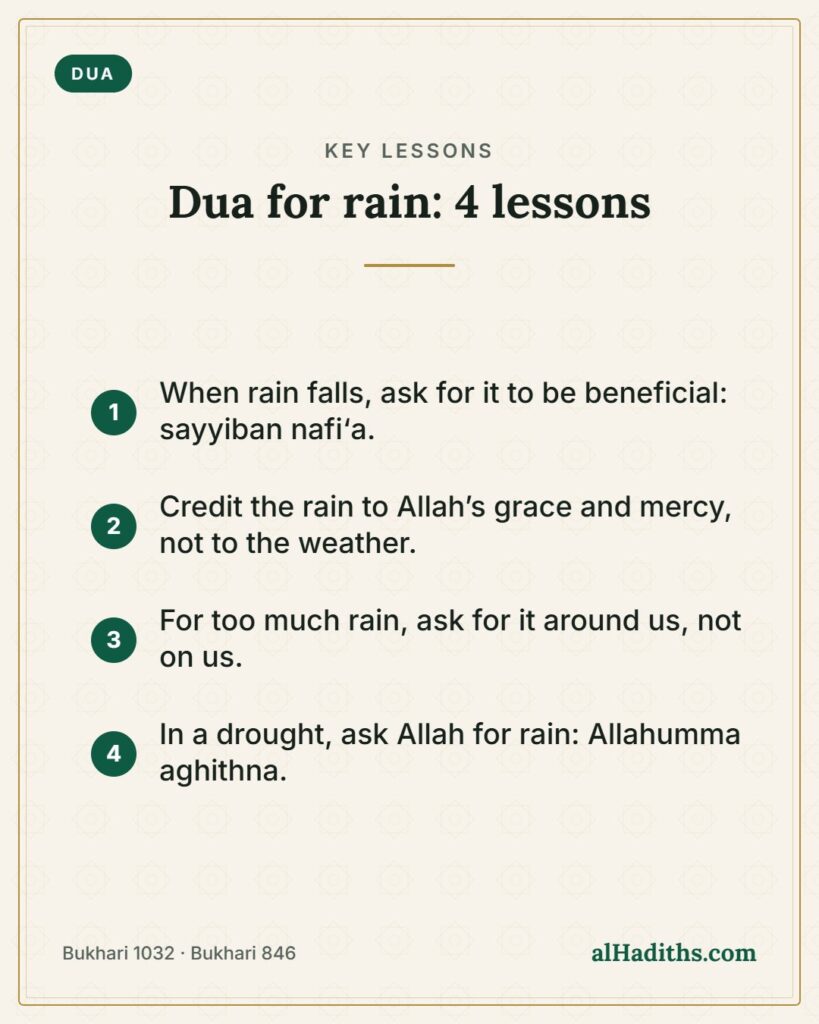
- When rain falls, ask Allah to make it beneficial.
- Say the rain came by the grace and mercy of Allah.
- For heavy rain, ask for it around us and not on us.
- In a drought, raise your hands and ask Allah for rain.
Part of our Dua series: see all our dua articles in one place.
May Allah send us rain that benefits and never harms, and make us among those who say it came by His grace and mercy.
Save this to Pinterest so you remember it at the next downpour
Share the reward. Send this article to someone who needs it today — teaching a hadith or dua can become a lasting good deed for you, in shaa Allah.