Dua When Visiting the Sick: What the Prophet ﷺ Said
Contents
You are standing at a hospital bed and you do not know what to say. The Prophet ﷺ did not leave us without words for that moment. This article gathers the authentic dua when visiting the sick, what he ﷺ said to the people he visited, and six hadith on why the visit itself matters so much to Allah.
At a glance
- Hadith: 6, from Sahih al-Bukhari, Sahih Muslim and Sunan Abi Dawud
- Grade: Sahih (Abu Dawud 3106: Sahih, al-Albani)
- Topic: What to say and do when visiting someone who is ill
- Do it today: Visit or call someone unwell and say “La ba’sa, tahurun in sha Allah”
1. The dua when visiting the sick: “La ba’sa, tahur”
Ibn Abbas (may Allah be pleased with him) reported that whenever the Prophet ﷺ visited a sick person, he would say:
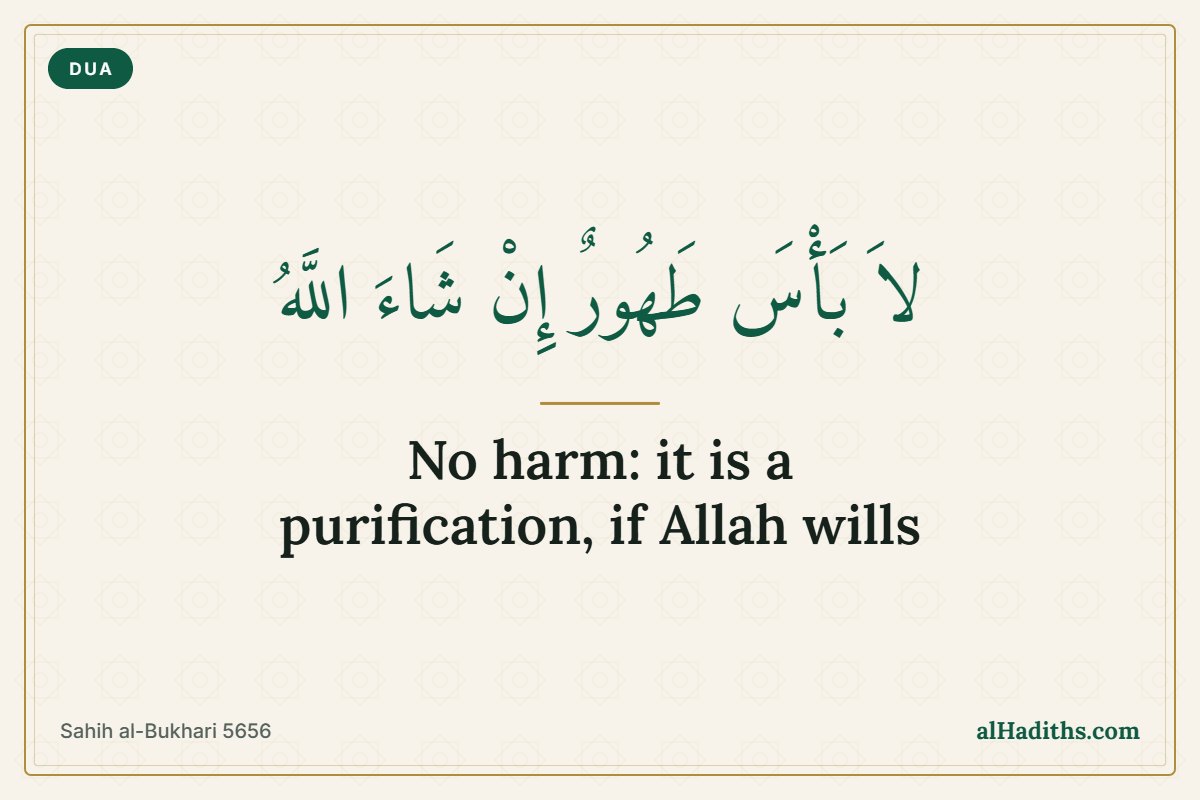
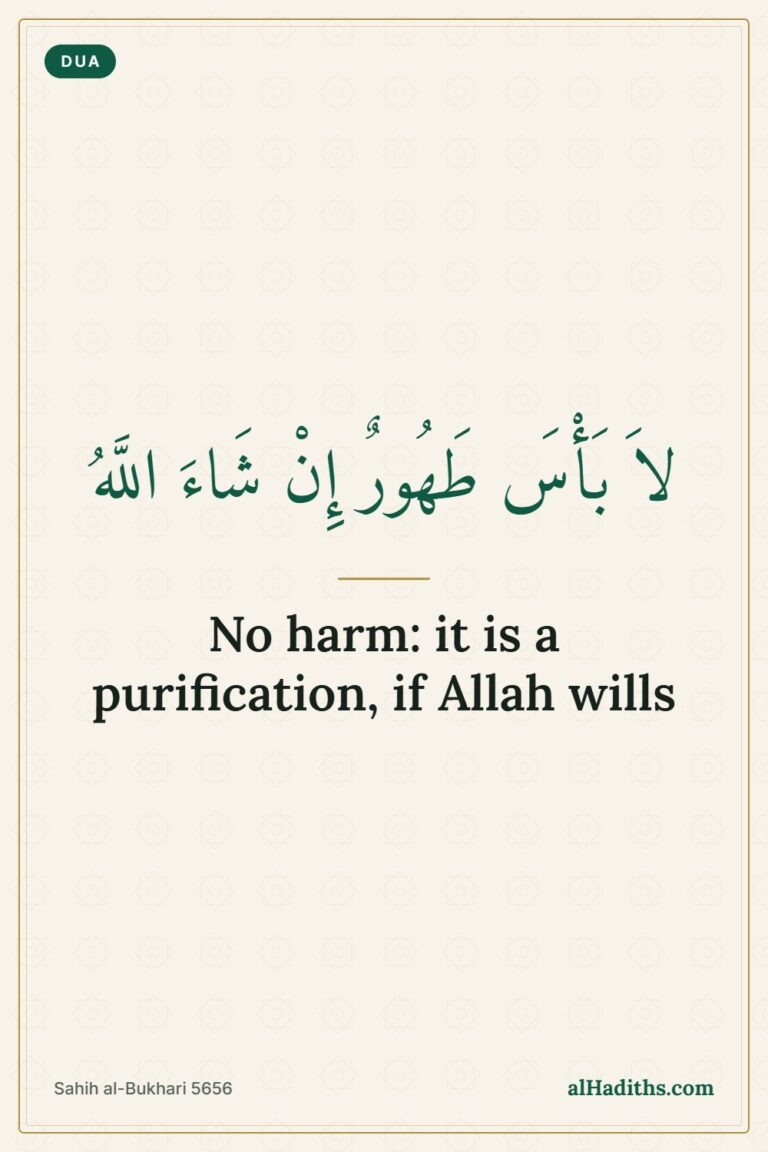
لاَ بَأْسَ طَهُورٌ إِنْ شَاءَ اللَّهُ
Lā baʾs, ṭahūrun in shāʾ Allāh.
“No harm: it is a purification, if Allah wills.”
Sahih al-Bukhari 5656 · Narrated by Ibn Abbas · Translation adapted from Sunnah.com
In the full hadith, a bedouin he visited answered that it was only a fever that would take an old man to his grave, and the Prophet ﷺ replied, “Then, yes, it is so.” The words are meant as comfort and hope: illness can wipe away sins. They are short enough to say at any bedside.
Try this: learn these four words before your next visit, and say them gently, not as a lecture.
2. Ask Allah seven times to cure them
Ibn Abbas also reported this promise from the Prophet ﷺ:
مَنْ عَادَ مَرِيضًا لَمْ يَحْضُرْ أَجَلُهُ فَقَالَ عِنْدَهُ سَبْعَ مِرَارٍ أَسْأَلُ اللَّهَ الْعَظِيمَ رَبَّ الْعَرْشِ الْعَظِيمِ أَنْ يَشْفِيَكَ إِلاَّ عَافَاهُ اللَّهُ مِنْ ذَلِكَ الْمَرَضِ
“If anyone visits a sick person whose time (of death) has not come, and says seven times in his presence: ‘I ask Allah the Mighty, Lord of the Mighty Throne, to cure you’, Allah will cure him of that illness.”
Sunan Abi Dawud 3106 · Sahih (al-Albani) · Narrated by Ibn Abbas · Translation adapted from Sunnah.com
The words are “As’alullahal-’Azim, Rabbal-’Arshil-’Azim, an yashfiyak.” The same hadith is in Jami’ at-Tirmidhi 2083 (Sahih, Darussalam). We cover it with other healing duas in our dua for healing article.
Try this: count the seven times quietly on your fingers while you sit with them.
3. The dua the Prophet ﷺ made for the sick
Aisha (may Allah be pleased with her) reported what the Prophet ﷺ said when he visited a patient or a patient was brought to him:
أَذْهِبِ الْبَاسَ رَبَّ النَّاسِ، اشْفِ وَأَنْتَ الشَّافِي لاَ شِفَاءَ إِلاَّ شِفَاؤُكَ، شِفَاءً لاَ يُغَادِرُ سَقَمًا
Adhhibil-ba’s, Rabban-nās, ishfi wa Antash-Shāfī, lā shifā’a illā shifā’uk, shifā’an lā yughādiru saqamā.
“Take away the disease, O Lord of the people! Cure him, for You are the One Who cures. There is no cure but Yours, a cure that leaves no disease.”
Sahih al-Bukhari 5675 · Narrated by Aisha · Translation adapted from Sunnah.com
This dua asks for a complete cure and reminds both the visitor and the patient that cure comes from Allah, whatever means are used.
Try this: say it for a relative who is ill even when you cannot be there in person.
4. “I was sick but you did not visit Me”
Abu Hurairah (may Allah be pleased with him) reported this hadith qudsi, in which the Prophet ﷺ tells us what Allah will say on the Day of Resurrection:
إِنَّ اللَّهَ عَزَّ وَجَلَّ يَقُولُ يَوْمَ الْقِيَامَةِ يَا ابْنَ آدَمَ مَرِضْتُ فَلَمْ تَعُدْنِي. قَالَ يَا رَبِّ كَيْفَ أَعُودُكَ وَأَنْتَ رَبُّ الْعَالَمِينَ. قَالَ أَمَا عَلِمْتَ أَنَّ عَبْدِي فُلاَنًا مَرِضَ فَلَمْ تَعُدْهُ أَمَا عَلِمْتَ أَنَّكَ لَوْ عُدْتَهُ لَوَجَدْتَنِي عِنْدَهُ يَا ابْنَ آدَمَ اسْتَطْعَمْتُكَ فَلَمْ تُطْعِمْنِي. قَالَ يَا رَبِّ وَكَيْفَ أُطْعِمُكَ وَأَنْتَ رَبُّ الْعَالَمِينَ. قَالَ أَمَا عَلِمْتَ أَنَّهُ اسْتَطْعَمَكَ عَبْدِي فُلاَنٌ فَلَمْ تُطْعِمْهُ أَمَا عَلِمْتَ أَنَّكَ لَوْ أَطْعَمْتَهُ لَوَجَدْتَ ذَلِكَ عِنْدِي يَا ابْنَ آدَمَ اسْتَسْقَيْتُكَ فَلَمْ تَسْقِنِي. قَالَ يَا رَبِّ كَيْفَ أَسْقِيكَ وَأَنْتَ رَبُّ الْعَالَمِينَ قَالَ اسْتَسْقَاكَ عَبْدِي فُلاَنٌ فَلَمْ تَسْقِهِ أَمَا إِنَّكَ لَوْ سَقَيْتَهُ وَجَدْتَ ذَلِكَ عِنْدِي
“Allah, the Mighty and Majestic, will say on the Day of Resurrection: ‘O son of Adam, I was sick and you did not visit Me.’ He will say: ‘My Lord, how could I visit You when You are the Lord of the worlds?’ He will say: ‘Did you not know that My servant so-and-so was sick and you did not visit him? Did you not know that if you had visited him, you would have found Me with him? O son of Adam, I asked you for food and you did not feed Me.’ He will say: ‘My Lord, how could I feed You when You are the Lord of the worlds?’ He will say: ‘Did you not know that My servant so-and-so asked you for food and you did not feed him? Did you not know that if you had fed him, you would have found that with Me? O son of Adam, I asked you for water and you did not give Me to drink.’ He will say: ‘My Lord, how could I give You to drink when You are the Lord of the worlds?’ He will say: ‘My servant so-and-so asked you for water and you did not give him to drink. Had you given him to drink, you would have found that with Me.’”
Sahih Muslim 2569 · Narrated by Abu Hurairah · Translation adapted from Sunnah.com
HadeethEnc’s explanation notes that for the sick person Allah said “you would have found Me with him”, not “its reward with Me” as with food and drink, which shows how close the sick person is to Allah (HadeethEnc 5544). It adds that scholars say the sick person’s dua is worthy of being answered.
Try this: ask the person you visit to make dua for you.
5. The visitor walks in the harvest of Paradise
Thawban (may Allah be pleased with him) reported that the Messenger of Allah ﷺ said:
عَائِدُ الْمَرِيضِ فِي مَخْرَفَةِ الْجَنَّةِ حَتَّى يَرْجِعَ
“The one who visits the sick is in the harvest of Paradise until he returns.”
Sahih Muslim 2568a · Narrated by Thawban (Sunnah.com’s English heading names Abu ar-Rabi’, one of the transmitters; the Companion in the Arabic chain is Thawban) · Translation adapted from Sunnah.com
The reward lasts “until he returns”: the whole visit counts, from the moment you set out to the moment you are home.
Try this: make your intention before you leave the house, so the whole trip is for Allah.
6. Visiting the sick is a command
Abu Musa al-Ash’ari (may Allah be pleased with him) reported that the Messenger of Allah ﷺ said:
أَطْعِمُوا الْجَائِعَ، وَعُودُوا الْمَرِيضَ، وَفُكُّوا الْعَانِيَ
“Feed the hungry, visit the sick, and set free the captives.”
Sahih al-Bukhari 5649 · Narrated by Abu Musa al-Ash’ari · Translation from Sunnah.com
Visiting the sick sits beside feeding the hungry and freeing captives: it is part of looking after the community, not an optional courtesy.
Try this: if someone in your masjid or office is off sick, arrange a visit or a call this week.
Bringing it together
Put together, these hadith give a simple plan: go with the right intention, say “La ba’sa, tahurun in sha Allah”, ask Allah seven times to cure them, and remember that Allah is with the one you are visiting. These are duas and good manners, not medical advice: always follow the doctor’s and the hospital’s guidance, including visiting rules.
Reflection: a sick person often feels forgotten. A short visit, a few words of hope and a quiet dua can be the brightest part of their week, and the hadith tell us it is also one of the brightest parts of ours.
Questions people ask
What do you say when visiting a sick person?
The Prophet ﷺ used to say “La ba’sa, tahurun in sha Allah” (No harm: it is a purification, if Allah wills), as in Sahih al-Bukhari 5656. He also taught saying seven times “As’alullahal-’Azim, Rabbal-’Arshil-’Azim, an yashfiyak” (Sunan Abi Dawud 3106, Sahih, al-Albani).
Do 70,000 angels pray for someone who visits the sick?
Graders differ on this narration from Ali. Al-Albani graded Sunan Abi Dawud 3098 Sahih as a statement of Ali and 3099 Sahih as the Prophet’s words; Darussalam graded Sunan Ibn Majah 1442 Hasan but Jami’ at-Tirmidhi 969 Da’if (grades as shown on Sunnah.com). Because of this difference we have not used it as one of the six hadith above.
Did the Prophet ﷺ visit sick people who were not Muslim?
Yes. Anas reported that a Jewish boy who served the Prophet ﷺ fell ill and the Prophet ﷺ went to visit him (Sahih al-Bukhari 1356).
Key lessons
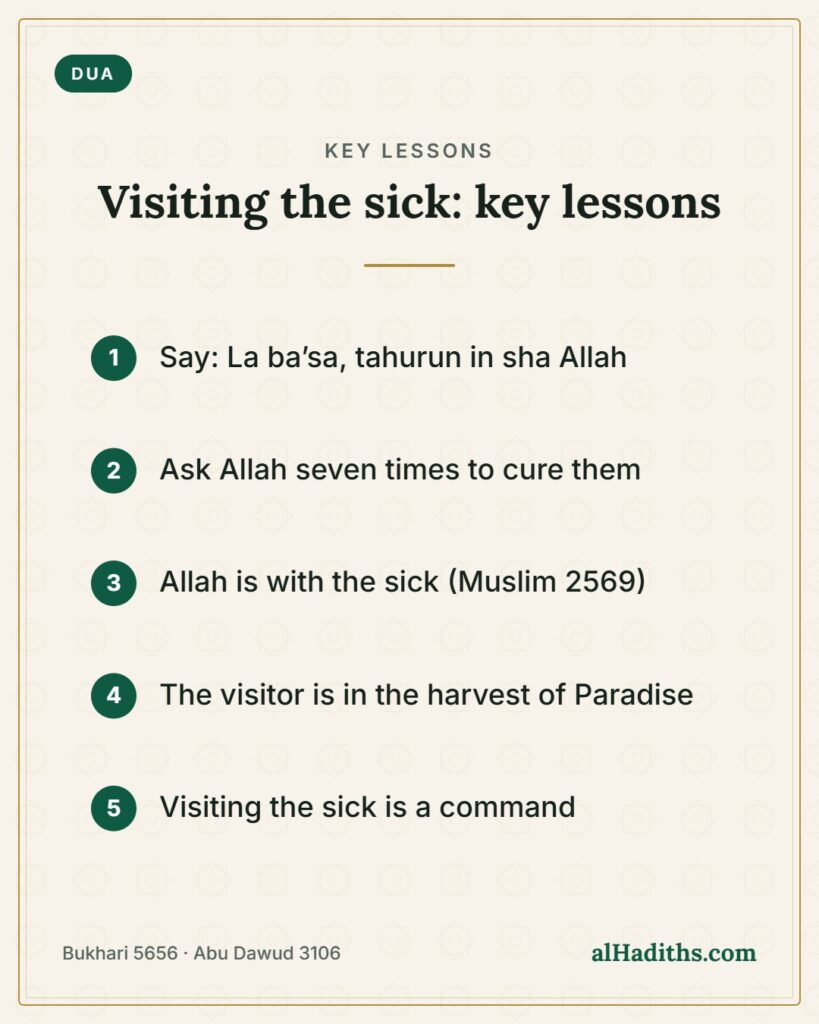
- When visiting the sick, the Prophet ﷺ said “La ba’sa, tahurun in sha Allah” (Bukhari 5656).
- Ask Allah seven times to cure them (Abu Dawud 3106, Sahih).
- Allah says that whoever visits the sick will find Him there (Muslim 2569).
- The visitor is in the harvest of Paradise until he returns (Muslim 2568).
- Visiting the sick is commanded alongside feeding the hungry (Bukhari 5649).
Part of our Dua series: see all our dua articles in one place.
Who do you know who is unwell right now? A visit this week, even a short one, puts every one of these hadith into practice.
Save this to Pinterest so you have the right words ready for your next hospital visit.
Share the reward. Send this article to someone who needs it today — teaching a hadith or dua can become a lasting good deed for you, in shaa Allah.