Dua for Evil Eye: Authentic Duas and Ruqyah From the Sunnah
Contents
A child suddenly falls ill after a stranger praised her, or a new business stalls after everyone admired it, and someone in the family whispers, “It’s the eye.” If you are looking for an authentic dua for evil eye, the Sunnah gives us more than a single line: a ruqyah that Jibril himself recited over the Prophet ﷺ, a clear instruction to treat the evil eye with ruqyah, and a simple habit that stops it before it starts.
Below are five authentic hadith on the evil eye, each with its Arabic from Sunnah.com, its grade and a short explanation, plus one verse of the Quran that teaches us what to say when something impresses us.
At a glance
- Hadith: 5 authentic narrations + 1 Quran verse
- Collections: Sahih Muslim, Sahih al-Bukhari, Sunan Ibn Majah
- Grade: Sahih (Bukhari and Muslim; Ibn Majah 3509 Sahih, Darussalam)
- Topic: The evil eye, ruqyah and protection
- Do it today: When you admire something, say “ma sha’ Allah” and pray for blessing for its owner
1. The evil eye is real
Ibn Abbas (may Allah be pleased with him) reported that the Prophet ﷺ said:
الْعَيْنُ حَقٌّ وَلَوْ كَانَ شَىْءٌ سَابَقَ الْقَدَرَ سَبَقَتْهُ الْعَيْنُ وَإِذَا اسْتُغْسِلْتُمْ فَاغْسِلُوا
“The evil eye is real. If anything were to precede the decree, the evil eye would precede it. And when you are asked to wash, then wash.”
Sahih Muslim 2188 · Narrated by Ibn Abbas · Translation adapted from Sunnah.com
This hadith settles the basic question: the evil eye (al-‘ayn) is a reality, not a superstition. At the same time it keeps it in its place. Nothing precedes Allah’s decree, and the evil eye only harms by His permission. The hadith also mentions washing as a remedy, which we come back to in hadith 5.
Try this: when fear of the evil eye starts to take over, remember the first half of this hadith and the second together: it is real, and it is still under Allah’s decree.
2. The dua for evil eye that Jibril recited
Abu Sa‘id al-Khudri (may Allah be pleased with him) reported that Jibril came to the Prophet ﷺ and asked, “O Muhammad, are you ill?” He said, “Yes.” Jibril then recited:
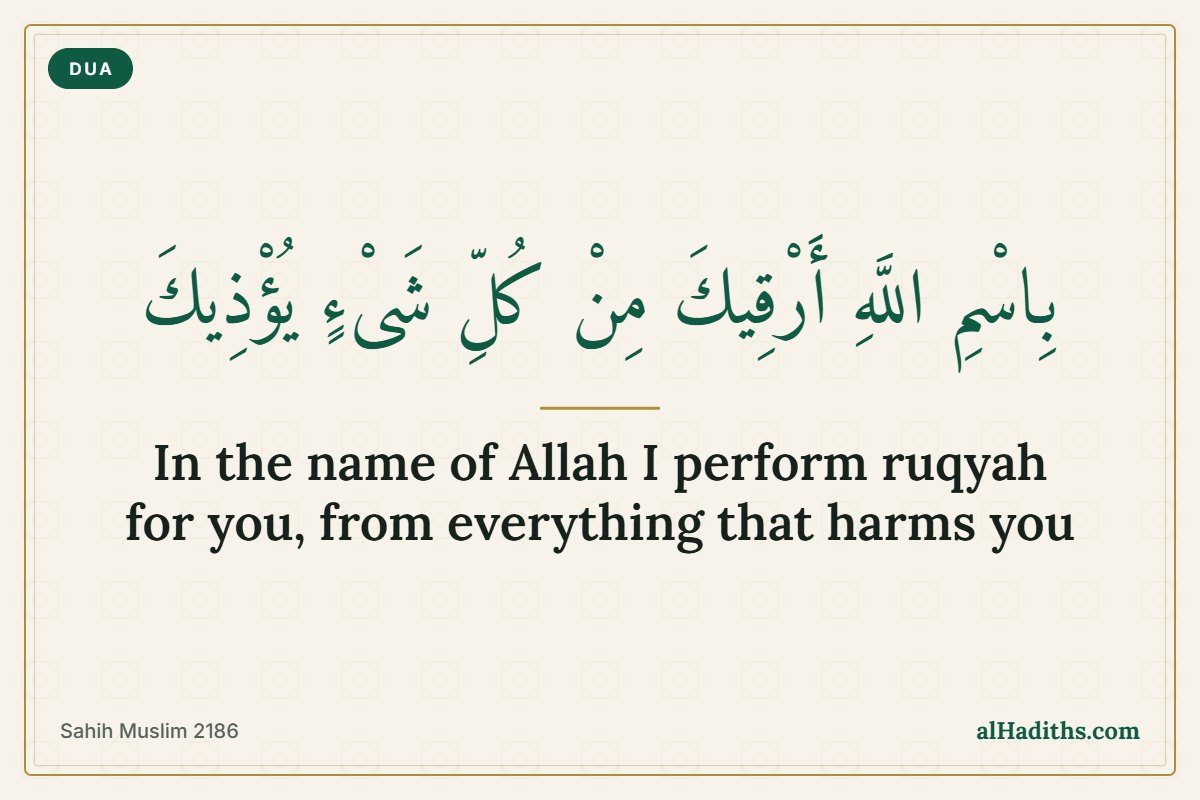
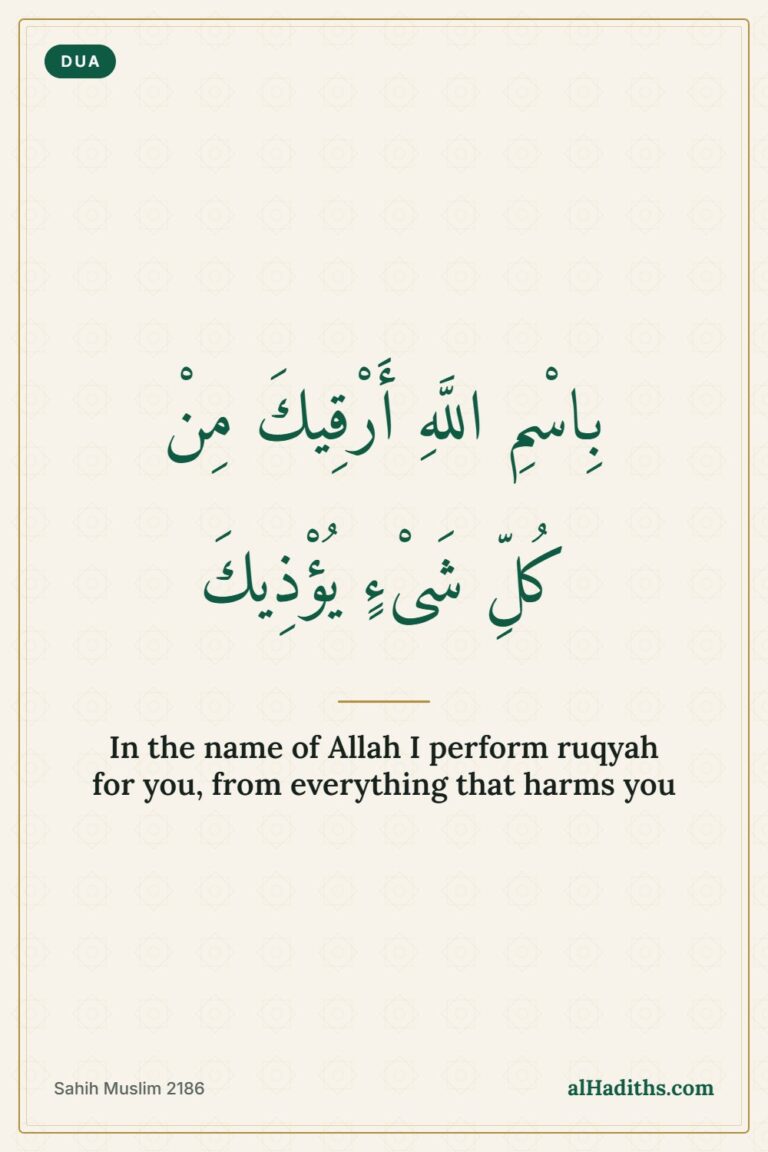
بِاسْمِ اللَّهِ أَرْقِيكَ مِنْ كُلِّ شَىْءٍ يُؤْذِيكَ مِنْ شَرِّ كُلِّ نَفْسٍ أَوْ عَيْنِ حَاسِدٍ اللَّهُ يَشْفِيكَ بِاسْمِ اللَّهِ أَرْقِيكَ
Bismillahi arqika, min kulli shay’in yu’dhika, min sharri kulli nafsin aw ‘ayni hasid, Allahu yashfika, bismillahi arqika.
“In the name of Allah I perform ruqyah for you, from everything that harms you, from the evil of every soul or envious eye. Allah will heal you. In the name of Allah I perform ruqyah for you.”
Sahih Muslim 2186 · Narrated by Abu Sa‘id al-Khudri · Translation adapted from Sunnah.com
This is the clearest dua for evil eye in the Sunnah, because it names the “envious eye” (‘ayni hasid) directly. It was recited over a sick person, so it is said for someone else: the speaker says “I perform ruqyah for you”. Reciting it over yourself by changing the pronoun is a common adaptation, but the hadith itself gives the wording addressed to another person.
Try this: learn the first line, Bismillahi arqika, this week, and recite the whole dua over a family member who is unwell.
3. The Prophet ﷺ ordered ruqyah for the evil eye
Aishah (may Allah be pleased with her) said:
أَمَرَنِي رَسُولُ اللَّهِ صلى الله عليه وسلم أَوْ أَمَرَ أَنْ يُسْتَرْقَى مِنَ الْعَيْنِ
“The Messenger of Allah ﷺ ordered me, or he ordered (someone else), that ruqyah be done for the evil eye.”
Sahih al-Bukhari 5738 · Narrated by Aishah · Translation adapted from Sunnah.com
Ruqyah means reciting the Quran and authentic duas over a person and asking Allah to cure them. This hadith shows that seeking ruqyah for the evil eye is part of the Sunnah, not something borrowed from folk practice. It is a dua and recitation, not amulets, knots or charms.
Try this: if you look for someone to do ruqyah, choose a person who recites only the Quran and authentic duas, and ask a trusted local scholar if you are unsure.
4. “Seek ruqyah for her”
Umm Salamah (may Allah be pleased with her) reported that the Prophet ﷺ saw a girl in her house with a dark mark on her face, and said:
اسْتَرْقُوا لَهَا، فَإِنَّ بِهَا النَّظْرَةَ
“Seek ruqyah for her, for she has been struck by the (evil) eye.”
Sahih al-Bukhari 5739 · Narrated by Umm Salamah · Translation adapted from Sunnah.com
Here the Prophet ﷺ recognised the effect of the evil eye on a child and told the household to treat it with ruqyah. He did not tell them to panic, cut people off or hunt for who did it. The response is calm: recite, make dua and trust Allah.
Try this: for children, the Prophet ﷺ also had a special protection dua he recited over his grandsons; see our dua for protection of children.
5. What to say when you admire something
Abu Umamah ibn Sahl ibn Hunayf reported that ‘Amir ibn Rabi‘ah saw Sahl ibn Hunayf bathing and praised his skin, and Sahl fell to the ground. When he was brought to the Prophet ﷺ, he asked whom they suspected, and they named ‘Amir. He said:
عَلاَمَ يَقْتُلُ أَحَدُكُمْ أَخَاهُ إِذَا رَأَى أَحَدُكُمْ مِنْ أَخِيهِ مَا يُعْجِبُهُ فَلْيَدْعُ لَهُ بِالْبَرَكَةِ
“Why would one of you kill his brother? If one of you sees something in his brother that he likes, let him pray for blessing for him.”
Sunan Ibn Majah 3509 · Sahih (Darussalam) · Narrated by Abu Umamah ibn Sahl ibn Hunayf · Translation adapted from Sunnah.com
In the same narration, the Prophet ﷺ then had ‘Amir perform wudu and wash parts of his body, and the water was poured over Sahl. This is the “washing” mentioned in hadith 1. The lesson for everyday life is the first part: the evil eye often comes from a friend who admires, not only from an enemy, so the cure starts with the one who looks.
Try this: whenever you praise someone’s child, home or success, add a dua: “Barakallahu fik” (may Allah bless you), or “Allahumma barik lahu”.
Bringing it together: protection from the Quran
The Quran teaches the same habit in the story of the two gardens. The believing man tells his proud friend what he should have said when he entered his garden:
وَلَوْلَآ إِذْ دَخَلْتَ جَنَّتَكَ قُلْتَ مَا شَآءَ ٱللَّهُ لَا قُوَّةَ إِلَّا بِٱللَّهِ ۚ إِن تَرَنِ أَنَا۠ أَقَلَّ مِنكَ مَالًا وَوَلَدًا
“And why did you, when you entered your garden, not say, ‘What Allāh willed [has occurred]; there is no power except in Allāh’? Although you see me less than you in wealth and children,”
Surah Al-Kahf 18:39 · Translation: Saheeh International, from Quran.com
Saying ma sha’ Allah, la quwwata illa billah turns admiration into remembrance. Surah al-Falaq also ends with seeking refuge “from the evil of an envier when he envies,” and it is recited with an-Nas for protection. For the daily morning and evening protection, see Bismillahilladhi la yadurru.
Reflection: the evil eye can make people suspicious of everyone around them. These hadith point the other way: the Prophet ﷺ asked only who was involved so the cure could be done, then turned the moment into a lesson about praying for one another. The best protection is a home where people say “ma sha’ Allah” and “barakallahu fik” to each other, and where trust in Allah is bigger than fear.
Questions people ask
What is the dua for evil eye for kids?
The Prophet ﷺ used to seek protection for al-Hasan and al-Husayn with the words “U‘idhukuma bi kalimatillahit-tammah…” (Sahih al-Bukhari 3371). We explain it with its Arabic in our dua for protection of children. The ruqyah of Jibril above can also be recited over a child.
Is washing a cure for the evil eye?
Sahih Muslim 2188 says, “When you are asked to wash, then wash,” and Sunan Ibn Majah 3509 (Sahih, Darussalam) describes the person who gave the eye washing with water that was then poured over the one affected. We share this as it appears in the hadith; for how it is done today, ask a qualified local scholar.
Are there weak hadith about the evil eye?
Yes. Some narrations people share, such as Jami‘ at-Tirmidhi 2058 and Sunan Ibn Majah 3508, are graded Da‘if (Darussalam) on Sunnah.com, so we have not used them here. The authentic hadith above are enough.
Key lessons
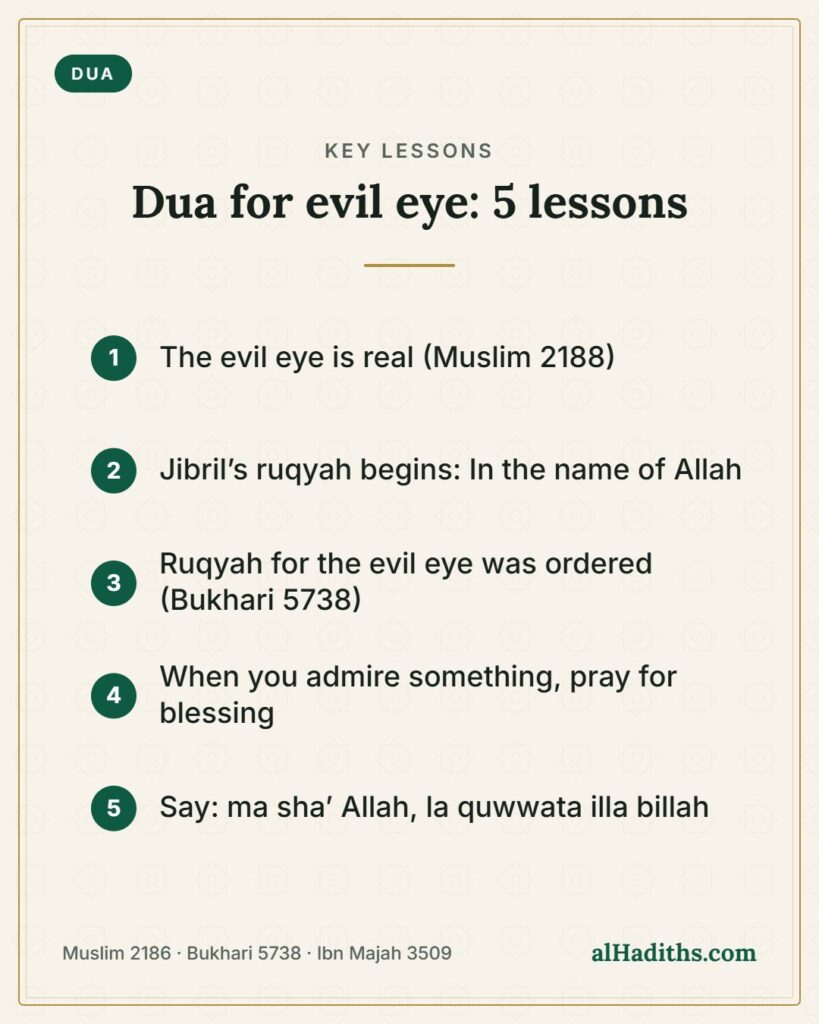
- The evil eye is real, but nothing precedes Allah’s decree.
- The main dua for evil eye is Jibril’s ruqyah: “Bismillahi arqika…” (Muslim 2186).
- The Prophet ﷺ ordered ruqyah for the evil eye, for adults and children.
- When you admire something, pray for blessing for its owner.
- Say “ma sha’ Allah, la quwwata illa billah” (Quran 18:39).
Part of our Dua series: see all our dua articles in one place.
Next time you feel that pang of admiration for someone’s blessing, let it come out as a dua for them. That one habit protects them, and it protects your heart too.
Save this to Pinterest so you can find the dua for evil eye when you need it.
Share the reward. Send this article to someone who needs it today — teaching a hadith or dua can become a lasting good deed for you, in shaa Allah.