Dua for Good Health: 5 Authentic Duas for Well-Being
Contents
We rarely think about our health until a fever, a scan result or a sleepless night takes it away. If you are looking for a dua for good health, the Sunnah gives us a short, powerful word to ask for: al-‘afiyah, well-being in body and religion, in this world and the next.
This article gathers five authentic duas and teachings on ‘afiyah, each with its Arabic from Sunnah.com and its grade. It is what the Prophet ﷺ taught, not medical advice: for an illness, please see a doctor as well as making dua.
At a glance
- Duas: 5 authentic duas and teachings + 1 hadith on the blessing of health
- Collections: Jami‘ at-Tirmidhi, Sunan Abi Dawud, Sahih Muslim, Sahih al-Bukhari
- Grade: Sahih or Hasan (graders named on each card)
- Topic: Good health and ‘afiyah (well-being)
- Do it today: Say the dua in section 3 this morning or evening
Why health is a blessing we must not waste
Ibn ‘Abbas (may Allah be pleased with him) reported that the Prophet ﷺ said:
نِعْمَتَانِ مَغْبُونٌ فِيهِمَا كَثِيرٌ مِنَ النَّاسِ، الصِّحَّةُ وَالْفَرَاغُ
“There are two blessings that many people are deceived into losing: health and free time.”
Sahih al-Bukhari 6412 · Narrated by Ibn ‘Abbas · Translation from Sunnah.com
HadeethEnc explains this hadith with the picture of a trader: health and free time are like capital, and the one who spends them in obeying Allah makes a profit, while the one who wastes them makes a loss. So a dua for good health is not only asking to feel well. It is asking for the capital to do good.
1. “Ask Allah for al-‘afiyah”: what the Prophet ﷺ taught his uncle
Al-‘Abbas ibn ‘Abd al-Muttalib (may Allah be pleased with him), the Prophet’s uncle, asked him twice to teach him something to ask Allah for. Both times the answer was the same. The second time the Prophet ﷺ said:
يَا عَبَّاسُ يَا عَمَّ رَسُولِ اللَّهِ سَلِ اللَّهَ الْعَافِيَةَ فِي الدُّنْيَا وَالآخِرَةِ
“O ‘Abbas, O uncle of the Messenger of Allah! Ask Allah for al-‘afiyah (well-being) in this world and in the Hereafter.”
Jami‘ at-Tirmidhi 3514 · Sahih (Darussalam) · Narrated by al-‘Abbas ibn ‘Abd al-Muttalib · Translation adapted from Sunnah.com
Think about who was asking: a close relative of the Prophet ﷺ, who could have asked for anything. He was given one word, twice. ‘Afiyah covers health of the body, but also safety from trials, harm and sin.
Try this: when you don’t know what to ask for, say simply: “Allahumma inni as’alukal-‘afiyah” (O Allah, I ask You for well-being), as in the dua of section 3.
2. Nothing after certainty is better than ‘afiyah
Rifa‘ah ibn Rafi‘ reported that Abu Bakr as-Siddiq (may Allah be pleased with him) stood on the minbar and wept, then said that the Prophet ﷺ had stood on the minbar in the first year after the Hijrah, wept, and said:
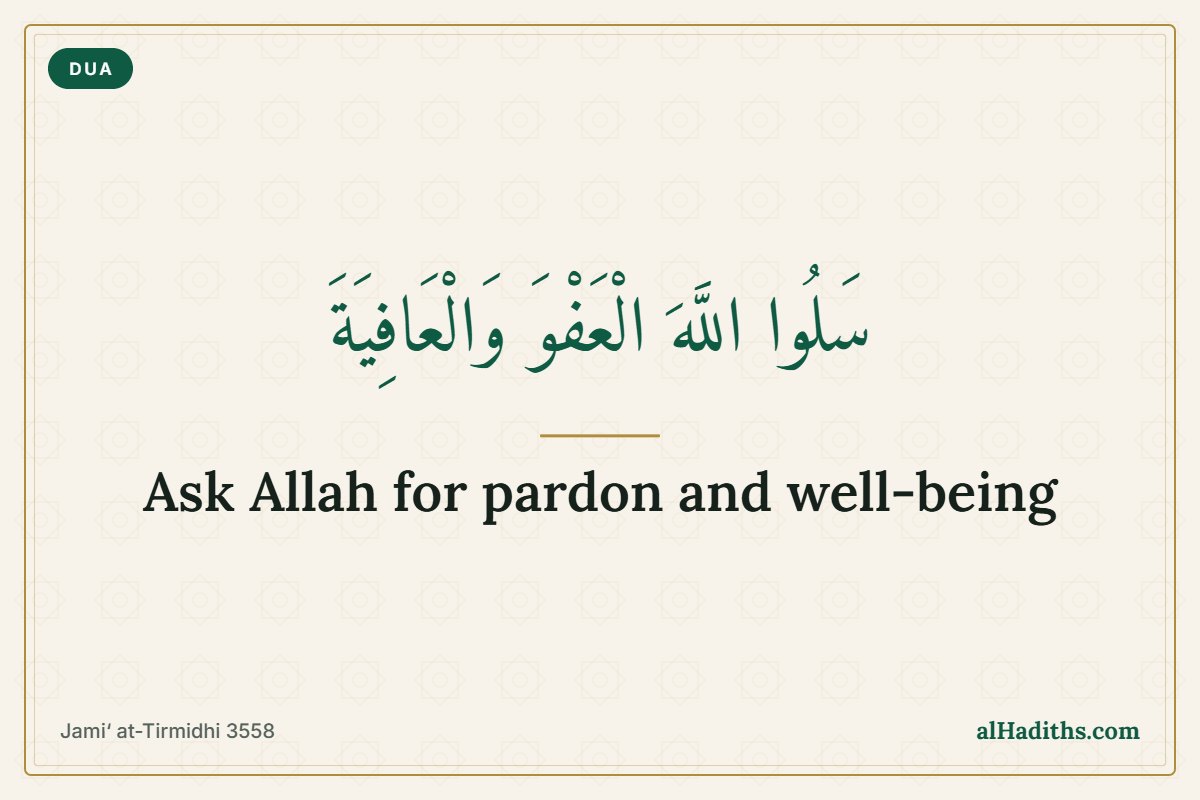
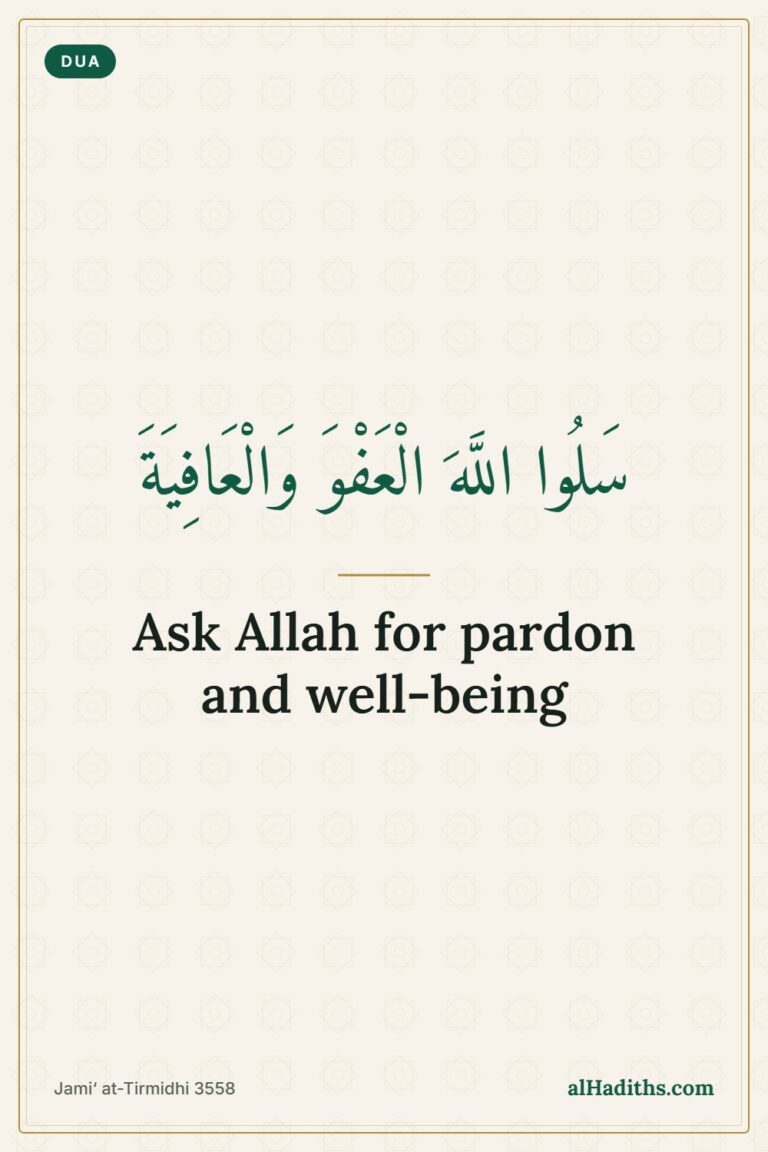
سَلُوا اللَّهَ الْعَفْوَ وَالْعَافِيَةَ فَإِنَّ أَحَدًا لَمْ يُعْطَ بَعْدَ الْيَقِينِ خَيْرًا مِنَ الْعَافِيَةِ
“Ask Allah for pardon and al-‘afiyah (well-being), for no one has been given anything, after certainty (yaqin), better than al-‘afiyah.”
Jami‘ at-Tirmidhi 3558 · Sahih (Darussalam) · Narrated by Abu Bakr as-Siddiq · Translation adapted from Sunnah.com
Certainty of faith comes first, and then ‘afiyah. Wealth, status and success are not on the list. This hadith is also why many of the morning duas pair al-‘afw (pardon) with al-‘afiyah.
Try this: make “pardon and well-being” the first thing you ask for in your next sujud or after your salah.
3. The morning and evening dua for ‘afiyah
Ibn ‘Umar (may Allah be pleased with him) said that the Prophet ﷺ never left these words in the evening and the morning. Here is the opening of that dua; the full dua, with its protection from all six sides, is in our morning and evening dua for protection.
اللَّهُمَّ إِنِّي أَسْأَلُكَ الْعَافِيَةَ فِي الدُّنْيَا وَالآخِرَةِ اللَّهُمَّ إِنِّي أَسْأَلُكَ الْعَفْوَ وَالْعَافِيَةَ فِي دِينِي وَدُنْيَاىَ وَأَهْلِي وَمَالِي
Allahumma inni as’alukal-‘afiyata fid-dunya wal-akhirah. Allahumma inni as’alukal-‘afwa wal-‘afiyata fi dini wa dunyaya wa ahli wa mali.
“O Allah, I ask You for well-being in this world and in the Hereafter. O Allah, I ask You for pardon and well-being in my religion and my worldly affairs, my family and my property.”
Sunan Abi Dawud 5074 · Sahih (al-Albani) · Narrated by Ibn ‘Umar · Translation adapted from Sunnah.com, trimmed to the opening of the dua
HadeethEnc explains ‘afiyah here as freedom from diseases, misfortunes and trials in religion and in worldly life. Notice how wide the dua is: your religion, your daily life, your family and your money all need well-being.
Try this: add it to your morning adhkar after Fajr and your evening adhkar after Asr or Maghrib.
4. Dua for good health in the body, hearing and sight
‘Abd ar-Rahman, the son of Abu Bakrah (may Allah be pleased with him), told his father that he heard him say these words every morning. Abu Bakrah said he had heard the Prophet ﷺ supplicate with them and he loved to follow his Sunnah:
اللَّهُمَّ عَافِنِي فِي بَدَنِي اللَّهُمَّ عَافِنِي فِي سَمْعِي اللَّهُمَّ عَافِنِي فِي بَصَرِي لاَ إِلَهَ إِلاَّ أَنْتَ
Allahumma ‘afini fi badani, Allahumma ‘afini fi sam‘i, Allahumma ‘afini fi basari, la ilaha illa ant.
“O Allah, grant me well-being in my body. O Allah, grant me well-being in my hearing. O Allah, grant me well-being in my sight. There is no god but You.”
Sunan Abi Dawud 5090 · Hasan in its chain (al-Albani) · Narrated by Abu Bakrah · Translation adapted from Sunnah.com
In the same narration, his son says Abu Bakrah repeated it three times in the morning and three times in the evening. Hearing and sight are named because they are the doors of knowledge and of worship. We also include this dua in our dua for anxiety article, as part of the same narration.
Try this: say it three times after Fajr, and three times in the evening, as Abu Bakrah did.
5. Seeking refuge from losing your health
‘Abdullah ibn ‘Umar (may Allah be pleased with him) said that among the duas of the Prophet ﷺ was:
اللَّهُمَّ إِنِّي أَعُوذُ بِكَ مِنْ زَوَالِ نِعْمَتِكَ وَتَحَوُّلِ عَافِيَتِكَ وَفُجَاءَةِ نِقْمَتِكَ وَجَمِيعِ سَخَطِكَ
Allahumma inni a‘udhu bika min zawali ni‘matika, wa tahawwuli ‘afiyatika, wa fuja’ati niqmatika, wa jami‘i sakhatik.
“O Allah, I seek refuge in You from the loss of Your blessing, the change of Your well-being, the suddenness of Your punishment, and all of Your displeasure.”
Sahih Muslim 2739 · Narrated by ‘Abdullah ibn ‘Umar · Translation adapted from Sunnah.com
HadeethEnc explains “the change of Your well-being” as well-being being replaced by misfortune, and the believer asks Allah for continuous well-being and freedom from pain and disease. This is the dua for good health for the healthy: it protects what we already have.
Try this: say it when you notice a blessing you usually take for granted: an easy breath, a good night’s sleep, a clear test result.
How to make the dua for good health part of your day
- Morning and evening: the dua of section 3, and the dua of section 4 three times.
- In sujud and after salah: ask for “al-‘afwa wal-‘afiyah” (pardon and well-being), in Arabic or in your own words.
- When things are good: the refuge dua of section 5, so the blessing stays.
- For someone who is ill: use the duas in our dua for healing article, and encourage them to see a doctor.
Reflection: I notice that every dua here asks for ‘afiyah in more than the body. The Prophet ﷺ taught us to ask for well-being in our religion, our family and the Hereafter too. Maybe that is the real meaning of good health: a body strong enough to worship, a heart kept safe from sin, and a return to Allah with His pardon.
Questions people ask
What does ‘afiyah mean?
‘Afiyah means well-being and safety. HadeethEnc explains it as freedom from diseases, misfortunes and trials, in religion and in worldly life. So it includes good health, but it is wider than health alone.
Can I make dua for good health for someone else?
Yes, making dua for others is part of the Sunnah. The wording of these duas is for oneself; changing “me” to “him” or “her” is an adaptation, not stated in the hadith. For someone who is ill, see the duas for the sick in our dua for healing article.
Is the dua “Allahumma inni as’alukal-mu‘afah” authentic?
The narration in Sunan Ibn Majah 3851 saying no dua is better than asking for al-mu‘afah is graded Da‘if (Darussalam), and a similar one in Jami‘ at-Tirmidhi 3512 is also graded Da‘if (Darussalam), so we do not use them here. The same meaning is taught in the authentic hadith of sections 1 and 2.
Key lessons
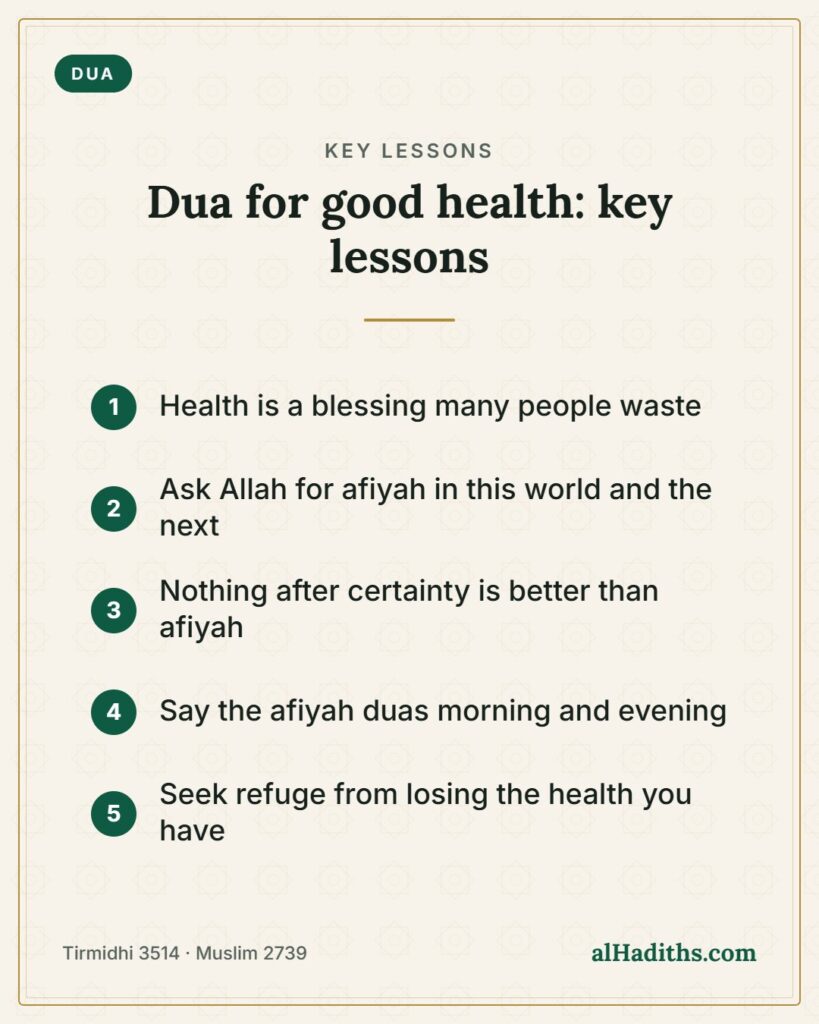
- Health and free time are blessings that many people waste (Bukhari 6412).
- The Prophet ﷺ taught his uncle to ask Allah for ‘afiyah in this world and the Hereafter (Tirmidhi 3514).
- After certainty of faith, no one is given anything better than ‘afiyah (Tirmidhi 3558).
- He never left the ‘afiyah dua in the morning and evening (Abu Dawud 5074).
- Seek refuge from losing the well-being you have (Muslim 2739).
Part of our Dua series: see all our dua articles in one place.
May Allah grant you and your family ‘afiyah in your bodies and your religion, in this world and the next.
Save this to Pinterest so you have these duas for good health ready every morning and evening.
Share the reward. Send this article to someone who needs it today — teaching a hadith or dua can become a lasting good deed for you, in shaa Allah.