Dua for Anxiety: 6 Authentic Duas for Worry and Stress
Contents
Worry about money, family, health, the future: everyone carries some of it. If you are looking for a dua for anxiety, the Prophet ﷺ left us several, and he said them himself in hard moments. Here are six authentic duas for worry, grief and distress. They are what the Prophet ﷺ taught, not medical advice: if anxiety stays with you, please also speak to a doctor or counsellor.
At a glance
- Duas: 6, plus Surah Ar-Ra’d 13:28
- Collections: Sahih al-Bukhari, Sunan Abi Dawud, Jami’ at-Tirmidhi, Hisn al-Muslim (Ahmad)
- Grade: Sahih or Hasan (graders named on each card)
- Topic: Worry (hamm), grief (hazan) and distress (karb)
- One thing to do today: Learn the first dua below and say it in your morning or evening dhikr
1. Refuge from worry and grief
Anas ibn Malik (may Allah be pleased with him) said the Prophet ﷺ used to say:
اللَّهُمَّ إِنِّي أَعُوذُ بِكَ مِنَ الْهَمِّ وَالْحَزَنِ، وَالْعَجْزِ وَالْكَسَلِ، وَالْجُبْنِ وَالْبُخْلِ، وَضَلَعِ الدَّيْنِ، وَغَلَبَةِ الرِّجَالِ
Allāhumma innī a‘ūdhu bika minal-hammi wal-ḥazan, wal-‘ajzi wal-kasal, wal-jubni wal-bukhl, wa ḍala‘id-dayn, wa ghalabatir-rijāl.
“O Allah, I seek refuge in You from worry and grief, from incapacity and laziness, from cowardice and miserliness, from being heavily in debt and from being overpowered by men.”
Sahih al-Bukhari 6369 · Narrated by Anas ibn Malik · Translation adapted from Sunnah.com
Worry (hamm) is about what may come; grief (hazan) is about what has already happened. This dua asks for protection from both, and from the things that often feed them. It also appears in our dua for debt article.
Try this: add it to your morning and evening dhikr so it is ready before worry starts.
2. The dua of distress
Ibn Abbas (may Allah be pleased with him) said the Messenger of Allah ﷺ used to say at a time of distress:
لاَ إِلَهَ إِلاَّ اللَّهُ الْعَظِيمُ الْحَلِيمُ، لاَ إِلَهَ إِلاَّ اللَّهُ رَبُّ الْعَرْشِ الْعَظِيمِ، لاَ إِلَهَ إِلاَّ اللَّهُ رَبُّ السَّمَوَاتِ، وَرَبُّ الأَرْضِ، وَرَبُّ الْعَرْشِ الْكَرِيمِ
Lā ilāha illallāhul-‘Aẓīmul-Ḥalīm, lā ilāha illallāhu Rabbul-‘arshil-‘aẓīm, lā ilāha illallāhu Rabbus-samāwāti wa Rabbul-arḍi wa Rabbul-‘arshil-karīm.
“There is no god but Allah, the Most Great, the Forbearing. There is no god but Allah, Lord of the Mighty Throne. There is no god but Allah, Lord of the heavens, Lord of the earth and Lord of the Noble Throne.”
Sahih al-Bukhari 6346 · Narrated by Ibn Abbas · also Sahih Muslim 2730a · Translation adapted from Sunnah.com
There is no request in this dua at all, only praise. As the explanation on HadeethEnc (hadith 5141) notes, it shows the need to turn to Allah when hardship strikes, and it is recommended at times of calamity.
Try this: when bad news arrives, say this before you reach for your phone to tell anyone.
3. “Allah, Allah is my Lord”
Asma’ bint Umays (may Allah be pleased with her) said the Messenger of Allah ﷺ told her: “Shall I not teach you words to say in distress?”
اللَّهُ اللَّهُ رَبِّي لاَ أُشْرِكُ بِهِ شَيْئًا
Allāhu Allāhu Rabbī, lā ushriku bihī shay’ā.
“Allah, Allah is my Lord; I do not associate anything with Him.”
Sunan Abi Dawud 1525 · Sahih (al-Albani) · Narrated by Asma’ bint Umays · Translation adapted from Sunnah.com
It is the shortest dua here, and easy to say even when your mind is racing. It brings the heart back to one thing: Allah is my Lord, and nothing else holds my affairs.
Try this: repeat it slowly a few times when anxiety makes it hard to think clearly.
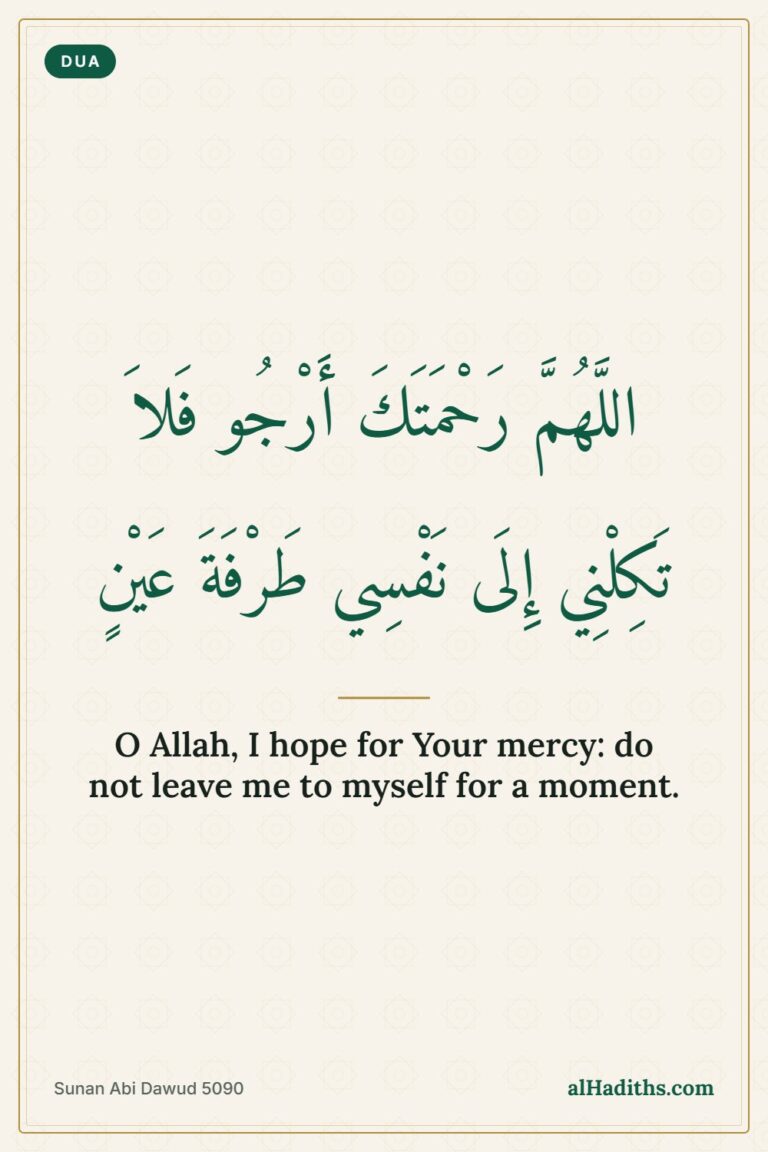
4. “Do not leave me to myself”
Abu Bakrah (may Allah be pleased with him) reported that the Messenger of Allah ﷺ said the supplications of the distressed person are:
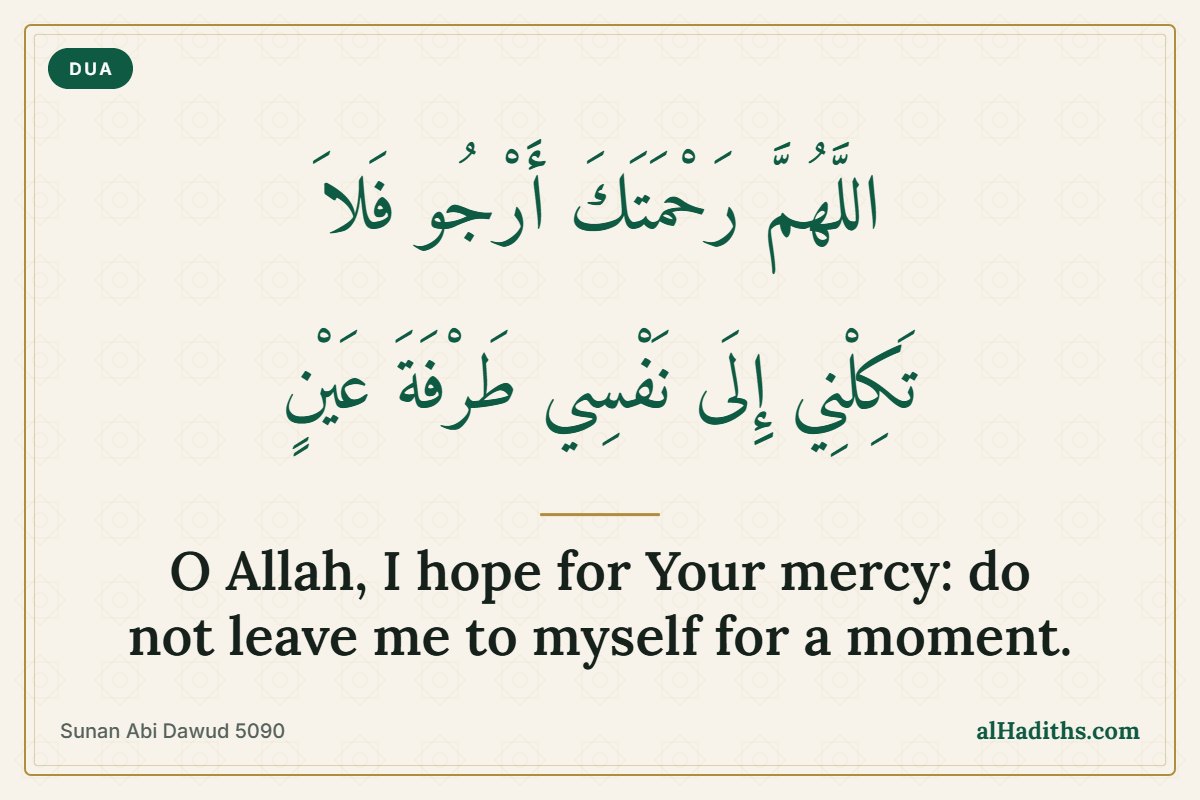
اللَّهُمَّ رَحْمَتَكَ أَرْجُو فَلاَ تَكِلْنِي إِلَى نَفْسِي طَرْفَةَ عَيْنٍ وَأَصْلِحْ لِي شَأْنِي كُلَّهُ لاَ إِلَهَ إِلاَّ أَنْتَ
Allāhumma raḥmataka arjū, fa lā takilnī ilā nafsī ṭarfata ‘ayn, wa aṣliḥ lī sha’nī kullahu, lā ilāha illā ant.
“O Allah, it is Your mercy that I hope for, so do not leave me to myself even for the blink of an eye, and set right all my affairs. There is no god but You.”
Sunan Abi Dawud 5090 · Hasan in chain (al-Albani) · Narrated by Abu Bakrah · Translation adapted from Sunnah.com
Anxiety often feels like being left alone with our own thoughts. This dua asks for exactly the opposite: that Allah never leaves us to ourselves, not even for a moment.
Try this: say it before a hard conversation, an exam or a medical appointment.
5. “O Ever-Living, O Self-Sustaining”
Anas ibn Malik (may Allah be pleased with him) said that whenever a matter distressed the Prophet ﷺ, he would say:
يَا حَىُّ يَا قَيُّومُ بِرَحْمَتِكَ أَسْتَغِيثُ
Yā Ḥayyu yā Qayyūm, bi raḥmatika astaghīth.
“O Ever-Living, O Self-Sustaining, by Your mercy I seek relief.”
Jami’ at-Tirmidhi 3524 · Hasan (Darussalam) · Narrated by Anas ibn Malik · Translation adapted from Sunnah.com
At-Tirmidhi calls this chain gharib (reported through one route) and notes it is reported from Anas in other ways; Darussalam grades it Hasan. It calls on two of Allah’s names that remind us He never tires and never needs anyone, while we always need Him.
Try this: make it your “first words” when you feel a wave of panic.
6. “Allahumma inni abduka”, the dua against grief
This is probably the best-known dua for anxiety. It is reported from Abdullah ibn Mas’ud (may Allah be pleased with him) by Imam Ahmad, and Hisn al-Muslim quotes it with al-Albani’s grading:
اللّهُمَّ إِنِّي عَبْدُكَ ابْنُ عَبْدِكَ ابْنُ أَمَتِكَ نَاصِيَتِي بِيَدِكَ مَاضٍ فِيَّ حُكْمُكَ عَدْلٌ فِيَّ قَضَاؤكَ أَسْأَلُكَ بِكُلِّ اسْمٍ هُوَ لَكَ سَمَّيْتَ بِهِ نَفْسَكَ أِوْ أَنْزَلْتَهُ فِي كِتَابِكَ أَوْ عَلَّمْتَهُ أَحَداً مِنْ خَلْقِكَ أَوِ اسْتَأْثَرْتَ بِهِ فِي عِلْمِ الغَيْبِ عِنْدَكَ أَنْ تَجْعَلَ القُرْآنَ رَبِيعَ قَلْبِي وَنورَ صَدْرِي وجَلَاءَ حُزْنِي وذَهَابَ هَمِّي
Allāhumma innī ‘abduka, ibnu ‘abdika, ibnu amatika, nāṣiyatī biyadika, māḍin fiyya ḥukmuka, ‘adlun fiyya qaḍā’uka, as’aluka bikulli-smin huwa laka, sammayta bihī nafsaka, aw anzaltahū fī kitābika, aw ‘allamtahū aḥadan min khalqika, awista’tharta bihī fī ‘ilmil-ghaybi ‘indaka, an taj‘alal-Qur’āna rabī‘a qalbī, wa nūra ṣadrī, wa jalā’a ḥuznī, wa dhahāba hammī.
“O Allah, I am Your slave, the son of Your male slave and the son of Your female slave. My forelock is in Your Hand. Your judgment upon me is assured, and Your decree concerning me is just. I ask You by every name that is Yours, by which You have named Yourself, or revealed in Your Book, or taught any one of Your creation, or kept to Yourself in the knowledge of the unseen with You, to make the Qur’an the spring of my heart, the light of my chest, the banisher of my sadness and the reliever of my distress.”
Hisn al-Muslim 120 · Sahih (al-Albani, as cited in Hisn al-Muslim) · Reported by Ahmad from Abdullah ibn Mas’ud · Translation adapted from Sunnah.com
A note on its grading: this dua is not in the six main hadith books. Hisn al-Muslim cites it from Musnad Ahmad (1/391) and says al-Albani graded it authentic. A different, longer wording in Mishkat al-Masabih 2452 (from Razin) is marked “not yet studied” on Sunnah.com, so we use the Hisn al-Muslim wording. The Arabic above is copied from Sunnah.com with only the stretching marks (tatweel) removed.
Try this: learn it one line a day. By the end of the week, you will have it for life.
Bringing it together: a dua for anxiety and a calm heart
ٱلَّذِينَ ءَامَنُوا۟ وَتَطْمَئِنُّ قُلُوبُهُم بِذِكْرِ ٱللَّهِ ۗ أَلَا بِذِكْرِ ٱللَّهِ تَطْمَئِنُّ ٱلْقُلُوبُ
Those who have believed and whose hearts are assured by the remembrance of Allāh. Unquestionably, by the remembrance of Allāh hearts are assured.”
Surah Ar-Ra’d 13:28 · Translation: Saheeh International, from Quran.com
Reflection: none of these duas promise that the problem will disappear by itself. They turn the heart to Allah while we still take the steps in front of us, the same balance the Prophet ﷺ taught in the tie your camel hadith. The dua of Prophet Yunus in the belly of the whale is another one to keep close: see the dua of Yunus.
Questions people ask
What dua did the Prophet ﷺ say when he was worried?
He used to seek refuge from worry and grief (Sahih al-Bukhari 6369), and at a time of distress he would say “La ilaha illallahul-‘Azimul-Halim…” (Sahih al-Bukhari 6346). Both are above.
Is there a dua for anxiety and overthinking or depression?
The hadith do not name a separate dua for overthinking or depression; the duas for worry, grief and distress above cover them. These duas are not a replacement for treatment, so please also see a doctor or counsellor if anxiety or low mood continues.
Is the “Allahumma inni abduka” dua authentic?
It is reported by Imam Ahmad from Abdullah ibn Mas’ud, and Hisn al-Muslim 120 says al-Albani graded it authentic. It is not in the six main hadith books; see the note on its grading above.
Key lessons
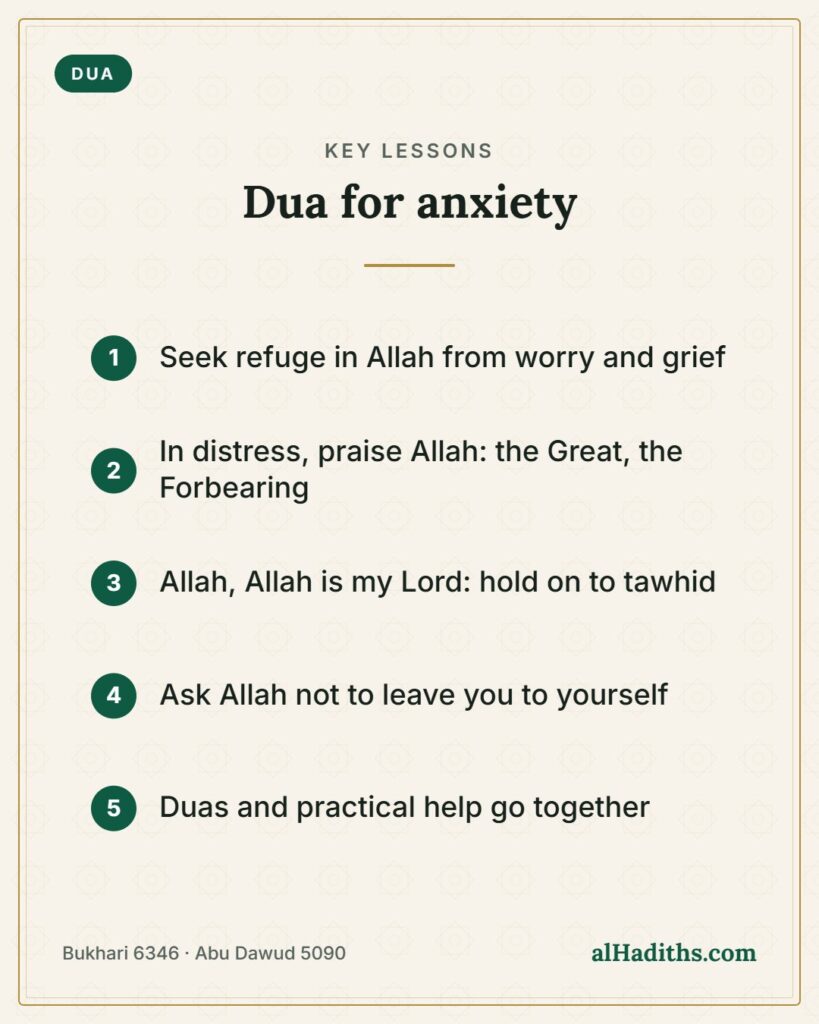
- The Prophet ﷺ sought refuge from worry and grief, so feeling them is not a lack of faith.
- At times of distress he praised Allah before asking for anything.
- The shortest dua, “Allah, Allah is my Lord”, is enough when words are hard.
- Ask Allah not to leave you to yourself for the blink of an eye.
- Make dua and take practical steps, including professional help when needed.
Part of our Dua series: see all our dua articles in one place.
May Allah replace every worry you carry today with ease, and make the Qur’an the spring of your heart.
Save this to Pinterest so these duas are close at hand when worry comes.
Share the reward. Send this article to someone who needs it today — teaching a hadith or dua can become a lasting good deed for you, in shaa Allah.