Halal Investing: What 6 Authentic Hadith Teach About Wealth
Contents
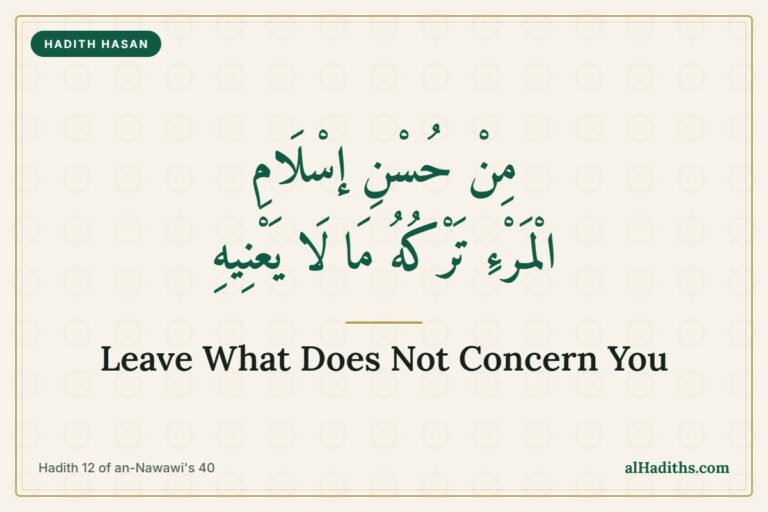
Most questions about halal investing start with products: which fund, which app, which shares. The hadith start somewhere else. They do not name any modern investment, but they set out how a Muslim earns, buys and sells: honestly, clearly, without cheating, and with a care for where the money comes from. Here are 6 authentic hadith on wealth and trade, all from Sahih al-Bukhari and Sahih Muslim.
At a glance
- Hadith: 6 (Bukhari, Muslim)
- Grades: Sahih (Bukhari and Muslim)
- Topic: Earning, trade and wealth
- Key hadith: Truth brings blessing to a sale (Bukhari 2079)
- Do today: Before your next deal, ask: is anything hidden from the other side?
1. Truth and clarity bring blessing
Hakim ibn Hizam (may Allah be pleased with him) narrated that the Messenger of Allah ﷺ said:
الْبَيِّعَانِ بِالْخِيَارِ مَا لَمْ يَتَفَرَّقَا ـ أَوْ قَالَ حَتَّى يَتَفَرَّقَا ـ فَإِنْ صَدَقَا وَبَيَّنَا بُورِكَ لَهُمَا فِي بَيْعِهِمَا، وَإِنْ كَتَمَا وَكَذَبَا مُحِقَتْ بَرَكَةُ بَيْعِهِمَا
“The buyer and the seller have the choice (to cancel) as long as they have not parted, or he said: until they part. If they are truthful and make things clear, their sale is blessed for them. If they hide things and lie, the blessing of their sale is erased.”
Sahih al-Bukhari 2079 · Narrated by Hakim ibn Hizam · Translation adapted from Sunnah.com
Blessing here is tied to two actions: telling the truth and making things clear. A deal can make a profit and still lose its blessing. Try this: before you sign or sell, list what the other side would want to know, and tell them.
2. Stay away from deals built on uncertainty
Abu Hurairah (may Allah be pleased with him) reported:
نَهَى رَسُولُ اللَّهِ صلى الله عليه وسلم عَنْ بَيْعِ الْحَصَاةِ وَعَنْ بَيْعِ الْغَرَرِ
“The Messenger of Allah ﷺ forbade the pebble sale and the sale involving uncertainty (gharar).”
Sahih Muslim 1513 · Narrated by Abu Hurairah · Translation adapted from Sunnah.com
In the pebble sale, a throw of a stone decided what was sold. Gharar is uncertainty about what is being bought or what it will cost. Scholars discuss in detail which modern contracts fall under it, so that is a question for a qualified scholar. Try this: if you cannot explain what you own and how it makes money, stop and ask before you buy.
3. Hiding a defect is cheating
Abu Hurairah (may Allah be pleased with him) narrated that the Prophet ﷺ passed a heap of food, put his hand in it and found it wet underneath. The owner said rain had fallen on it. The Prophet ﷺ said:
أَفَلاَ جَعَلْتَهُ فَوْقَ الطَّعَامِ كَىْ يَرَاهُ النَّاسُ مَنْ غَشَّ فَلَيْسَ مِنِّي
“Why did you not put it on top of the food so that people could see it? Whoever cheats is not of me.”
Sahih Muslim 102 · Narrated by Abu Hurairah · Translation adapted from Sunnah.com
The fault was not the rain. It was hiding the damaged part where buyers could not see it. Try this: when you sell or recommend anything, put the weak points where people can see them.
4. Swearing to sell erases the blessing
Abu Qatadah al-Ansari (may Allah be pleased with him) heard the Messenger of Allah ﷺ say:
إِيَّاكُمْ وَكَثْرَةَ الْحَلِفِ فِي الْبَيْعِ فَإِنَّهُ يُنَفِّقُ ثُمَّ يَمْحَقُ
“Beware of swearing a lot when selling, for it makes the goods sell, then it wipes out (the blessing).”
Sahih Muslim 1607 · Narrated by Abu Qatadah al-Ansari · Translation adapted from Sunnah.com
Oaths can close a sale quickly, and that is the trap: the sale goes through, the blessing goes out. Try this: describe what you sell plainly, with no “wallahi” to push a deal.
5. Be easy when you buy, sell and collect
Jabir ibn ‘Abdullah (may Allah be pleased with them) narrated that the Messenger of Allah ﷺ said:
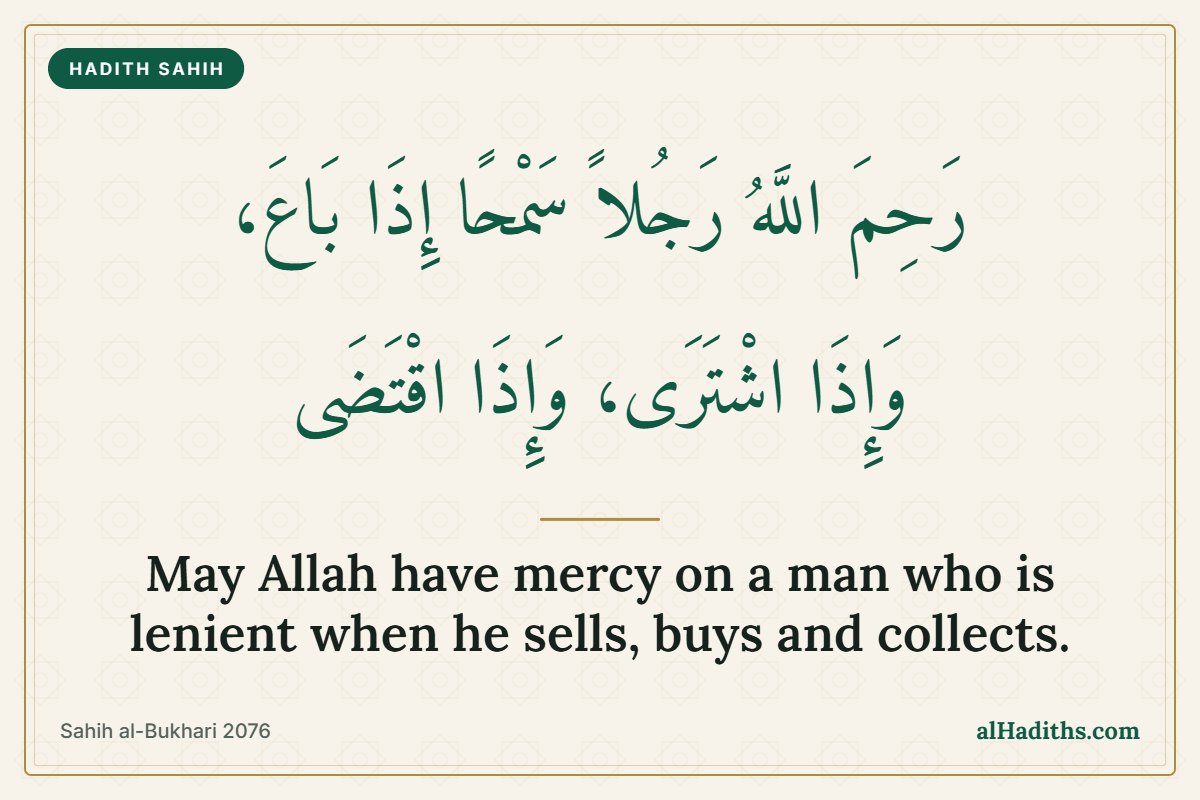
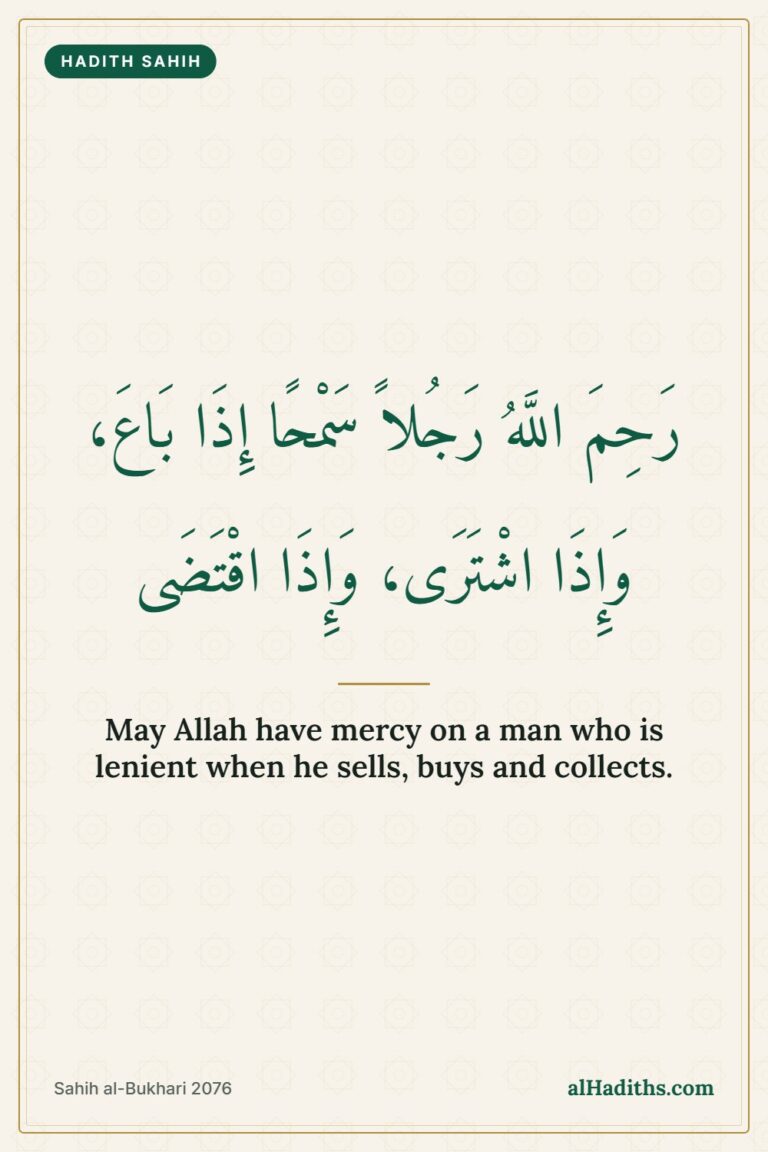
رَحِمَ اللَّهُ رَجُلاً سَمْحًا إِذَا بَاعَ، وَإِذَا اشْتَرَى، وَإِذَا اقْتَضَى
“May Allah have mercy on a man who is lenient when he sells, when he buys, and when he asks for repayment.”
Sahih al-Bukhari 2076 · Narrated by Jabir ibn ‘Abdullah · Translation adapted from Sunnah.com
HadeethEnc explains that such a person “does not make things hard for the poor and needy; rather, he asks them for repayment in a kind and gentle manner and gives respite to those unable to pay” (HadeethEnc 3716). Try this: if someone owes you, give them more time this month.
6. Care where your money comes from
Abu Hurairah (may Allah be pleased with him) narrated that the Prophet ﷺ said:
لَيَأْتِيَنَّ عَلَى النَّاسِ زَمَانٌ لاَ يُبَالِي الْمَرْءُ بِمَا أَخَذَ الْمَالَ، أَمِنْ حَلاَلٍ أَمْ مِنْ حَرَامٍ
“A time will certainly come upon people when a person will not care how he takes money, whether from halal or from haram.”
Sahih al-Bukhari 2083 · Narrated by Abu Hurairah · Translation adapted from Sunnah.com
This is a warning, not a prediction to accept. Asking where money comes from is the habit that keeps a person out of that description. Try this: for each source of income you have, ask: do I know how this money is made?
Bringing it together: what this means for halal investing
Reflection: these hadith do not tell us which shares, funds or apps are halal, and this article does not either. What they give is a test for any way of earning: is it truthful, is it clear, is anything hidden, is it built on chance, and do I know where the money comes from? Interest (riba) is covered in Riba in Islam, and the line between clear and doubtful matters in Halal Is Clear and Haram Is Clear.
This is not a fiqh ruling or financial advice. For a ruling on a specific investment, ask a qualified scholar; for financial decisions, speak to a licensed adviser.
Questions people ask
Does this article say which investments are halal?
No. It shares what authentic hadith teach about honest trade and earning. Whether a specific fund, share or app is permissible is a question for a qualified scholar.
Is day trading haram?
Scholars differ on day trading and on many modern contracts, often because of uncertainty (gharar) and interest. This site does not give rulings, so ask a qualified scholar about your situation.
What does Islam say about halal income?
The Prophet ﷺ warned of a time when people would not care whether money came from halal or haram (Bukhari 2083). See also our article on Allah is Good and accepts only good.
Is the hadith “the truthful merchant is with the prophets” authentic?
It is in Jami‘ at-Tirmidhi (Tirmidhi 1209), graded Da‘if (Darussalam) on Sunnah.com, so it is not used here.
Key lessons
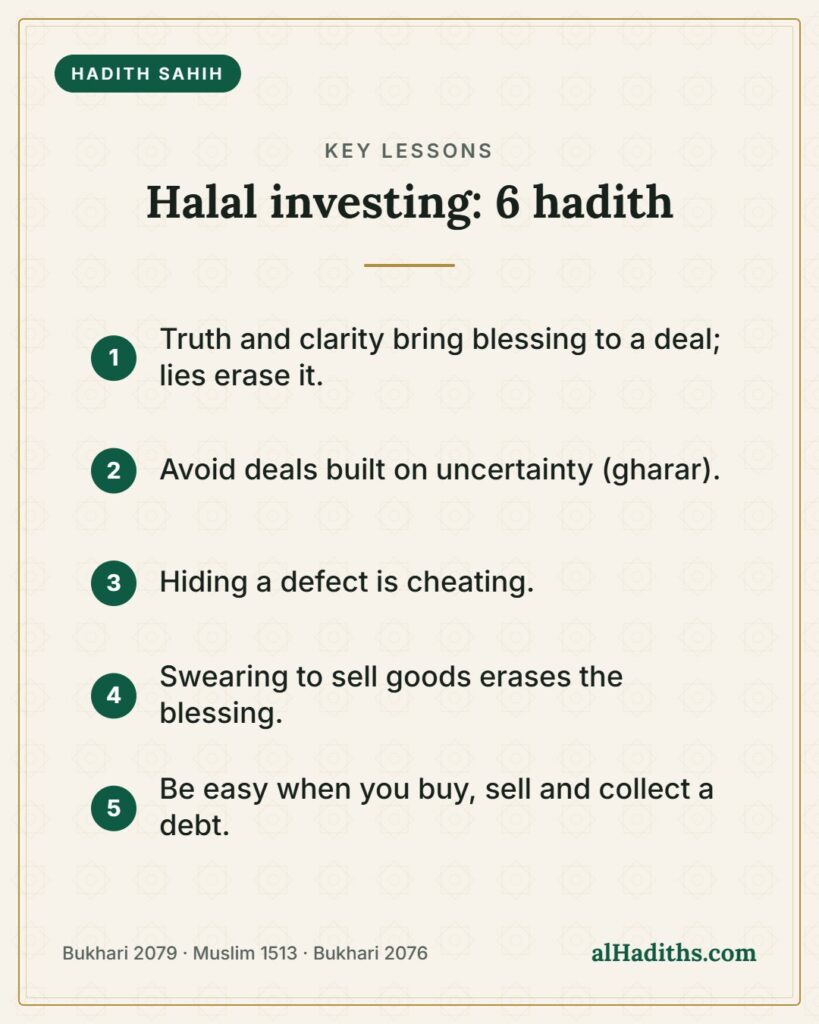
- Truthfulness and clarity bring blessing to a deal; lies and hiding erase it (Bukhari 2079).
- The Prophet ﷺ forbade sales built on uncertainty (Muslim 1513).
- Hiding a defect is cheating (Muslim 102).
- Swearing to sell erases the blessing (Muslim 1607).
- Be lenient in buying, selling and collecting debts (Bukhari 2076), and care where your money comes from (Bukhari 2083).
Before the next question about which product to choose, take the one question these hadith keep asking: is my earning truthful, clear and clean?
Save this to Pinterest so you can check your earnings against these hadith
Share the reward. Send this article to someone who needs it today — teaching a hadith or dua can become a lasting good deed for you, in shaa Allah.