Dua for Looking in the Mirror: Is It Authentic?
Contents
You catch your reflection on the way out and remember a forwarded message: there is a sunnah dua for looking in the mirror. It is shared in apps, posters and school notes. But is it authentic? The short answer: the narrations that tie a dua to the mirror are all weak, and some are fabricated. The good news is that the words themselves come to us in an authentic hadith, as a dua for good character that we can say at any time.
At a glance
- Popular claim: A special dua to say when looking in the mirror
- Status: Not authentic: every mirror narration is weak, some fabricated
- Authentic alternative: The dua for good character, Bulugh al-Maram 1537 (Sahih)
- Topic: Dua, good character
- Do today: Say the dua for good character, at any time of the day
Is there a dua for looking in the mirror?
Not an authentic one. Several narrations say the Prophet ﷺ praised Allah and asked for good character when he looked in a mirror. They are reported from ‘Ali, Ibn ‘Abbas, ‘Aishah and Anas (may Allah be pleased with them) in later books such as Ibn as-Sunni’s ‘Amal al-Yawm wal-Laylah and at-Tabarani’s al-Awsat. None of them is in Sahih al-Bukhari, Sahih Muslim or the other four of the six books.
The footnote on Bulugh al-Maram 1537 at Sunnah.com sums it up: this is a general dua a Muslim can make at any time, and tying it to looking in the mirror is not authentic. It refers to Shaykh al-Albani’s Irwa’ al-Ghalil (no. 74). Because the mirror versions are weak, we give no Arabic card for them here. If grading terms are new to you, our guide to sahih, hasan and weak hadith explains them.
How scholars graded the mirror narrations
IslamQA went through the chains one by one (answer 239755):
- From ‘Ali (Ibn as-Sunni 163): fabricated. One narrator was called a liar, and another was abandoned (matruk).
- From Ibn ‘Abbas (Abu Ya‘la 2611, Ibn as-Sunni 164): its chain has a narrator Imam Ahmad called a liar who fabricated hadith.
- From ‘Aishah (several books): chains with an abandoned or very weak narrator.
- From Anas (at-Tabarani, al-Awsat 787, and others): weak, with unknown and rejected narrators.
Its conclusion: the mirror hadith is weak in all its chains, and calling it hasan is not correct. The dua itself is authentic from the Prophet ﷺ in general terms, with no mention of a mirror.
1. The authentic dua for good character
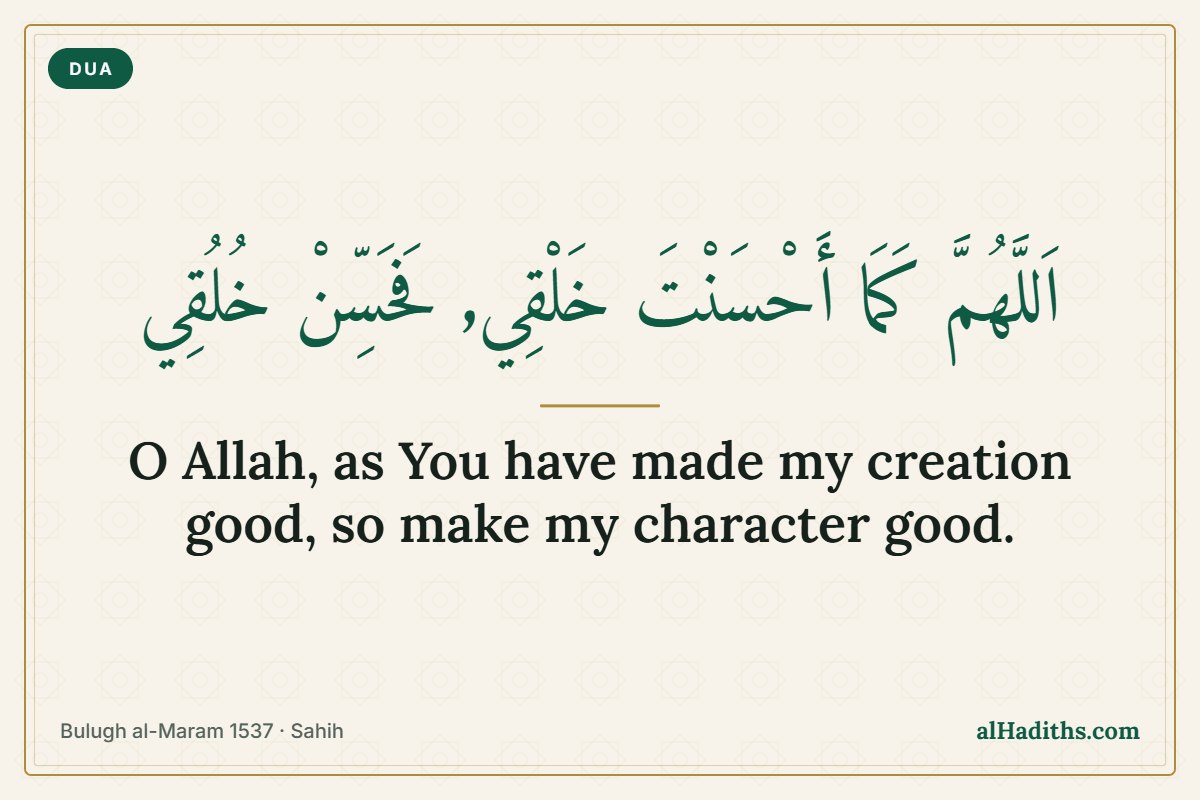
‘Abdullah ibn Mas‘ud (may Allah be pleased with him) reported that the Prophet ﷺ used to make this dua.
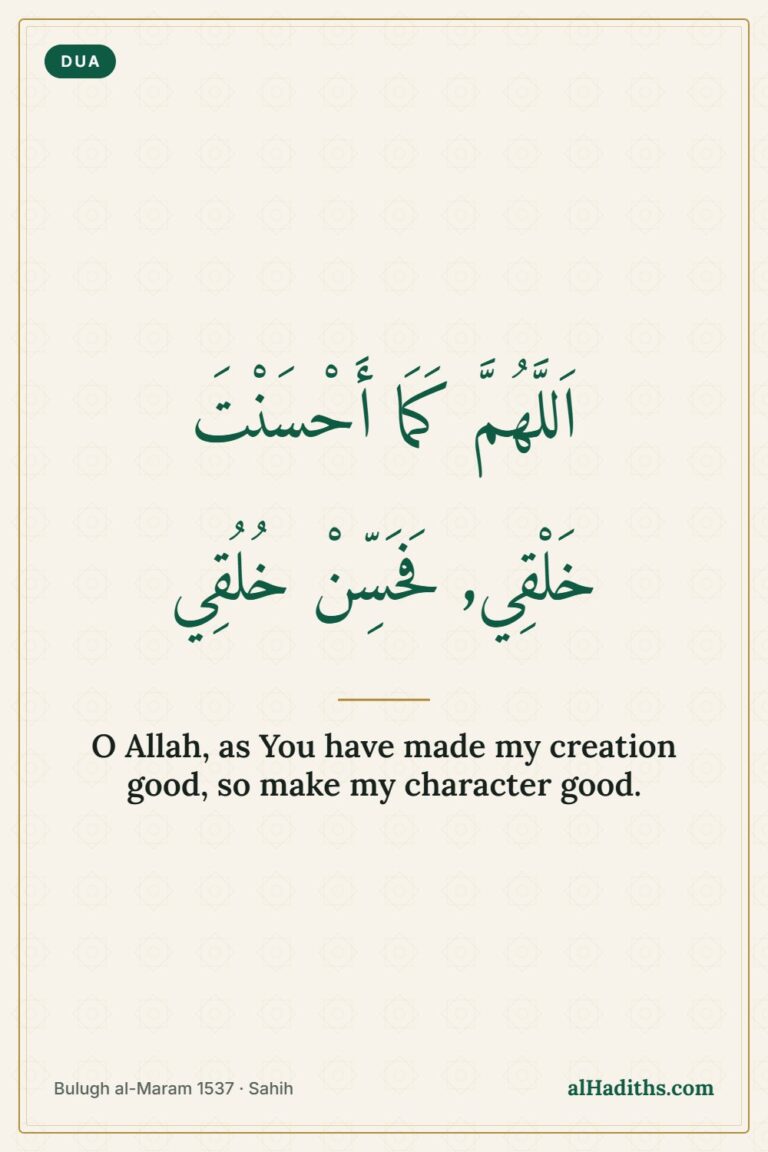
اَللَّهُمَّ كَمَا أَحْسَنْتَ خَلْقِي, فَحَسِّنْ خُلُقِي
Allahumma kama ahsanta khalqi, fa-hassin khuluqi
“O Allah, as You have made my creation good, so make my character good.”
Bulugh al-Maram 1537 · Reported by Ahmad · Sahih (Ibn Hibban) · Narrated by Ibn Mas‘ud · Translation adapted from Sunnah.com
The two Arabic words look almost the same: khalq is our outward creation, and khuluq is our character. The dua thanks Allah for the first and asks Him to perfect the second. The footnote in this edition grades it Sahih and mentions a supporting report from ‘Aishah in Musnad Ahmad. HadeethEnc also grades it Sahih.
Try this: learn the six words and say them in your own dua, in sujud or any time you remember. It does not need a mirror.
2. Nothing is heavier on the Scale than good character
Abu ad-Darda’ (may Allah be pleased with him) heard the Prophet ﷺ say why this dua matters so much.
مَا مِنْ شَيْءٍ يُوضَعُ فِي الْمِيزَانِ أَثْقَلُ مِنْ حُسْنِ الْخُلُقِ وَإِنَّ صَاحِبَ حُسْنِ الْخُلُقِ لَيَبْلُغُ بِهِ دَرَجَةَ صَاحِبِ الصَّوْمِ وَالصَّلاَةِ
“Nothing is placed on the Scale that is heavier than good character. Indeed, the person with good character will reach the rank of the person who fasts and prays.”
Jami‘ at-Tirmidhi 2003 · Hasan (Darussalam) · Narrated by Abu ad-Darda’ · Translation adapted from Sunnah.com
Our looks are a gift we did not earn. Our character is something we work on, and it is what will weigh on the Day of Judgement. That is why the dua asks for good character, not a better face.
Try this: pick one habit to improve this week, such as keeping your temper or speaking gently at home, and ask Allah for help with it.
3. The believer is his brother’s mirror
There is one authentic hadith with a mirror in it, and it is not about our reflection. Abu Hurairah (may Allah be pleased with him) narrated it.
الْمُؤْمِنُ مِرْآةُ الْمُؤْمِنِ وَالْمُؤْمِنُ أَخُو الْمُؤْمِنِ يَكُفُّ عَلَيْهِ ضَيْعَتَهُ وَيَحُوطُهُ مِنْ وَرَائِهِ
“The believer is the believer’s mirror, and the believer is the believer’s brother who guards him against loss and protects him when he is absent.”
Sunan Abi Dawud 4918 · Hasan (al-Albani) · Narrated by Abu Hurairah · Translation from Sunnah.com
A mirror shows a fault quietly and only to the one standing in front of it. In the same way, a good friend points out our mistakes privately and kindly, and protects our name when we are not there.
Try this: if you need to tell a friend about a mistake, do it in private and gently, the way a mirror would.
Bringing it together: a mirror is a reminder, not a ritual
The Quran reminds us who gave us our form:
خَلَقَ ٱلسَّمَـٰوَٰتِ وَٱلْأَرْضَ بِٱلْحَقِّ وَصَوَّرَكُمْ فَأَحْسَنَ صُوَرَكُمْ ۖ وَإِلَيْهِ ٱلْمَصِيرُ
“He created the heavens and earth in truth and formed you and perfected your forms; and to Him is the [final] destination.”
Surah at-Taghabun 64:3 · Translation: Saheeh International, from Quran.com
Reflection: I think the mirror dua spread because its words are beautiful and true. We lose nothing by letting the weak story go. The authentic dua is ours to say any time, and the authentic mirror is the friend who helps us grow. Next time you catch your reflection, there is no special sunnah to follow, but you can still thank Allah and ask Him for better character.
Questions people ask
Can I say this dua when I look in the mirror?
The dua for good character is authentic and can be said at any time, so nothing stops you from saying it then. What is not authentic is the claim that the Prophet ﷺ said it whenever he looked in a mirror, so we should not teach it as a mirror sunnah. For a ruling on your own practice, ask a qualified local scholar.
What is the mirror dua in Arabic?
The forwarded versions usually begin with “Alhamdulillah” and then ask Allah to make one’s character good, sometimes with extra lines. Because those wordings come only through weak chains, we do not give them an Arabic card. The authentic words are in section 1: Allahumma kama ahsanta khalqi, fa-hassin khuluqi.
Is looking in a mirror allowed in Islam?
Imam Malik reports that ‘Abdullah ibn ‘Umar looked in a mirror while in ihram to check something that was bothering him (Muwatta Malik, Book 20, Hadith 95). Beyond that report we give no ruling here; for questions about your own situation, ask a qualified local scholar.
Key lessons
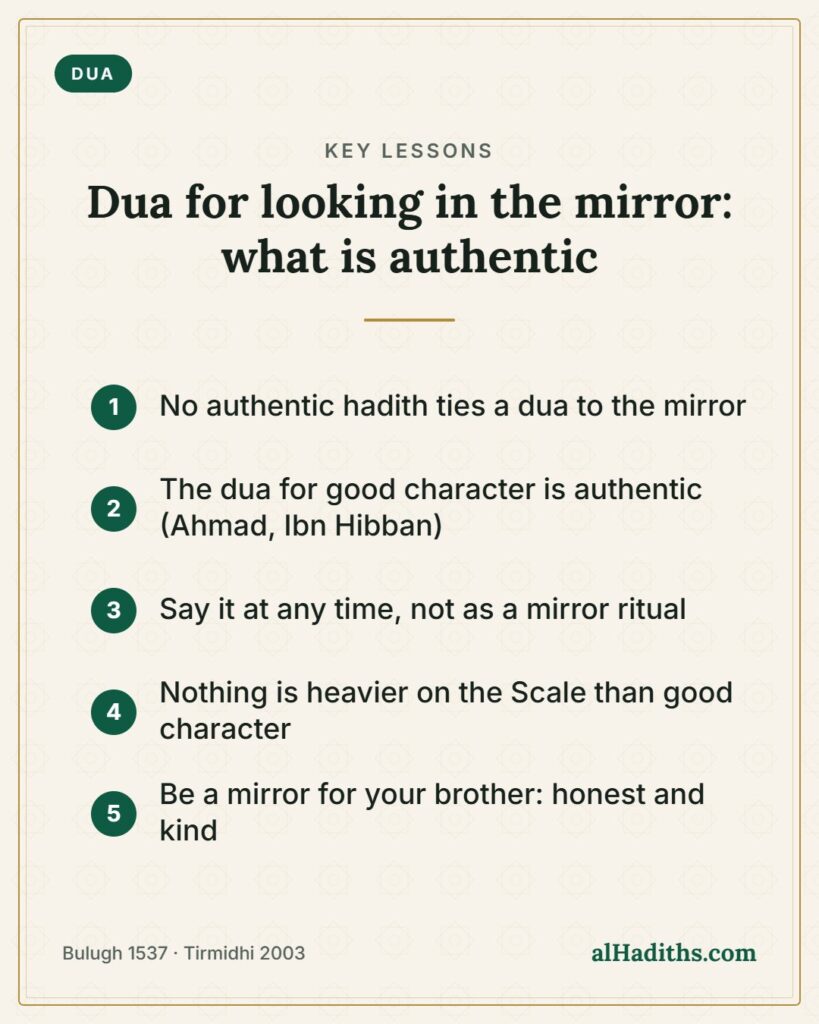
- The narrations that tie a dua to the mirror are all weak, and some are fabricated.
- The dua “O Allah, as You have made my creation good, so make my character good” is authentic (Ahmad; Sahih by Ibn Hibban).
- Say it at any time, without teaching it as a mirror sunnah.
- Nothing is heavier on the Scale than good character (Tirmidhi 2003).
- The believer is his brother’s mirror: correct gently and in private.
Part of our Dua series: see all our dua articles in one place.
A mirror shows us our face for a moment. Good character is what people remember, and what stays on the Scale. May Allah make our character as good as the creation He gave us.
Save this to Pinterest so you can remember which dua for good character is authentic
Share the reward. Send this article to someone who needs it today — teaching a hadith or dua can become a lasting good deed for you, in shaa Allah.