Dua for Exam: Authentic Duas for Knowledge and Studying
Contents
Many students look for a dua for exam success the night before a paper, and find long lists of special prayers. The honest answer is simpler: no authentic hadith gives a dua made only for exams. What the Quran and the Sunnah do give us are duas for knowledge, for ease and against laziness, and each of them fits exam season. Here are five, with the Arabic, the meaning and when to say them.
At a glance
- Duas: 5 authentic duas for knowledge and studying
- Sources: Quran, Sahih Muslim, Sunan Ibn Majah
- Grade: Quran; hadith Sahih or Hasan
- Topic: Knowledge, studying and exams
- Today: Say “Rabbi zidni ‘ilma” before you open your notes
Is there a dua for exam in the hadith?
No authentic hadith teaches a dua for exams as such. What we do have are duas for knowledge, for ease in a task and for protection from laziness, and they suit studying and exams well. You can also ask Allah for success in your own words; the duas below are simply the ones with a verified source.
A dua is not a replacement for revision, and the hadith at the end of this article ties the two together.
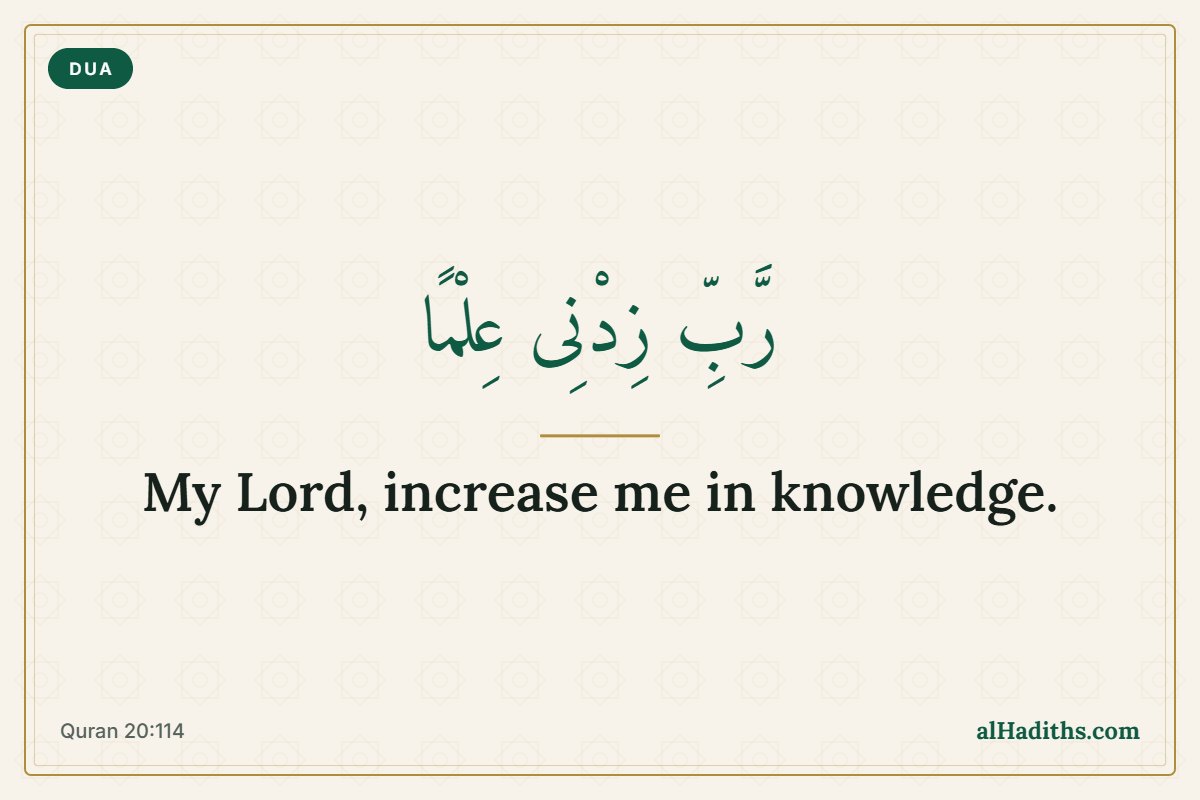
1. Rabbi zidni ‘ilma: increase me in knowledge
Allah taught this dua to the Prophet ﷺ in the Quran, in Surah Taha:
فَتَعَـٰلَى ٱللَّهُ ٱلْمَلِكُ ٱلْحَقُّ ۗ وَلَا تَعْجَلْ بِٱلْقُرْءَانِ مِن قَبْلِ أَن يُقْضَىٰٓ إِلَيْكَ وَحْيُهُۥ ۖ وَقُل رَّبِّ زِدْنِى عِلْمًا
“So high [above all] is Allāh, the Sovereign, the Truth. And, [O Muḥammad], do not hasten with [recitation of] the Qur’ān before its revelation is completed to you, and say, ‘My Lord, increase me in knowledge.’”
Surah Taha 20:114 · Translation: Saheeh International, from Quran.com
The dua itself is the last line: Rabbi zidni ‘ilma, “My Lord, increase me in knowledge.” The verse gives no set time or number, so it can be said at any point: before a class, while revising, or as you sit down to an exam. It is a short dua with a large request: not one grade or one paper, but more knowledge.
Try this: say “Rabbi zidni ‘ilma” each time you open your notes this week.
2. Dua for beneficial knowledge after Fajr
Umm Salamah (may Allah be pleased with her) reported that when the Prophet ﷺ prayed Subh (Fajr), as he said the salam, he would say:
اللَّهُمَّ إِنِّي أَسْأَلُكَ عِلْمًا نَافِعًا، وَرِزْقًا طَيِّبًا، وَعَمَلاً مُتَقَبَّلاً
Allahumma inni as’aluka ‘ilman nafi‘an, wa rizqan tayyiban, wa ‘amalan mutaqabbalan.
“O Allah, I ask You for beneficial knowledge, goodly provision and acceptable deeds.”
Sunan Ibn Majah 925 · Sahih (Darussalam) · Narrated by Umm Salamah · Translation adapted from Sunnah.com
Three requests, and knowledge comes first. The dua does not ask for knowledge alone but for knowledge that benefits, then pairs it with good, lawful provision and deeds that Allah accepts. For a student, that is the whole picture: learning that is useful, a livelihood that is clean, and work that counts.
Try this: say it once after the salam of Fajr during exam season, and keep it after the exams are over.
3. Dua against laziness and useless knowledge
Zayd ibn Arqam (may Allah be pleased with him) said, “I only say to you what the Messenger of Allah ﷺ used to say.” He used to say:
اللَّهُمَّ إِنِّي أَعُوذُ بِكَ مِنَ الْعَجْزِ وَالْكَسَلِ وَالْجُبْنِ وَالْبُخْلِ وَالْهَرَمِ وَعَذَابِ الْقَبْرِ اللَّهُمَّ آتِ نَفْسِي تَقْوَاهَا وَزَكِّهَا أَنْتَ خَيْرُ مَنْ زَكَّاهَا أَنْتَ وَلِيُّهَا وَمَوْلاَهَا اللَّهُمَّ إِنِّي أَعُوذُ بِكَ مِنْ عِلْمٍ لاَ يَنْفَعُ وَمِنْ قَلْبٍ لاَ يَخْشَعُ وَمِنْ نَفْسٍ لاَ تَشْبَعُ وَمِنْ دَعْوَةٍ لاَ يُسْتَجَابُ لَهَا
Allahumma inni a‘udhu bika minal-‘ajzi wal-kasal, wal-jubni wal-bukhl, wal-harami wa ‘adhabil-qabr. Allahumma ati nafsi taqwaha, wa zakkiha anta khayru man zakkaha, anta waliyyuha wa mawlaha. Allahumma inni a‘udhu bika min ‘ilmin la yanfa‘, wa min qalbin la yakhsha‘, wa min nafsin la tashba‘, wa min da‘watin la yustajabu laha.
“O Allah, I seek refuge in You from inability, laziness, cowardice, miserliness, old age and the torment of the grave. O Allah, grant my soul its piety and purify it, for You are the best to purify it; You are its Protector and its Guardian. O Allah, I seek refuge in You from knowledge that does not benefit, from a heart that does not fear You, from a soul that is not satisfied, and from a supplication that is not answered.”
Sahih Muslim 2722 · Narrated by Zayd ibn Arqam · Translation adapted from Sunnah.com
The HadeethEnc explanation separates the first two: inability is not being able to act, and laziness is not wanting to. In its words, “the incapable cannot act, and the lazy does not want to.” It explains knowledge that does not benefit as knowledge that brings no benefit in the Hereafter, or knowledge that is not acted upon. A shorter version with the last four requests is in Sunan an-Nasa’i 5536 (Sahih, Darussalam), narrated by Abu Hurairah.
Try this: on a day when you cannot get started, say this dua, then begin with one small task, such as a single page of notes.
4. Ask Allah for beneficial knowledge
Jabir (may Allah be pleased with him) reported that the Messenger of Allah ﷺ said:
سَلُوا اللَّهَ عِلْمًا نَافِعًا وَتَعَوَّذُوا بِاللَّهِ مِنْ عِلْمٍ لاَ يَنْفَعُ
“Ask Allah for beneficial knowledge and seek refuge with Allah from knowledge that is of no benefit.”
Sunan Ibn Majah 3843 · Hasan (Darussalam) · Narrated by Jabir · Translation adapted from Sunnah.com
Here the Prophet ﷺ does not only make the dua himself; he tells us to make it. The dua after Fajr above is one way to ask, and the dua from Sahih Muslim is one way to seek refuge.
Try this: before a study session, ask Allah in your own words for knowledge that will help you in this life and the next.
5. Musa’s dua for ease: Rabbish-rah li sadri
When Allah sent Musa (peace be upon him) to Pharaoh, he asked Allah for four things:
قَالَ رَبِّ ٱشْرَحْ لِى صَدْرِى وَيَسِّرْ لِىٓ أَمْرِى وَٱحْلُلْ عُقْدَةً مِّن لِّسَانِى يَفْقَهُوا۟ قَوْلِى
“[Moses] said, ‘My Lord, expand [i.e., relax] for me my breast [with assurance], and ease for me my task, and untie the knot from my tongue, that they may understand my speech.’”
Surah Taha 20:25-28 · Translation: Saheeh International, from Quran.com
The words are: Rabbish-rah li sadri, wa yassir li amri, wahlul ‘uqdatan min lisani, yafqahu qawli. Many students say it before exams and oral presentations. That use is not stated in a hadith; it is a Quranic dua for an open heart, an easy task and clear speech, which is why it fits a hard day.
Try this: say it before an oral exam or presentation, then take a breath and speak slowly.
Bringing it together
Dua and effort go together. Abu Hurairah (may Allah be pleased with him) reported that the Messenger of Allah ﷺ said:
مَنْ سَلَكَ طَرِيقًا يَلْتَمِسُ فِيهِ عِلْمًا سَهَّلَ اللَّهُ لَهُ طَرِيقًا إِلَى الْجَنَّةِ
“Whoever takes a path upon which to obtain knowledge, Allah makes the path to Paradise easy for him.”
Jami‘ at-Tirmidhi 2646 · Sahih (Darussalam) · Narrated by Abu Hurairah · Translation adapted from Sunnah.com
The same words are part of a longer hadith in Sahih Muslim 2699.
Reflection: an exam is one step on that path. Make the dua, do the revision, sleep, and walk in calmly. The result is from Allah, and the effort is never wasted.
Questions people ask
Is there a special dua for exams?
No authentic hadith gives a dua made only for exams. The duas in this article are authentic duas for knowledge, ease and protection from laziness, and any of them can be said before studying or an exam. You can also ask Allah for success in your own words.
What does Rabbi zidni ‘ilma mean, and when do I say it?
It means “My Lord, increase me in knowledge” and comes from Surah Taha 20:114. The verse gives no fixed time or number, so it can be said at any time: before a class, while revising or before an exam.
Is the dua “Allahumman-fa‘ni bima ‘allamtani” authentic?
It is in Jami‘ at-Tirmidhi 3599 and Sunan Ibn Majah 251, both graded Da‘if (Darussalam) on Sunnah.com, so it is not used here. The Quran’s “Rabbi zidni ‘ilma” asks for the same increase in knowledge with an authentic source.
Key lessons
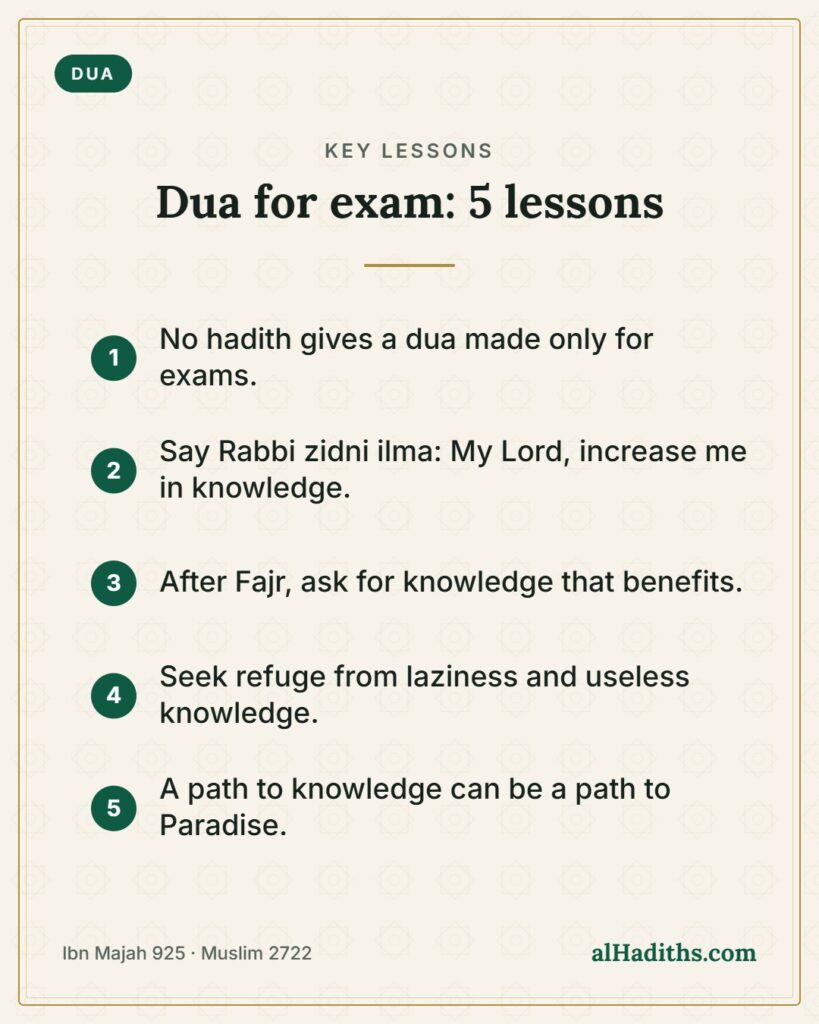
- No authentic hadith gives a dua made only for exams.
- Say “Rabbi zidni ‘ilma”: My Lord, increase me in knowledge.
- After Fajr, ask Allah for beneficial knowledge, good provision and accepted deeds.
- Seek refuge from inability, laziness and knowledge that does not benefit.
- Whoever takes a path to knowledge, Allah eases their path to Paradise.
Part of our Dua series: see all our dua articles in one place.
May Allah make your studies a path to good, and give you calm on the day of your exam.
Save this to Pinterest so you can say it before your next exam
Share the reward. Send this article to someone who needs it today — teaching a hadith or dua can become a lasting good deed for you, in shaa Allah.