Dua for Breaking Fast: The Authentic Iftar Dua From the Sunnah
Contents
The sun sets, the adhan for Maghrib begins, and you lift a date to your mouth. What did the Prophet ﷺ say at that moment? The authentic dua for breaking fast is short: “Dhahaba az-zama’u wabtallatil-‘uruqu wa thabatal-ajru in sha’ Allah.” Here it is in Arabic with its meaning and grade, when to say it, what the Sunnah says about breaking the fast, the dua for someone who feeds you, and why the most-shared iftar dua is weak.
At a glance
- Source: Sunan Abi Dawud 2357
- Narrated by: ‘Abdullah ibn ‘Umar
- Grade: Hasan (al-Albani)
- Topic: Iftar, the meal that breaks the fast
- Practise it: Say it right after your first sip of water or first date
The dua for breaking fast
‘Abdullah ibn ‘Umar (may Allah be pleased with him) reported that when the Prophet ﷺ broke his fast, he would say:
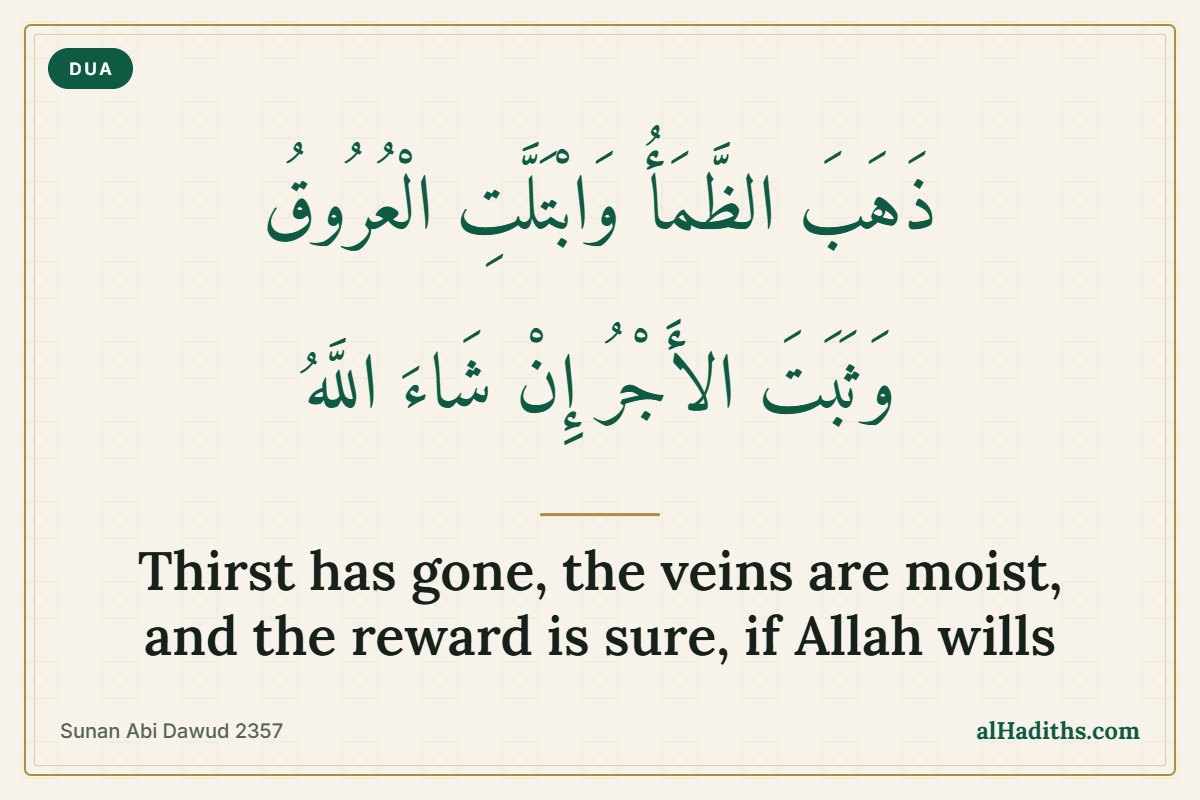
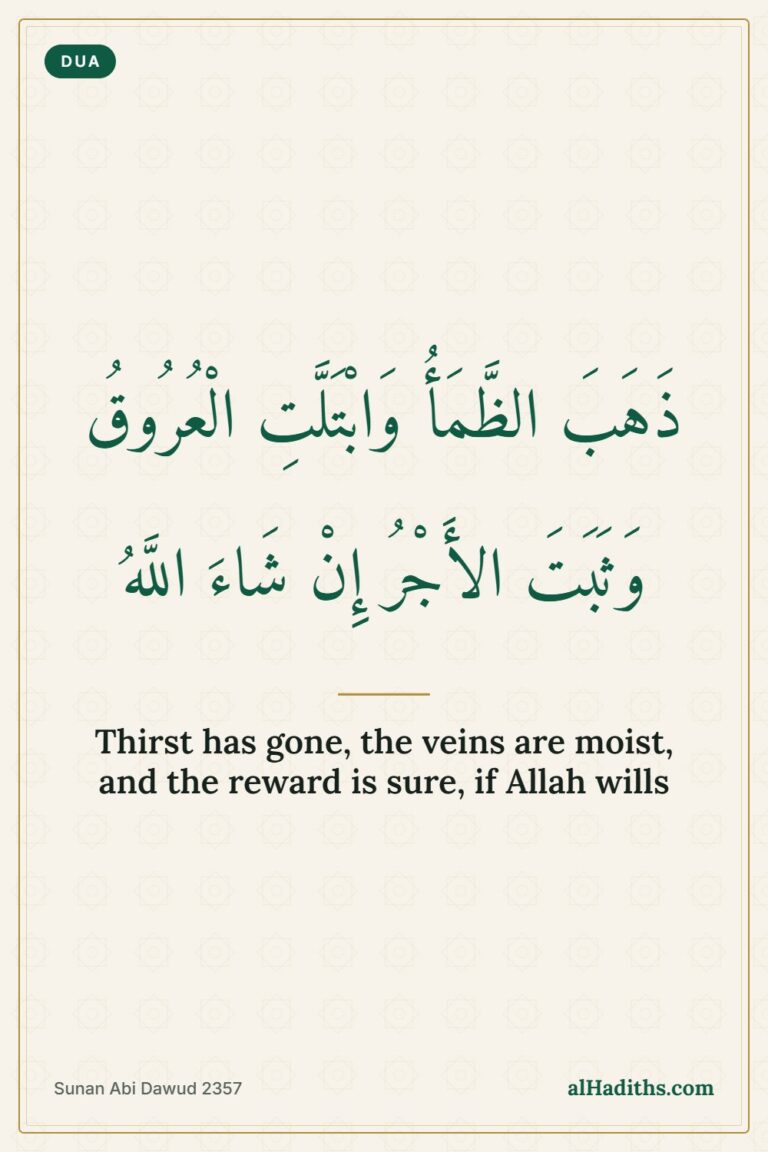
ذَهَبَ الظَّمَأُ وَابْتَلَّتِ الْعُرُوقُ وَثَبَتَ الأَجْرُ إِنْ شَاءَ اللَّهُ
Dhahaba az-zama’u wabtallatil-‘uruqu wa thabatal-ajru in sha’ Allah
“Thirst has gone, the veins are moist, and the reward is sure, if Allah wills.”
Sunan Abi Dawud 2357 · Hasan (al-Albani) · Narrated by Ibn ‘Umar · Translation adapted from Sunnah.com
IslamQA also cites Ibn Hajar, who reported that ad-Daraqutni called its chain sound (IslamQA 26879). It is the iftar dua that is established from the Prophet ﷺ himself.
What the iftar dua means
The dua has three parts, and each one describes the moment of iftar:
- Thirst has gone (dhahaba az-zama’u): the dryness of the day is over.
- The veins are moist (wabtallatil-‘uruqu): water reaches the body again.
- The reward is sure, if Allah wills (wa thabatal-ajru in sha’ Allah): the tiredness passes, and the reward of the fast remains, with Allah.
Reflection: the dua turns a physical relief into a reminder. The thirst lasted a few hours and is already gone; the reward, by Allah’s will, stays. That is the trade of every fasting day.
When to say it: after you break your fast
The words are in the past tense (“thirst has gone”), so this dua is said after the first sip or bite, not before. IslamQA explains that this dhikr can only be said after breaking the fast (IslamQA 293455).
The minutes before iftar are also a time for your own duas. ‘Abdullah ibn ‘Amr (may Allah be pleased with him) narrated:
إِنَّ لِلصَّائِمِ عِنْدَ فِطْرِهِ لَدَعْوَةً مَا تُرَدُّ
“The fasting person has, when he breaks his fast, a supplication that is not turned back.”
Sunan Ibn Majah 1753 · Hasan (Darussalam) · Narrated by ‘Abdullah ibn ‘Amr · Translation adapted from Sunnah.com
In the same report, one of the narrators says he heard ‘Abdullah ibn ‘Amr himself say at iftar: “O Allah, I ask You by Your mercy, which encompasses all things, to forgive me.” That is a Companion’s own dua, a good one to say, but it is not a dua the Prophet ﷺ taught for iftar. A similar promise is in Jami‘ at-Tirmidhi 3598 (Hasan, Darussalam), which counts the fasting person among three whose dua is not rejected.
What the Prophet ﷺ broke his fast with
Anas ibn Malik (may Allah be pleased with him) described the Prophet’s ﷺ iftar:
كَانَ رَسُولُ اللَّهِ صلى الله عليه وسلم يُفْطِرُ عَلَى رُطَبَاتٍ قَبْلَ أَنْ يُصَلِّيَ فَإِنْ لَمْ تَكُنْ رُطَبَاتٌ فَعَلَى تَمَرَاتٍ فَإِنْ لَمْ تَكُنْ حَسَا حَسَوَاتٍ مِنْ مَاءٍ
“The Messenger of Allah ﷺ used to break his fast before praying with some fresh dates; if there were no fresh dates, then with a few dry dates; and if there were no dry dates, he took a few sips of water.”
Sunan Abi Dawud 2356 · Hasan Sahih (al-Albani) · Narrated by Anas ibn Malik · Translation adapted from Sunnah.com
He also encouraged breaking the fast on time, without delay:
لاَ يَزَالُ النَّاسُ بِخَيْرٍ مَا عَجَّلُوا الْفِطْرَ
“The people will remain upon good as long as they hasten to break the fast.”
Sahih al-Bukhari 1957 · Narrated by Sahl ibn Sa‘d · Translation adapted from Sunnah.com
The time itself is sunset: when night comes from the east, the day leaves from the west and the sun has set, the fasting person breaks the fast (Sahih al-Bukhari 1954).
The iftar dua for your host
Anas (may Allah be pleased with him) reported that the Prophet ﷺ visited Sa‘d ibn ‘Ubadah, who brought bread and olive oil. He ate, and then said:
أَفْطَرَ عِنْدَكُمُ الصَّائِمُونَ وَأَكَلَ طَعَامَكُمُ الأَبْرَارُ وَصَلَّتْ عَلَيْكُمُ الْمَلاَئِكَةُ
Aftara ‘indakumus-sa’imun, wa akala ta‘amakumul-abrar, wa sallat ‘alaykumul-mala’ikah
“May fasting people break their fast with you, may the righteous eat your food, and may the angels pray for you.”
Sunan Abi Dawud 3854 · Sahih (al-Albani) · Narrated by Anas ibn Malik · Translation adapted from Sunnah.com
The hadith does not say the Prophet ﷺ was fasting that day, but its words fit anyone who hosts an iftar, which is why many Muslims say it to the family or masjid that feeds them in Ramadan.
What about “Allahumma laka sumtu”?
“Allahumma laka sumtu wa ‘ala rizqika aftartu” (O Allah, for You I have fasted, and with Your provision I have broken my fast) is the iftar dua many of us learned as children. Al-Albani graded it Da‘if (Sunan Abi Dawud 2358), so it should not be taught as the Prophet’s ﷺ dua. The meaning is fine, but the dua with a sound chain is “Dhahaba az-zama’u…”. We cover this and other popular weak narrations in Ramadan hadith: what is authentic and what is weak.
How to practise it
- Learn the three short phrases before Ramadan, so they come naturally at Maghrib.
- In the last minutes before sunset, put the phone down and make your own duas.
- Break the fast as soon as the sun sets, with a date or water if you can.
- After the first sip or date, say: “Dhahaba az-zama’u wabtallatil-‘uruqu wa thabatal-ajru in sha’ Allah.”
- When someone gives you iftar, make the host’s dua for them.
Questions people ask
What is the iftar dua in English?
“Thirst has gone, the veins are moist, and the reward is sure, if Allah wills.” In Arabic it is “Dhahaba az-zama’u wabtallatil-‘uruqu wa thabatal-ajru in sha’ Allah” (Sunan Abi Dawud 2357, graded Hasan by al-Albani).
Do you say the dua for breaking fast before or after eating?
After. The dua describes thirst that has already gone, so it is said after the first sip of water or first date. The minutes before iftar are a separate time for your own duas.
Is “Allahumma laka sumtu” authentic?
It is recorded in Sunan Abi Dawud 2358, but al-Albani graded it Da‘if (weak). Its meaning is good, but the authentic iftar dua is “Dhahaba az-zama’u…”.
What dua do you say when someone gives you iftar?
“Aftara ‘indakumus-sa’imun, wa akala ta‘amakumul-abrar, wa sallat ‘alaykumul-mala’ikah”: may fasting people break their fast with you, may the righteous eat your food, and may the angels pray for you (Sunan Abi Dawud 3854, Sahih according to al-Albani).
Key lessons
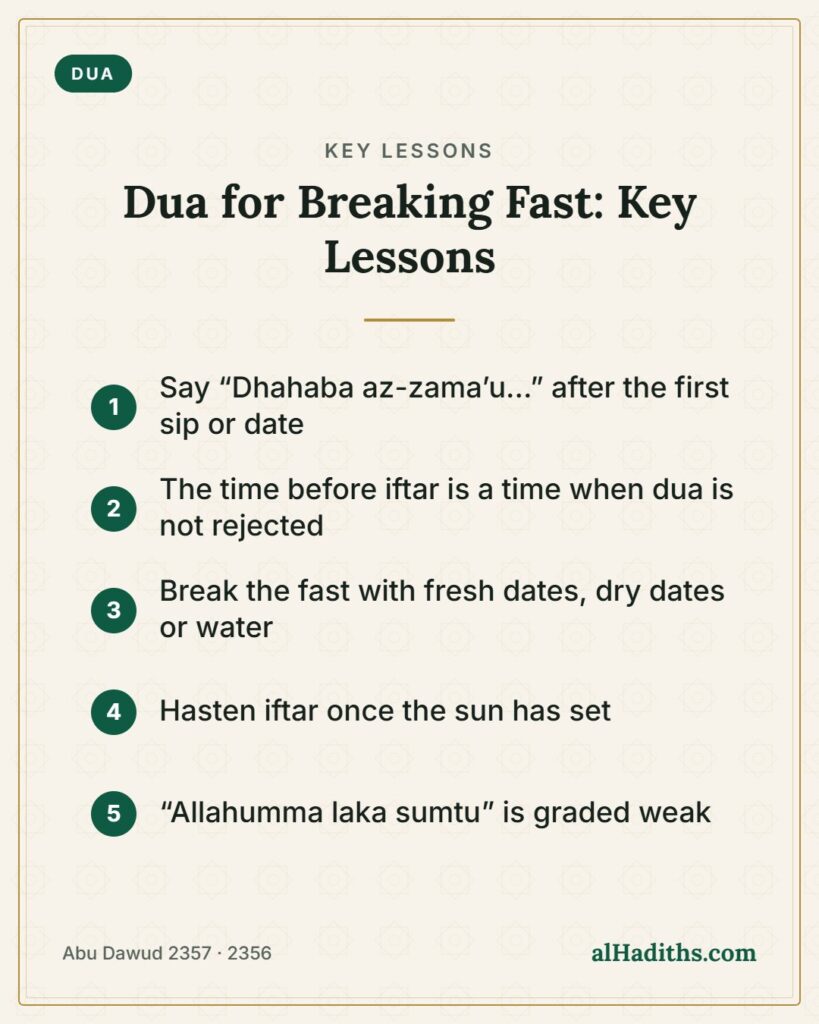
- The authentic dua for breaking fast is “Dhahaba az-zama’u wabtallatil-‘uruqu wa thabatal-ajru in sha’ Allah” (Abu Dawud 2357).
- It is said after breaking the fast, because it describes thirst that has gone.
- The fasting person’s dua at iftar is not turned back, so use the minutes before Maghrib.
- The Sunnah is to hasten iftar, with fresh dates, dry dates or water.
- “Allahumma laka sumtu” is graded weak; the host’s dua in Abu Dawud 3854 is sahih.
Part of our Dua series: see all our dua articles in one place.
May Allah let us reach Ramadan, accept our fasts, and make our iftar a time of thanks and answered duas.
Save this to Pinterest so you can say the authentic iftar dua this Ramadan
Share the reward. Send this article to someone who needs it today — teaching a hadith or dua can become a lasting good deed for you, in shaa Allah.