Ramadan Hadith: What Is Authentic and What Is Weak
Contents
Every year, as Ramadan gets close, the same messages start to circulate: the first ten days are mercy, the middle ten forgiveness, the last ten freedom from the Fire; a special dua for each part; “fast and you will be healthy”; even “the sleep of the fasting person is worship”. Some of what people forward is a real Ramadan hadith from Sahih al-Bukhari, and some of it is weak. This article gathers six authentic hadith on Ramadan and fasting, then labels the popular weak narrations with the scholars who graded them, so we can spend the month on what the Prophet ﷺ actually taught.
At a glance
- What it is: The 9th month of the Islamic calendar, when fasting is obligatory
- Authentic hadith here: 6, from Bukhari and at-Tirmidhi, plus Quran 2:183 and 23:118
- Weak: The “three ashras” sermon, “fast and you will be healthy”, “the sleep of the fasting person is worship”, “a lifetime of fasting cannot make up one day”, the “Allahumma laka sumtu” iftar dua
- Ramadan 2027: Expected to begin around 8 February 2027 (the moon sighting decides)
- One thing to do: Fast with faith and hope of reward, guard your tongue, and make dua before iftar every day
Why Allah made fasting obligatory
Before the hadith, the purpose. Allah tells us why fasting was prescribed for us, as it was for the nations before us:
يَـٰٓأَيُّهَا ٱلَّذِينَ ءَامَنُوا۟ كُتِبَ عَلَيْكُمُ ٱلصِّيَامُ كَمَا كُتِبَ عَلَى ٱلَّذِينَ مِن قَبْلِكُمْ لَعَلَّكُمْ تَتَّقُونَ
O you who have believed, decreed upon you is fasting as it was decreed upon those before you that you may become righteous
Surah al-Baqarah 2:183 · Translation: Saheeh International, from Quran.com
The goal is taqwa: being mindful of Allah. Every hadith below points to that same goal, from the gates of Paradise to the way a fasting person speaks.
1. The gates of Paradise open and the devils are chained
Abu Hurayrah (may Allah be pleased with him) reported what happens when the month begins:
إِذَا دَخَلَ شَهْرُ رَمَضَانَ فُتِّحَتْ أَبْوَابُ السَّمَاءِ، وَغُلِّقَتْ أَبْوَابُ جَهَنَّمَ، وَسُلْسِلَتِ الشَّيَاطِينُ
“When the month of Ramadan starts, the gates of heaven are opened, the gates of Hell are closed and the devils are chained.”
Sahih al-Bukhari 1899 · Narrated by Abu Hurayrah · Translation adapted from Sunnah.com
HadeethEnc explains that scholars asked how sins still happen if the devils are chained. Their answers: the restraint is for those who fast properly and keep its manners; or it is the most rebellious devils who are chained, as another narration says; or the meaning is that evil becomes less in this month, which we can see (HadeethEnc 10107). Our own desires and bad habits are still there, so a sin in Ramadan cannot simply be blamed on Shaytan.
Try this: pick one habit you usually blame on “whispers” and drop it for the whole month. With the devils chained, it is a good time to see how much of it was really us.
2. People are freed from the Fire every night
At-Tirmidhi records a fuller version of the same hadith, with a call that goes out on the very first night:
إِذَا كَانَ أَوَّلُ لَيْلَةٍ مِنْ شَهْرِ رَمَضَانَ صُفِّدَتِ الشَّيَاطِينُ وَمَرَدَةُ الْجِنِّ وَغُلِّقَتْ أَبْوَابُ النَّارِ فَلَمْ يُفْتَحْ مِنْهَا بَابٌ. وَفُتِّحَتْ أَبْوَابُ الْجَنَّةِ فَلَمْ يُغْلَقْ مِنْهَا بَابٌ وَيُنَادِي مُنَادٍ يَا بَاغِيَ الْخَيْرِ أَقْبِلْ وَيَا بَاغِيَ الشَّرِّ أَقْصِرْ وَلِلَّهِ عُتَقَاءُ مِنَ النَّارِ وَذَلِكَ كُلَّ لَيْلَةٍ
“On the first night of the month of Ramadan, the devils and the rebellious jinn are shackled, the gates of the Fire are shut so that none of them is opened, and the gates of Paradise are opened so that none of them is closed. A caller calls: ‘O seeker of good, come forward! O seeker of evil, stop!’ And Allah has people whom He frees from the Fire, and that is every night.”
Jami‘ at-Tirmidhi 682 · Hasan (Darussalam) · Narrated by Abu Hurayrah · Translation adapted from Sunnah.com
Notice the last words: every night. Freedom from the Fire is not saved for the last ten nights. It is offered from the first night to the last, which matters when we look at the “three ashras” narration below. The nights are also when tarawih is prayed; our guide to the tarawih prayer covers the authentic hadith on standing in Ramadan.
Try this: each night after iftar, ask Allah plainly to free you from the Fire and admit you to Paradise. A few sincere words, every night, all month.
3. Fasting with faith wipes away past sins
This is the best-known Ramadan hadith, and one of the most hopeful:
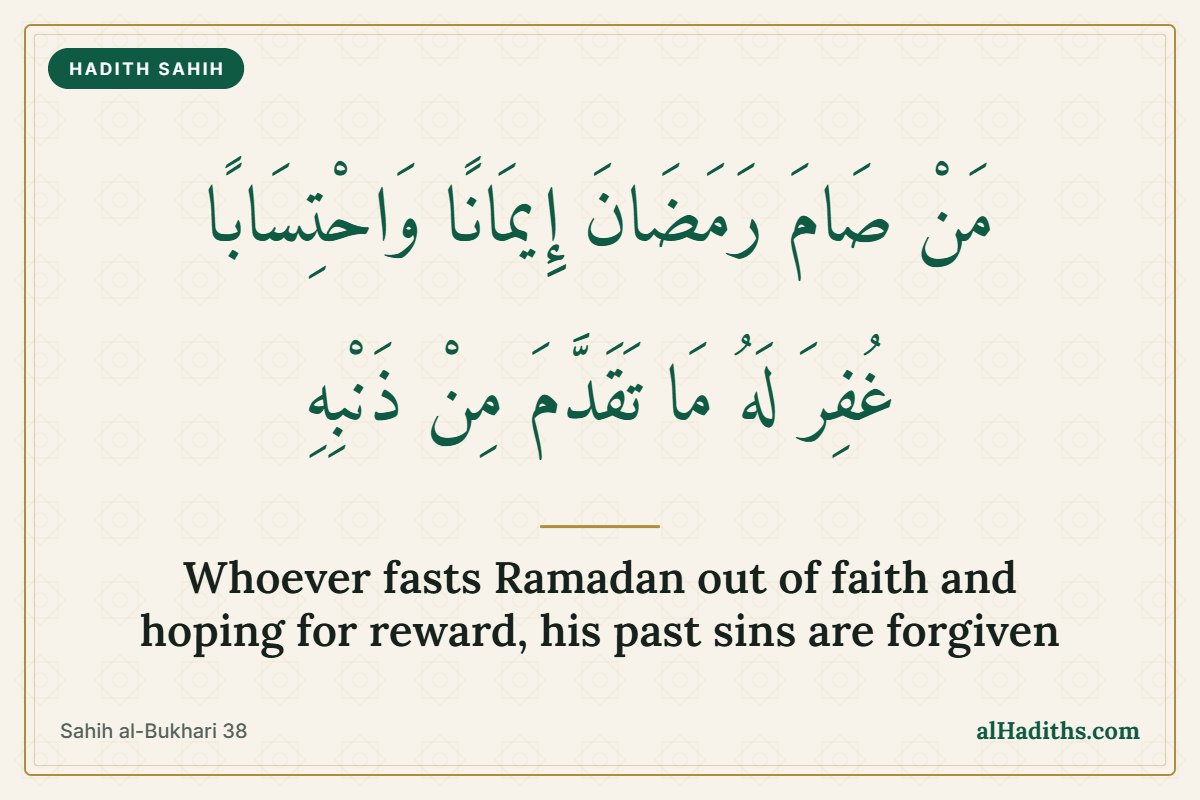
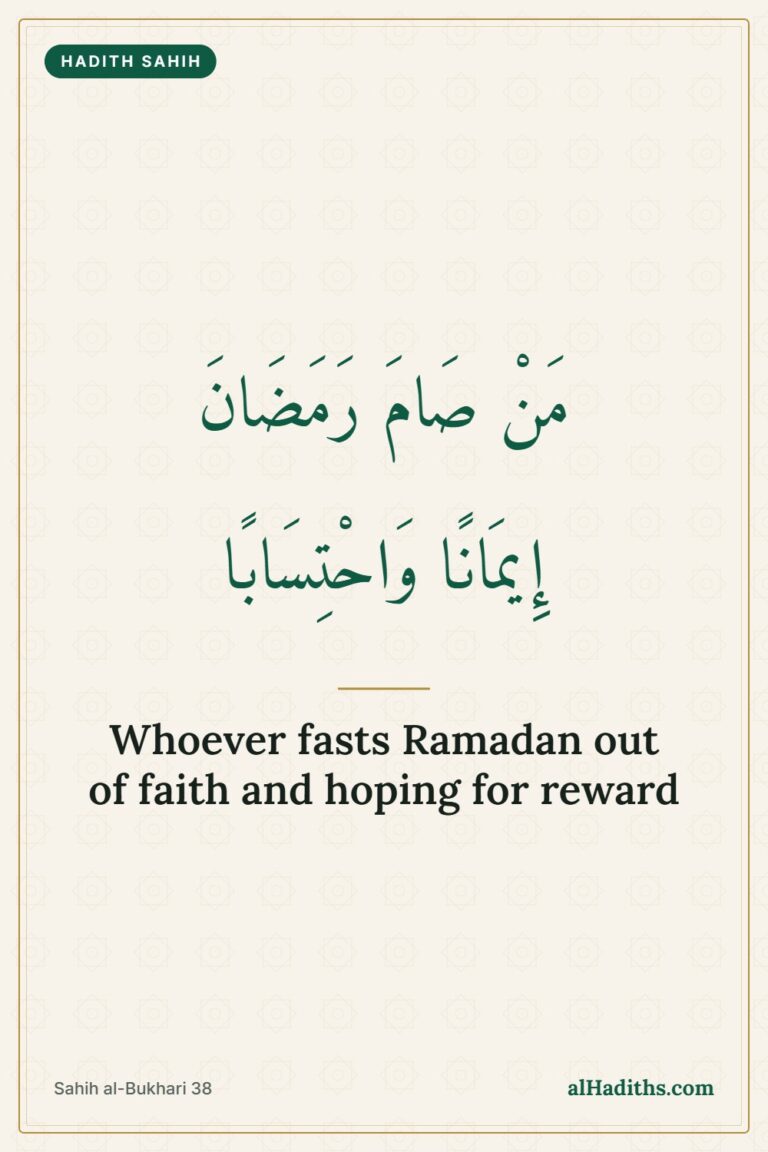
مَنْ صَامَ رَمَضَانَ إِيمَانًا وَاحْتِسَابًا غُفِرَ لَهُ مَا تَقَدَّمَ مِنْ ذَنْبِهِ
“Whoever fasts Ramadan out of faith and hoping for reward, his past sins will be forgiven.”
Sahih al-Bukhari 38 · Narrated by Abu Hurayrah · Translation adapted from Sunnah.com
HadeethEnc explains the two conditions: faith means believing in Allah and that fasting is His command, and hoping for reward means fasting for Allah’s pleasure, not to be seen or praised by people (HadeethEnc 4196). Fasting out of habit, or because everyone around us is fasting, is not the same thing.
Try this: before Fajr, renew your intention in your heart: “I am fasting today because Allah commanded it, and I hope for His reward.”
4. Fasting is for Allah, and it is a shield
In this hadith qudsi, the Prophet ﷺ relates what Allah said about fasting:
قَالَ اللَّهُ كُلُّ عَمَلِ ابْنِ آدَمَ لَهُ إِلاَّ الصِّيَامَ، فَإِنَّهُ لِي، وَأَنَا أَجْزِي بِهِ. وَالصِّيَامُ جُنَّةٌ
“Allah said: ‘Every deed of the son of Adam is for him except fasting; it is for Me, and I will give the reward for it.’ And fasting is a shield.”
Sahih al-Bukhari 1904 · Narrated by Abu Hurayrah · Translation adapted from Sunnah.com
The full narration goes on to say that a fasting person should avoid foul talk and quarrels, and if someone insults or fights him, he should say “I am fasting”. It also mentions two joys for the fasting person: one when he breaks his fast and one when he meets his Lord. A shield is something we hold up on purpose: fasting protects us from sin in this life and, as the Sunnah.com translation explains, from the Fire.
Try this: when someone provokes you this Ramadan, say the words from the hadith, “I am fasting”, and walk away.
5. A fast without good speech misses the point
Hunger and thirst alone are not what Allah wants from us:
مَنْ لَمْ يَدَعْ قَوْلَ الزُّورِ وَالْعَمَلَ بِهِ فَلَيْسَ لِلَّهِ حَاجَةٌ فِي أَنْ يَدَعَ طَعَامَهُ وَشَرَابَهُ
“Whoever does not give up false speech and acting on it, Allah has no need of his giving up his food and drink.”
Sahih al-Bukhari 1903 · Narrated by Abu Hurayrah · Translation adapted from Sunnah.com
This is a stern line. The fast is meant to change how we speak and act, not just when we eat. Lying, backbiting and harsh words can leave a person with nothing from the day but an empty stomach.
Try this: choose one sin of the tongue you know you fall into, and guard against it every fasting day.
6. The fasting person’s dua is not rejected
The time before iftar is one of the best times for dua:
ثَلاَثَةٌ لاَ تُرَدُّ دَعْوَتُهُمُ الصَّائِمُ حَتَّى يُفْطِرَ وَالإِمَامُ الْعَادِلُ وَدَعْوَةُ الْمَظْلُومِ يَرْفَعُهَا اللَّهُ فَوْقَ الْغَمَامِ وَيَفْتَحُ لَهَا أَبْوَابَ السَّمَاءِ وَيَقُولُ الرَّبُّ وَعِزَّتِي لأَنْصُرَنَّكَ وَلَوْ بَعْدَ حِينٍ
“There are three whose supplication is not rejected: the fasting person until he breaks his fast, the just leader, and the supplication of the one who is wronged. Allah raises it above the clouds and opens the gates of heaven to it, and the Lord says: ‘By My might, I will surely help you, even if after a while.’”
Jami‘ at-Tirmidhi 3598 · Hasan (Darussalam) · Narrated by Abu Hurayrah · Translation adapted from Sunnah.com
When he broke his fast, the Prophet ﷺ would say: “Thirst has gone, the veins are moist, and the reward is sure, if Allah wills” (Sunan Abi Dawud 2357, Hasan according to al-Albani). It is a short, authentic dua for iftar, and our guide to the dua for breaking fast explains it in detail.
Try this: keep the last ten minutes before Maghrib free from the phone and the kitchen, and spend them in dua.
Weak Ramadan hadith people share
The narrations below are popular, especially on WhatsApp and in Ramadan posters, but hadith scholars have graded them weak. We mention them only to label them, so there are no Arabic cards for them here. If the grading terms are new to you, our guide to sahih, hasan and weak hadith explains them.
“Its beginning is mercy, its middle forgiveness, its end freedom from the Fire”
This line comes from a long sermon attributed to Salman al-Farisi (may Allah be pleased with him), said to have been given on the last day of Sha‘ban. Ibn Khuzaymah recorded it (1887) under a chapter heading that adds “if the report is sound”. Al-Albani graded it Da‘if (Mishkat al-Masabih 1965), and IslamQA notes that Abu Hatim ar-Razi called it munkar (IslamQA 21364). For fairness: HadithAnswers, a Hanafi hadith service, also calls it weak but considers it usable for encouragement in virtues (HadithAnswers). Either way, it is not an authentic saying of the Prophet ﷺ, and the authentic hadith in section 2 already tells us that freedom from the Fire is offered every night, not only in the last ten.
The “ashra of Ramadan” duas
From that sermon came the idea of a set dua for each ashra of Ramadan (each set of ten days). The best known is the so-called first ashra dua, “Rabbighfir warham wa anta khayrur rahimin”. These words are real and beautiful, but they are from the Quran, not from a hadith about the first ten days:
وَقُل رَّبِّ ٱغْفِرْ وَٱرْحَمْ وَأَنتَ خَيْرُ ٱلرَّٰحِمِينَ
And, [O Muḥammad], say, “My Lord, forgive and have mercy, and You are the best of the merciful.”
Surah al-Mu’minun 23:118 · Translation: Saheeh International, from Quran.com
So this dua can be said on any day of the year, including in Ramadan. What has no basis is tying it, or any other wording, to one ashra only. IslamQA explains that singling out the first third of Ramadan for mercy, the second for forgiveness and the last for freedom from the Fire has no basis, because all of Ramadan is mercy, forgiveness and freedom from the Fire (IslamQA 220647). Ask for all three, every day.
“Fast and you will be healthy”
This short line is often quoted in health articles. The Permanent Committee for Fatwas graded it Da‘if; it is reported by at-Tabarani in al-Awsat and others, and one of its narrators, Nahshal, is abandoned (matruk) (al-feqh.com). Fasting may well bring benefits for the body, but we should not put that sentence in the Prophet’s ﷺ mouth.
“The sleep of the fasting person is worship”
Al-Bayhaqi recorded it and said its narrators are weak, al-‘Iraqi said one of them was among the liars, and al-Albani graded it Da‘if (IslamQA 106528). The Mufti of the Federal Territories in Malaysia also explains its weakness (Irsyad al-Hadith 370). Sleep with the intention of gaining strength for worship can be rewarded, but this narration is not a reason to sleep the fasting day away.
“Missing one fast cannot be made up by a lifetime of fasting”
The narration says that whoever breaks one day of Ramadan without a valid excuse could not make up for it by fasting forever. It is graded Da‘if by al-Albani (Sunan Abi Dawud 2396) and by Darussalam (Jami‘ at-Tirmidhi 723, Sunan Ibn Majah 1672). Breaking a Ramadan fast without excuse is still a serious sin; how it is made up is a question of fiqh, so ask a qualified local scholar.
The “Allahumma laka sumtu” iftar dua
“O Allah, for You I have fasted, and with Your provision I have broken my fast” is probably the most-shared iftar dua, but al-Albani graded it Da‘if (Sunan Abi Dawud 2358). The authentic dua for breaking the fast is the one in section 6: “Thirst has gone, the veins are moist, and the reward is sure, if Allah wills.”
Bringing it together
Put side by side, the authentic hadith say more than the weak ones ever did. Ramadan opens the gates of Paradise, frees people from the Fire every night, wipes away past sins for those who fast with faith, and gives the fasting person a dua that is not rejected. The weak narrations add a timetable (mercy, then forgiveness, then freedom) and promises the Prophet ﷺ did not make, and they can make us less careful with what we attribute to him.
Reflection: it is easy to forward a Ramadan poster because it sounds right. But the Prophet ﷺ warned against attributing to him what he did not say, and the authentic Sunnah on this month is already more than enough. This Ramadan, we can make it a small act of worship to check a hadith before we pass it on.
Questions people ask
When is Ramadan 2027?
Ramadan 1448 is expected to begin around 8 February 2027, with Eid al-Fitr around 9 or 10 March 2027. The moon sighting decides the exact dates, so follow your local mosque or authority. Our Islamic calendar lists the key dates of the year.
Is the hadith about the three ashras of Ramadan authentic?
No. The narration that Ramadan’s beginning is mercy, its middle forgiveness and its end freedom from the Fire comes from a sermon attributed to Salman al-Farisi; al-Albani graded it Da‘if, and Abu Hatim called it munkar. The authentic hadith say mercy, forgiveness and freedom from the Fire are offered throughout the month.
What is the first ashra dua?
It is usually given as “Rabbighfir warham wa anta khayrur rahimin” (My Lord, forgive and have mercy, and You are the best of the merciful). The words are from the Quran (23:118) and are good to say at any time, but no authentic hadith ties them to the first ten days of Ramadan.
Is “fast and you will be healthy” a hadith?
It is reported as one, but it is weak (Da‘if). The Permanent Committee for Fatwas graded it weak, and one of its narrators is abandoned. It should not be quoted as a saying of the Prophet ﷺ.
Which iftar dua is authentic?
“Dhahaba al-zama’u wabtallatil-‘uruqu wa thabatal-ajru in sha’ Allah” (Thirst has gone, the veins are moist, and the reward is sure, if Allah wills), from Sunan Abi Dawud 2357, graded Hasan by al-Albani. The well-known “Allahumma laka sumtu” (Abu Dawud 2358) is graded Da‘if.
Key lessons
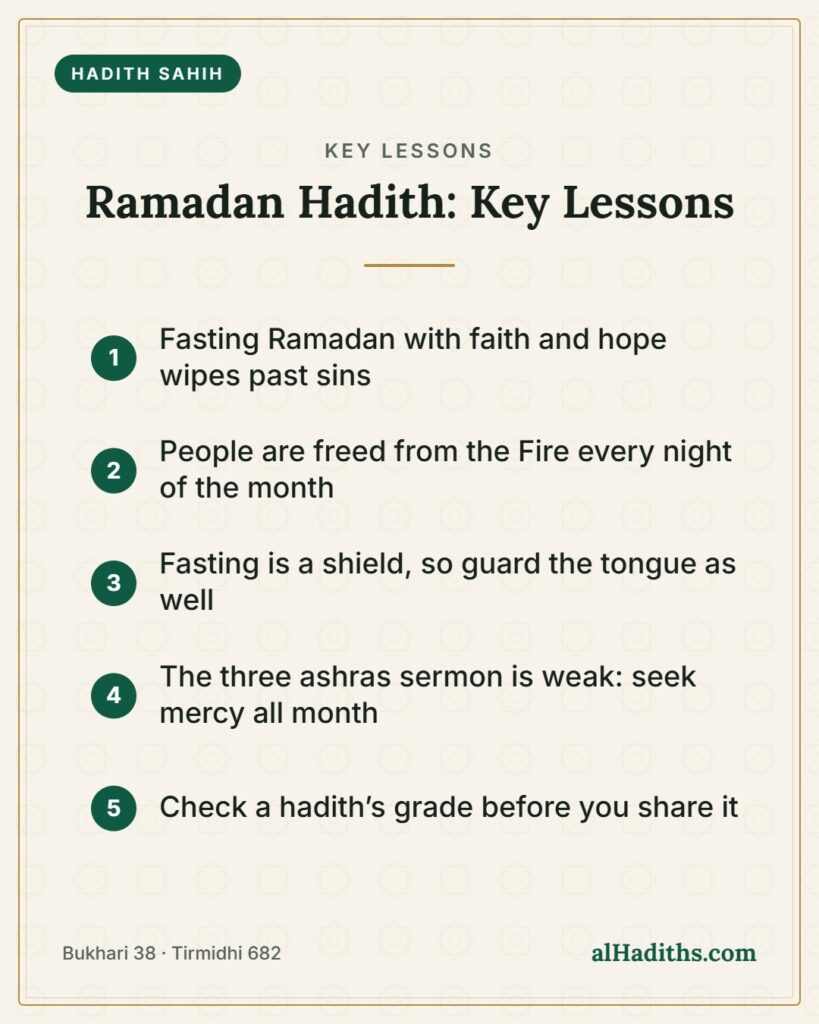
- Fasting Ramadan out of faith and hoping for reward wipes away past sins (Bukhari 38).
- Freedom from the Fire is offered every night of Ramadan, not only in the last ten (Tirmidhi 682).
- Fasting is a shield, and a fast without good speech misses its purpose (Bukhari 1903, 1904).
- The “three ashras” sermon and its set duas are weak; ask for mercy, forgiveness and freedom from the Fire every day.
- “Fast and you will be healthy”, “the sleep of the fasting person is worship” and “Allahumma laka sumtu” are graded weak.
May Allah let us reach Ramadan, accept our fasting and standing, and count us among those He frees from the Fire.
Save this to Pinterest so you can check a Ramadan hadith before you forward it
Share the reward. Send this article to someone who needs it today — teaching a hadith or dua can become a lasting good deed for you, in shaa Allah.