Dua of Musa: 6 Duas of Prophet Musa From the Quran
Contents
Before a hard conversation, after a mistake, or on a day when you have nothing left, Prophet Musa (Moses), peace be upon him, turned to Allah with a few honest words. The dua of Musa most people look for is “Rabbi inni lima anzalta ilayya min khairin faqir”, but the Quran records several more. Here are six of them, each with the Arabic from Quran.com, its meaning and the moment Musa said it.
At a glance
- Duas: 6, all from the Quran
- Where: Surah Ta-Ha, Surah Al-Qasas and Surah Al-A‘raf
- Grade: Quran text (no grading needed)
- Topic: The supplications of Prophet Musa
- One thing to do today: Say “Rabbi-shrah li sadri” before your next difficult conversation
1. Dua of Musa for speech and confidence
When Allah sent Musa to Pharaoh, his first request was not for victory but for help with the task itself:
قَالَ رَبِّ ٱشْرَحْ لِى صَدْرِى وَيَسِّرْ لِىٓ أَمْرِى وَٱحْلُلْ عُقْدَةً مِّن لِّسَانِى يَفْقَهُوا۟ قَوْلِى
“[Moses] said, ‘My Lord, expand [i.e., relax] for me my breast [with assurance] / And ease for me my task / And untie the knot from my tongue / That they may understand my speech.’”
Surah Ta-Ha 20:25–28 · Translation: Saheeh International, from Quran.com
Rabbi-shrah lī ṣadrī, wa yassir lī amrī, waḥlul ‘uqdatan min lisānī, yafqahū qawlī. He asked for a calm heart, an easy path and clear speech, so that the message would be understood. A few verses later (20:36) Allah tells him his request has been granted.
Try this: say it quietly before an exam, an interview or a talk. Using it for our own tasks is a common practice, not something the verse itself commands, and it fits because it asks for what every speaker needs.
2. When you are in need: “Rabbi inni lima anzalta”
Musa had fled Egypt and reached Madyan alone, tired and without money. After he watered the flock of two women who were waiting at the well, he sat in the shade and said:
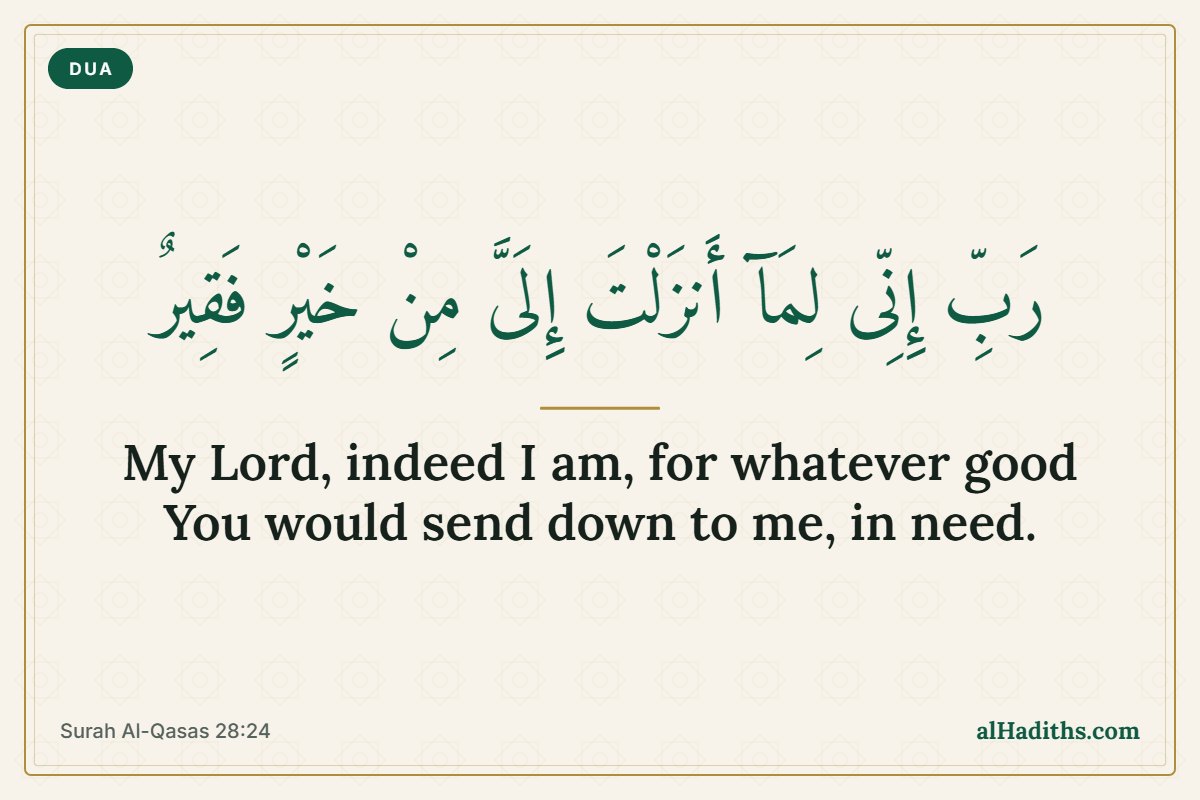
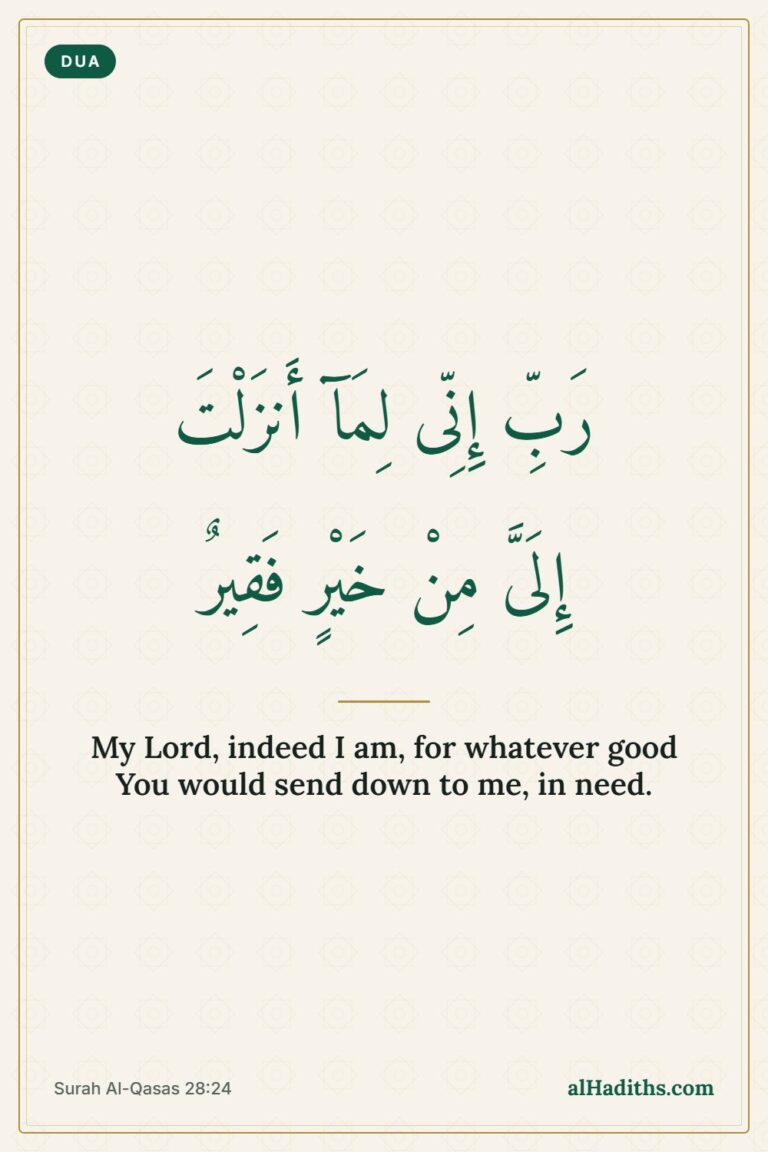
فَسَقَىٰ لَهُمَا ثُمَّ تَوَلَّىٰٓ إِلَى ٱلظِّلِّ فَقَالَ رَبِّ إِنِّى لِمَآ أَنزَلْتَ إِلَىَّ مِنْ خَيْرٍ فَقِيرٌ
“So he watered [their flocks] for them; then he went back to the shade and said, ‘My Lord, indeed I am, for whatever good You would send down to me, in need.’”
Surah Al-Qasas 28:24 · Translation: Saheeh International, from Quran.com
Rabbi innī limā anzalta ilayya min khayrin faqīr. He did not name a job, a meal or a home. He simply told Allah that he needed whatever good He would send. The verses after it (28:25–27) tell how the women’s father invited him, gave him work and offered him marriage. We look at this dua for marriage in Dua for Marriage: What the Quran and Sunnah Teach.
Try this: when you feel stuck and do not know what to ask for, say this dua and leave the choosing to Allah.
3. After a mistake: “Rabbi inni zalamtu nafsi”
In Egypt, Musa found two men fighting, one of them from his own people. He struck the other man, and the blow ended his life. Musa at once called it the work of Shaytan (28:15), and then he said:
قَالَ رَبِّ إِنِّى ظَلَمْتُ نَفْسِى فَٱغْفِرْ لِى فَغَفَرَ لَهُۥٓ ۚ إِنَّهُۥ هُوَ ٱلْغَفُورُ ٱلرَّحِيمُ
“He said, ‘My Lord, indeed I have wronged myself, so forgive me,’ and He forgave him. Indeed, He is the Forgiving, the Merciful.”
Surah Al-Qasas 28:16 · Translation: Saheeh International, from Quran.com
Rabbi innī ẓalamtu nafsī faghfir lī. There are no excuses in it, only an honest admission and a request. And the verse tells us the result in the same breath: He forgave him.
Try this: the next time you slip, name it to Allah as Musa did, ask forgiveness right away, and do not wait until you feel “good enough” to return.
4. When you are afraid: “Rabbi najjini”
A man ran to warn him that Pharaoh’s chiefs were planning to kill him (28:20), so Musa left the city in a hurry, fearful and watching:
فَخَرَجَ مِنْهَا خَآئِفًا يَتَرَقَّبُ ۖ قَالَ رَبِّ نَجِّنِى مِنَ ٱلْقَوْمِ ٱلظَّـٰلِمِينَ
“So he left it, fearful and anticipating [apprehension]. He said, ‘My Lord, save me from the wrongdoing people.’”
Surah Al-Qasas 28:21 · Translation: Saheeh International, from Quran.com
Rabbi najjinī mina-l-qawmi-ẓ-ẓālimīn. Fear did not stop him from acting. He took the road and asked Allah for safety at the same time.
Try this: when you are worried about someone who treats you unjustly, take the practical steps you can, and make this dua as you take them.
5. Setting out without a map: “Asa rabbi an yahdiyani”
Musa did not know the way to Madyan. As he turned toward it, he said:
وَلَمَّا تَوَجَّهَ تِلْقَآءَ مَدْيَنَ قَالَ عَسَىٰ رَبِّىٓ أَن يَهْدِيَنِى سَوَآءَ ٱلسَّبِيلِ
“And when he directed himself toward Madyan, he said, ‘Perhaps my Lord will guide me to the sound way.’”
Surah Al-Qasas 28:22 · Translation: Saheeh International, from Quran.com
‘Asā rabbī an yahdiyanī sawā’a-s-sabīl. It is a dua said as hope: he trusted that Allah would show him the right road. That road led to the well, to the dua of need above, and to a new life.
Try this: before a move, a new job or any first step into the unknown, say these words as you set out.
6. For yourself and your family: “Rabbighfir li wa li akhi”
When Musa came back from meeting his Lord and found his people worshipping the calf, he was angry and took hold of his brother Harun. When Harun explained that the people had overpowered him, Musa turned to Allah for them both:
قَالَ رَبِّ ٱغْفِرْ لِى وَلِأَخِى وَأَدْخِلْنَا فِى رَحْمَتِكَ ۖ وَأَنتَ أَرْحَمُ ٱلرَّٰحِمِينَ
“[Moses] said, ‘My Lord, forgive me and my brother and admit us into Your mercy, for You are the most merciful of the merciful.’”
Surah Al-A‘raf 7:151 · Translation: Saheeh International, from Quran.com
Rabbighfir lī wa li-akhī wa adkhilnā fī raḥmatik, wa anta arḥamu-r-rāḥimīn. He began with himself, then his brother, then asked for both to be taken into Allah’s mercy.
Try this: after a quarrel at home, make this dua for yourself and the person you argued with. Putting a parent, spouse or child in place of “my brother” is an adaptation, not the wording of the verse.
Bringing it together: how Musa made dua
Reflection: almost every one of these duas begins with “Rabbi”, my Lord, and none of them is long. Musa spoke to Allah in the middle of real events: before a task, after a sin, while running, while lost, while hungry. Each time he said exactly what was true about his state. That is something we can copy today without memorizing anything new. For more of how Musa appears in the Sunnah, read Prophet Musa in the Hadith.
Questions people ask
What is the dua of Musa for speech?
It is Surah Ta-Ha 20:25–28: “Rabbi-shrah li sadri, wa yassir li amri, wahlul ‘uqdatan min lisani, yafqahu qawli” (“My Lord, expand for me my breast, ease for me my task, untie the knot from my tongue, that they may understand my speech”). Musa said it when Allah sent him to Pharaoh.
Is there a hadith where Musa asked Allah to teach him a dhikr?
A popular narration says Musa asked, “Teach me something to remember You by,” and was told that “la ilaha illallah” outweighs the heavens and earth. It is in Sahih Ibn Hibban 6218 and al-Hakim, who called it sahih, but al-Albani graded it Da‘if and al-Arna’ut called its chain weak (see the grading). Because graders differ, we do not use it here. An authentic alternative: the Prophet ﷺ said, “The best remembrance is la ilaha illallah” (Tirmidhi 3383, Hasan, Darussalam).
Can I read the dua of Musa for rizq or marriage?
The verse (28:24) is general: Musa asked for whatever good Allah would send. Many people say it when asking for provision, work or a spouse, and that fits its meaning, but the verse does not name those things. Say it with your own need in your heart.
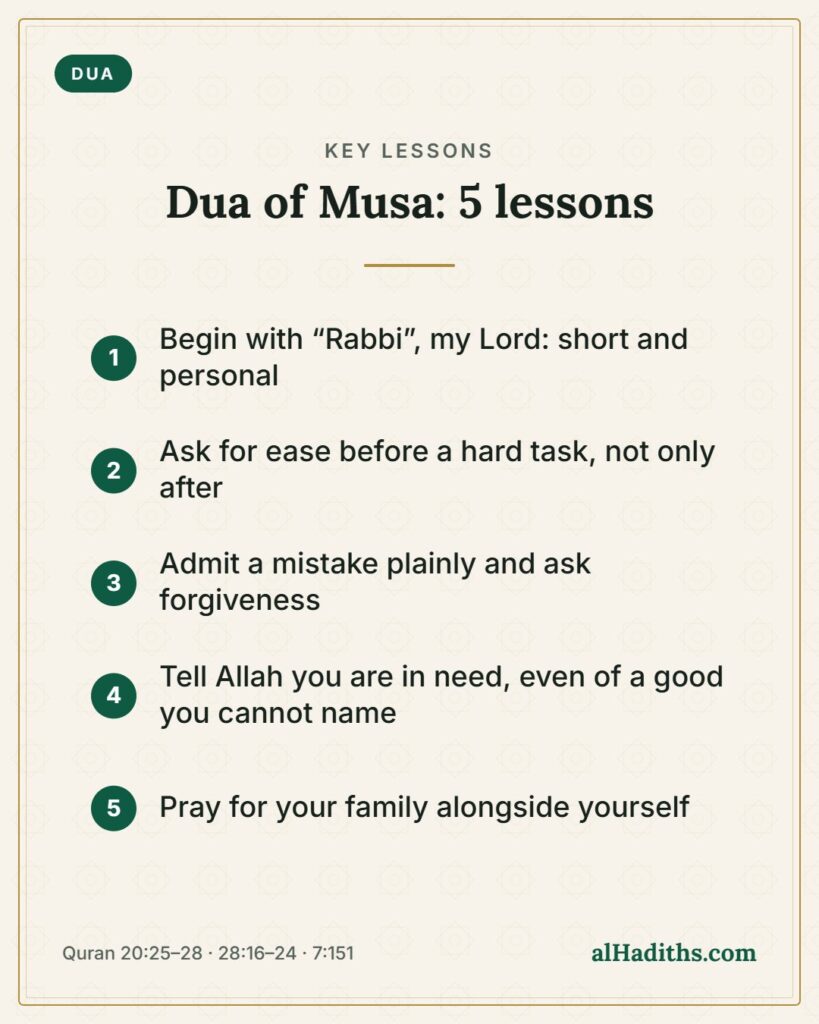
Key lessons
- Short duas count: most of Musa’s duas are one line.
- Ask for help with a hard task before you begin it (20:25–28).
- After a mistake, admit it plainly and ask forgiveness (28:16).
- When you have nothing, tell Allah you are in need of His good (28:24).
- Include the people close to you in your dua (7:151).
Part of our Dua and Prophets in the Hadith series: see all our dua articles and articles on the prophets in one place.
May Allah open your chest, ease your affairs and send you every good you are in need of.
Save this to Pinterest so you can keep the duas of Musa close
Share the reward. Send this article to someone who needs it today — teaching a hadith or dua can become a lasting good deed for you, in shaa Allah.