How Many Rakats in Each Prayer? What the Hadith Show
Contents
Whether you are a new Muslim, teaching your children or simply double-checking before you pray, it is a fair question: how many rakats in each prayer? The short answer is Fajr 2, Dhuhr 4, Asr 4, Maghrib 3 and Isha 4, which makes 17 obligatory rak‘ahs a day.
There is no single hadith that lists all five numbers together. Muslims have known them from the Prophet’s ﷺ daily practice, prayed in front of his companions five times a day and passed on by every generation since. The authentic hadith below confirm the pieces: how the prayer began, why some prayers are four, why Maghrib is three, and what happens on a journey.
At a glance
- Hadith: 5 authentic narrations
- Collections: Sahih al-Bukhari, Sahih Muslim
- Grade: Sahih (Bukhari and Muslim)
- Topic: The number of rak‘ahs in the five daily prayers
- Do it today: Teach one child or friend the five numbers: 2, 4, 4, 3, 4
How many rakats in each prayer: the quick table
| Prayer | Fard rak‘ahs | When traveling | Regular sunnah |
|---|---|---|---|
| Fajr | 2 | 2 | 2 before |
| Dhuhr | 4 | 2 | 4 before, 2 after |
| Asr | 4 | 2 | None of the 12 |
| Maghrib | 3 | 3 | 2 after |
| Isha | 4 | 2 | 2 after |
| Total | 17 | 11 | 12 |
The sunnah column shows the regular sunnah prayers (the 12 rak‘ahs), which we explain with their hadith in Sunnah Prayers: The 12 Rak‘ahs. The travel column is explained in hadith 2 to 4 below.
1. The prayer began as two rak‘ahs
Aishah (may Allah be pleased with her), the Mother of the Believers, said:
فَرَضَ اللَّهُ الصَّلاَةَ حِينَ فَرَضَهَا رَكْعَتَيْنِ رَكْعَتَيْنِ فِي الْحَضَرِ وَالسَّفَرِ، فَأُقِرَّتْ صَلاَةُ السَّفَرِ، وَزِيدَ فِي صَلاَةِ الْحَضَرِ
“Allah prescribed the prayer, when He prescribed it, as two rak‘ahs and two rak‘ahs, both when resident and when traveling. Then the prayer of the journey was kept as it was, and the prayer of the resident was increased.”
Sahih al-Bukhari 350 · Narrated by Aishah · Translation adapted from Sunnah.com
This explains where the numbers come from. The prayers were first two rak‘ahs each; later the prayers of the resident were increased, which is why Dhuhr, Asr and Isha are four at home. Fajr stayed two, and Maghrib is three.
Try this: when you pray two rak‘ahs of Fajr, remember that this is the original shape of the prayer as it was first prescribed.
2. Four at home, two on a journey
Ibn Abbas (may Allah be pleased with him) said:
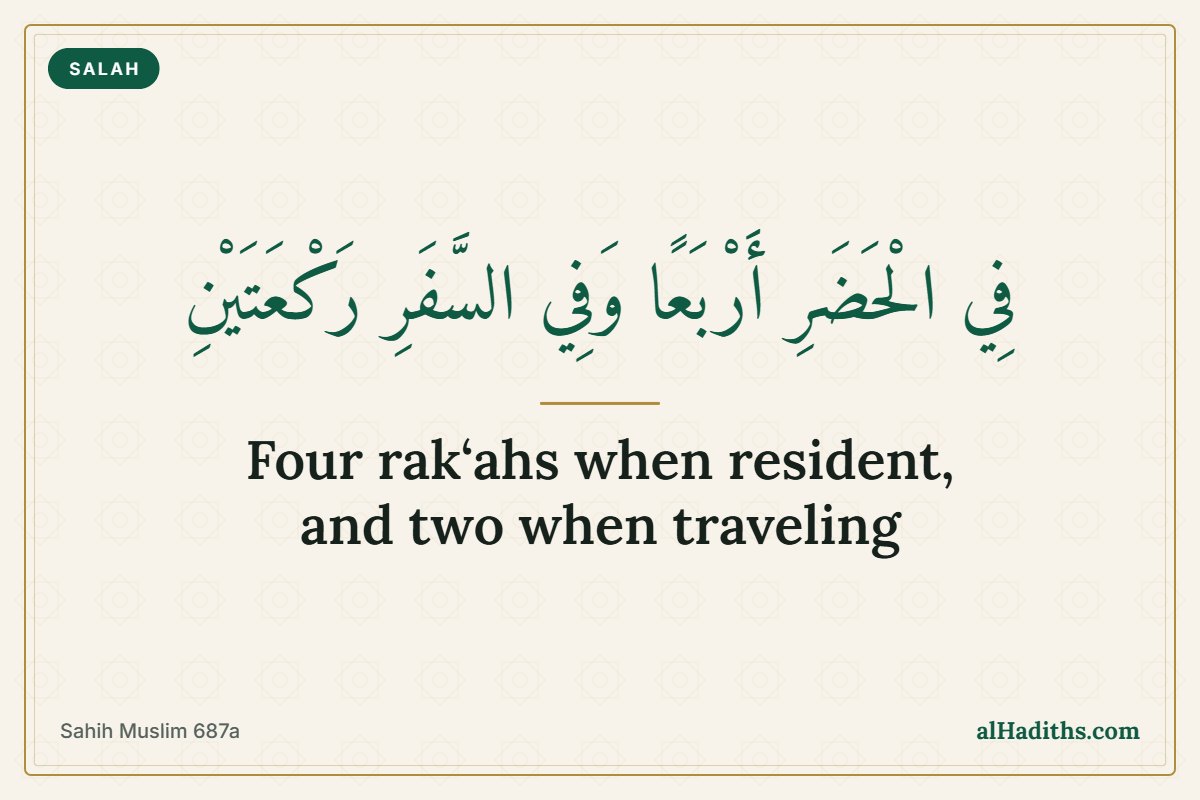
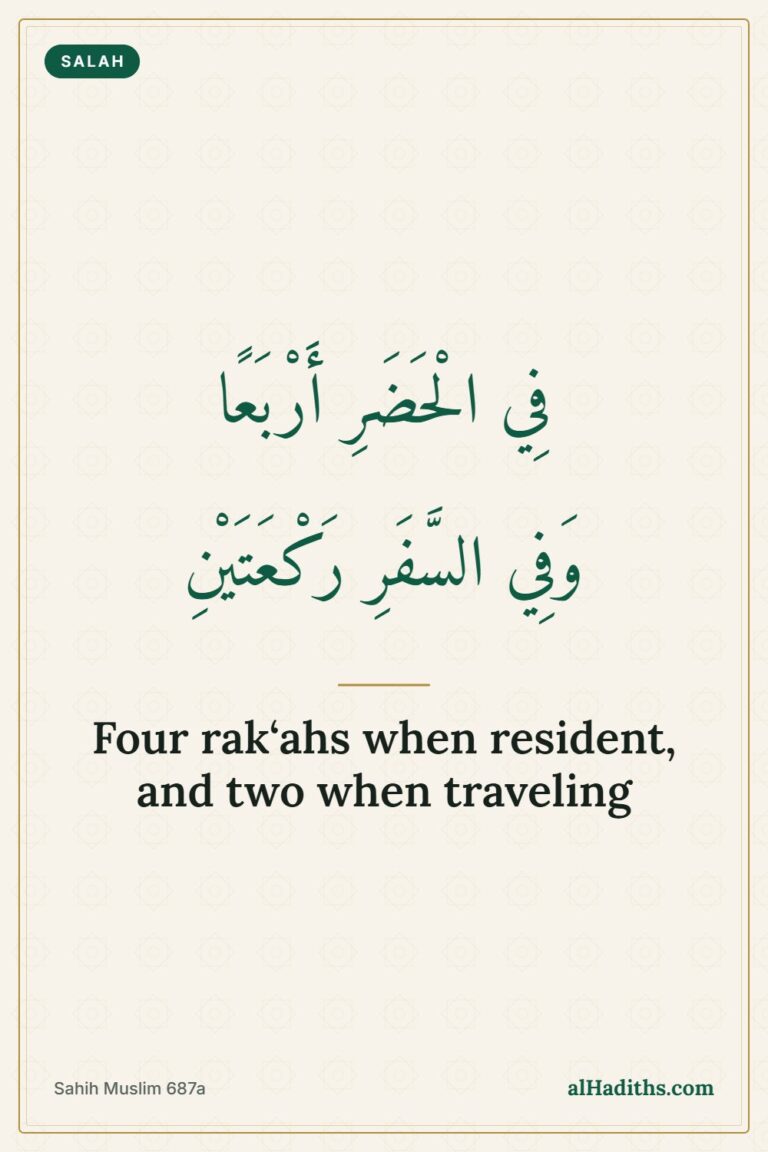
فَرَضَ اللَّهُ الصَّلاَةَ عَلَى لِسَانِ نَبِيِّكُمْ صلى الله عليه وسلم فِي الْحَضَرِ أَرْبَعًا وَفِي السَّفَرِ رَكْعَتَيْنِ وَفِي الْخَوْفِ رَكْعَةً
“Allah prescribed the prayer on the tongue of your Prophet ﷺ as four rak‘ahs when resident, two when traveling, and one in (a state of) fear.”
Sahih Muslim 687a · Narrated by Ibn Abbas · Translation adapted from Sunnah.com
This is the clearest statement of the four-rak‘ah prayers: four at home and two on a journey. The last part, “one in fear”, refers to the prayer in times of danger; scholars explain it in different ways, so ask a qualified scholar if you need its details.
Try this: before your next trip, read our guide to qasr prayer so you know which prayers are shortened.
3. Dhuhr is four in Madinah
Anas ibn Malik (may Allah be pleased with him) said:
صَلَّيْتُ الظُّهْرَ مَعَ النَّبِيِّ صلى الله عليه وسلم بِالْمَدِينَةِ أَرْبَعًا، وَبِذِي الْحُلَيْفَةِ رَكْعَتَيْنِ
“I prayed Dhuhr with the Prophet ﷺ in Madinah as four rak‘ahs, and at Dhul-Hulayfah two rak‘ahs.”
Sahih al-Bukhari 1089 · Narrated by Anas ibn Malik · Translation adapted from Sunnah.com
On the same day the Prophet ﷺ prayed four rak‘ahs at home and, once he had set out on his journey, two at Dhul-Hulayfah (Sunnah.com’s translation notes that this was Asr, shortened). It shows both numbers side by side: four for the resident, two for the traveler.
Try this: if you are unsure whether you count as a traveler for a particular trip, ask a local scholar; the hadith show the practice, not every condition.
4. Maghrib stays three, even when traveling
Abdullah ibn Umar (may Allah be pleased with him) said:
رَأَيْتُ النَّبِيَّ صلى الله عليه وسلم إِذَا أَعْجَلَهُ السَّيْرُ يُؤَخِّرُ الْمَغْرِبَ، فَيُصَلِّيهَا ثَلاَثًا ثُمَّ يُسَلِّمُ، ثُمَّ قَلَّمَا يَلْبَثُ حَتَّى يُقِيمَ الْعِشَاءَ فَيُصَلِّيَهَا رَكْعَتَيْنِ ثُمَّ يُسَلِّمُ
“I saw the Prophet ﷺ, when he was in a hurry on a journey, delay Maghrib, then pray it as three rak‘ahs and say the salam. Then, after only a short while, he would have the iqamah called for Isha and pray it as two rak‘ahs, then say the salam.”
Sahih al-Bukhari 1091 · Narrated by Abdullah ibn Umar · Translation adapted from Sunnah.com
Maghrib is the one prayer that is never shortened: it is three at home and three on a journey. Isha, a four-rak‘ah prayer, became two. This hadith also shows the Prophet ﷺ combining Maghrib and Isha when he was in a hurry on a journey.
Try this: on your next journey, notice the difference: shorten Isha to two, but keep Maghrib at three.
5. When the Prophet ﷺ prayed five in Dhuhr
Abdullah ibn Mas‘ud (may Allah be pleased with him) said that the Prophet ﷺ once prayed Dhuhr as five rak‘ahs, and someone asked whether the prayer had been increased. He said:
وَمَا ذَاكَ. قَالَ صَلَّيْتَ خَمْسًا. فَسَجَدَ سَجْدَتَيْنِ بَعْدَ مَا سَلَّمَ
“And what is that?” He said, “You prayed five.” So he made two prostrations after he had said the salam.
Sahih al-Bukhari 1226 · Narrated by Abdullah ibn Mas‘ud · Translation adapted from Sunnah.com
The companions noticed at once that five was too many, because they knew Dhuhr was four. The Prophet ﷺ did not repeat the prayer; he made the two prostrations of forgetfulness. It is a mercy for anyone who loses count.
Try this: learn how sujud sahw works, so a slip in the count never makes you anxious.
Bringing it together
Put together, these hadith give us the full picture: two for Fajr, three for Maghrib, four for Dhuhr, Asr and Isha at home, and two for those three prayers on a journey. The numbers were not invented later; they are what the Prophet ﷺ prayed with his companions every day.
Reflection: seventeen rak‘ahs take perhaps half an hour across a whole day. The hadith about the prayer first being two rak‘ahs reminds me that Allah increased it for us at home and kept it light for us on the road. The count is easy to memorize; the harder and better work is to stand in each of those rak‘ahs with a present heart.
Questions people ask
How many rakats in each prayer including sunnah?
The fard are Fajr 2, Dhuhr 4, Asr 4, Maghrib 3 and Isha 4. The regular sunnah prayers add 12 rak‘ahs a day: 2 before Fajr, 4 before and 2 after Dhuhr, 2 after Maghrib and 2 after Isha. We explain them with their hadith in Sunnah Prayers: The 12 Rak‘ahs.
How many rakats in Isha prayer?
Isha is four fard rak‘ahs (two when traveling). Witr is a separate prayer usually prayed after Isha; see our witr prayer hadith.
How many rakats is Jummah?
The Friday prayer is two rak‘ahs, prayed after the khutbah in place of Dhuhr. Read more in Importance of Jummah Prayer.
Key lessons
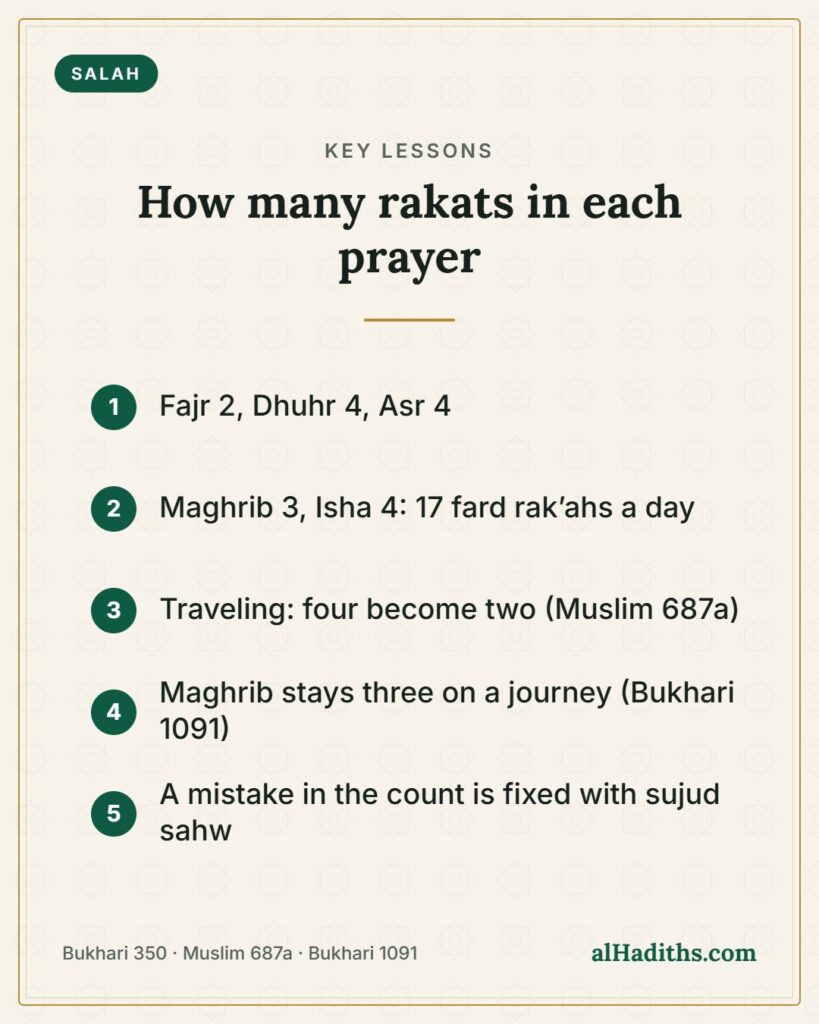
- Fajr 2, Dhuhr 4, Asr 4, Maghrib 3, Isha 4: 17 fard rak‘ahs a day.
- The prayer began as two rak‘ahs and was increased for the resident (Bukhari 350).
- Four-rak‘ah prayers become two on a journey (Muslim 687a).
- Maghrib stays three even when traveling (Bukhari 1091).
- A mistake in the count is fixed with sujud sahw (Bukhari 1226).
Part of our Salah series: see all our salah articles in one place.
Say the five numbers out loud once today, 2, 4, 4, 3, 4, and then pray your next salah knowing exactly where each one comes from.
Save this to Pinterest so you have the rakat count for each prayer at hand.
Share the reward. Send this article to someone who needs it today — teaching a hadith or dua can become a lasting good deed for you, in shaa Allah.