Hadith About Black Seed: What the Prophet ﷺ Said
Contents
Black seed shows up in kitchens, supplement aisles and family remedies across the Muslim world, often with the words “a cure for everything.” So what does the hadith about black seed actually say? It is short, it is authentic, and it is in both Sahih al-Bukhari and Sahih Muslim. Here it is, with its context, what it means, and what it does not say.
At a glance
- Source: Sahih al-Bukhari 5688 and Sahih Muslim 2215
- Narrated by: Abu Hurairah (may Allah be pleased with him)
- Grade: Sahih (in Bukhari and Muslim)
- Topic: Black seed (al-habbah as-sawda), healing
- Practise it: Treat illness with means Allah made, and trust that the cure is from Him
The hadith about black seed
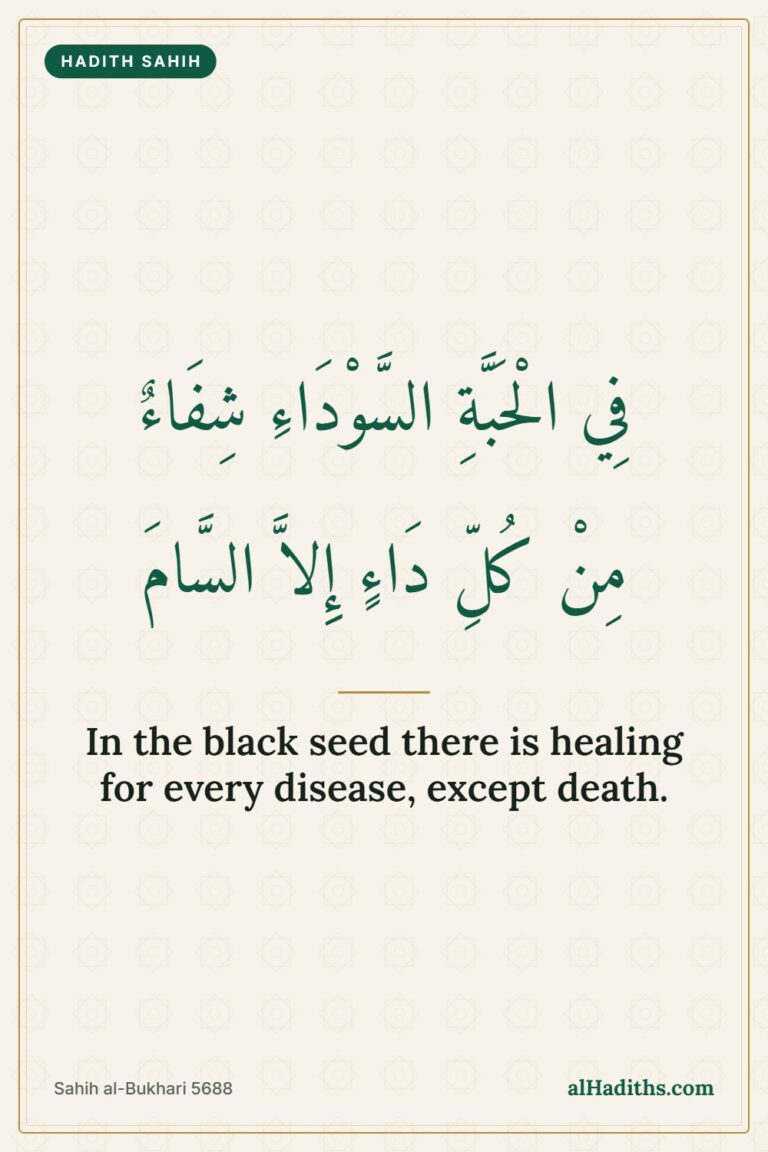
Abu Hurairah (may Allah be pleased with him) heard the Prophet ﷺ say:
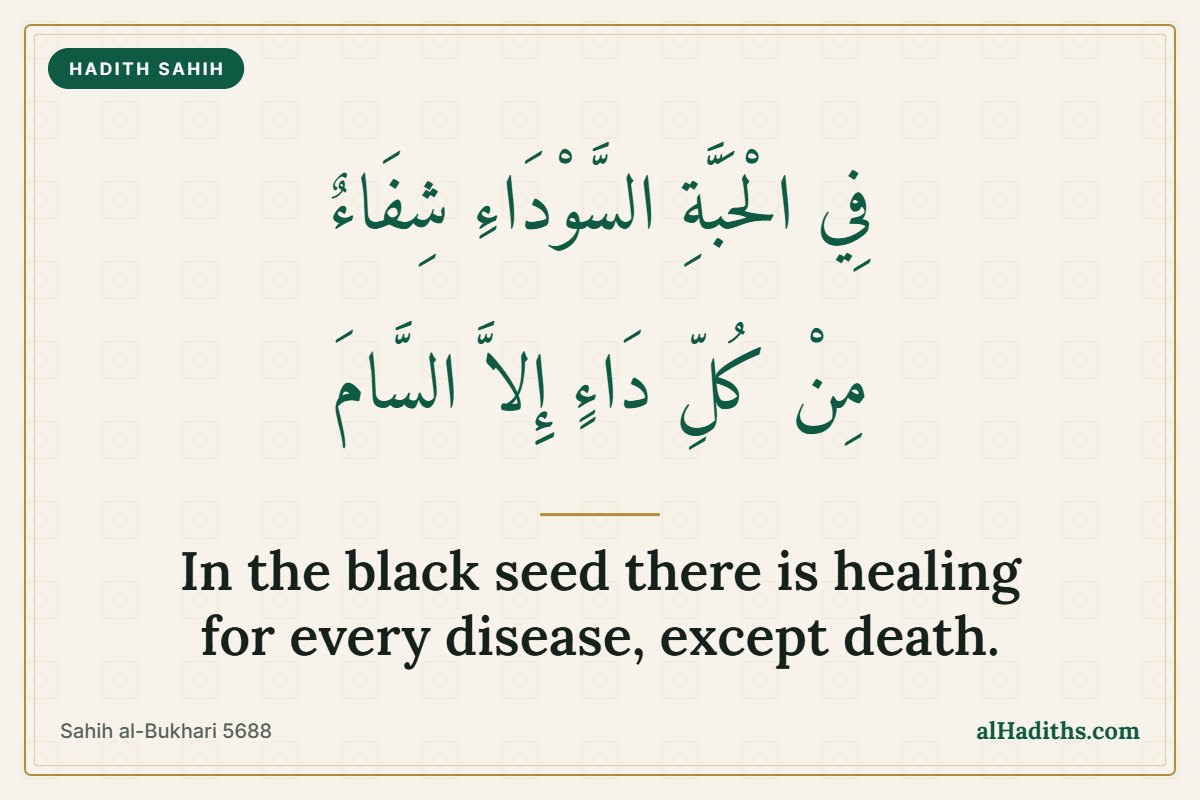
فِي الْحَبَّةِ السَّوْدَاءِ شِفَاءٌ مِنْ كُلِّ دَاءٍ إِلاَّ السَّامَ
“There is healing in the black seed for every disease, except as-sam (death).”
Sahih al-Bukhari 5688 · Narrated by Abu Hurairah · Translation adapted from Sunnah.com
Imam Muslim records the same words through the same Companion:
إِنَّ فِي الْحَبَّةِ السَّوْدَاءِ شِفَاءً مِنْ كُلِّ دَاءٍ إِلاَّ السَّامَ
“Indeed, in the black seed there is healing for every disease, except as-sam (death).”
Sahih Muslim 2215a · Narrated by Abu Hurairah · Translation adapted from Sunnah.com
At the end of the narration in Bukhari, the scholar Ibn Shihab az-Zuhri explains the two key words: as-sam is death, and al-habbah as-sawda (the black seed) is shuniz, the seed known today as nigella or black cumin.
Context: how the early Muslims used it
Sahih al-Bukhari also keeps a short scene. Khalid ibn Sa’d says a travelling companion fell ill on the way to Madinah. Ibn Abi ‘Atiq visited him and told them to crush five or seven black seeds and drop them into his nose with drops of oil. He gave his reason: ‘Aishah (may Allah be pleased with her) had told him she heard the Prophet ﷺ say:
إِنَّ هَذِهِ الْحَبَّةَ السَّوْدَاءَ شِفَاءٌ مِنْ كُلِّ دَاءٍ إِلاَّ مِنَ السَّامِ
“This black seed is healing for every disease, except as-sam (death).”
Sahih al-Bukhari 5687 · Narrated by ‘Aishah, through Khalid ibn Sa’d · Translation adapted from Sunnah.com
Notice the difference. The words about healing are the Prophet’s ﷺ. The nose-drop method was Ibn Abi ‘Atiq’s own way of using it; the hadith he quotes does not describe a method.
What the hadith means
This hadith sits inside a larger teaching about medicine. In the same book of Sahih al-Bukhari, the Prophet ﷺ said:
مَا أَنْزَلَ اللَّهُ دَاءً إِلاَّ أَنْزَلَ لَهُ شِفَاءً
“Allah has not sent down any disease except that He has also sent down its cure.”
Sahih al-Bukhari 5678 · Narrated by Abu Hurairah · Translation adapted from Sunnah.com
And Jabir (may Allah be pleased with him) narrated how that cure works:
لِكُلِّ دَاءٍ دَوَاءٌ فَإِذَا أُصِيبَ دَوَاءُ الدَّاءِ بَرَأَ بِإِذْنِ اللَّهِ عَزَّ وَجَلَّ
“For every disease there is a remedy. When the remedy reaches the disease, it is cured by the permission of Allah, the Mighty and Majestic.”
Sahih Muslim 2204 · Narrated by Jabir ibn ‘Abdullah · Translation adapted from Sunnah.com
Reflection: read together, these hadith keep two things side by side. Black seed is a real means of healing that the Prophet ﷺ praised, and the healing itself belongs to Allah. The exception, death, is a reminder that no remedy, however blessed, can delay the appointed time. The hadith praises a seed; it does not set a dose, replace a doctor, or promise that one remedy fits every person.
How to practise it
- Keep the meaning in mind: black seed is a means, and Allah is the One who heals.
- If you use black seed, use the seed itself or a trusted food-grade product, in normal food amounts.
- Ask your doctor first if you take medication, are pregnant, or have a long-term condition.
- Never stop prescribed treatment because of a remedy you read about online.
- Pair any treatment with dua for healing, as the Prophet ﷺ taught.
This article explains what the hadith say; it is not medical advice.
Questions people ask
Is black seed oil mentioned in the hadith?
The authentic hadith name the black seed itself (al-habbah as-sawda), not the oil. Oil appears only in Ibn Abi ‘Atiq’s method in Bukhari 5687, where crushed seeds were dropped into the nose with drops of oil.
Does black seed cure every disease?
The hadith says there is healing in it for every disease except death. Healing comes by Allah’s permission (Muslim 2204), and the hadith gives no dose or method, so it is not a reason to skip medical care.
Is there a hadith about black seed and honey?
We did not find an authentic hadith that names the two together. Honey has its own hadith, about a man whose brother had stomach trouble (Bukhari 5684).
What does as-sam mean?
As-sam means death. Ibn Shihab az-Zuhri explains it at the end of the narration in Bukhari 5688.
Key lessons
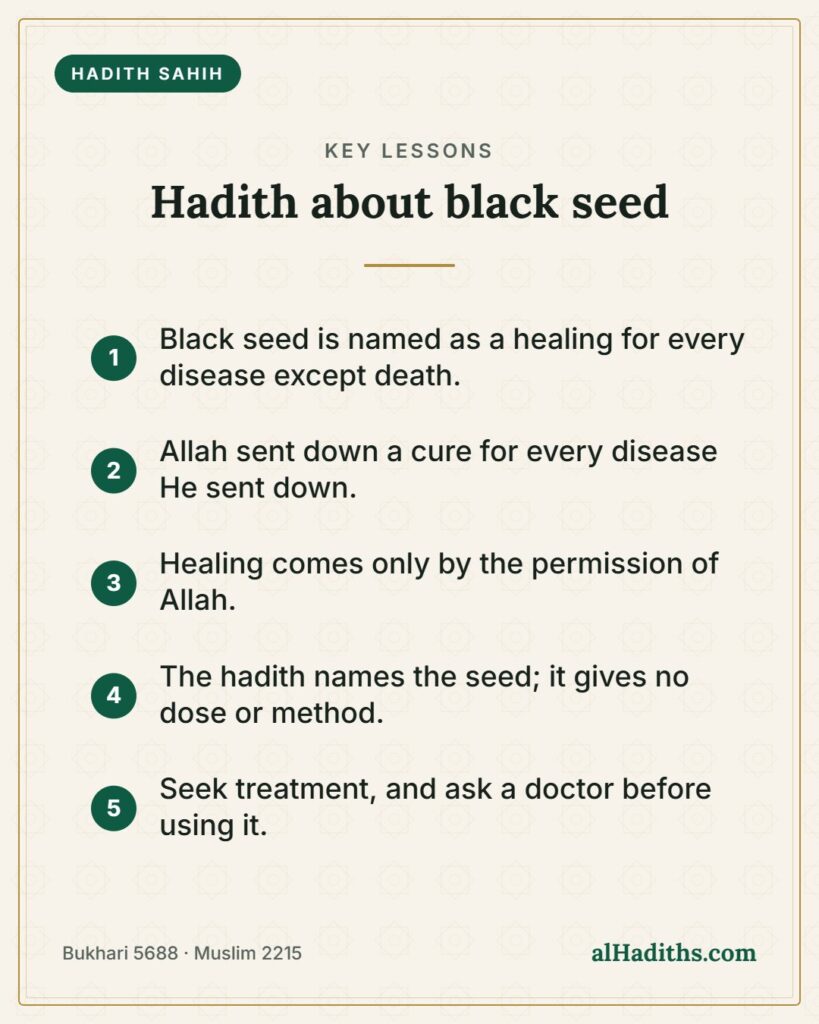
- The black seed is praised in Sahih al-Bukhari and Sahih Muslim as healing for every disease except death.
- Allah sent down a cure for every disease, and healing happens only by His permission.
- The method in Bukhari 5687 was a Companion-era practice, not a prophetic instruction.
- Use means and see a doctor; trust Allah for the result.
Next time you see a jar of black seed on the shelf, let it remind you of a bigger truth: every cure is a gift from Allah, and every illness has one, by His permission.
Save this to Pinterest so you can come back to this hadith about black seed
Share the reward. Send this article to someone who needs it today — teaching a hadith or dua can become a lasting good deed for you, in shaa Allah.