Difference Between Zakat and Sadaqah: 4 Authentic Hadith
Contents
Zakat and sadaqah are both giving for the sake of Allah, so it is easy to mix them up. What is the difference between zakat and sadaqah? The clearest way to see it is through the hadith themselves. Here are four authentic hadith, each checked on Sunnah.com, and what each one shows about the two.
At a glance
- Hadith: 4, all in Sahih al-Bukhari, plus one Quran verse
- Grade: Sahih
- Topic: Zakat (obligatory charity) and sadaqah (voluntary charity)
- In short: Zakat is a fixed duty on wealth; sadaqah is open to everyone, in any amount
- Do today: Give one small sadaqah, even a single date’s worth
This article explains what the hadith say. It does not calculate anyone’s zakat or give rulings. Zakat has detailed conditions that scholars explain, so for your own zakat please ask a qualified scholar or your local zakat authority.
1. Zakat is an obligation, taken from the rich
Abdullah ibn Abbas (may Allah be pleased with him) reported that the Prophet ﷺ sent Mu’adh ibn Jabal (may Allah be pleased with him) to Yemen and said:
ادْعُهُمْ إِلَى شَهَادَةِ أَنْ لاَ إِلَهَ إِلاَّ اللَّهُ، وَأَنِّي رَسُولُ اللَّهِ، فَإِنْ هُمْ أَطَاعُوا لِذَلِكَ فَأَعْلِمْهُمْ أَنَّ اللَّهَ قَدِ افْتَرَضَ عَلَيْهِمْ خَمْسَ صَلَوَاتٍ فِي كُلِّ يَوْمٍ وَلَيْلَةٍ، فَإِنْ هُمْ أَطَاعُوا لِذَلِكَ فَأَعْلِمْهُمْ أَنَّ اللَّهَ افْتَرَضَ عَلَيْهِمْ صَدَقَةً فِي أَمْوَالِهِمْ، تُؤْخَذُ مِنْ أَغْنِيَائِهِمْ وَتُرَدُّ عَلَى فُقَرَائِهِمْ
“Invite the people to testify that none has the right to be worshipped but Allah and I am Allah’s Messenger, and if they obey you to do so, then teach them that Allah has enjoined on them five prayers in every day and night, and if they obey you to do so, then teach them that Allah has made it obligatory for them to pay the Zakat from their property and it is to be taken from the wealthy among them and given to the poor.”
Sahih al-Bukhari 1395 · Narrated by Abdullah ibn Abbas · Translation adapted from Sunnah.com
This hadith places zakat right after the testimony of faith and the five prayers. Two words stand out: it is obligatory, and it is taken from the wealthy and given to the poor. In other words, zakat is not left to mood or generosity; it is a right of the poor in the wealth of those who have enough.
One detail is worth knowing. The Arabic word in this hadith is sadaqah, and Sunnah.com translates it as “Zakat” because the context is the obligatory charity. So the word sadaqah can include zakat, while in everyday use people mean voluntary charity when they say sadaqah.
Try this: if you have savings, find out this week whether they reach the minimum for zakat, by asking your local zakat office or a scholar.
2. Zakat has fixed minimum amounts
Abu Sa’id al-Khudri (may Allah be pleased with him) reported that Allah’s Messenger ﷺ said:
لَيْسَ فِيمَا دُونَ خَمْسِ ذَوْدٍ صَدَقَةٌ مِنَ الإِبِلِ، وَلَيْسَ فِيمَا دُونَ خَمْسِ أَوَاقٍ صَدَقَةٌ، وَلَيْسَ فِيمَا دُونَ خَمْسَةِ أَوْسُقٍ صَدَقَةٌ
“There is no Zakat on less than five camels and also there is no Zakat on less than five Awaq (of silver). And there is no Zakat on less than five Awsuq.”
Sahih al-Bukhari 1447 · Narrated by Abu Sa’id al-Khudri · Translation adapted from Sunnah.com (translator’s notes left out)
Here is a key part of the difference between zakat and sadaqah. Zakat only begins once wealth reaches a set minimum: five camels, five awaq of silver (awaq is a weight of silver), or five awsuq of grain or dates (wasq is a measure of produce). Below that, nothing is due. How these old measures convert into today’s money is explained by scholars and zakat offices, so we leave the numbers to them.
Try this: learn the term nisab, the minimum amount for zakat, and ask your local zakat authority what it is this year.
3. Sadaqah is for every Muslim, in any form
Abu Musa al-Ash’ari (may Allah be pleased with him) reported that the Prophet ﷺ said:
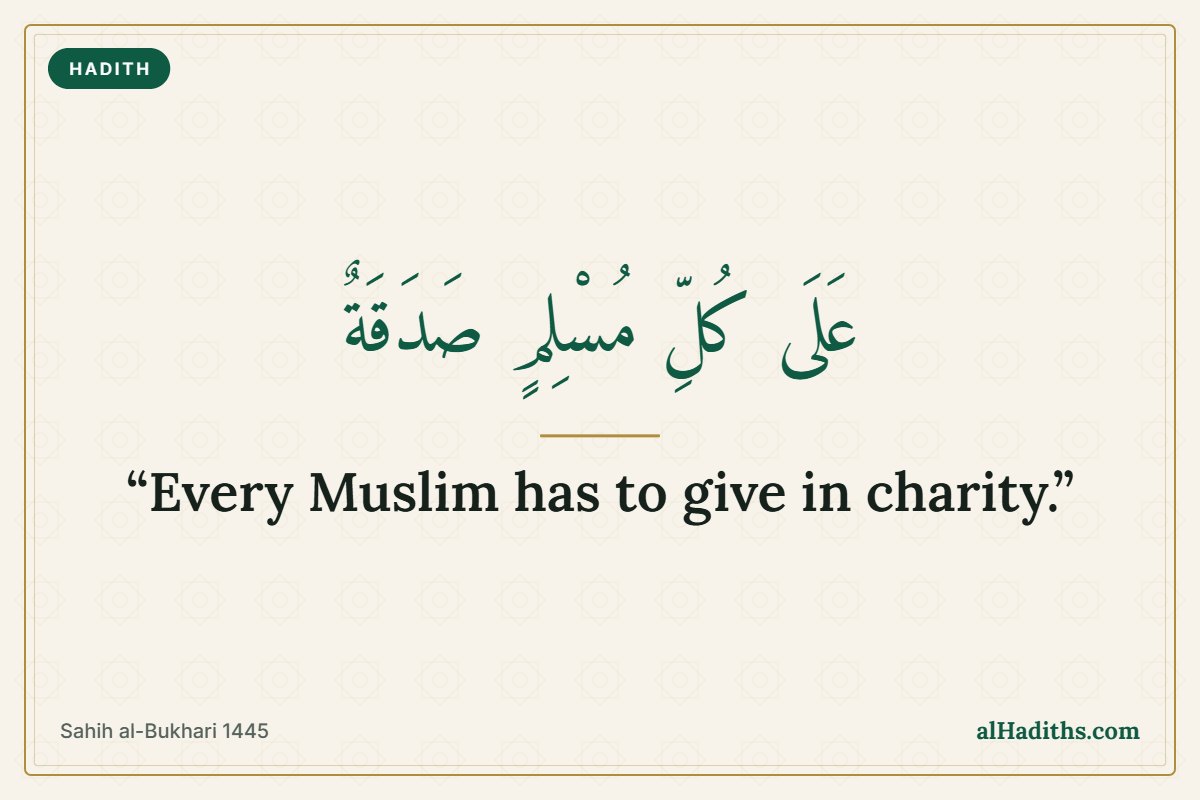
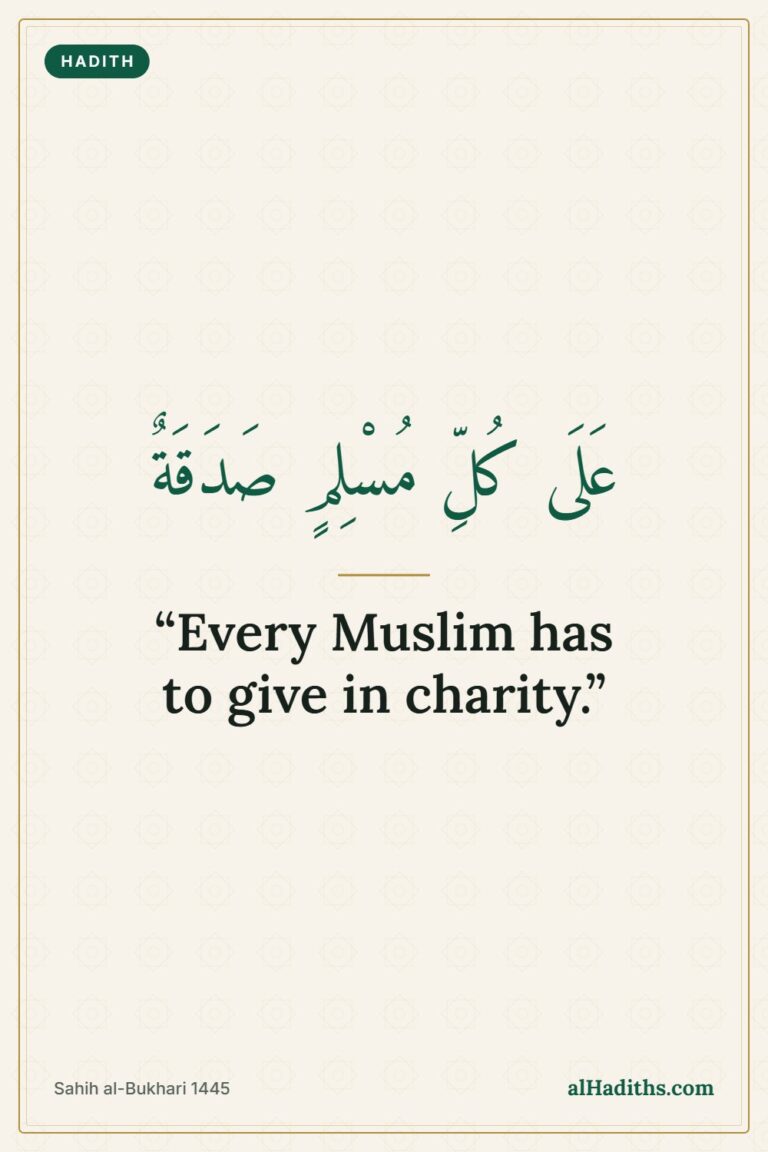
عَلَى كُلِّ مُسْلِمٍ صَدَقَةٌ. فَقَالُوا يَا نَبِيَّ اللَّهِ فَمَنْ لَمْ يَجِدْ قَالَ يَعْمَلُ بِيَدِهِ فَيَنْفَعُ نَفْسَهُ وَيَتَصَدَّقُ. قَالُوا فَإِنْ لَمْ يَجِدْ قَالَ يُعِينُ ذَا الْحَاجَةِ الْمَلْهُوفَ. قَالُوا فَإِنْ لَمْ يَجِدْ. قَالَ فَلْيَعْمَلْ بِالْمَعْرُوفِ، وَلْيُمْسِكْ عَنِ الشَّرِّ فَإِنَّهَا لَهُ صَدَقَةٌ
“Every Muslim has to give in charity.” The people asked, “O Allah’s Prophet! If someone has nothing to give, what will he do?” He said, “He should work with his hands and benefit himself and also give in charity (from what he earns).” The people further asked, “If he cannot find even that?” He replied, “He should help the needy who appeal for help.” Then the people asked, “If he cannot do that?” He replied, “Then he should perform good deeds and keep away from evil deeds and this will be regarded as charitable deeds.”
Sahih al-Bukhari 1445 · Narrated by Abu Musa al-Ash’ari · Translation from Sunnah.com
Sunnah.com’s heading names Abu Burda, but in the chain it is his son Sa’id who narrates from his father Abu Burda, from his grandfather Abu Musa al-Ash’ari. Unlike zakat, sadaqah here has no minimum at all. If you have money, give some. If you have none, work and give. If you cannot work, help someone in need. And if even that is out of reach, doing good and holding back from harm is itself counted as sadaqah.
Try this: on a day you have nothing to give, choose one good deed on purpose and avoid one harm on purpose, and count it as your sadaqah.
4. Even one date of sadaqah grows
Abu Hurairah (may Allah be pleased with him) reported that Allah’s Messenger ﷺ said:
مَنْ تَصَدَّقَ بِعَدْلِ تَمْرَةٍ مِنْ كَسْبٍ طَيِّبٍ ـ وَلاَ يَقْبَلُ اللَّهُ إِلاَّ الطَّيِّبَ ـ وَإِنَّ اللَّهَ يَتَقَبَّلُهَا بِيَمِينِهِ، ثُمَّ يُرَبِّيهَا لِصَاحِبِهِ كَمَا يُرَبِّي أَحَدُكُمْ فَلُوَّهُ حَتَّى تَكُونَ مِثْلَ الْجَبَلِ
“If one gives in charity what equals one date-fruit from honestly earned money, and Allah accepts only the honestly earned money, Allah takes it in His right (hand) and then enlarges its reward for that person (who has given it), as anyone of you brings up his baby horse, so much so that it becomes as big as a mountain.”
Sahih al-Bukhari 1410 · Narrated by Abu Hurairah · Translation adapted from Sunnah.com
Sadaqah has no fixed amount, and this hadith shows why small amounts still matter. One date, if it comes from honest earnings, can grow with Allah into something as large as a mountain. The condition is in the middle of the hadith: Allah accepts only what is good and honestly earned.
Try this: keep a small amount aside each week just for sadaqah, however little, and give it from money you know is clean.
Bringing it together: the difference between zakat and sadaqah
The Quran names exactly who may receive zakat:
۞ إِنَّمَا ٱلصَّدَقَـٰتُ لِلْفُقَرَآءِ وَٱلْمَسَـٰكِينِ وَٱلْعَـٰمِلِينَ عَلَيْهَا وَٱلْمُؤَلَّفَةِ قُلُوبُهُمْ وَفِى ٱلرِّقَابِ وَٱلْغَـٰرِمِينَ وَفِى سَبِيلِ ٱللَّهِ وَٱبْنِ ٱلسَّبِيلِ ۖ فَرِيضَةً مِّنَ ٱللَّهِ ۗ وَٱللَّهُ عَلِيمٌ حَكِيمٌ
“Zakāh expenditures are only for the poor and for the needy and for those employed for it and for bringing hearts together [for Islām] and for freeing captives [or slaves] and for those in debt and for the cause of Allāh and for the [stranded] traveler – an obligation [imposed] by Allāh. And Allāh is Knowing and Wise.”
Surah at-Tawbah 9:60 · Translation: Saheeh International, from Quran.com
Putting the hadith and this verse side by side, zakat vs sadaqah looks like this:
- Duty: zakat is obligatory, a pillar of Islam (Bukhari 1395); sadaqah is asked of every Muslim in some form, and much of it is voluntary (Bukhari 1445).
- Amount: zakat starts only above fixed minimums (Bukhari 1447); sadaqah has no minimum, even one date counts (Bukhari 1410).
- Who receives it: zakat goes to the eight groups named in at-Tawbah 9:60; sadaqah is wider, and even good deeds count.
- Timing: zakat has conditions on when it is due, explained by scholars; sadaqah can be given at any time.
Reflection: I see zakat and sadaqah as two hands of the same giving. Zakat makes sure the poor are never forgotten, whatever the mood of the rich. Sadaqah makes sure no one, rich or poor, is left out of the reward. One is the floor, the other has no ceiling.
Questions people ask
Is zakat a type of sadaqah?
In the Arabic of Sahih al-Bukhari 1395 and 1447, the word used for zakat is sadaqah. So the word sadaqah can cover zakat. In everyday use, though, zakat means the obligatory charity and sadaqah means voluntary giving.
Can sadaqah be given to anyone?
The eight groups in at-Tawbah 9:60 are for zakat. Voluntary sadaqah is much wider, and the hadith even count good deeds as sadaqah. For a specific case, such as giving to a relative, please ask a qualified scholar.
What is sadaqah jariyah?
It is charity whose reward continues after death. The Prophet ﷺ named it among three deeds that carry on (Sahih Muslim 1631). Read more in our guide to sadaqah jariyah.
Is Zakat al-Fitr zakat or sadaqah?
Both words are used for it. In Sunan Abi Dawud 1609 (Hasan), given before the Eid prayer it is accepted as zakat, and after the prayer it is ordinary sadaqah. See our article on Zakat al-Fitr in the hadith.
Key lessons
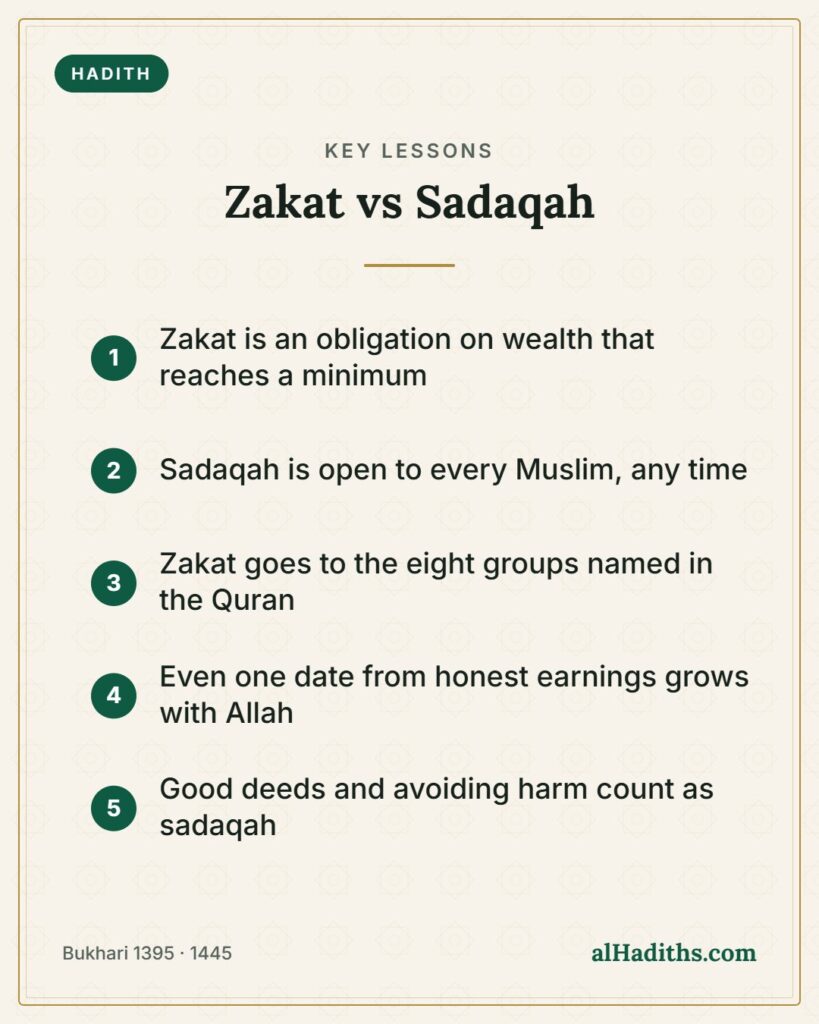
- Zakat is an obligation, taken from those with enough wealth and given to the poor.
- Zakat only begins above fixed minimums; ask a scholar or zakat office about yours.
- Sadaqah is for every Muslim and has no minimum, even one date counts.
- Good deeds and holding back from harm are counted as sadaqah too.
- Zakat goes to the eight groups named in at-Tawbah 9:60.
Whether it is the zakat we owe or a single date given quietly, may Allah accept it from us and let it grow.
Save this to Pinterest so you can explain the difference between zakat and sadaqah to someone else.
Share the reward. Send this article to someone who needs it today — teaching a hadith or dua can become a lasting good deed for you, in shaa Allah.