Riba in Islam: What 5 Authentic Hadith Say About Interest
Contents
What does riba in Islam really mean for a Muslim today? Before any talk of banks or products, it helps to hear what the Prophet ﷺ himself said. Here are five authentic hadith on riba, each checked on Sunnah.com, with what they teach and one small step to take from each.
At a glance
- Hadith: 5, all authentic
- Collections: Sahih Muslim, Sahih al-Bukhari, Sunan Ibn Majah, Sunan Abi Dawud
- Grade: Sahih (Bukhari, Muslim; al-Albani and Darussalam for the Sunan)
- Topic: Riba (interest or usury) in the hadith
- Do today: Look at one of your own deals, and ask a scholar about anything you are unsure of
So what is riba, and why is it taken so seriously? Sunnah.com’s English translators render it as “interest” or “usury.” Scholars explain in detail which modern transactions count as riba, and they differ on some of them. This article gives no rulings on banks, loans, cards or any product. It shows what the hadith say. For your own situation, please ask a qualified scholar you trust.
1. Everyone involved is cursed
Jabir ibn Abdullah (may Allah be pleased with him) reported:
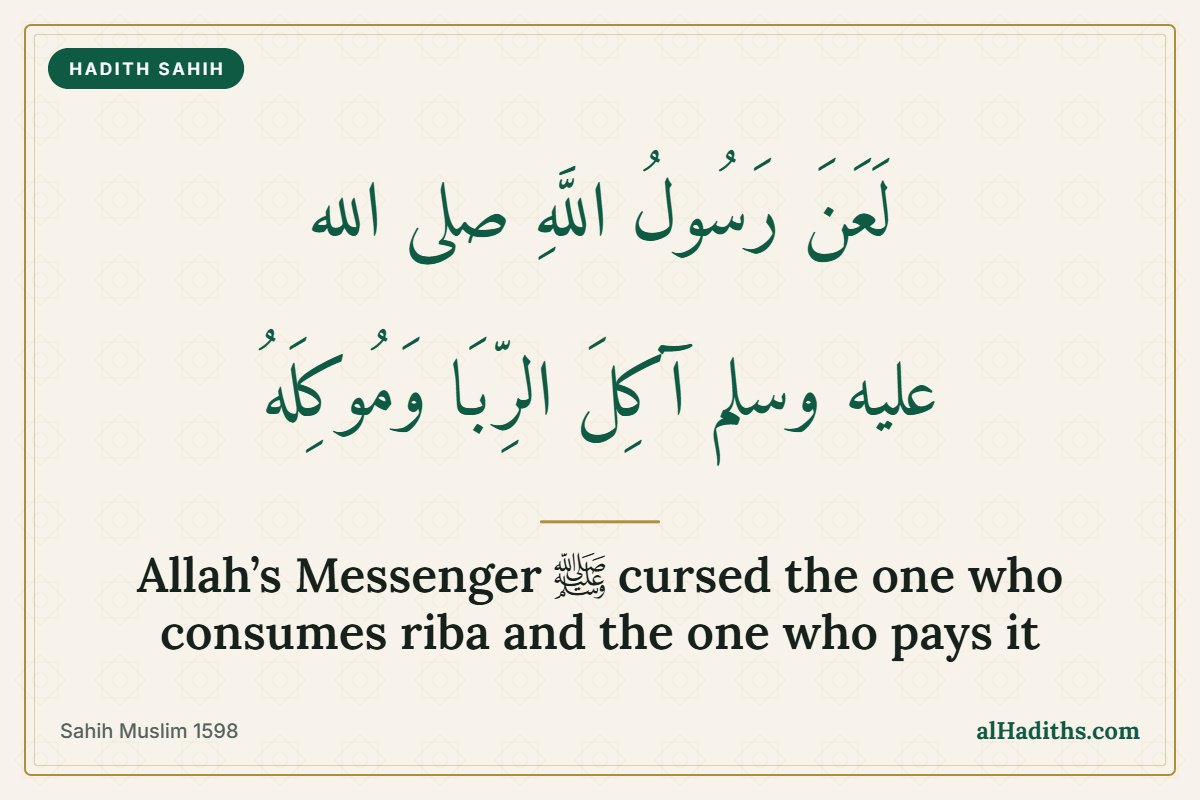
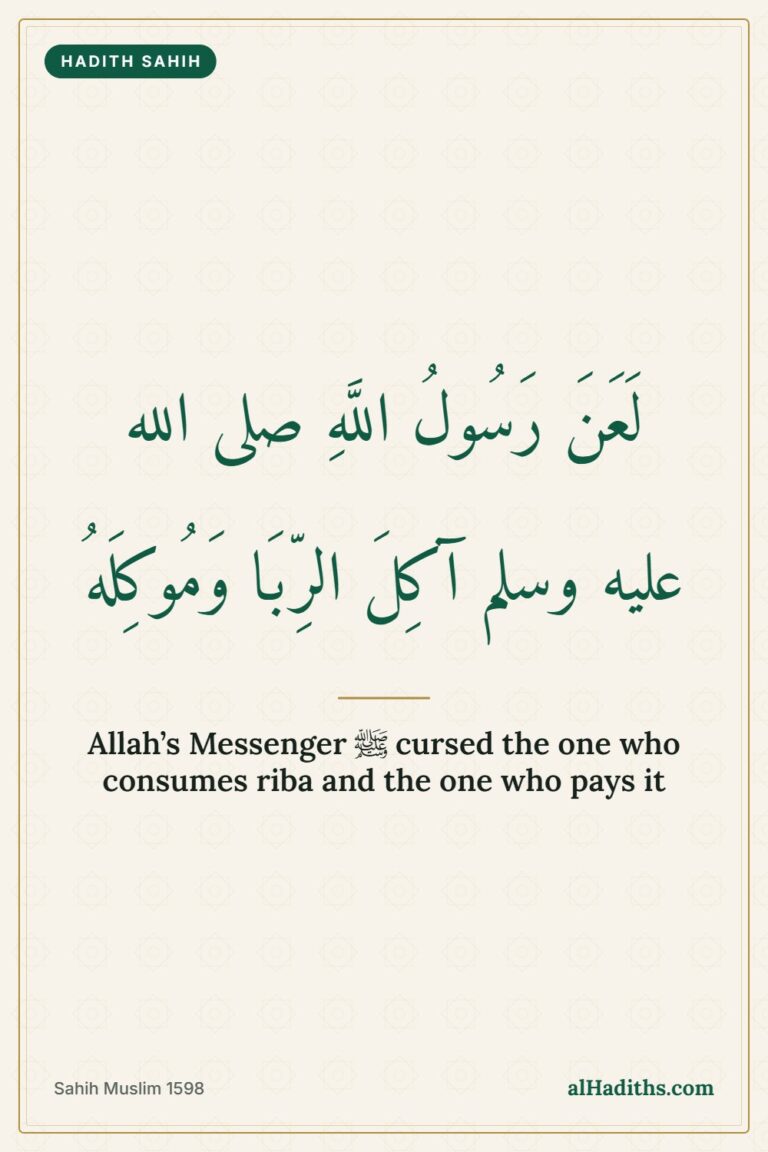
لَعَنَ رَسُولُ اللَّهِ صلى الله عليه وسلم آكِلَ الرِّبَا وَمُوكِلَهُ وَكَاتِبَهُ وَشَاهِدَيْهِ وَقَالَ هُمْ سَوَاءٌ
“Allah’s Messenger ﷺ cursed the accepter of interest and its payer, and the one who records it, and the two witnesses, and he said: ‘They are all equal.’”
Sahih Muslim 1598 · Narrated by Jabir ibn Abdullah · Translation adapted from Sunnah.com
This is one of the clearest hadith on riba. It does not stop at the one who receives it. It names the one who pays it, the one who writes it down and the two people who witness it, and then says they are all equal. Abdullah ibn Mas’ud (may Allah be pleased with him) narrated the same list in Sunan Abi Dawud 3333 (graded Sahih by al-Albani).
Try this: before you sign or witness any agreement that adds extra on a loan, pause and ask whether it is riba. If you are not sure, ask a scholar first.
2. One of the seven destructive sins
Abu Hurairah (may Allah be pleased with him) reported that the Prophet ﷺ said:
اجْتَنِبُوا السَّبْعَ الْمُوبِقَاتِ. قَالُوا يَا رَسُولَ اللَّهِ، وَمَا هُنَّ قَالَ الشِّرْكُ بِاللَّهِ، وَالسِّحْرُ، وَقَتْلُ النَّفْسِ الَّتِي حَرَّمَ اللَّهُ إِلاَّ بِالْحَقِّ، وَأَكْلُ الرِّبَا، وَأَكْلُ مَالِ الْيَتِيمِ، وَالتَّوَلِّي يَوْمَ الزَّحْفِ، وَقَذْفُ الْمُحْصَنَاتِ الْمُؤْمِنَاتِ الْغَافِلاَتِ
“Avoid the seven great destructive sins.” The people asked, “O Allah’s Messenger! What are they?” He said, “To join others in worship along with Allah, to practice sorcery, to kill the life which Allah has forbidden except for a just cause (according to Islamic law), to eat up riba (usury), to eat up an orphan’s wealth, to give back to the enemy and flee from the battlefield at the time of fighting, and to accuse chaste women, who never even think of anything touching chastity and are good believers.”
Sahih al-Bukhari 2766 · Narrated by Abu Hurairah · Translation adapted from Sunnah.com
Riba sits in this short list next to shirk, sorcery and killing. The explanation of this hadith on HadeethEnc (3331) describes “eating” riba as taking it or benefiting from it in any way, so the word covers far more than food.
Try this: learn the seven by heart this week, so you always remember where riba stands.
3. What the Prophet ﷺ saw in a dream
Samura ibn Jundab (may Allah be pleased with him) reported that the Prophet ﷺ said:
رَأَيْتُ اللَّيْلَةَ رَجُلَيْنِ أَتَيَانِي، فَأَخْرَجَانِي إِلَى أَرْضٍ مُقَدَّسَةٍ، فَانْطَلَقْنَا حَتَّى أَتَيْنَا عَلَى نَهَرٍ مِنْ دَمٍ فِيهِ رَجُلٌ قَائِمٌ، وَعَلَى وَسَطِ النَّهْرِ رَجُلٌ بَيْنَ يَدَيْهِ حِجَارَةٌ، فَأَقْبَلَ الرَّجُلُ الَّذِي فِي النَّهَرِ فَإِذَا أَرَادَ الرَّجُلُ أَنْ يَخْرُجَ رَمَى الرَّجُلُ بِحَجَرٍ فِي فِيهِ فَرَدَّهُ حَيْثُ كَانَ، فَجَعَلَ كُلَّمَا جَاءَ لِيَخْرُجَ رَمَى فِي فِيهِ بِحَجَرٍ، فَيَرْجِعُ كَمَا كَانَ، فَقُلْتُ مَا هَذَا فَقَالَ الَّذِي رَأَيْتَهُ فِي النَّهَرِ آكِلُ الرِّبَا
“This night I dreamt that two men came and took me to a holy land whence we proceeded on till we reached a river of blood, where a man was standing, and on its bank was standing another man with stones in his hands. The man in the middle of the river tried to come out, but the other threw a stone in his mouth and forced him to go back to his original place. So, whenever he tried to come out, the other man would throw a stone in his mouth and force him to go back to his former place. I asked, ‘Who is this?’ I was told, ‘The person in the river was a riba-eater.’”
Sahih al-Bukhari 2085 · Narrated by Samura ibn Jundab · Translation adapted from Sunnah.com
Imam al-Bukhari placed this hadith in his chapter on the sin of riba, its witness and its writer. The man keeps trying to leave the river and is pushed back every time. It is a hard picture, and it is meant to be. The Quran also says that those who consume riba will not stand except as one who is beaten by Satan into insanity (Surah al-Baqarah 2:275).
Try this: when a deal with extra on a loan looks tempting, remember this dream. Easy money now is not worth that.
4. Riba ends in less, not more
Abdullah ibn Mas’ud (may Allah be pleased with him) reported that the Prophet ﷺ said:
مَا أَحَدٌ أَكْثَرَ مِنَ الرِّبَا إِلاَّ كَانَ عَاقِبَةُ أَمْرِهِ إِلَى قِلَّةٍ
“There is no one who deals in usury a great deal (to increase his wealth) but he will end up with little (i.e., his wealth will be decreased).”
Sunan Ibn Majah 2279 · Sahih (Darussalam) · Narrated by Abdullah ibn Mas’ud · Translation adapted from Sunnah.com
Riba can look like growth on paper. This hadith says its end is loss. Allah says the same in the Quran: “Allāh destroys interest and gives increase for charities” (Surah al-Baqarah 2:276). The increase that lasts comes from giving, not from riba.
Try this: give a small sadaqah today, however small, and ask Allah to put barakah in what you earn.
5. Abolished at the Farewell Pilgrimage
Sulaiman ibn ’Amr reported from his father, who heard the Prophet ﷺ say during the Farewell Pilgrimage:
أَلاَ إِنَّ كُلَّ رِبًا مِنْ رِبَا الْجَاهِلِيَّةِ مَوْضُوعٌ لَكُمْ رُءُوسُ أَمْوَالِكُمْ لاَ تَظْلِمُونَ وَلاَ تُظْلَمُونَ
“Lo, all claims to usury of the pre-Islamic period have been abolished. You shall have your capital sums, deal not unjustly and you shall not be dealt with unjustly.”
Sunan Abi Dawud 3334 · Sahih (al-Albani) · Narrated by Sulaiman ibn ’Amr from his father · Translation adapted from Sunnah.com
This was near the end of the Prophet’s ﷺ life, in front of a huge gathering of believers. He cancelled every riba claim from the time before Islam and set one fair rule: you get back what you lent, no more and no less. The same words appear in the verses below.
Try this: if someone owes you money, ask only for what you lent. If they are struggling, give them more time.
Bringing it together: riba in Islam and the Quran
Allah says in Surah al-Baqarah:
يَـٰٓأَيُّهَا ٱلَّذِينَ ءَامَنُوا۟ ٱتَّقُوا۟ ٱللَّهَ وَذَرُوا۟ مَا بَقِىَ مِنَ ٱلرِّبَوٰٓا۟ إِن كُنتُم مُّؤْمِنِينَ فَإِن لَّمْ تَفْعَلُوا۟ فَأْذَنُوا۟ بِحَرْبٍ مِّنَ ٱللَّهِ وَرَسُولِهِۦ ۖ وَإِن تُبْتُمْ فَلَكُمْ رُءُوسُ أَمْوَٰلِكُمْ لَا تَظْلِمُونَ وَلَا تُظْلَمُونَ
“O you who have believed, fear Allāh and give up what remains [due to you] of interest, if you should be believers. And if you do not, then be informed of a war [against you] from Allāh and His Messenger. But if you repent, you may have your principal – [thus] you do no wrong, nor are you wronged.”
Surah al-Baqarah 2:278–279 · Translation: Saheeh International, from Quran.com
Reflection: put these five hadith side by side and a pattern shows. Riba is not treated as a small matter of paperwork. It is cursed, it is counted among the destructive sins, it is punished, it ends in loss, and the Prophet ﷺ cancelled it in his last Hajj. Yet the door stays open: the verse ends with repentance and getting your principal back. Earning honestly is part of faith, and it is never too late to start.
Modern finance has many products, and scholars discuss each of them in detail. If you are unsure about a loan, a card or an account, ask a qualified scholar you trust before you decide.
Questions people ask
Is riba a major sin?
Yes. In Sahih al-Bukhari 2766 the Prophet ﷺ counted consuming riba among the seven destructive sins, alongside shirk, sorcery and killing.
Is riba the same as interest?
Sunnah.com’s translators render riba as “interest” or “usury,” and Saheeh International uses “interest” in the Quran. Which modern transactions count as riba is a detailed question that scholars discuss, so please ask a qualified scholar about your own case.
What is the punishment for riba?
In Sahih al-Bukhari 2085 the Prophet ﷺ saw a riba-eater in a river of blood, pushed back with stones each time he tried to leave. Surah al-Baqarah 2:275 says those who consume it will stand like one beaten by Satan into insanity, and 2:279 warns of war from Allah and His Messenger.
Is riba only about money?
Not only cash loans. In Sahih al-Bukhari 2312, Bilal (may Allah be pleased with him) traded two measures of poorer dates for one measure of better dates, and the Prophet ﷺ called it the very essence of riba. He told him to sell the dates for money first, then buy the better ones. How this applies today is a question for scholars.
Key lessons
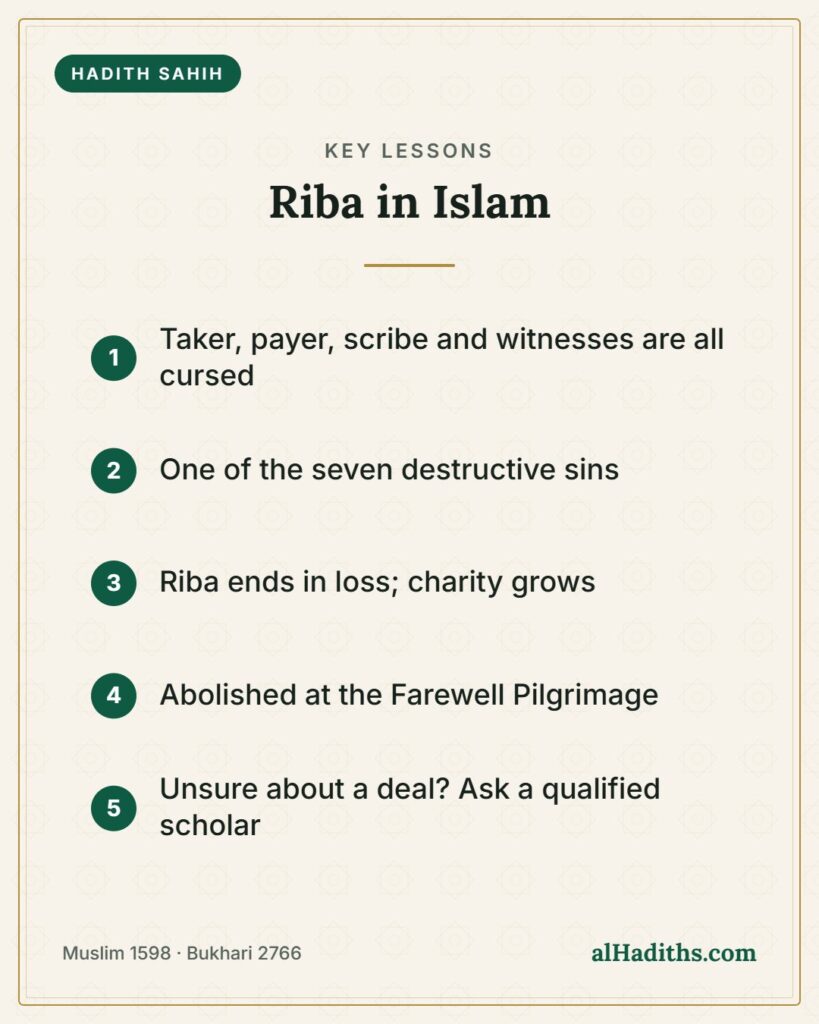
- Riba is cursed for everyone involved: the taker, the payer, the scribe and the witnesses.
- It is one of the seven destructive sins.
- Riba ends in loss, while charity grows.
- The Prophet ﷺ abolished it at the Farewell Pilgrimage.
- If you are unsure about a transaction, ask a qualified scholar.
May Allah keep our earnings clean and put barakah in what we have.
Save this to Pinterest so you can keep these hadith on riba close
Share the reward. Send this article to someone who needs it today — teaching a hadith or dua can become a lasting good deed for you, in shaa Allah.