Jummah Mubarak Hadith: Friday Forwards That Aren’t Authentic
Contents
Every Thursday night the phones start buzzing: “Jummah Mubarak!”, a Friday poster, and sometimes a promise attached, like “whoever sends this first, Allah forbids the Fire for him.” Is there a real Jummah Mubarak hadith, and which Friday forwards are actually authentic? This article checks the popular messages against what hadith scholars said about them, then gives four authentic hadith about Friday that are worth sharing instead.
At a glance
- Topic: Friday forwards and the hadith behind them
- Checked: 4 popular Friday messages, with their grades
- Authentic: Sahih Muslim, Sahih al-Bukhari, Sunan Abi Dawud, Mishkat al-Masabih
- Grades: Sahih, Hasan (graders named); weak ones labelled, no Arabic cards
- Do today: Before you forward a Friday message, check its source
Is there a Jummah Mubarak hadith?
No. We could not find any hadith in which the Prophet ﷺ or the Companions set “Jummah Mubarak” as a Friday greeting. The phrase simply means “blessed Friday”, and the day really is blessed, as the authentic hadith below show. What has no basis is the reward that some forwards attach to it.
The best-known version says that whoever is the first to wish others “Jummah Mubarak”, the Fire becomes forbidden for him. It has no source in any hadith collection. The same template also circulates for the month of Rabi‘ al-Awwal, and the Fatwa Department of Jamiatul Ulama (KZN) answered that they had not come across any hadith making that claim (Jamiatul Ulama KZN). A promise of safety from the Fire cannot be taken from a chain message with no chain.
Saying “Jummah Mubarak” as a kind wish is a separate question. Scholars differ on it. The Council of Ulama (Eastern Cape) said it is permissible, as long as people do not treat it as a sunnah or an obligation (Council of Ulama via IslamQA.org), while others discourage making it a fixed weekly ritual. For a ruling, ask a qualified local scholar.
Weak Friday hadith people share
The narrations below are popular on WhatsApp and in Friday posters, but hadith scholars have graded them weak or worse. We mention them only to label them, so there are no Arabic cards for them here. If the grading terms are new to you, our guide to sahih, hasan and weak hadith explains them.
“Recite Surah ad-Dukhan on Friday night and you will be forgiven”
At-Tirmidhi recorded it, and it is graded Da‘if (Darussalam) (Jami‘ at-Tirmidhi 2889). A related version, that seventy thousand angels seek forgiveness for whoever recites ad-Dukhan at night, is also graded Da‘if (Darussalam) (Jami‘ at-Tirmidhi 2888). Reciting any surah of the Quran is good, but these particular promises are not established.
“Going early to Jumu‘ah is the Hajj of the poor”
It is often shared as “Friday is the Hajj of the poor.” Ad-Daylami recorded it, and al-Suyuti listed it among fabricated narrations; HadithAnswers says it is not suitable to quote (HadithAnswers). Going early to Jumu‘ah has a real reward in Sahih al-Bukhari, explained in our Friday sunnahs article, so there is no need for this one.
“Eighty salawat after ‘Asr on Friday forgives eighty years of sins”
This one needs care. The version that adds eighty years of worship recorded for the reader is extremely weak. A shorter version, recorded by ad-Daraqutni, about sending salawat eighty times on Friday, was graded hasan by al-‘Iraqi and others, as Moulana Muhammad Abasoomar explains (Council of Ulama via IslamQA.org). So the long forward with its extra promises should not be passed on as it is. Sending more salawat on Friday is firmly established, as hadith 4 below shows.
Dying on Friday: a note on its grading
This forward is different, because it is not weak by every grader. ‘Abdullah ibn ‘Amr (may Allah be pleased with him) reported:
مَا مِنْ مُسْلِمٍ يَمُوتُ يَوْمَ الْجُمُعَةِ أَوْ لَيْلَةَ الْجُمُعَةِ إِلاَّ وَقَاهُ اللَّهُ فِتْنَةَ الْقَبْرِ
The Messenger of Allah ﷺ said: “No Muslim dies on the day of Friday, nor the night of Friday, except that Allah protects him from the trial of the grave.”
Jami‘ at-Tirmidhi 1074 · Hasan (Darussalam) · Narrated by ‘Abdullah ibn ‘Amr · Translation adapted from Sunnah.com
Darussalam grades it Hasan. At-Tirmidhi himself, right after recording it, called it gharib and said its chain is not connected, because Rabi‘ah ibn Sayf is not known to have heard from ‘Abdullah ibn ‘Amr. So it can be shared with its grade named, but not as if it were in Sahih al-Bukhari. And no one chooses the day they die: what we can choose is how we live each Friday.
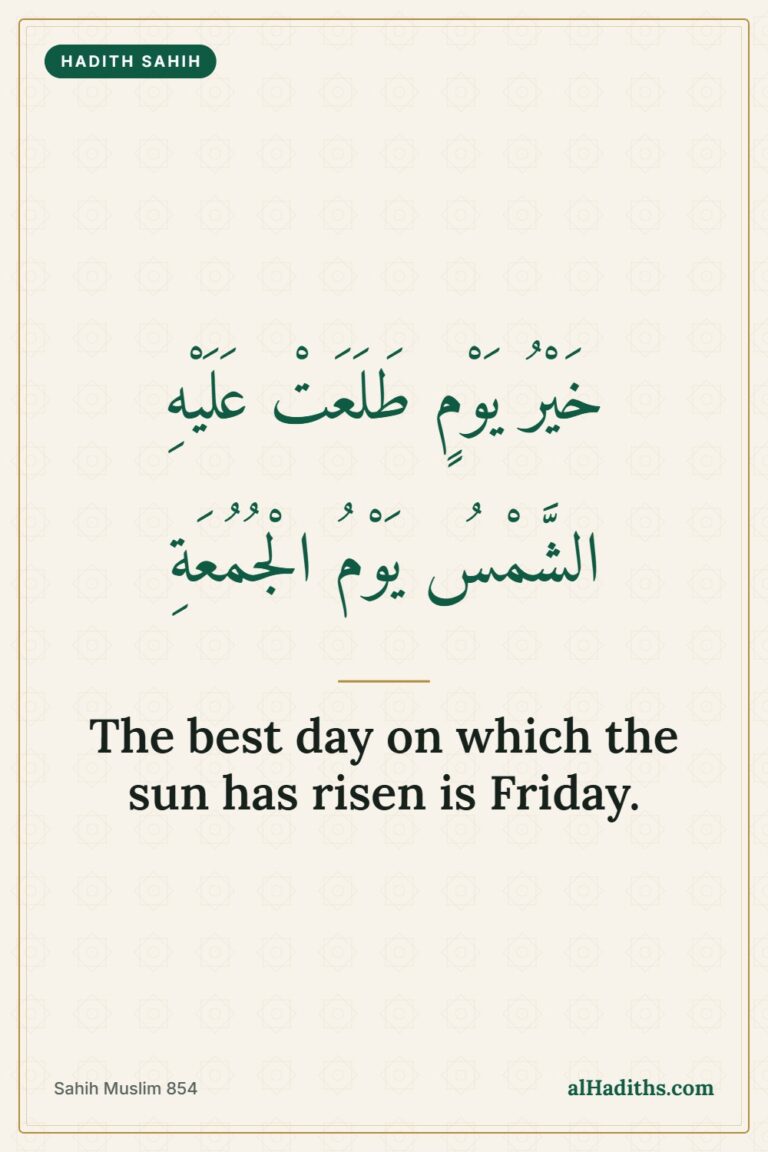
1. Friday is the best day the sun rises on
Abu Hurairah (may Allah be pleased with him) reported:
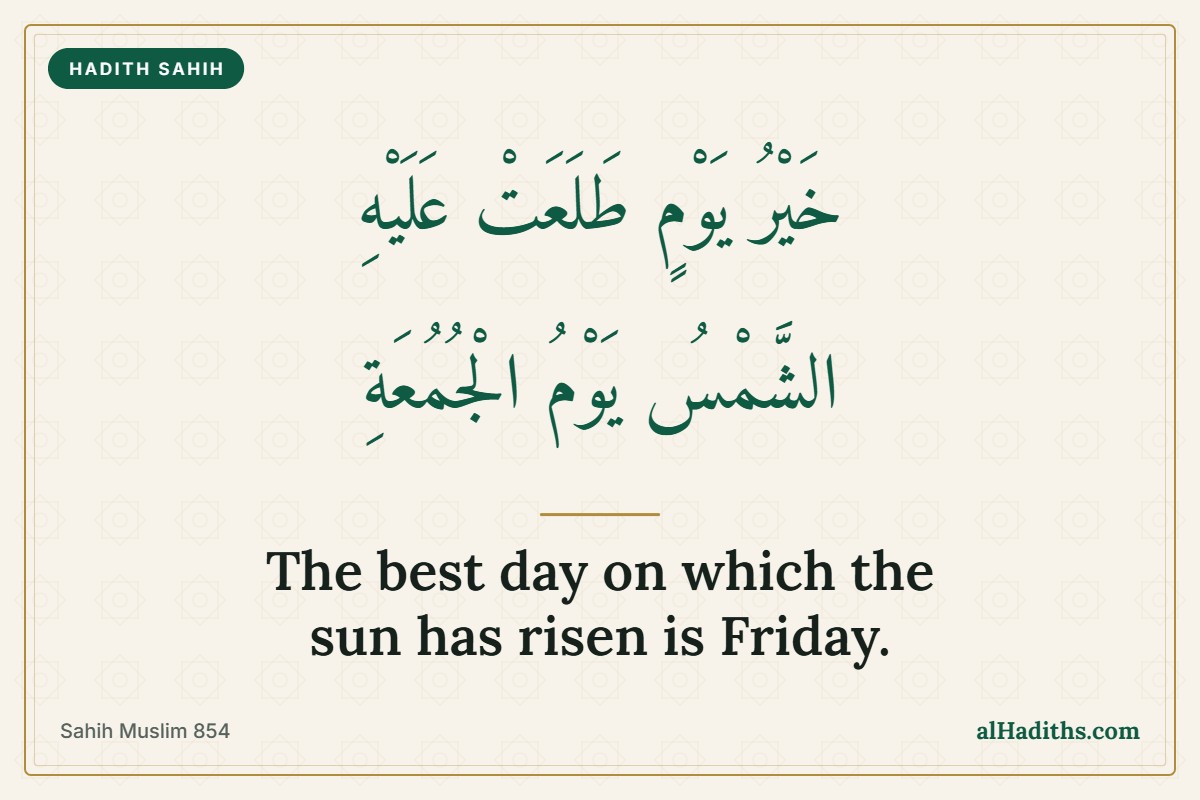
خَيْرُ يَوْمٍ طَلَعَتْ عَلَيْهِ الشَّمْسُ يَوْمُ الْجُمُعَةِ فِيهِ خُلِقَ آدَمُ وَفِيهِ أُدْخِلَ الْجَنَّةَ وَفِيهِ أُخْرِجَ مِنْهَا
The Messenger of Allah ﷺ said: “The best day on which the sun has risen is Friday; on it Adam was created, on it he was made to enter Paradise, and on it he was expelled from it.”
Sahih Muslim 854 · Narrated by Abu Hurairah · Translation adapted from Sunnah.com
HadeethEnc explains that these events show the merit of Friday, and that Muslims are encouraged to increase good deeds on it (HadeethEnc 3711). This is the hadith that makes “blessed Friday” true.
Try this: instead of a poster, send this hadith with its source line.
2. An hour when dua is answered
Abu Hurairah (may Allah be pleased with him) also reported:
فِيهِ سَاعَةٌ لاَ يُوَافِقُهَا عَبْدٌ مُسْلِمٌ، وَهْوَ قَائِمٌ يُصَلِّي، يَسْأَلُ اللَّهَ تَعَالَى شَيْئًا إِلاَّ أَعْطَاهُ إِيَّاهُ
Allah’s Messenger ﷺ talked about Friday and said: “There is an hour on Friday; if a Muslim servant meets it while standing in prayer and asks Allah for something, Allah will give it to him.” And he pointed with his hand to show how short that time is.
Sahih al-Bukhari 935 · Narrated by Abu Hurairah · Translation adapted from Sunnah.com
Other narrations place this hour between the imam sitting down and the end of the prayer, or in the last hour after ‘Asr; our Friday sunnahs article gives both.
Try this: keep a short list of what you want to ask Allah, and use it in the last hour before Maghrib.
3. Surah al-Kahf on Friday
Abu Sa‘id al-Khudri (may Allah be pleased with him) reported:
من قَرَأَ سُورَة الْكَهْف فِي يَوْم الْجُمُعَة أَضَاء لَهُ النُّور مَا بَيْنَ الْجُمْعَتَيْنِ
The Prophet ﷺ said: “If anyone recites Surah al-Kahf on Friday, light will shine brightly for him till the next Friday.”
Mishkat al-Masabih 2175 · Hasan (al-Albani) · Narrated by Abu Sa‘id al-Khudri · Translation adapted from Sunnah.com
Al-Baihaqi recorded it, and al-Albani graded it Hasan in his checking of Mishkat al-Masabih. This is one Friday forward that holds up, so share it with its grade.
Try this: read al-Kahf in two sittings, one after Fajr and one after Jumu‘ah.
4. Send more salawat on Friday
Aws ibn Aws (may Allah be pleased with him) reported:
إِنَّ مِنْ أَفْضَلِ أَيَّامِكُمْ يَوْمَ الْجُمُعَةِ فِيهِ خُلِقَ آدَمُ وَفِيهِ قُبِضَ وَفِيهِ النَّفْخَةُ وَفِيهِ الصَّعْقَةُ فَأَكْثِرُوا عَلَىَّ مِنَ الصَّلاَةِ فِيهِ فَإِنَّ صَلاَتَكُمْ مَعْرُوضَةٌ عَلَىَّ
The Prophet ﷺ said: “Among the most excellent of your days is Friday; on it Adam was created, on it he died, on it the last trumpet will be blown, and on it the shout will be made, so invoke more blessings on me that day, for your blessings will be submitted to me.”
Sunan Abi Dawud 1047 · Sahih (al-Albani) · Narrated by Aws ibn Aws · Translation adapted from Sunnah.com
No number is given here, so any amount counts. Our guide to salawat on the Prophet ﷺ has the authentic wordings.
Try this: pair your Friday salawat with something you already do, such as the walk to the mosque.
Bringing it together
Reflection: Friday does not need invented rewards to be special. The authentic hadith already give us more than a forward ever could: the best day of the week, an hour when dua is answered, light from al-Kahf, and salawat that reach the Prophet ﷺ. Checking a message before we share it is part of honouring the one it is attributed to.
Is saying Jummah Mubarak a bid‘ah?
There is no hadith that sets it as a Friday greeting. Some scholars say it is permissible as a kind wish, as long as it is not treated as a sunnah (Council of Ulama via IslamQA.org); others discourage it as a fixed ritual. Ask a qualified local scholar for a ruling.
Is reading Surah al-Kahf on Friday sunnah?
A hadith says that whoever recites al-Kahf on Friday will have light till the next Friday; al-Albani graded it Hasan (Mishkat al-Masabih 2175).
What happens if a Muslim dies on Friday?
A hadith in at-Tirmidhi says Allah protects him from the trial of the grave. Darussalam grades it Hasan, but at-Tirmidhi noted that its chain is not connected (Jami‘ at-Tirmidhi 1074).
Key lessons
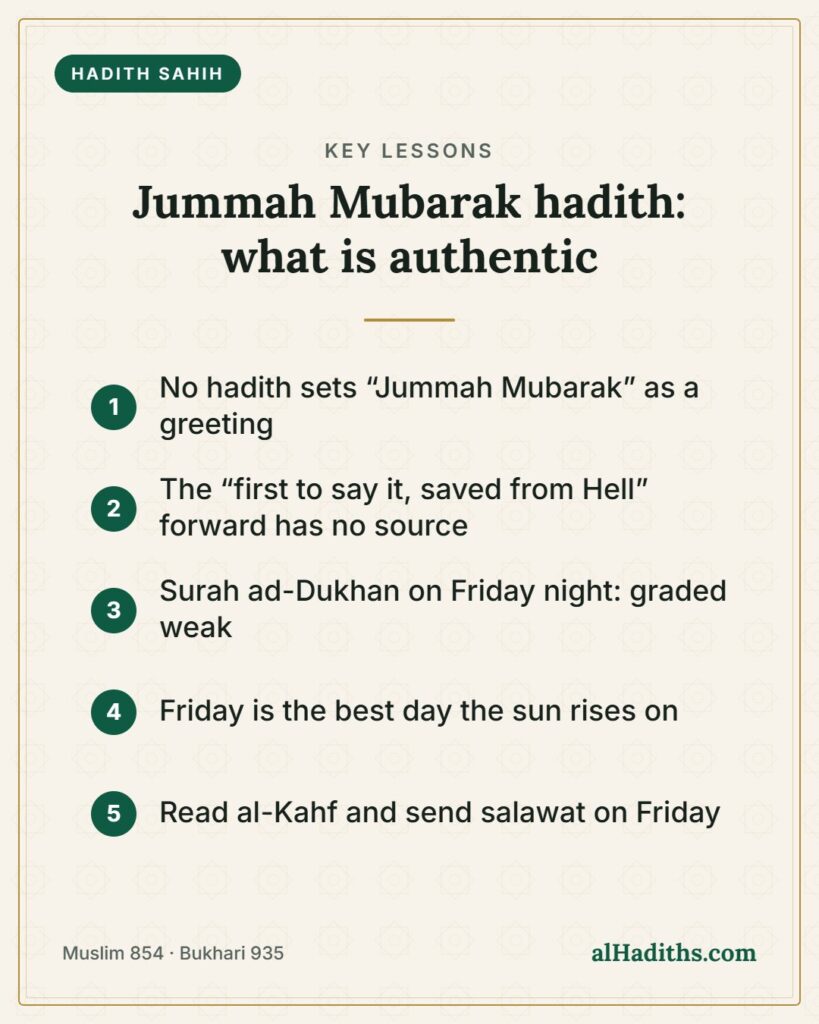
- No authentic hadith sets “Jummah Mubarak” as a greeting, and the “first to say it is saved from the Fire” forward has no source.
- The ad-Dukhan Friday-night promises are graded weak, and “the Hajj of the poor” is fabricated.
- The dying-on-Friday hadith is graded Hasan by Darussalam, with a break in its chain noted by at-Tirmidhi.
- Share the authentic Friday hadith instead: the best day (Muslim 854), the hour of dua (Bukhari 935), al-Kahf, and more salawat.
Next time a Friday message arrives, look for its source line before you press forward. If it has none, send Muslim 854 instead, and let the reward of sharing a true hadith be yours.
Save this to Pinterest so you can check a Friday forward before you share it
Share the reward. Send this article to someone who needs it today — teaching a hadith or dua can become a lasting good deed for you, in shaa Allah.