Hadith About Lying: 7 Authentic Hadith on Lies and Honesty
Contents
A small lie can feel harmless: to get out of trouble, to make a story funnier, to close a sale. The hadith about lying show that the Prophet ﷺ saw it very differently. Here are seven authentic hadith on where lies lead, what honesty brings, and the narrow cases the Sunnah mentions.
At a glance
- Hadith: 7, plus 1 Quran verse
- Collections: Bukhari, Abu Dawud, Quran
- Grade: Sahih or Hasan (graders named on each card)
- Topic: Lying, truthfulness and honesty in daily life
- One thing to do today: Catch one small lie before you say it, and tell the truth instead
1. Where truthfulness and lying lead
ʿAbdullah ibn Masʿud (may Allah be pleased with him) reported the Prophet ﷺ as saying:
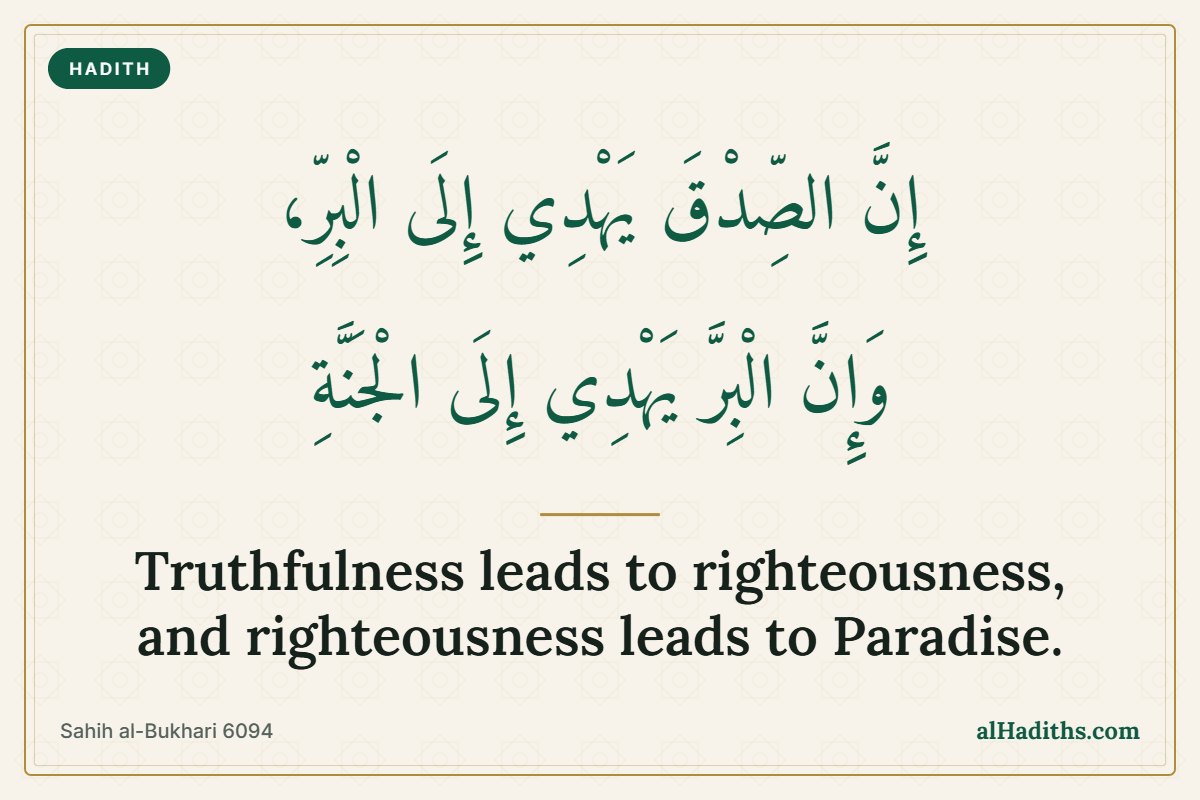
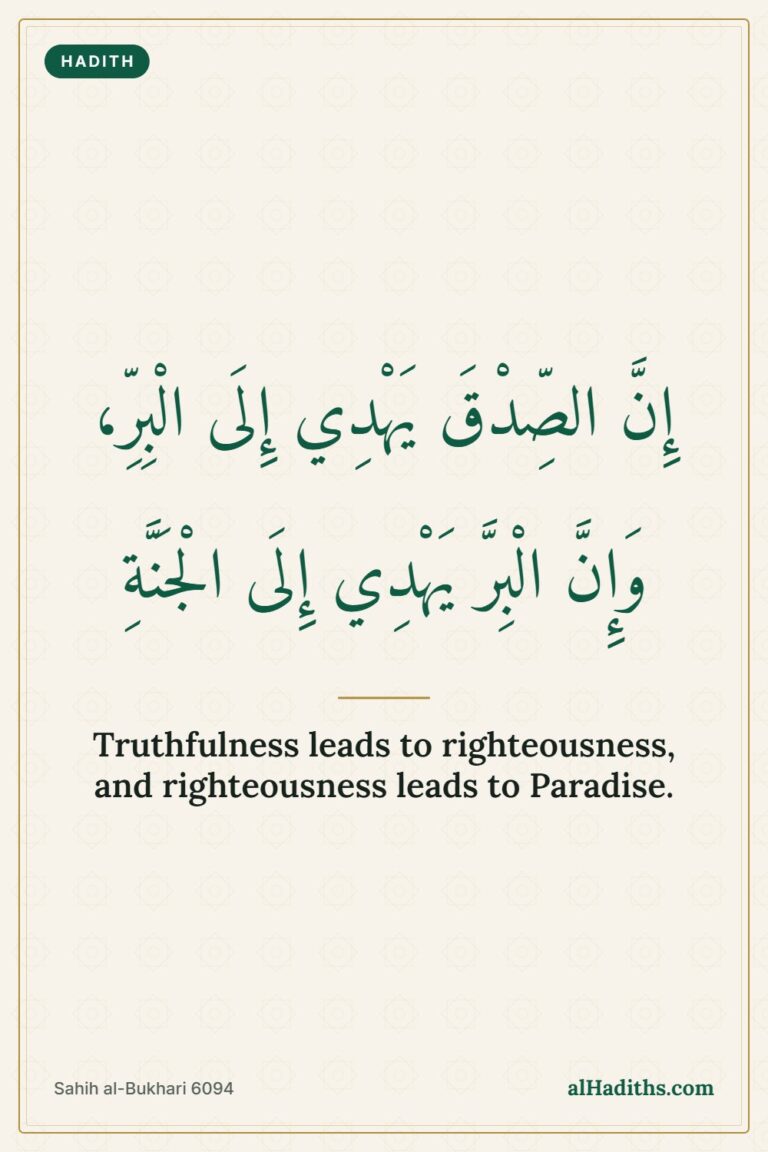
إِنَّ الصِّدْقَ يَهْدِي إِلَى الْبِرِّ، وَإِنَّ الْبِرَّ يَهْدِي إِلَى الْجَنَّةِ، وَإِنَّ الرَّجُلَ لَيَصْدُقُ حَتَّى يَكُونَ صِدِّيقًا، وَإِنَّ الْكَذِبَ يَهْدِي إِلَى الْفُجُورِ، وَإِنَّ الْفُجُورَ يَهْدِي إِلَى النَّارِ، وَإِنَّ الرَّجُلَ لَيَكْذِبُ، حَتَّى يُكْتَبَ عِنْدَ اللَّهِ كَذَّابًا
“Truthfulness leads to righteousness, and righteousness leads to Paradise. A man keeps telling the truth until he becomes a truthful person. Lying leads to wickedness, and wickedness leads to the Fire. A man keeps telling lies until he is written with Allah as a liar.”
Sahih al-Bukhari 6094 · Narrated by ʿAbdullah ibn Masʿud · Translation adapted from Sunnah.com
Truth and lies are both roads, and both lead somewhere. HadeethEnc explains that a person who keeps striving to be truthful makes it part of his nature, while one who keeps lying is drawn into sin until he is recorded with Allah among the liars. The same hadith is in Sahih Muslim 2607.
Try this: for one day, notice every time you are tempted to bend the truth, even slightly, and choose the true version.
2. Lying is a sign of a hypocrite
Abu Hurayrah (may Allah be pleased with him) reported the Prophet ﷺ as saying:
آيَةُ الْمُنَافِقِ ثَلاَثٌ إِذَا حَدَّثَ كَذَبَ، وَإِذَا وَعَدَ أَخْلَفَ، وَإِذَا اؤْتُمِنَ خَانَ
“The signs of a hypocrite are three: when he speaks, he lies; when he promises, he breaks it; and when he is trusted, he betrays.”
Sahih al-Bukhari 33 · Narrated by Abu Hurayrah · Translation adapted from Sunnah.com
Lying comes first in the list. A believer’s words, promises and trusts should all be reliable; when they are not, the person is showing a trait of hypocrisy, even if he prays and fasts.
Try this: before you make a promise this week, ask yourself whether you can really keep it.
3. Lying about the Prophet ﷺ
ʿAbdullah ibn az-Zubayr asked his father, az-Zubayr ibn al-ʿAwwam (may Allah be pleased with him), why he did not narrate hadith as often as others did. He replied that he had always been with the Prophet ﷺ, but had heard him say:
مَنْ كَذَبَ عَلَىَّ فَلْيَتَبَوَّأْ مَقْعَدَهُ مِنَ النَّارِ
“Whoever lies about me, let him take his seat in the Fire.”
Sahih al-Bukhari 107 · Narrated by az-Zubayr ibn al-ʿAwwam · Translation adapted from Sunnah.com
A companion who spent years with the Prophet ﷺ narrated less, out of fear of saying something he did not say. This is why we check every hadith on this site against its source, and why sharing a made-up “hadith” online is not a small thing. Our weak hadith series looks at some popular ones.
Try this: before forwarding a hadith, check its source and grade.
4. Lying to make people laugh
Muʿawiyah al-Qushayri (may Allah be pleased with him) heard the Prophet ﷺ say:
وَيْلٌ لِلَّذِي يُحَدِّثُ فَيَكْذِبُ لِيُضْحِكَ بِهِ الْقَوْمَ وَيْلٌ لَهُ وَيْلٌ لَهُ
“Woe to the one who speaks and lies to make people laugh. Woe to him! Woe to him!”
Sunan Abi Dawud 4990 · Hasan (al-Albani) · Narrated by Muʿawiyah al-Qushayri · Translation adapted from Sunnah.com
Humor is not the problem. The problem is making something up to get the laugh. The Prophet ﷺ repeated the warning three times.
Try this: keep your jokes true. If a story needs a made-up detail to be funny, leave it out.
5. A house in Jannah for leaving lies, even in jest
Abu Umamah (may Allah be pleased with him) reported the Prophet ﷺ as saying:
أَنَا زَعِيمٌ بِبَيْتٍ فِي رَبَضِ الْجَنَّةِ لِمَنْ تَرَكَ الْمِرَاءَ وَإِنْ كَانَ مُحِقًّا وَبِبَيْتٍ فِي وَسَطِ الْجَنَّةِ لِمَنْ تَرَكَ الْكَذِبَ وَإِنْ كَانَ مَازِحًا وَبِبَيْتٍ فِي أَعْلَى الْجَنَّةِ لِمَنْ حَسَّنَ خُلُقَهُ
“I guarantee a house on the outskirts of Paradise for one who gives up arguing even when he is right, a house in the middle of Paradise for one who gives up lying even when joking, and a house in the highest part of Paradise for one whose character is good.”
Sunan Abi Dawud 4800 · Hasan (al-Albani) · Narrated by Abu Umamah · Translation adapted from Sunnah.com
Where the last hadith warned, this one promises. Giving up even the “harmless” joking lie earns a house in the middle of Paradise.
Try this: pick one of the three houses in this hadith and work on it this month.
6. Honesty brings blessing in business
Hakim ibn Hizam (may Allah be pleased with him) reported the Prophet ﷺ as saying:
الْبَيِّعَانِ بِالْخِيَارِ مَا لَمْ يَتَفَرَّقَا ـ أَوْ قَالَ حَتَّى يَتَفَرَّقَا ـ فَإِنْ صَدَقَا وَبَيَّنَا بُورِكَ لَهُمَا فِي بَيْعِهِمَا، وَإِنْ كَتَمَا وَكَذَبَا مُحِقَتْ بَرَكَةُ بَيْعِهِمَا
“The buyer and the seller have the option (to cancel) as long as they have not parted. If they both speak the truth and make things clear, their deal is blessed. If they hide things and lie, the blessing of their deal is wiped out.”
Sahih al-Bukhari 2079 · Narrated by Hakim ibn Hizam · Translation adapted from Sunnah.com
A lie may win one sale, but the hadith says it takes away the barakah. Telling the buyer about a defect may lose a little profit, but it brings blessing into what remains.
Try this: if you sell anything, online or in person, describe its faults as clearly as its good points.
7. The peacemaker is not a liar
Umm Kulthum bint ʿUqbah (may Allah be pleased with her) heard the Prophet ﷺ say:
لَيْسَ الْكَذَّابُ الَّذِي يُصْلِحُ بَيْنَ النَّاسِ، فَيَنْمِي خَيْرًا، أَوْ يَقُولُ خَيْرًا
“He is not a liar who makes peace between people, passing on good or saying good.”
Sahih al-Bukhari 2692 · Narrated by Umm Kulthum bint ʿUqbah · Translation adapted from Sunnah.com
Someone repairing a quarrel may pass on only the kind words each side said, and leave out the harsh ones. The hadith does not count that as lying. It is a narrow door for making peace, not a general permission.
Try this: if two people you know have fallen out, pass on something good one has said about the other.
Bringing it together: what the hadith about lying teach
Allah commands the believers to stay close to truthful people:
يَـٰٓأَيُّهَا ٱلَّذِينَ ءَامَنُوا۟ ٱتَّقُوا۟ ٱللَّهَ وَكُونُوا۟ مَعَ ٱلصَّـٰدِقِينَ
“O you who have believed, fear Allāh and be with those who are true.”
Surah At-Tawbah 9:119 · Translation: Saheeh International, from Quran.com
Reflection: these hadith turn honesty from a rule into a direction of travel. Every true word is a step towards righteousness and Paradise; every lie, even a small or funny one, is a step the other way. The narrow cases the Sunnah allows, like making peace, only show how serious the rule is everywhere else.
Questions people ask
Is lying allowed in 3 cases?
Asma’ bint Yazid reported the Prophet ﷺ as saying it is not lawful to lie except in three cases: what a man says to his wife to please her, in war, and to make peace between people (Jami’ at-Tirmidhi 1939, Sahih, Darussalam). In Sahih Muslim 2605, the list of three is a comment by the narrator Ibn Shihab after the Prophet’s ﷺ words in card 7. Scholars discuss how far these cases go, so ask a qualified scholar before relying on them.
Is it a sin to lie as a joke?
The Prophet ﷺ warned “Woe to him” three times for one who lies to make people laugh (Abu Dawud 4990), and promised a house in the middle of Paradise for one who leaves lying even when joking (Abu Dawud 4800). Joking with true words is fine.
What does the hadith say about lying about the Prophet ﷺ?
“Whoever lies about me, let him take his seat in the Fire” (Sahih al-Bukhari 107). This is why it matters to check a hadith’s source before sharing it.
What is the hadith about truthfulness leading to Paradise?
Sahih al-Bukhari 6094 and Sahih Muslim 2607: truthfulness leads to righteousness, and righteousness leads to Paradise. It is the first hadith in this article.
Key lessons
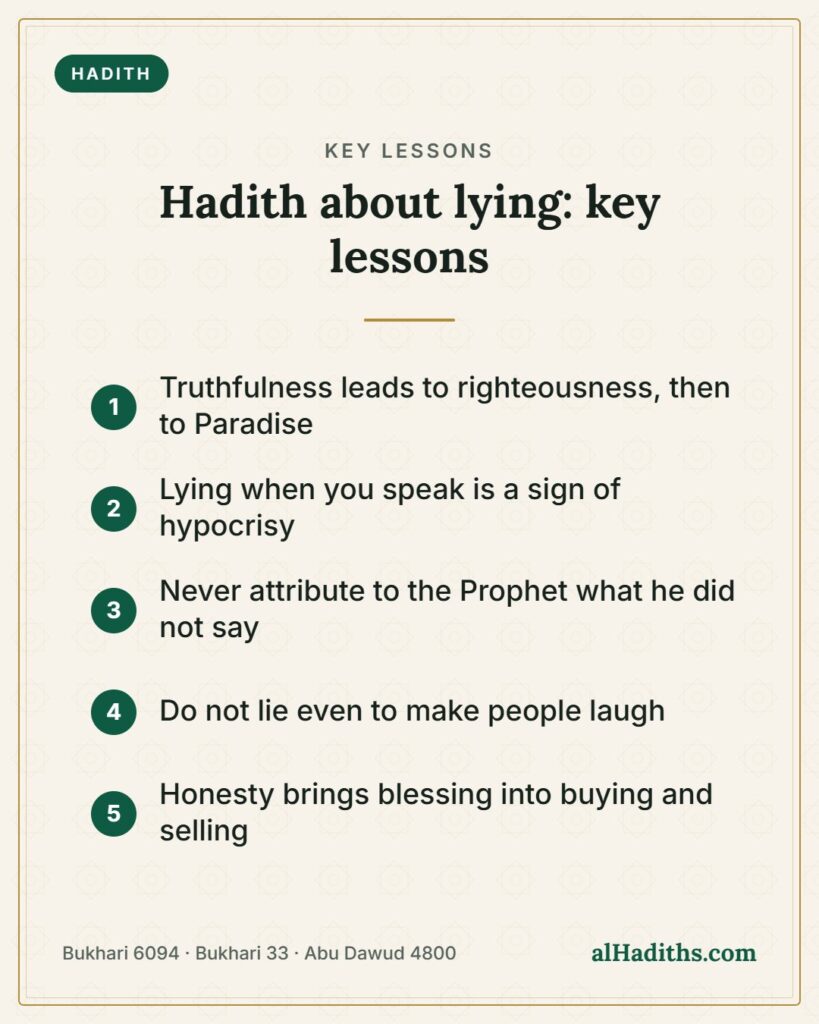
- Truthfulness leads to righteousness and Paradise; lying leads to wickedness and the Fire.
- Lying when you speak is one of the three signs of a hypocrite.
- Attributing words to the Prophet ﷺ that he did not say carries a severe warning.
- Do not lie even to make people laugh.
- Honesty brings blessing into trade; lies wipe it out.
Truth is not always the easy word, but it is always the one that leads somewhere good. Choose it once today, and then again tomorrow.
Save this to Pinterest so you can come back to these hadith about lying and honesty.
Share the reward. Send this article to someone who needs it today — teaching a hadith or dua can become a lasting good deed for you, in shaa Allah.