Janazah Prayer: How the Prophet ﷺ Prayed Over the Dead
Contents
The announcement comes after Zuhr: there will be a janazah prayer for a brother from the neighborhood, and the rows form again. What did the Prophet ﷺ do when he prayed over the dead, and what did he promise those who attend? These six authentic hadith describe the janazah prayer, the funeral prayer in Islam: its four takbirs, the reward of one and two qirats, the number of people who pray, and the right every Muslim has to be followed to the grave.
At a glance
- Hadith: 6 authentic narrations
- Collections: Sahih al-Bukhari and Sahih Muslim
- Grade: Sahih (all from Bukhari or Muslim)
- Topic: How the Prophet ﷺ prayed over the dead, and the reward of attending
- Do today: Learn the four takbirs so you are ready for the next janazah
1. The janazah prayer: four takbirs, in rows
Abu Hurairah (may Allah be pleased with him) reported:
رَسُولَ اللَّهِ صلى الله عليه وسلم نَعَى النَّجَاشِيَّ فِي الْيَوْمِ الَّذِي مَاتَ فِيهِ، خَرَجَ إِلَى الْمُصَلَّى، فَصَفَّ بِهِمْ وَكَبَّرَ أَرْبَعًا
Allah’s Messenger ﷺ announced the death of an-Najashi on the very day he died. He went out to the musalla (prayer place), lined the people up in rows, and said four takbirs.
Bukhari 1245 · Narrated by Abu Hurairah · Translation adapted from Sunnah.com
An-Najashi was the king of Abyssinia who sheltered the Muslims who migrated to his land. HadeethEnc explains that he died in a land where the funeral prayer had not been offered over him, so the Prophet ﷺ announced his death the same day and led the prayer for him. The essentials of the janazah prayer are already here: rows behind an imam, and four takbirs.
Try this: at the next janazah, straighten the rows as you would for the daily prayers. The Prophet ﷺ lined the people up for this prayer too.
2. One qirat for the prayer, two for the burial
Abu Hurairah reported that the Prophet ﷺ said:
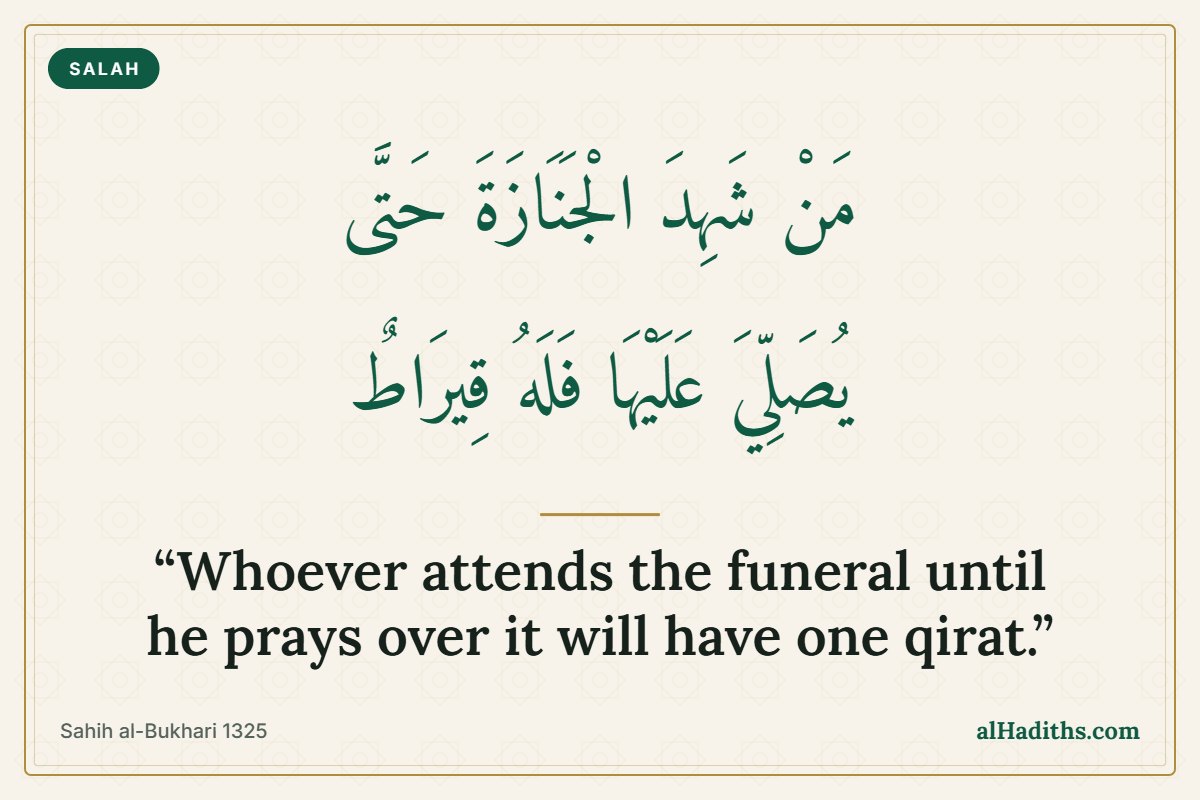
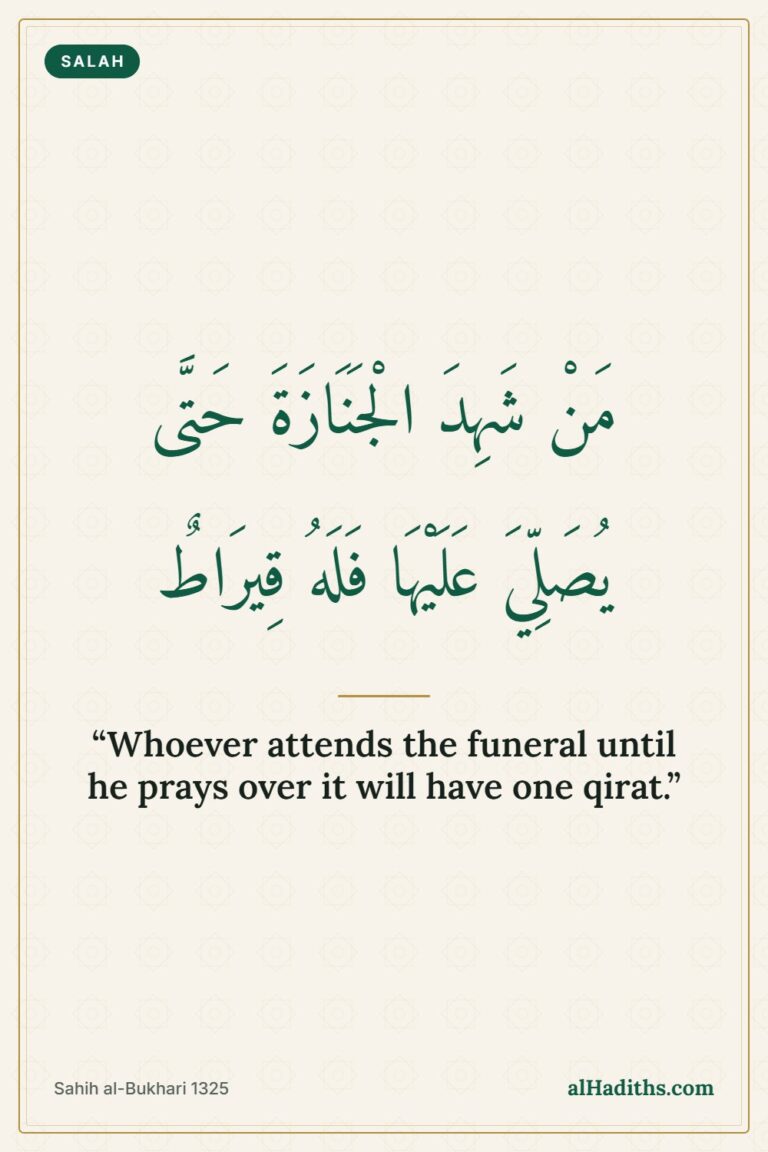
مَنْ شَهِدَ الْجَنَازَةَ حَتَّى يُصَلِّيَ عَلَيْهَا فَلَهُ قِيرَاطٌ، وَمَنْ شَهِدَ حَتَّى تُدْفَنَ كَانَ لَهُ قِيرَاطَانِ. قِيلَ وَمَا الْقِيرَاطَانِ قَالَ مِثْلُ الْجَبَلَيْنِ الْعَظِيمَيْنِ
“Whoever attends the funeral until he offers the funeral prayer for it will get a reward equal to one qirat, and whoever stays until the burial will get a reward equal to two qirats.” It was asked, “What are two qirats?” He replied, “Like two huge mountains.”
Bukhari 1325 · Narrated by Abu Hurairah · Translation adapted from Sunnah.com
In another narration in Sahih Muslim, the smaller of the two qirats is like Mount Uhud. Sahih Muslim 945 adds that Ibn ‘Umar (may Allah be pleased with him) used to pray and then leave before the burial. When this hadith reached him, he said: “We have lost many qirats.” HadeethEnc notes that the reward is great because attending fulfils the right of a fellow Muslim, includes dua for him, reminds us of death and comforts his family.
Try this: when you can, stay after the prayer and walk with the family to the burial.
3. Forty people who associate nothing with Allah
A son of Ibn ‘Abbas (may Allah be pleased with him) died at Qudaid or ‘Usfan. Ibn ‘Abbas sent Kuraib to see how many people had gathered, and when he heard there were about forty, he said, “Bring him out,” because he had heard the Prophet ﷺ say:
مَا مِنْ رَجُلٍ مُسْلِمٍ يَمُوتُ فَيَقُومُ عَلَى جَنَازَتِهِ أَرْبَعُونَ رَجُلاً لاَ يُشْرِكُونَ بِاللَّهِ شَيْئًا إِلاَّ شَفَّعَهُمُ اللَّهُ فِيهِ
“If any Muslim man dies and forty men who associate nothing with Allah stand over his funeral prayer, Allah will accept their intercession for him.”
Muslim 948 · Narrated by Ibn ‘Abbas · Translation adapted from Sunnah.com
The condition is tawhid: the people who pray associate nothing with Allah. Ibn ‘Abbas waited until the number was reached before bringing the body out, which shows how seriously the Companions took this promise.
Try this: when a janazah is announced at your masjid, stay for it, even if you did not know the person. You may be one of the forty.
4. A hundred Muslims interceding
‘A’ishah (may Allah be pleased with her) reported that the Prophet ﷺ said:
مَا مِنْ مَيِّتٍ يُصَلِّي عَلَيْهِ أُمَّةٌ مِنَ الْمُسْلِمِينَ يَبْلُغُونَ مِائَةً كُلُّهُمْ يَشْفَعُونَ لَهُ إِلاَّ شُفِّعُوا فِيهِ
“If a company of Muslims numbering one hundred pray over a dead person, all of them interceding for him, their intercession for him will be accepted.”
Muslim 947 · Narrated by ‘A’ishah · Translation from Sunnah.com
The intercession here is the dua made for the deceased in the prayer. The Prophet ﷺ also told us, “When you pray over the dead, make a sincere supplication for him” (Sunan Abi Dawud 3199, Hasan (al-Albani)). The number matters, and so does the sincerity of each person in the rows.
Try this: pass on a janazah announcement to your local group so more people can come and pray.
5. Hurry with the funeral
Abu Hurairah reported that the Prophet ﷺ said:
أَسْرِعُوا بِالْجِنَازَةِ، فَإِنْ تَكُ صَالِحَةً فَخَيْرٌ تُقَدِّمُونَهَا {إِلَيْهِ}، وَإِنْ يَكُ سِوَى ذَلِكَ فَشَرٌّ تَضَعُونَهُ عَنْ رِقَابِكُمْ
“Hurry up with the dead body, for if it was righteous, you are forwarding it to good; and if it was otherwise, then you are putting an evil thing down off your necks.”
Bukhari 1315 · Narrated by Abu Hurairah · Translation adapted from Sunnah.com
HadeethEnc explains that the instruction covers carrying the body quickly, or preparing it quickly: washing it, praying over it, carrying it and burying it. Either way, the deceased is not kept waiting. A righteous person is sent on to good, and the living are relieved of their burden.
Try this: if you help a grieving family, help with the practical steps, so the washing, the prayer and the burial are not delayed.
6. Following the funeral is a right of every Muslim
Abu Hurairah said he heard Allah’s Messenger ﷺ say:
حَقُّ الْمُسْلِمِ عَلَى الْمُسْلِمِ خَمْسٌ رَدُّ السَّلاَمِ، وَعِيَادَةُ الْمَرِيضِ، وَاتِّبَاعُ الْجَنَائِزِ، وَإِجَابَةُ الدَّعْوَةِ، وَتَشْمِيتُ الْعَاطِسِ
“The rights of a Muslim on the Muslims are five: to respond to the salam, to visit the sick, to follow the funeral processions, to accept an invitation, and to reply to one who sneezes.”
Bukhari 1240 · Narrated by Abu Hurairah · Translation adapted from Sunnah.com
Following the funeral sits beside returning the salam and visiting the sick: ordinary duties Muslims owe one another. It is not only for relatives and close friends.
Try this: pick one of these five rights and act on it this week.
How to pray janazah, step by step
Putting these hadith together with the narrations in our article on the janazah dua for the deceased, the janazah prayer is prayed standing, with four takbirs and no ruku’ or sujud:
- Stand in rows behind the imam, facing the qiblah, with the intention of praying over the deceased.
- First takbir: recite al-Fatihah quietly. Ibn ‘Abbas did this at a funeral and said it is the Sunnah (Bukhari 1335).
- Second takbir: send salawat on the Prophet ﷺ. Many people use the salawat Ibrahimiyyah they already say in the tashahhud.
- Third takbir: make a sincere dua for the deceased, such as the dua the Prophet ﷺ made in Sahih Muslim 963.
- Fourth takbir: then the salam. Abu Umamah (may Allah be pleased with him) described this order as the Sunnah (Sunan an-Nasa’i 1989, Sahih (Darussalam)).
This list follows the hadith above and the way the prayer is commonly taught. Details such as raising the hands with each takbir, a short dua after the fourth takbir, and one salam or two differ between the schools of fiqh, so follow your imam or ask a qualified local scholar.
Bringing it together
Reflection: The janazah prayer is one of the few prayers we offer entirely for someone else. There is no ruku’ and no sujud, only standing, praising Allah and asking Him to forgive a person who can no longer add to his own deeds. Every hadith here asks something of the living: to stand in the rows, to stay until the burial, to make the dua sincere, and not to delay. The deceased gains, and so do we.
Is the janazah prayer fard?
Scholars describe it as fard kifayah, a communal obligation: if enough of the community prays it, the rest are not sinful, while everyone who attends earns the reward of a qirat. For the details, ask a qualified scholar.
What do you say in the janazah prayer?
Al-Fatihah after the first takbir, salawat on the Prophet ﷺ after the second, dua for the deceased after the third, then the salam after the fourth. The words of the dua are in our janazah dua article.
Can you pray janazah for someone who died far away?
The Prophet ﷺ prayed over an-Najashi, who died in another land (Bukhari 1245). Scholars differ on whether this applies to anyone who dies elsewhere or mainly to someone over whom no funeral prayer was offered, as HadeethEnc notes was the case for an-Najashi. Ask a local scholar.
Do you raise your hands at every takbir of the janazah prayer?
Scholars differ on this. Follow your imam, and ask a qualified scholar if you want to learn the evidence for each view.
Can women attend the janazah prayer?
Scholars differ on women attending the funeral prayer and following the procession. Ask a qualified local scholar about the practice in your community.
Key lessons
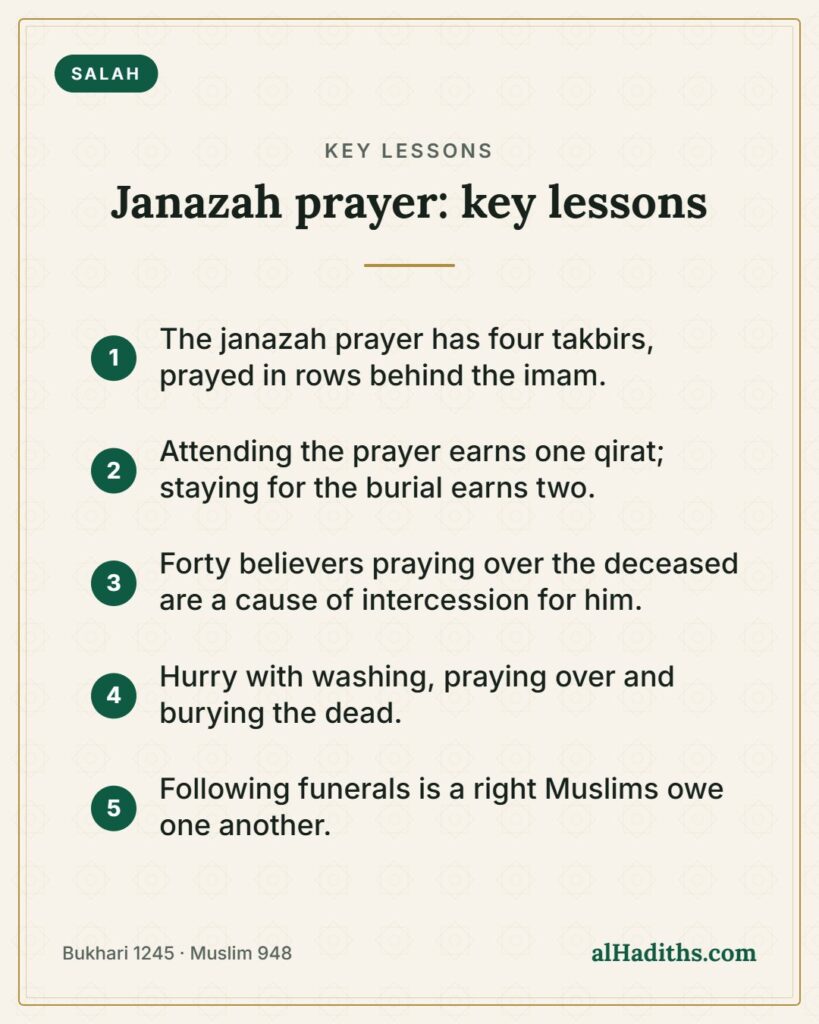
- The janazah prayer has four takbirs, prayed in rows behind the imam.
- Attending the prayer earns one qirat; staying until the burial earns two.
- Forty believers who associate nothing with Allah are a cause of intercession for the deceased.
- Hurry with washing, praying over and burying the dead.
- Following funerals is a right Muslims owe one another, not only family and friends.
Part of our Salah series: see all our salah articles in one place.
May Allah make us among those who stand sincerely in the rows for our brothers and sisters, and send believers to pray over us when our own time comes.
Save this to Pinterest so you have the steps ready for the next janazah
Share the reward. Send this article to someone who needs it today — teaching a hadith or dua can become a lasting good deed for you, in shaa Allah.