Relieve a Believer’s Hardship: Hadith 36 of an-Nawawi
Have you ever helped someone through a hard time and wondered whether it really counted for anything? This is Hadith 36 of Imam an-Nawawi’s collection, the whoever relieves a believer hadith. In it the Prophet ﷺ promises that Allah repays each kindness to others with the same kind of kindness, and more.
At a glance
- Source: Sahih Muslim 2699a; also Hadith 36 of an-Nawawi’s 40
- Narrated by: Abu Hurairah (may Allah be pleased with him)
- Grade: Sahih (Muslim)
- Topic: Easing hardship, covering faults, seeking knowledge and gathering over the Quran
- Put it into practice: Today, ease one burden for someone: a debt, a task, a worry
The hadith
Abu Hurairah (may Allah be pleased with him) reported that the Messenger of Allah ﷺ said:
مَنْ نَفَّسَ عَنْ مُؤْمِنٍ كُرْبَةً مِنْ كُرَبِ الدُّنْيَا نَفَّسَ اللَّهُ عَنْهُ كُرْبَةً مِنْ كُرَبِ يَوْمِ الْقِيَامَةِ وَمَنْ يَسَّرَ عَلَى مُعْسِرٍ يَسَّرَ اللَّهُ عَلَيْهِ فِي الدُّنْيَا وَالآخِرَةِ وَمَنْ سَتَرَ مُسْلِمًا سَتَرَهُ اللَّهُ فِي الدُّنْيَا وَالآخِرَةِ وَاللَّهُ فِي عَوْنِ الْعَبْدِ مَا كَانَ الْعَبْدُ فِي عَوْنِ أَخِيهِ وَمَنْ سَلَكَ طَرِيقًا يَلْتَمِسُ فِيهِ عِلْمًا سَهَّلَ اللَّهُ لَهُ بِهِ طَرِيقًا إِلَى الْجَنَّةِ وَمَا اجْتَمَعَ قَوْمٌ فِي بَيْتٍ مِنْ بُيُوتِ اللَّهِ يَتْلُونَ كِتَابَ اللَّهِ وَيَتَدَارَسُونَهُ بَيْنَهُمْ إِلاَّ نَزَلَتْ عَلَيْهِمُ السَّكِينَةُ وَغَشِيَتْهُمُ الرَّحْمَةُ وَحَفَّتْهُمُ الْمَلاَئِكَةُ وَذَكَرَهُمُ اللَّهُ فِيمَنْ عِنْدَهُ وَمَنْ بَطَّأَ بِهِ عَمَلُهُ لَمْ يُسْرِعْ بِهِ نَسَبُهُ
“He who alleviates the suffering of a brother out of the sufferings of the world, Allah would alleviate his suffering from the sufferings of the Day of Resurrection, and he who finds relief for one who is hard-pressed, Allah would make things easy for him in the Hereafter, and he who conceals (the faults) of a Muslim, Allah would conceal his faults in the world and in the Hereafter. Allah is at the back of a servant so long as the servant is at the back of his brother, and he who treads the path in search of knowledge, Allah would make that path easy, leading to Paradise for him and those persons who assemble in the house among the houses of Allah (mosques) and recite the Book of Allah and they learn and teach the Qur’an (among themselves) there would descend upon them tranquility and mercy would cover them and the angels would surround them and Allah mentions them in the presence of those near Him, and he who is slow-paced in doing good deeds, his (high) lineage does not make him go ahead.”
Sahih Muslim 2699a · Narrated by Abu Hurairah · Translation from Sunnah.com
What the whoever relieves a believer hadith means
HadeethEnc explains that the reward a Muslim receives from Allah is of the same kind as what he does for other Muslims. Based on its explanation:
- Relieve a hardship of this world, and Allah relieves one of the hardships of the Day of Judgment for you.
- Make things easy for someone in difficulty, and Allah makes things easy for you in this world and the Hereafter.
- Cover a Muslim’s slips, and Allah covers yours in this world and the Hereafter.
- Help your brother, in his religious or worldly needs, and Allah helps you. HadeethEnc says this help can be by dua, by physical effort, by money and in other ways.
- Seek knowledge of the religion for Allah’s sake, and Allah makes a path to Paradise easy for you.
- Gather in a mosque to recite and study the Quran, and tranquility descends, mercy covers you, the angels surround you, and Allah mentions you to those near Him.
- Lineage cannot carry you. Whoever falls short in good deeds will not be raised by a noble family name.
HadeethEnc also quotes Ibn Daqiq al-‘Id, who called this a great hadith because it covers so many kinds of knowledge, rulings and manners, and shows the merit of meeting Muslims’ needs in any way possible: with knowledge, wealth, help, advice or counsel.
Does covering faults mean ignoring wrong?
No. HadeethEnc says covering a Muslim’s faults includes not going looking for them, but it does not mean leaving a wrong unchanged; see whoever sees an evil, let him change it. The wrong is changed and the person is covered at the same time, for someone not known for corruption. For someone known for persisting in harm, it says covering him is not recommended, and his affair should go to those in authority, as long as that does not lead to a greater harm.
The Quran gives a clear example of easing the one in difficulty, in the case of a debt:
وَإِن كَانَ ذُو عُسْرَةٍ فَنَظِرَةٌ إِلَىٰ مَيْسَرَةٍ ۚ وَأَن تَصَدَّقُوا۟ خَيْرٌ لَّكُمْ ۖ إِن كُنتُمْ تَعْلَمُونَ
“And if someone is in hardship, then [let there be] postponement until [a time of] ease. But if you give [from your right as] charity, then it is better for you, if you only knew.”
Surah Al-Baqarah 2:280 · Translation: Saheeh International, from Quran.com
Reflection: it is striking how ordinary most of these deeds are. Giving a little more time on a loan, keeping quiet about someone’s mistake, sitting in a class at the mosque. None of them needs wealth or status, and the last line of the hadith reminds us that status will not help us anyway. What counts is what we did for others, and Allah promises to answer it in kind.
How to put it into practice
The hadith does not set a routine, so these are suggestions:
- Ask how you can help someone who is going through a hard time, and then do it: a meal, a lift, a call, a dua.
- Go easy on people who owe you. Give more time, or let some of it go, as the verse encourages; see charity does not decrease wealth.
- Keep a slip private. When you learn of someone’s mistake, do not pass it on.
- Join a class or halaqah where the Quran is read and studied, even once a week.
- Do not lean on your family name. Let your own deeds speak for you.
For what to do about a specific wrongdoing, please ask a qualified local scholar.
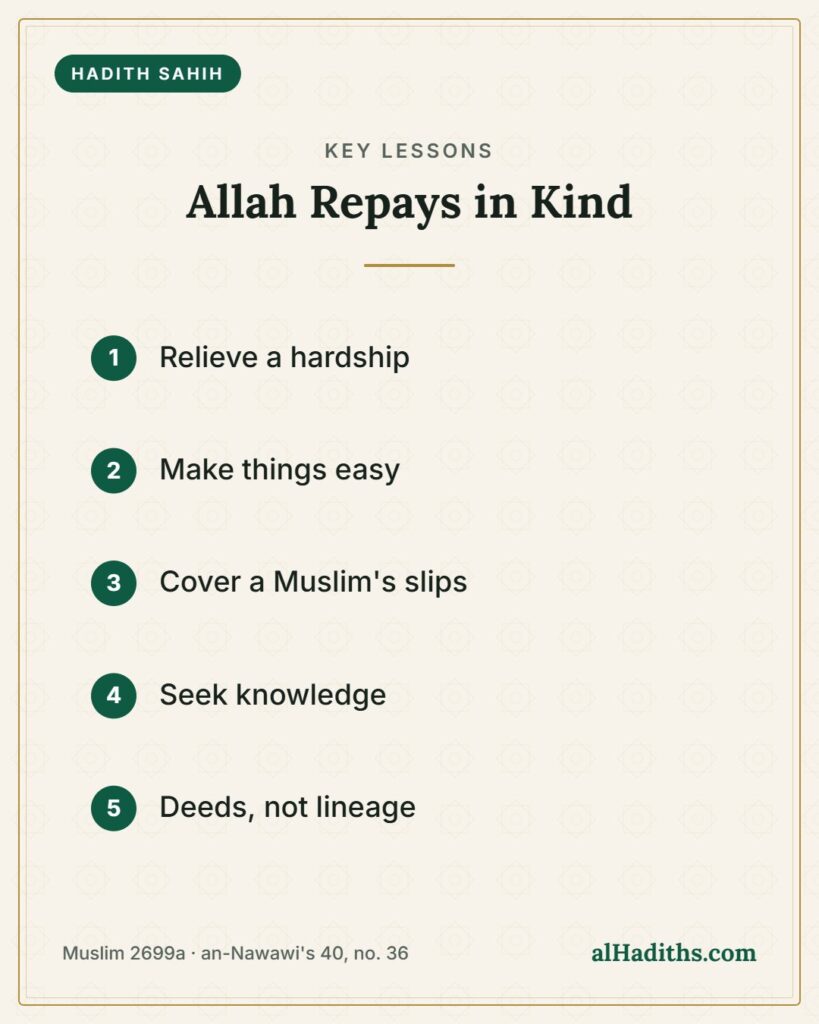
Key lessons
- Allah repays kindness to others with the same kind of kindness.
- Ease hardship and difficulty for others.
- Cover a Muslim’s slips, without leaving wrong unchanged.
- Seeking knowledge and studying the Quran bring Allah’s mercy.
- Deeds count, not lineage.
Questions people ask
What does “Allah helps the servant as long as he helps his brother” mean?
It means Allah supports His servant for as long as that servant supports his brother in his religious and worldly needs, whether by dua, physical effort, money or other help (HadeethEnc).
Does hiding a Muslim’s faults mean never reporting wrongdoing?
No. The wrong itself should still be changed. HadeethEnc says someone known for persisting in harm should not be covered, and his affair should go to those in authority, as long as that does not lead to a greater harm. For a specific case, ask a qualified scholar.
Is this hadith authentic?
Yes. It is in Sahih Muslim 2699a, narrated by Abu Hurairah, and Imam an-Nawawi included it as Hadith 36 of his 40.
May Allah ease every hardship you are carrying, cover your faults, and make you a means of ease for the people around you.
Save this to Pinterest so you can come back to this hadith later.
Share the reward. Send this article to someone who needs it today — teaching a hadith or dua can become a lasting good deed for you, in shaa Allah.

One Comment