No Harm and No Harming: Hadith 32 of an-Nawawi
Four Arabic words, and scholars built a whole principle on them. La darar wa la dirar: there should be no harming, and no harming back. This no harm, no harming hadith is Hadith 32 of Imam an-Nawawi’s collection, and it reaches into almost every part of life: our homes, our neighbors, our trade and the way we answer someone who has wronged us. Scholars differ on the grading of its chains, so we set that out clearly below.
At a glance
- Source: Sunan Ibn Majah 2341 and 2340 (Hadith 32 of an-Nawawi’s 40)
- Narrated by: Ibn ‘Abbas and ‘Ubadah ibn as-Samit (may Allah be pleased with them)
- Grade: Sahih by its other routes (al-Albani); hasan (an-Nawawi); graded weak by others. See the note on its grading
- Topic: Not causing harm, and not answering harm with more harm
- Put it into practice: Today, before you reply to someone who hurt you, ask: am I removing harm or adding to it?
The hadith
Ibn ‘Abbas (may Allah be pleased with him) narrated that the Messenger of Allah ﷺ said:
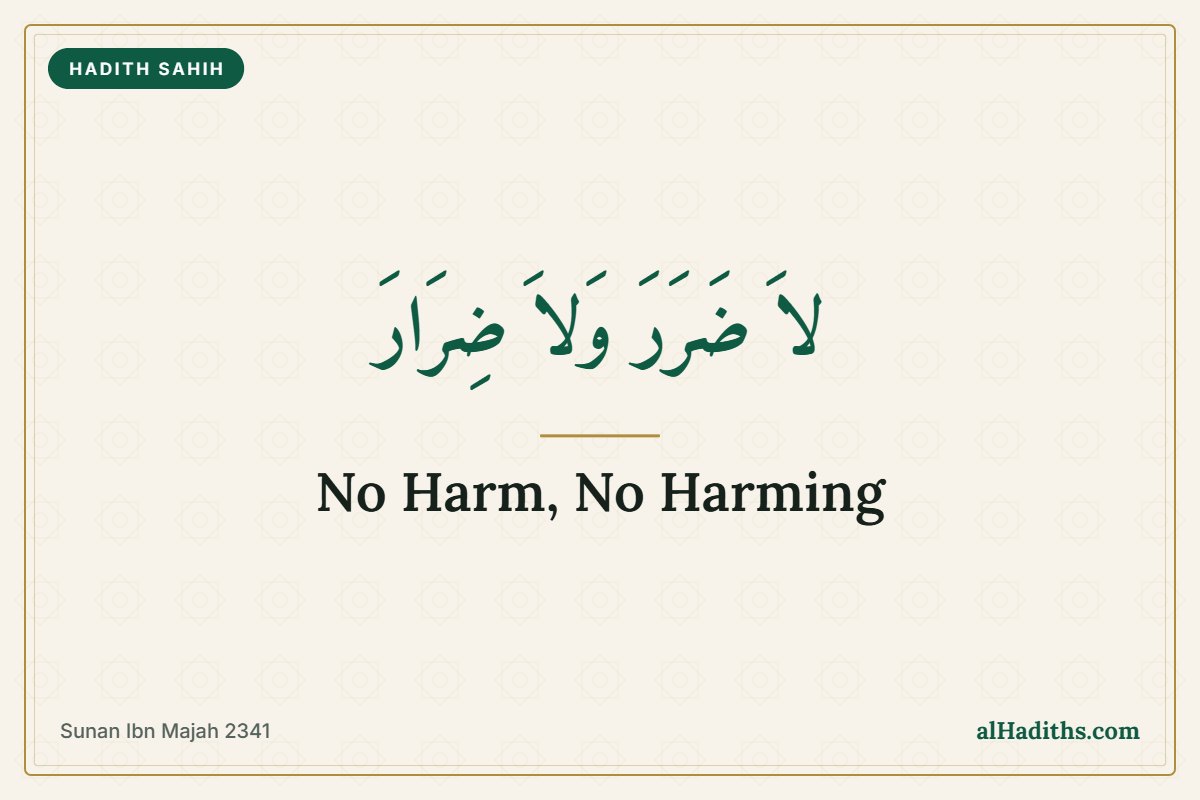
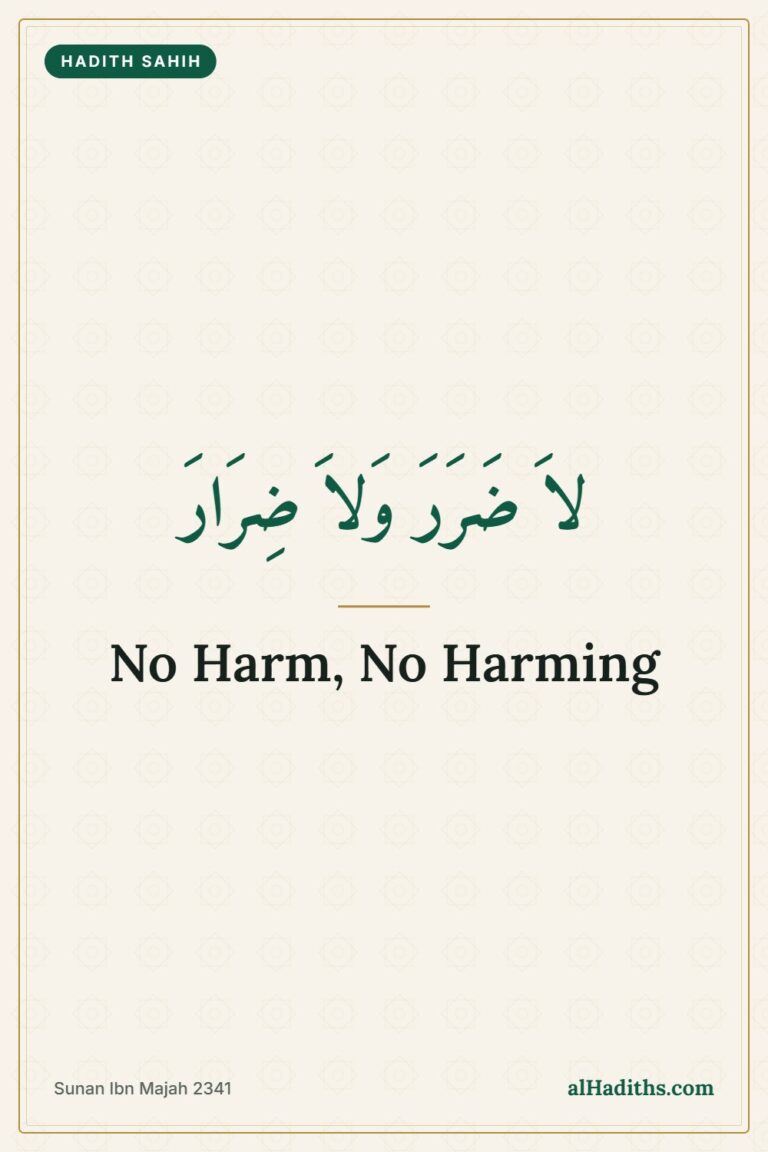
لاَ ضَرَرَ وَلاَ ضِرَارَ
“There should be neither harming nor reciprocating harm.”
Sunan Ibn Majah 2341 · Narrated by Ibn ‘Abbas · Translation from Sunnah.com
‘Ubadah ibn as-Samit (may Allah be pleased with him) narrated the same words, and said that the Prophet ﷺ ruled with them, as a judgment:
لاَ ضَرَرَ وَلاَ ضِرَارَ
“There should be neither harming nor reciprocating harm.”
Sunan Ibn Majah 2340 · Narrated by ‘Ubadah ibn as-Samit · Translation from Sunnah.com
Imam an-Nawawi gives it as Hadith 32 of his 40 Hadith, from Abu Sa’id al-Khudri (may Allah be pleased with him) through ad-Daraqutni. Imam Malik also recorded it in al-Muwatta (Book 36, Hadith 31), from Yahya al-Mazini directly from the Prophet ﷺ, without naming the Companion.
A note on its grading
Each single chain of this hadith has a weakness, and scholars weigh the chains together differently:
- Sahih by its other routes: Shaykh al-Albani graded Ibn Majah 2340 sahih (Silsilah as-Sahihah 250) and Ibn Majah 2341 sahih li-ghayrihi, authentic through its supporting routes (Tohed, Ibn Majah 2340; 2341).
- Hasan: Imam an-Nawawi graded it hasan and said it has routes that strengthen one another (Sunnah.com, 40 Hadith 32). HadeethEnc also gives it as hasan.
- Weak: Darussalam graded both Ibn Majah chains da’if (Sunnah.com), and Zubair Ali Zai graded them weak. In 2341 the narrator Jabir al-Ju’fi is weak, as al-Busiri noted (Hadith Unlocked); in 2340 the chain is broken before ‘Ubadah.
We present it as Imam an-Nawawi included it, with the gradings named so you can see the difference for yourself.
What no harm and no harming means
The two words are close, and the hadith rules out both. Based on the explanation in HadeethEnc:
- ضَرَرَ (darar): causing harm, whether to yourself or to someone else, in any form.
- ضِرَارَ (dirar): answering harm with harm. Harm is not removed by more harm; the exception is lawful retribution, without going beyond what is due.
HadeethEnc adds that the prohibition covers harm by words, by actions, and by failing to do what we should. Scholars of fiqh took a well-known maxim from it: harm is to be removed. In another wording, reported by ad-Daraqutni, the Prophet ﷺ added that whoever harms others, Allah will harm him, and whoever makes things hard for others, Allah will make things hard for him (HadeethEnc 4711).
Reflection: what stays with me is the second half. Not harming people is something most of us already agree with. But when someone harms us first, the heart wants to answer, and often to answer with a little extra. This hadith asks us to stop at that point. Even when we have a right, we take it fairly, through the proper way, and we do not turn one harm into two.
How to put it into practice
These are suggestions, not rulings:
- At home and with neighbors: think about noise, parking, drains, trees and building work before they become someone else’s problem.
- In words and online: before you post or forward something about a person, ask whether it harms them; see speak good or remain silent.
- When you are wronged: seek your right fairly, through the proper channels, and do not repay it with more than was done to you.
- With yourself: the hadith covers harming oneself too, so look after your body, health and faith.
- In work and trade: do not let a deal you profit from leave someone else carrying the loss.
For any dispute about rights, property or compensation, ask a qualified local scholar.
Key lessons
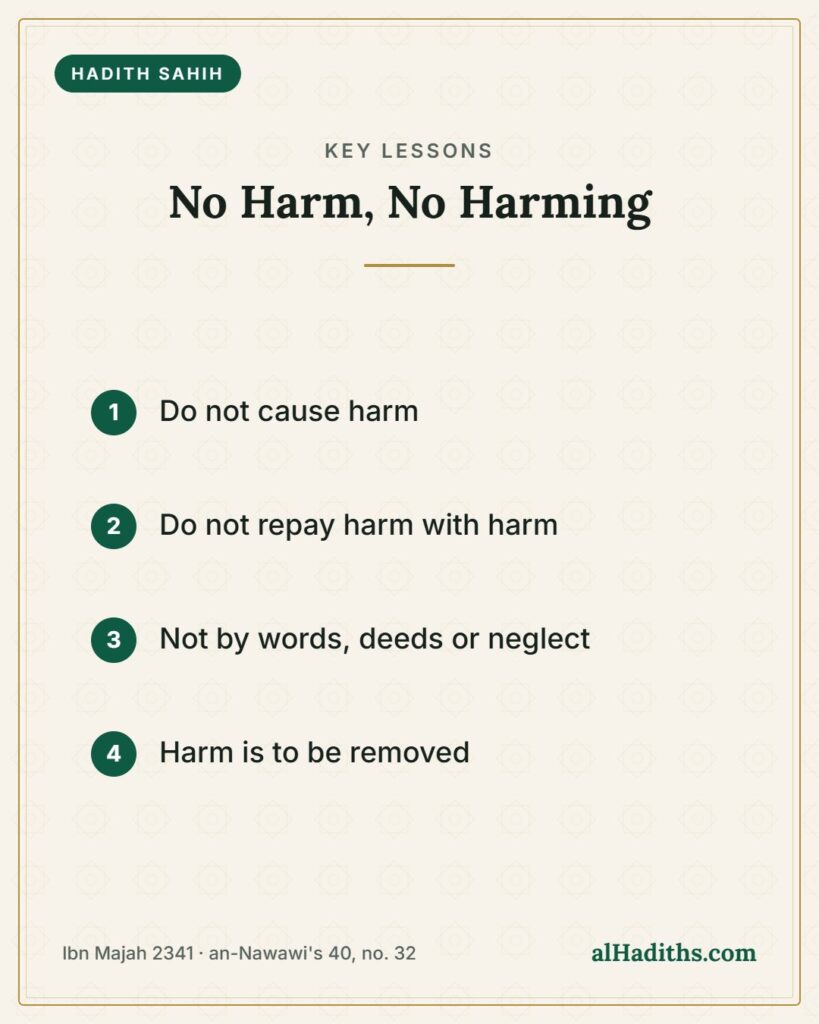
- Causing harm, to others or to yourself, is not allowed.
- Answering harm with more harm is not allowed either.
- Harm can come from words, deeds, or what we fail to do.
- Scholars took the maxim “harm is to be removed” from this hadith.
- Scholars differ on the grading of its chains; it is shown openly.
Questions people ask
What does la darar wa la dirar mean?
It means there should be no harming and no reciprocating harm. Darar is causing harm in the first place, and dirar is answering harm with harm. See Sunan Ibn Majah 2341.
Is the hadith “no harm and no harming” authentic?
Its chains are each weak on their own, but many scholars accepted it through its routes together: Shaykh al-Albani graded it sahih by its other routes and Imam an-Nawawi graded it hasan. Darussalam and Zubair Ali Zai graded the Ibn Majah chains weak. See Sunnah.com, 40 Hadith 32.
Does this hadith mean I cannot take my right back?
No. HadeethEnc explains that lawful retribution is allowed, as long as it does not go beyond what is due. How that applies in a real case is a question for a qualified local scholar.
One action for today: think of one small way your habits might be a burden on someone near you, a neighbor, a colleague or a family member, and change it quietly.
Save this to Pinterest so you can come back to this hadith later.
Share the reward. Send this article to someone who needs it today — teaching a hadith or dua can become a lasting good deed for you, in shaa Allah.