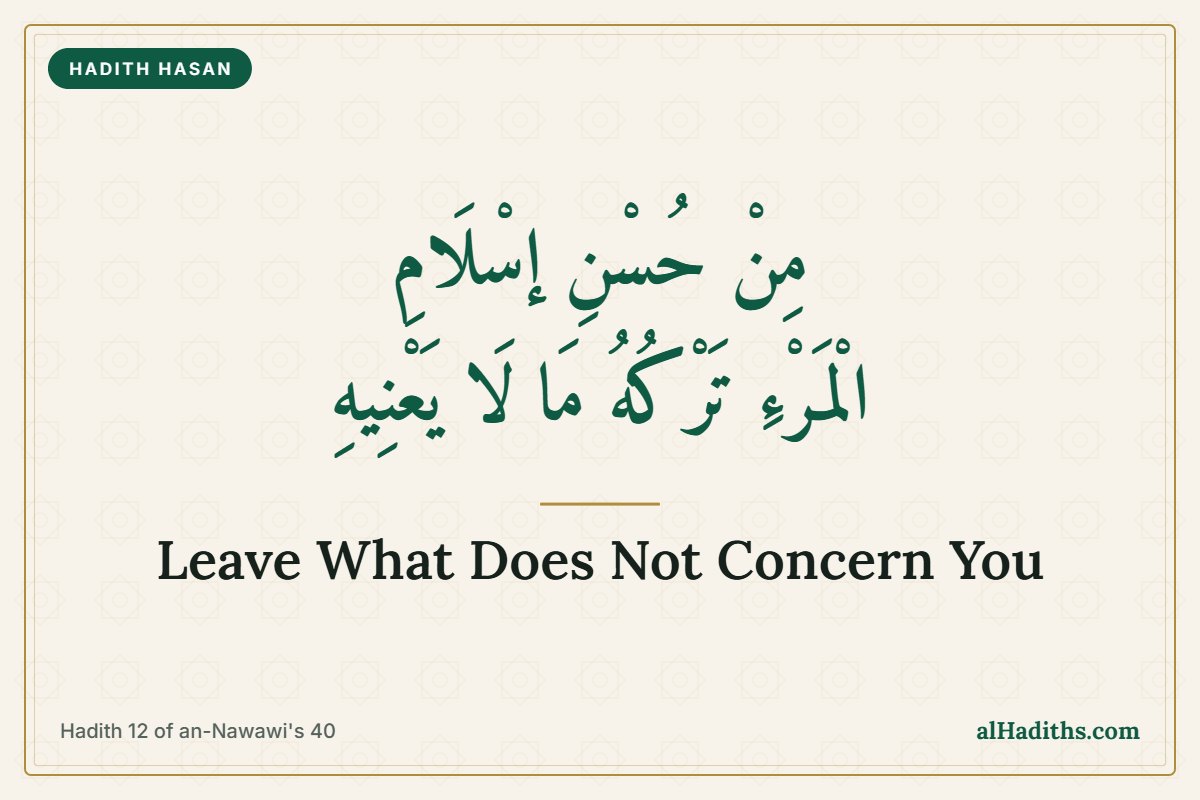
Leaving What Does Not Concern You: Hadith 12 of an-Nawawi
Other people’s business, idle talk, questions that lead nowhere: they take up more of our time and attention than we would like to admit. In one short sentence, the Prophet ﷺ described a mark of a beautiful Islam: leaving what does not concern you.
At a glance
- Source: Hadith 12 of an-Nawawi’s 40 Hadith (at-Tirmidhi and Ibn Majah)
- Narrated by: Abu Hurayrah (may Allah be pleased with him)
- Grade: Hasan (an-Nawawi); see the note on its grading below
- Topic: Focusing on what concerns you and leaving the rest
- Put it into practice: Before you speak or look into something, ask: does this concern me?
The hadith
Abu Hurayrah (may Allah be pleased with him) narrated that the Messenger of Allah ﷺ said:
مِنْ حُسْنِ إسْلَامِ الْمَرْءِ تَرْكُهُ مَا لَا يَعْنِيهِ
“Part of the perfection of one’s Islam is his leaving that which does not concern him.”
Hadith 12 of an-Nawawi’s 40 Hadith · Narrated by Abu Hurayrah · Grade: Hasan (an-Nawawi) · Translation from Sunnah.com
Imam an-Nawawi said it is a hasan (good) hadith, related by at-Tirmidhi and others.
A note on its grading
We want to be open about this. Imam an-Nawawi graded it hasan, and HadeethEnc cites his grading. On Sunnah.com, however, the Darussalam editions grade the versions in at-Tirmidhi and Ibn Majah as weak (da’if) (Tirmidhi 2317, 2318; Ibn Majah 3976). At-Tirmidhi himself said the version from ‘Ali ibn al-Husayn, which does not name the companion, is more sound than the one from Abu Hurayrah.
Its meaning is supported by authentic hadith, such as this one from al-Bukhari:
وَمَنْ كَانَ يُؤْمِنُ بِاللَّهِ وَالْيَوْمِ الآخِرِ فَلْيَقُلْ خَيْرًا أَوْ لِيَصْمُتْ
“…and anybody who believes in Allah and the Last Day should talk what is good or keep quiet.”
Sahih al-Bukhari 6018 · Narrated by Abu Hurayrah · Translation from Sunnah.com (end of a longer hadith)
Weighing up the different gradings is a matter for qualified scholars. What follows is the meaning scholars have explained.
What “what does not concern him” means
The Encyclopedia of Translated Prophetic Hadiths (HadeethEnc) explains that part of the perfection and beauty of a Muslim’s Islam is keeping away from what does not concern him: words and deeds that do not benefit him, and matters of religion or worldly life that have no relevance to him. Being busy with what does not concern a person “may distract him from what truly does, or may lead him to what he must avoid.”
Among the benefits it lists:
- People vary in the quality of their Islam, and it grows more excellent through certain deeds.
- Leaving idle and intrusive talk and action is a sign of a person’s excellence in Islam.
- If leaving what does not concern you is part of a good Islam, so is being busy with what does concern you.
- Ibn al-Qayyim said the Prophet ﷺ summed up wara’ (piety and caution) in this one sentence, covering speech, looking, listening, walking, thinking and other actions.
- Ibn Rajab called it a fundamental principle of good manners.
It is not a reason to stop caring
This hadith does not mean ignoring people. HadeethEnc points out that enjoining good, forbidding evil and giving sincere advice are among the things that do concern a Muslim, because he is required to do them. That links to the hadith on sincere advice and to Abu Bakr’s warning about staying silent.
It also lists seeking knowledge as part of this hadith: knowledge is how a person learns what concerns him and what does not.
Reflection: attention is limited. Every hour spent on what does not concern us is an hour not spent on our salah, our family, our work or our own mistakes. This hadith is less about shutting the world out and more about choosing where our attention goes.
How to put it into practice
The hadith does not give a routine, so these are suggestions:
- Ask yourself first: before you ask about, comment on or look into something, ask whether it concerns you.
- Guard your tongue: speak good or stay quiet, as the Prophet ﷺ taught.
- Step away from gossip and idle talk about other people’s lives, online and offline.
- Fill the time with what does concern you: your worship, your family, your work and learning your religion.
- Keep caring: sincere advice and helping put things right still concern you. If unsure, see Hadith 11: leave what makes you doubt.
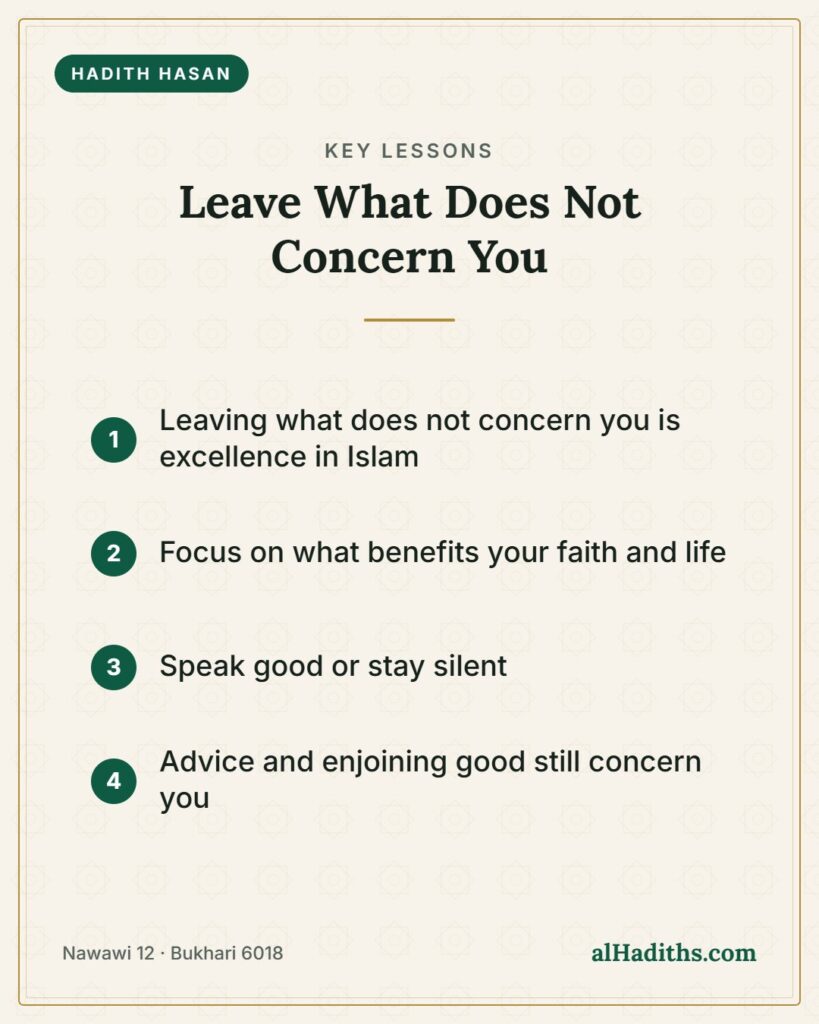
Key lessons
- Leaving what does not concern you is part of a person’s excellence in Islam.
- Being busy with what does concern you is part of it too.
- Speak good or stay silent.
- Sincere advice and enjoining good still concern every Muslim.
Questions people ask
What does “leave what does not concern you” mean?
It means keeping away from words, actions and matters that do not benefit you or have no relevance to you, and focusing on what does (Encyclopedia of Translated Prophetic Hadiths (HadeethEnc)).
Is the hadith “leave what does not concern you” authentic?
Imam an-Nawawi graded it hasan, and it is Hadith 12 of his 40 Hadith (Hadith 12 of an-Nawawi’s 40 Hadith). The Darussalam editions on Sunnah.com grade the versions in at-Tirmidhi and Ibn Majah as weak, so graders differ. Its meaning is supported by authentic hadith such as “talk what is good or keep quiet” (Sahih al-Bukhari 6018).
Does this hadith mean I should ignore other people’s problems?
No. Enjoining good, forbidding evil and giving sincere advice are among the things that do concern a Muslim, as HadeethEnc explains (Encyclopedia of Translated Prophetic Hadiths (HadeethEnc)).
One thing to do today: notice one conversation, video or thread that does not concern you, and step away from it.
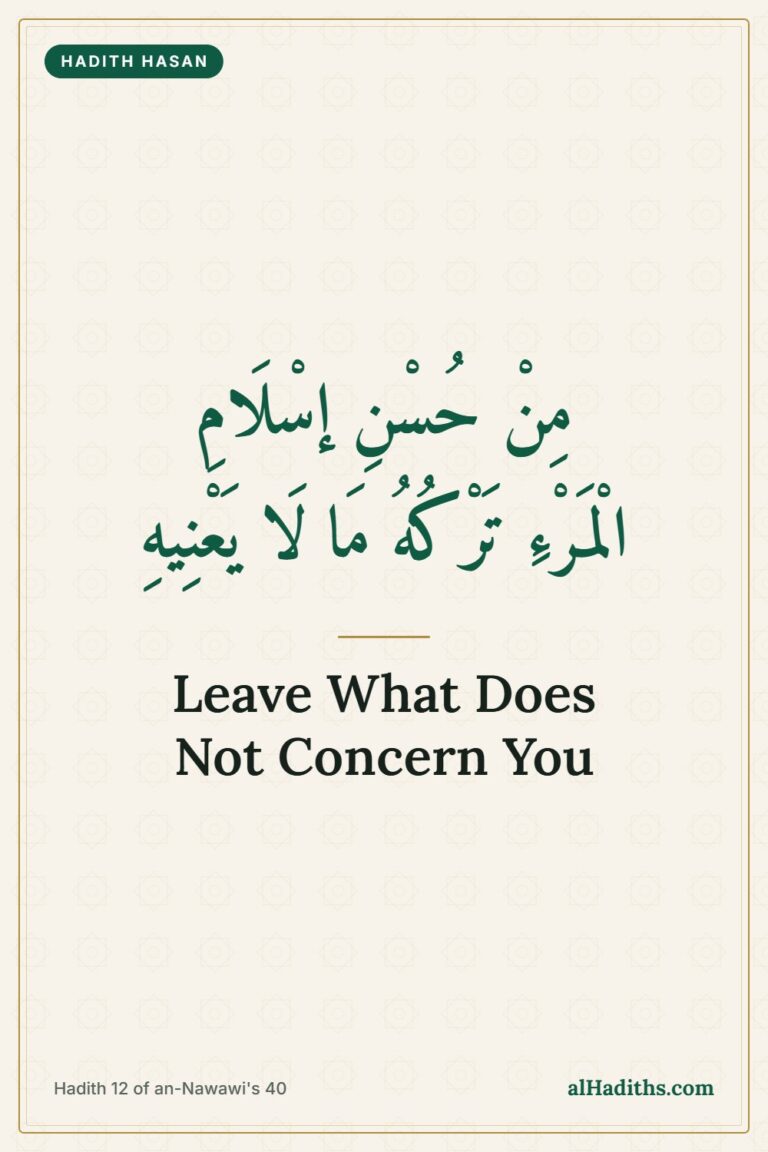
Save this to Pinterest so you can remember to focus on what concerns you
Share the reward. Send this article to someone who needs it today — teaching a hadith or dua can become a lasting good deed for you, in shaa Allah.

One Comment