Qasr Prayer: 7 Authentic Hadith on Shortening and Combining
Contents
Packing for a trip and wondering how to pray on the road? The qasr prayer (shortening the four-rak‘ah prayers to two) and jama‘ (combining two prayers) are concessions the Prophet ﷺ practised on his own journeys. In Malaysia many know them as jamak and qasar. Here are seven authentic hadith that show what he did, and where scholars differ on the details.
At a glance
- Hadith: 7 authentic hadith, plus 1 parallel and 1 Quran verse
- Collections: Sahih al-Bukhari, Sahih Muslim, Sunan Abi Dawud
- Grade: Sahih (Bukhari, Muslim); Sahih (al-Albani) for Abu Dawud 1220
- Topic: Shortening and combining prayers while traveling
- Do it today: Before your next trip, check the prayer times on your route and plan where you will stop to pray
1. How the travel prayer began
‘Aisha (may Allah be pleased with her) explains why the travel prayer is two rak‘ahs.
الصَّلاَةُ أَوَّلُ مَا فُرِضَتْ رَكْعَتَيْنِ فَأُقِرَّتْ صَلاَةُ السَّفَرِ، وَأُتِمَّتْ صَلاَةُ الْحَضَرِ
“When the prayers were first enjoined they were of two rak‘ahs each. Later the prayer in a journey was kept as it was, but the prayers for non-travelers were completed.”
Sahih al-Bukhari 1090 · Narrated by ‘Aisha · Translation adapted from Sunnah.com
So the two rak‘ahs of the traveler are not a cut-down prayer. They are the prayer as it was first prescribed. The same report is in Sahih Muslim 685a. In the same narration, az-Zuhri notes that ‘Aisha herself prayed in full on journeys, following an interpretation like ‘Uthman’s, and scholars differ on whether shortening is required or preferred.
Try this: On your next journey, pray Zuhr, Asr and Isha as two rak‘ahs each, as the Prophet ﷺ did.
2. A charity from Allah
Ya‘la ibn Umayyah asked ‘Umar ibn al-Khattab (may Allah be pleased with him) about the verse on shortening the prayer, which mentions fear, when people were now safe.
وَإِذَا ضَرَبْتُمْ فِى ٱلْأَرْضِ فَلَيْسَ عَلَيْكُمْ جُنَاحٌ أَن تَقْصُرُوا۟ مِنَ ٱلصَّلَوٰةِ إِنْ خِفْتُمْ أَن يَفْتِنَكُمُ ٱلَّذِينَ كَفَرُوٓا۟ ۚ إِنَّ ٱلْكَـٰفِرِينَ كَانُوا۟ لَكُمْ عَدُوًّا مُّبِينًا
“And when you travel throughout the land, there is no blame upon you for shortening the prayer, [especially] if you fear that those who disbelieve may disrupt [or attack] you. Indeed, the disbelievers are ever to you a clear enemy.”
Surah An-Nisa 4:101 · Translation: Saheeh International, from Quran.com
‘Umar said he had wondered the same, so he asked the Prophet ﷺ, who replied:
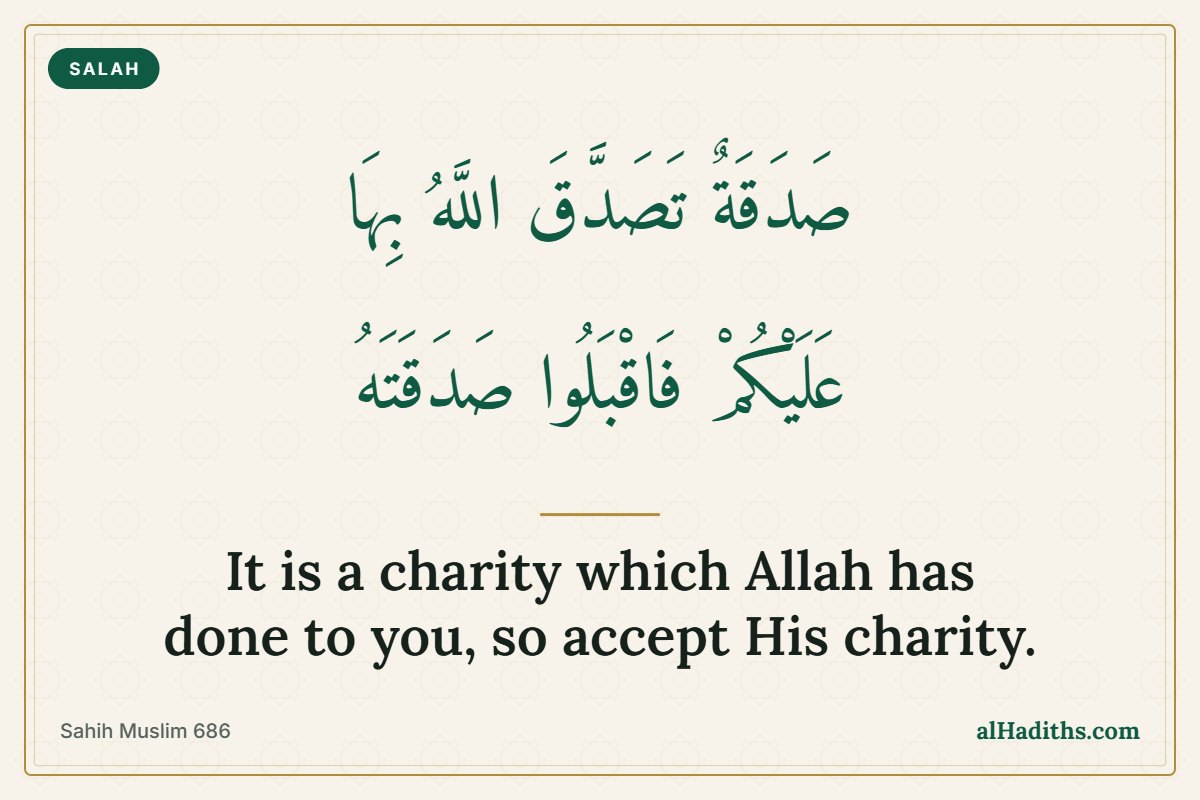
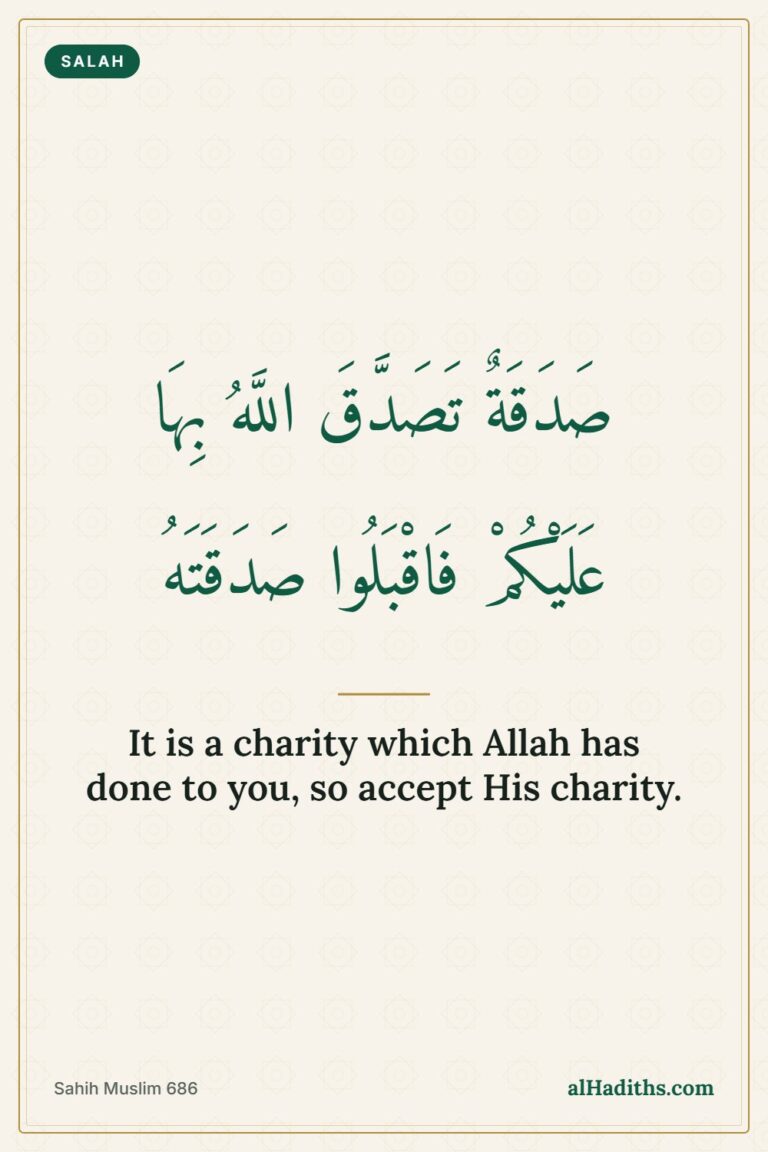
صَدَقَةٌ تَصَدَّقَ اللَّهُ بِهَا عَلَيْكُمْ فَاقْبَلُوا صَدَقَتَهُ
“It is an act of charity which Allah has done to you, so accept His charity.”
Sahih Muslim 686 · Narrated by Ya‘la ibn Umayyah · Translation adapted from Sunnah.com
So shortening is not limited to times of danger. It is a gift, and a gift is meant to be accepted. (Sunnah.com’s English heading names the narrator “Yahya b. Umayya”; the Arabic chain names Ya‘la ibn Umayyah.)
Try this: When you shorten on a journey, take it as Allah’s gift, not as cutting corners.
3. Two rak‘ahs, every journey
‘Abdullah ibn ‘Umar (may Allah be pleased with him) describes what he saw on his travels with the Prophet ﷺ and the first three caliphs.
صَحِبْتُ رَسُولَ اللَّهِ صلى الله عليه وسلم فَكَانَ لاَ يَزِيدُ فِي السَّفَرِ عَلَى رَكْعَتَيْنِ، وَأَبَا بَكْرٍ وَعُمَرَ وَعُثْمَانَ كَذَلِكَ
“I accompanied Allah’s Messenger ﷺ and he never offered more than two rak‘ahs during the journey. Abu Bakr, ‘Umar and ‘Uthman used to do the same.”
Sahih al-Bukhari 1102 · Narrated by Ibn ‘Umar · Translation adapted from Sunnah.com
HadeethEnc’s explanation notes that the two rak‘ahs apply to the four-rak‘ah prayers. Ibn ‘Umar also said the Prophet ﷺ did not offer optional prayers on the journey (Sahih al-Bukhari 1101).
Try this: Keep the shortened prayer simple: two rak‘ahs for Zuhr, Asr and Isha, with full focus.
4. How to combine Zuhr and Asr
Anas ibn Malik (may Allah be pleased with him) describes how the Prophet ﷺ timed the prayers around his departure.
كَانَ النَّبِيُّ صلى الله عليه وسلم إِذَا ارْتَحَلَ قَبْلَ أَنْ تَزِيغَ الشَّمْسُ أَخَّرَ الظُّهْرَ إِلَى وَقْتِ الْعَصْرِ، ثُمَّ يَجْمَعُ بَيْنَهُمَا، وَإِذَا زَاغَتْ صَلَّى الظُّهْرَ ثُمَّ رَكِبَ
“Whenever the Prophet ﷺ started the journey before noon, he used to delay the Zuhr prayer till the time for the ‘Asr prayer and then he would dismount and pray them together; and whenever the sun declined before he started the journey, he used to offer the Zuhr prayer and then ride.”
Sahih al-Bukhari 1111 · Narrated by Anas ibn Malik · Translation adapted from Sunnah.com
Mu‘adh ibn Jabal (may Allah be pleased with him) describes the same pattern on the expedition of Tabuk, for both pairs of prayers:
أَنَّ النَّبِيَّ صلى الله عليه وسلم كَانَ فِي غَزْوَةِ تَبُوكَ إِذَا ارْتَحَلَ قَبْلَ أَنْ تَزِيغَ الشَّمْسُ أَخَّرَ الظُّهْرَ حَتَّى يَجْمَعَهَا إِلَى الْعَصْرِ فَيُصَلِّيهِمَا جَمِيعًا وَإِذَا ارْتَحَلَ بَعْدَ زَيْغِ الشَّمْسِ صَلَّى الظُّهْرَ وَالْعَصْرَ جَمِيعًا ثُمَّ سَارَ وَكَانَ إِذَا ارْتَحَلَ قَبْلَ الْمَغْرِبِ أَخَّرَ الْمَغْرِبَ حَتَّى يُصَلِّيَهَا مَعَ الْعِشَاءِ وَإِذَا ارْتَحَلَ بَعْدَ الْمَغْرِبِ عَجَّلَ الْعِشَاءَ فَصَلاَّهَا مَعَ الْمَغْرِبِ
“If he moved off before the sun had declined, he would delay the noon prayer till he combined it with the afternoon prayer and offered them together. If he moved off after the sun had declined, he would pray the noon and afternoon prayers together and then set off. If he moved off before the sunset prayer, he would delay it until he prayed it with the night prayer; and if he moved off after the sunset prayer, he would bring the night prayer forward and pray it with the sunset prayer.”
Sunan Abi Dawud 1220 · Sahih (al-Albani) · Narrated by Mu‘adh ibn Jabal · Translation adapted from Sunnah.com
So he combined both ways: delaying the first prayer into the time of the second, or bringing the second forward into the time of the first, depending on when he set off.
Try this: Leaving before Zuhr? Plan to pray Zuhr and Asr together at your Asr stop. Leaving after Zuhr has come in? Pray both before you set off.
5. How to combine Maghrib and Isha
Ibn ‘Umar (may Allah be pleased with him) describes exactly how the Prophet ﷺ prayed the two evening prayers together.
رَأَيْتُ النَّبِيَّ صلى الله عليه وسلم إِذَا أَعْجَلَهُ السَّيْرُ يُؤَخِّرُ الْمَغْرِبَ، فَيُصَلِّيهَا ثَلاَثًا ثُمَّ يُسَلِّمُ، ثُمَّ قَلَّمَا يَلْبَثُ حَتَّى يُقِيمَ الْعِشَاءَ فَيُصَلِّيَهَا رَكْعَتَيْنِ ثُمَّ يُسَلِّمُ، وَلاَ يُسَبِّحُ بَعْدَ الْعِشَاءِ حَتَّى يَقُومَ مِنْ جَوْفِ اللَّيْلِ
“I saw the Prophet ﷺ, whenever he was in a hurry on a journey, delay the Maghrib prayer, then pray it as three rak‘ahs and finish with taslim. Then, after a short while, the iqamah would be made for ‘Isha’ and he would pray it as two rak‘ahs and finish with taslim. He would not offer any optional prayer after ‘Isha’ until he rose in the middle of the night.”
Sahih al-Bukhari 1091 · Narrated by Ibn ‘Umar · Translation adapted from Sunnah.com
Maghrib keeps its three rak‘ahs; only Isha is shortened to two. He did the same at Muzdalifah during Hajj (Sahih Muslim 1288a; see HadeethEnc’s explanation).
Try this: Combining in the evening? Pray Maghrib three, say the iqamah, then pray Isha two.
6. How many days the Prophet ﷺ shortened
Ibn ‘Abbas (may Allah be pleased with him) reports a long stay during which the Prophet ﷺ kept shortening.
أَقَامَ النَّبِيُّ صلى الله عليه وسلم تِسْعَةَ عَشَرَ يَقْصُرُ، فَنَحْنُ إِذَا سَافَرْنَا تِسْعَةَ عَشَرَ قَصَرْنَا، وَإِنْ زِدْنَا أَتْمَمْنَا
“The Prophet ﷺ once stayed for nineteen days and prayed shortened prayers. So when we traveled and stayed for nineteen days, we used to shorten the prayer, but if we stayed longer, we used to offer the full prayer.”
Sahih al-Bukhari 1080 · Narrated by Ibn ‘Abbas · Translation adapted from Sunnah.com
Other stays are reported too: ten days in Makkah (Sahih al-Bukhari 1081, from Anas) and twenty days at Tabuk (Sunan Abi Dawud 1235, Sahih (al-Albani), from Jabir). The Prophet ﷺ did not set a limit in words; the limits come from these stays and from scholars, who differ (see below).
Try this: Before a longer trip, ask a qualified local scholar which limit applies to your stay.
7. Combining without travel
Ibn ‘Abbas (may Allah be pleased with him) also reports a time the Prophet ﷺ combined prayers at home in Madinah.
صَلَّى رَسُولُ اللَّهِ صلى الله عليه وسلم الظُّهْرَ وَالْعَصْرَ جَمِيعًا بِالْمَدِينَةِ فِي غَيْرِ خَوْفٍ وَلاَ سَفَرٍ. قَالَ أَبُو الزُّبَيْرِ فَسَأَلْتُ سَعِيدًا لِمَ فَعَلَ ذَلِكَ فَقَالَ سَأَلْتُ ابْنَ عَبَّاسٍ كَمَا سَأَلْتَنِي فَقَالَ أَرَادَ أَنْ لاَ يُحْرِجَ أَحَدًا مِنْ أُمَّتِهِ
“The Messenger of Allah ﷺ observed the noon and afternoon prayers together in Madinah without being in a state of fear or of journey.” Abu az-Zubair said: I asked Sa‘id why he did that. He said: I asked Ibn ‘Abbas as you have asked me, and he replied that he wanted that no one among his ummah should be put to hardship.
Sahih Muslim 705b · Narrated by Ibn ‘Abbas · Translation adapted from Sunnah.com
Ibn ‘Abbas’s own explanation is the key: to spare the ummah hardship. Scholars differ on what kind of need this covers, so ask a qualified scholar before relying on it outside travel.
Try this: Remember this hadith when a real hardship makes a prayer time difficult, and ask a scholar what applies.
Where scholars differ on qasr prayer
- Distance: Anas said the Prophet ﷺ prayed two rak‘ahs once he had covered “three miles or three farsakh”, and a narrator was unsure which (Sahih Muslim 691). There is no fixed distance in the Prophet’s ﷺ words, and the madhhabs set their own.
- Days: If you intend a set stay, a Hanafi answer on Qibla (IslamQA.org) lists the madhhab limits: under 15 days (Hanafi), 4 days (Maliki and Shafi‘i), 21 prayers (Hanbali). Ibn ‘Abbas himself shortened up to 19 days.
- Required or preferred: scholars differ on whether a traveler must shorten or may pray in full, as ‘Aisha and ‘Uthman did.
- Combining at home: scholars differ on the need that allows it (hadith 7).
We don’t give rulings on this site. For your own trip, ask a qualified scholar or your local religious authority.
Bringing it together
Together these hadith show a Lord who makes worship easy for the traveler. HadeethEnc also lists a narration from Ibn ‘Abbas in Sahih Ibn Hibban: Allah loves His concessions to be taken as He loves His obligations to be done (HadeethEnc 65017).
Reflection: The travel prayer asks so little. Even on the busiest journey, two rak‘ahs at a rest stop keep us connected to Allah, and that is the real lesson: the prayer is lightened, never dropped.
Questions people ask
How many days can you pray qasr?
The Prophet ﷺ shortened for ten days in Makkah (Bukhari 1081), nineteen days in Makkah (Bukhari 1080) and twenty days at Tabuk (Abu Dawud 1235, Sahih (al-Albani)). Ibn ‘Abbas shortened up to 19 days. For a stay you have planned, the madhhabs set limits (under 15 days Hanafi; 4 days Maliki and Shafi‘i; 21 prayers Hanbali), as listed in a Hanafi answer on Qibla (IslamQA.org). Ask a local scholar which applies to you.
Can you pray qasr at your destination if you will leave once your business is done?
The Prophet ﷺ kept shortening while staying at his destination (Bukhari 1080, Abu Dawud 1235). When the end date is unknown, some Companions shortened for long periods, such as Ibn ‘Umar for six months in Azerbaijan, held up by snow, and Anas for two years in Syria. Ibn Qudamah lists these reports in al-Mughni, as cited in a Hanafi answer on Qibla (IslamQA.org), which also notes that Hanafi scholars read some of them as wartime cases. Scholars differ, so ask a qualified scholar.
What is the qasr prayer distance?
There is no fixed distance in the Prophet’s ﷺ words. Anas reported “three miles or three farsakh”, with a narrator unsure which (Muslim 691), and each madhhab sets its own distance. Follow your local religious authority’s figure.
Can you shorten Maghrib or Fajr?
No report shows them shortened. Maghrib was prayed as three rak‘ahs even when combined (Bukhari 1091), and Fajr is already two. Shortening applies to the four-rak‘ah prayers: Zuhr, Asr and Isha.
What is the difference between jama and qasr?
Qasr is shortening a four-rak‘ah prayer to two. Jama‘ is praying two prayers together: Zuhr with Asr, or Maghrib with Isha. The Prophet ﷺ did both on journeys (Bukhari 1102, Bukhari 1111).
Key lessons
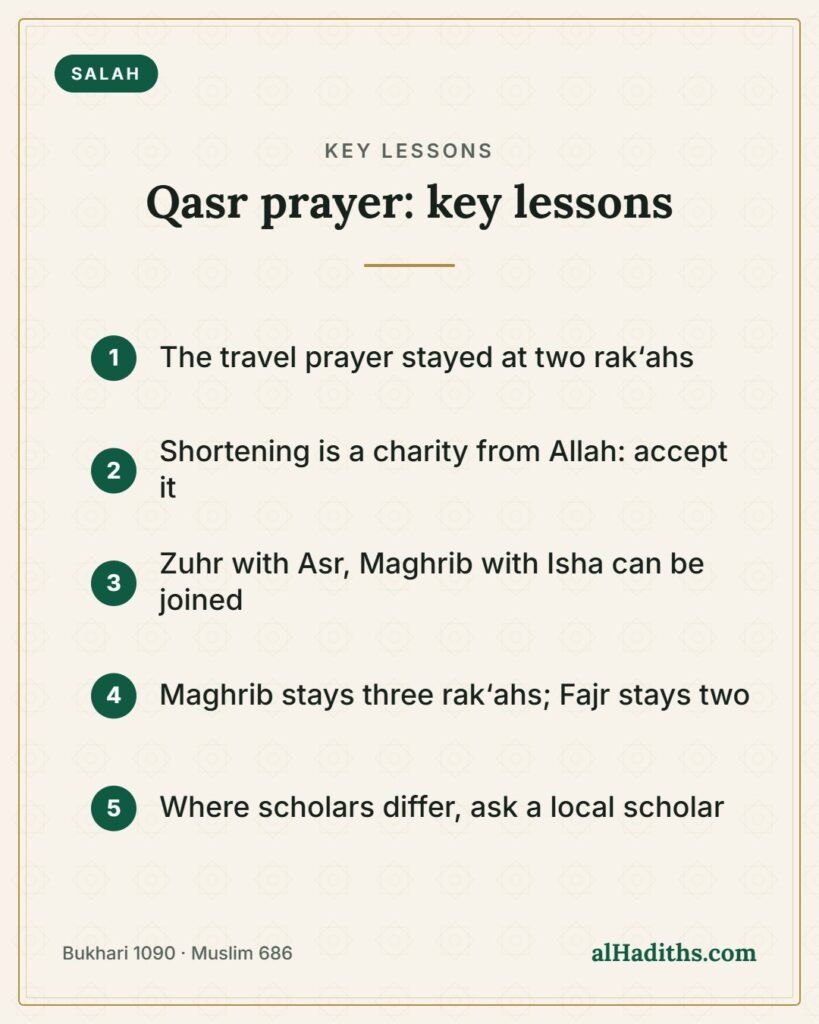
- The travel prayer stayed at its original two rak‘ahs (Bukhari 1090).
- Shortening is a charity from Allah to be accepted (Muslim 686).
- Zuhr and Asr, and Maghrib and Isha, can be joined on a journey (Bukhari 1111, 1091).
- Maghrib stays three rak‘ahs; only the four-rak‘ah prayers are shortened.
- On distance and days scholars differ: ask a qualified scholar.
Part of our Salah series: see all our salah articles in one place.
May Allah make our journeys easy and keep us steady in prayer wherever we are.
Save this to Pinterest so you can check how to shorten and combine your prayers on your next trip
Share the reward. Send this article to someone who needs it today — teaching a hadith or dua can become a lasting good deed for you, in shaa Allah.