Eid Prayer: How the Prophet ﷺ Prayed on Eid al-Fitr and Eid al-Adha
Contents
Twice a year, Muslims gather in the morning for a prayer unlike the five daily prayers. How did the Prophet ﷺ perform the Eid prayer? These authentic hadith describe it for both Eid al-Fitr and Eid al-Adha: where he prayed, how many rak’ahs and takbirs, what he ate before going out, and who he brought with him.
At a glance
- Hadith: 6 topics, 7 authentic narrations
- Collections: Sahih al-Bukhari, Sahih Muslim, Sunan Abi Dawud, Jami’ at-Tirmidhi
- Grade: Sahih and Hasan (graders named under each hadith)
- Topic: How the Prophet ﷺ prayed and spent the two Eids
- Do today: Save this page and read it again on the night before Eid
1. Prayer first, then the khutbah
Abu Sa’id al-Khudri (may Allah be pleased with him) described the Prophet’s ﷺ practice on both Eids:
كَانَ رَسُولُ اللَّهِ صلى الله عليه وسلم يَخْرُجُ يَوْمَ الْفِطْرِ وَالأَضْحَى إِلَى الْمُصَلَّى، فَأَوَّلُ شَىْءٍ يَبْدَأُ بِهِ الصَّلاَةُ ثُمَّ يَنْصَرِفُ، فَيَقُومُ مُقَابِلَ النَّاسِ، وَالنَّاسُ جُلُوسٌ عَلَى صُفُوفِهِمْ، فَيَعِظُهُمْ وَيُوصِيهِمْ وَيَأْمُرُهُمْ، فَإِنْ كَانَ يُرِيدُ أَنْ يَقْطَعَ بَعْثًا قَطَعَهُ، أَوْ يَأْمُرَ بِشَىْءٍ أَمَرَ بِهِ، ثُمَّ يَنْصَرِفُ
“The Messenger of Allah ﷺ used to go out to the musalla on the day of al-Fitr and al-Adha. The first thing he would begin with was the prayer. Then he would turn and stand facing the people, while they stayed sitting in their rows, and he would admonish them, advise them and give them instructions. If he wanted to send out an expedition he would do so, or if he wanted to order something he would order it. Then he would leave.”
Bukhari 956 · Narrated by Abu Sa’id al-Khudri · Translation adapted from Sunnah.com
The musalla was an open prayer ground. Imam an-Nawawi said this hadith shows it is sunnah to hold the Eid prayer in an open space, though in the Shafi’i school it may also be held in a mosque, as the Mufti of the Federal Territories explains. The order matters too: prayer first, then the khutbah. When a later governor of Madinah reversed this, a man stood up to object, a story that opens Hadith 34 of an-Nawawi.
Try this: arrive early and stay seated for the khutbah after the prayer, as the people did in their rows.
2. Two rak’ahs, with nothing before or after
Ibn ‘Abbas (may Allah be pleased with him) reported:
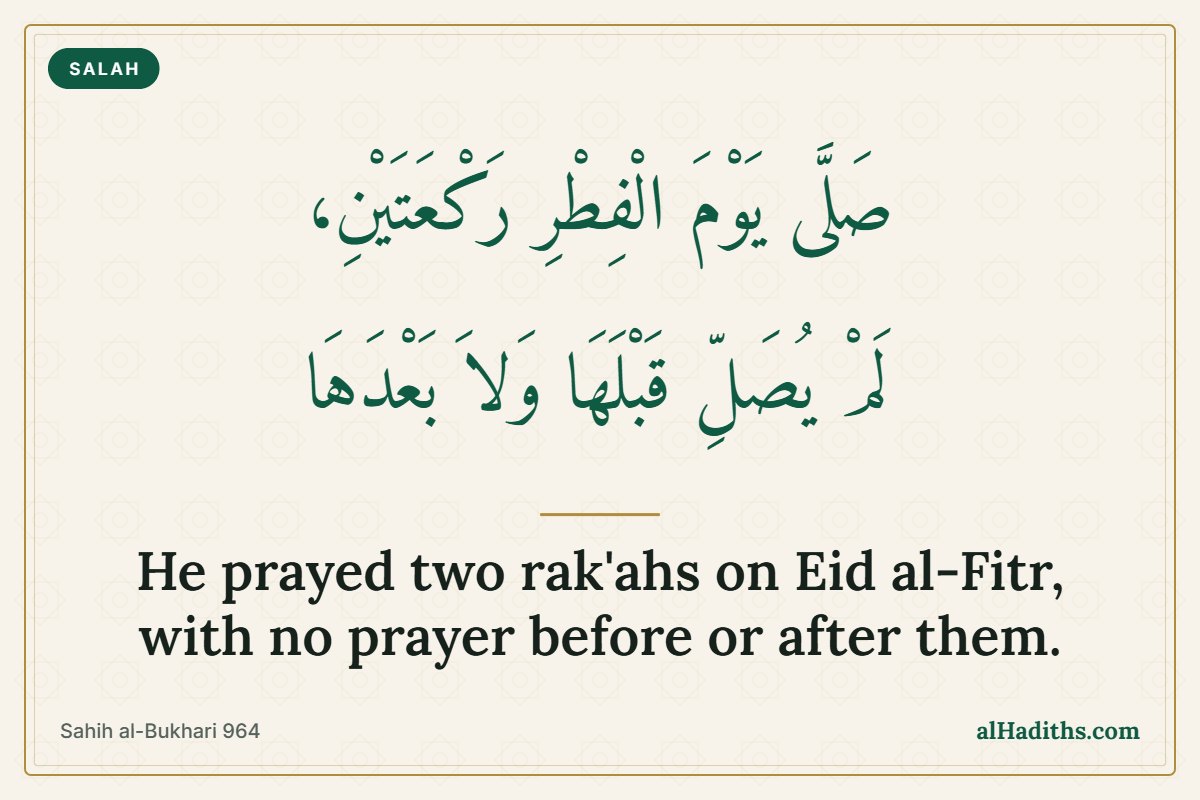
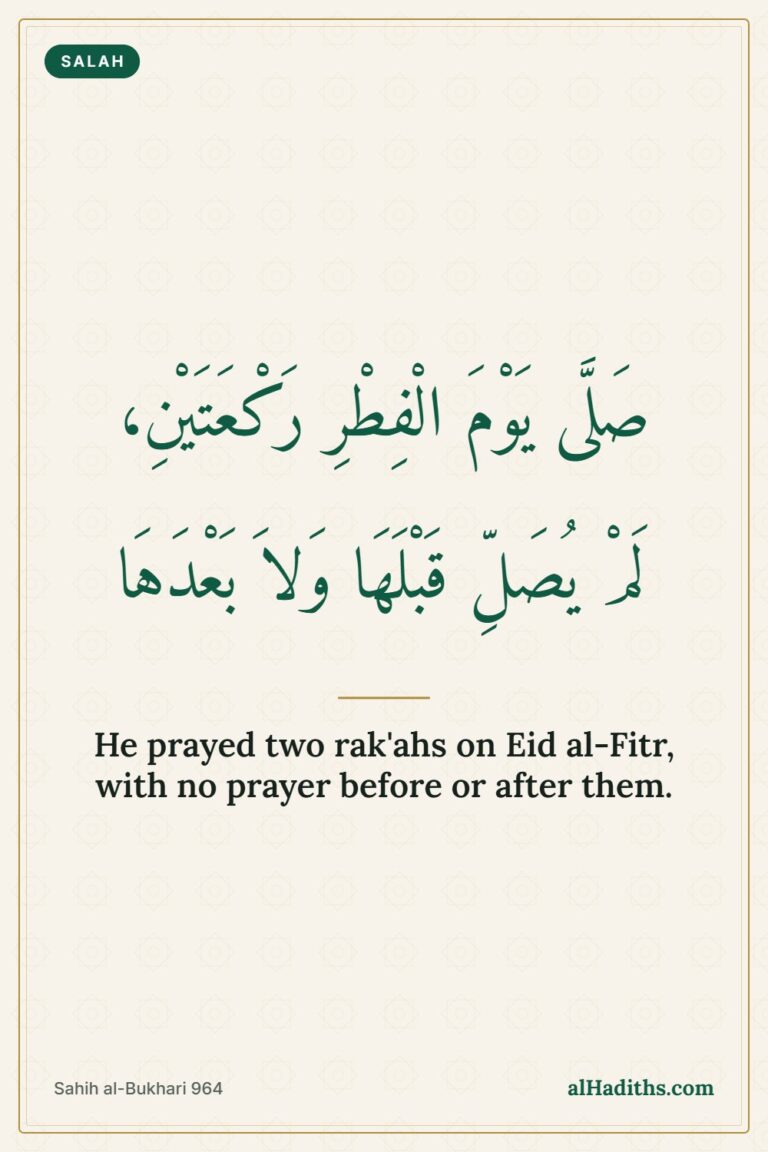
أَنَّ النَّبِيَّ صلى الله عليه وسلم صَلَّى يَوْمَ الْفِطْرِ رَكْعَتَيْنِ، لَمْ يُصَلِّ قَبْلَهَا وَلاَ بَعْدَهَا، ثُمَّ أَتَى النِّسَاءَ وَمَعَهُ بِلاَلٌ، فَأَمَرَهُنَّ بِالصَّدَقَةِ، فَجَعَلْنَ يُلْقِينَ، تُلْقِي الْمَرْأَةُ خُرْصَهَا وَسِخَابَهَا
“The Prophet ﷺ prayed two rak’ahs on the day of al-Fitr, and did not pray anything before or after them. Then he went to the women, with Bilal, and told them to give charity, and the women began to throw in their earrings and necklaces.”
Bukhari 964 · Narrated by Ibn ‘Abbas · Translation adapted from Sunnah.com
The Eid prayer is two rak’ahs, and at the musalla the Prophet ﷺ prayed nothing before it or after it. The charity in this hadith was not zakat al-fitr: in a parallel narration in Sahih Muslim 885, the narrator ‘Ata’ says it was charity the women gave on the spot.
Try this: bring a little cash to the Eid prayer so you can give charity there, as the women did that day.
3. The extra takbirs: seven and five
‘A’ishah (may Allah be pleased with her) reported:
أَنَّ رَسُولَ اللَّهِ صلى الله عليه وسلم كَانَ يُكَبِّرُ فِي الْفِطْرِ وَالأَضْحَى فِي الأُولَى سَبْعَ تَكْبِيرَاتٍ وَفِي الثَّانِيَةِ خَمْسًا
“The Messenger of Allah ﷺ used to say the takbir seven times in the first rak’ah and five times in the second, on al-Fitr and al-Adha.”
Abu Dawud 1149 · Sahih (al-Albani) · Narrated by ‘A’ishah · Translation adapted from Sunnah.com
These extra takbirs (“Allahu akbar”) are said at the start of each rak’ah, before the recitation. Scholars differ on their number. In his note under hadith 536, Imam at-Tirmidhi says seven and five is the view of the people of Madinah, Malik, ash-Shafi’i, Ahmad and Ishaq, while ‘Abdullah ibn Mas’ud is reported to have said nine in total, which is the view of the people of Kufa and Sufyan ath-Thawri. Follow your imam.
Try this: before Eid, ask your imam how many takbirs he will say, so you are not caught off guard in the first rak’ah.
4. Eat before Eid al-Fitr, but after the Eid al-Adha prayer
Anas ibn Malik (may Allah be pleased with him) said:
كَانَ رَسُولُ اللَّهِ صلى الله عليه وسلم لاَ يَغْدُو يَوْمَ الْفِطْرِ حَتَّى يَأْكُلَ تَمَرَاتٍ
“The Messenger of Allah ﷺ would not go out on the morning of al-Fitr until he had eaten some dates.”
Bukhari 953 · Narrated by Anas ibn Malik · Translation adapted from Sunnah.com
In another chain in the same hadith, Anas adds that he ate them in an odd number. Buraydah (may Allah be pleased with him) adds the other half for Eid al-Adha:
كَانَ النَّبِيُّ صلى الله عليه وسلم لاَ يَخْرُجُ يَوْمَ الْفِطْرِ حَتَّى يَطْعَمَ وَلاَ يَطْعَمُ يَوْمَ الأَضْحَى حَتَّى يُصَلِّيَ
“The Prophet ﷺ would not go out on the day of al-Fitr until he had eaten, and he would not eat on the day of al-Adha until he had prayed.”
Tirmidhi 542 · Hasan (Darussalam) · Narrated by Buraydah · Translation adapted from Sunnah.com
So the two Eids differ: on Eid al-Fitr, eat first (dates, in an odd number, if you have them); on Eid al-Adha, wait until after the prayer.
Try this: put three dates by the door the night before Eid al-Fitr, so you don’t forget them in the morning rush.
5. Take a different route home
Jabir ibn ‘Abdullah (may Allah be pleased with him) said:
كَانَ النَّبِيُّ صلى الله عليه وسلم إِذَا كَانَ يَوْمُ عِيدٍ خَالَفَ الطَّرِيقَ
“On the day of Eid, the Prophet ﷺ would take a different route (going and coming back).”
Bukhari 986 · Narrated by Jabir ibn ‘Abdullah · Translation adapted from Sunnah.com
The hadith does not give a reason, and scholars have suggested many, from greeting more people to giving charity along the way; Ibn Hajar listed several, as IslamQA 49010 summarizes. It is enough that the Prophet ﷺ did it.
Try this: plan your two routes before Eid morning, and use the second one to greet neighbors you rarely see.
6. Everyone comes out, even those not praying
Umm ‘Atiyyah (may Allah be pleased with her) said:
أَمَرَنَا – تَعْنِي النَّبِيَّ صلى الله عليه وسلم – أَنْ نُخْرِجَ فِي الْعِيدَيْنِ الْعَوَاتِقَ وَذَوَاتِ الْخُدُورِ وَأَمَرَ الْحُيَّضَ أَنْ يَعْتَزِلْنَ مُصَلَّى الْمُسْلِمِينَ
“He (the Prophet ﷺ) commanded us to bring out for the two Eids the young women and those kept in seclusion, and he commanded the menstruating women to keep away from the Muslims’ place of prayer.”
Muslim 890a · Narrated by Umm ‘Atiyyah · Translation adapted from Sunnah.com
Even women who could not pray were told to come. HadeethEnc explains that Eid is a day when the rituals of Islam are shown openly and Muslims gather as one, and cites another wording in which these women said the takbir and joined the dua of the Muslims, hoping for the blessing of that day.
Try this: bring the whole household to the Eid prayer this year, including anyone who will only listen and make dua.
How to pray Eid prayer, following these hadith
Putting the six hadith together, the Eid day the Prophet ﷺ followed looks like this:
- On Eid al-Fitr, eat a few dates before leaving; on Eid al-Adha, wait to eat until after the prayer.
- Go out to the place of prayer, with your family.
- Pray two rak’ahs, with extra takbirs before the recitation (seven and five in Abu Dawud 1149; scholars differ on the number).
- Stay for the khutbah, which comes after the prayer.
- Return home by a different route.
This list only follows the hadith above. Details such as the recitation and the number of takbirs differ between the schools of fiqh, so follow your local imam or ask a qualified scholar.
Bringing it together
Reflection: Almost every hadith here is about people as much as prayer: the people sitting in their rows for the khutbah, the women giving charity, the family brought out together, the route that passes more homes. The Eid prayer is short, two rak’ahs, but the Prophet ﷺ made the whole morning a gathering of the community.
Questions people ask
Is there an adhan or iqamah for the Eid prayer?
No. Jabir ibn Samurah said he prayed the two Eids with the Prophet ﷺ more than once or twice without an adhan or iqamah (Sahih Muslim 887).
Is the Eid prayer wajib or sunnah?
Scholars differ on its exact ruling. HadeethEnc, explaining Umm ‘Atiyyah’s hadith, describes attending it as a communal obligation; others rule differently, so ask a qualified scholar you trust.
Can the Eid prayer be held in a mosque?
The Prophet ﷺ prayed it at the musalla, an open ground. The Mufti of the Federal Territories notes that most scholars hold an open ground is sunnah, while the Shafi’i school also allows the mosque, as is commonly done today.
What if I miss the Eid prayer?
Imam al-Bukhari titled a chapter in his Sahih “Whoever misses the Eid prayer should pray two rak’ahs” (see the chapter). How and when to make it up is a point where scholars differ, so ask a local scholar.
How many takbirs are in the Eid prayer?
Abu Dawud 1149 gives seven in the first rak’ah and five in the second. At-Tirmidhi records other views, including nine in total from Ibn Mas’ud. Follow your imam.
Key lessons
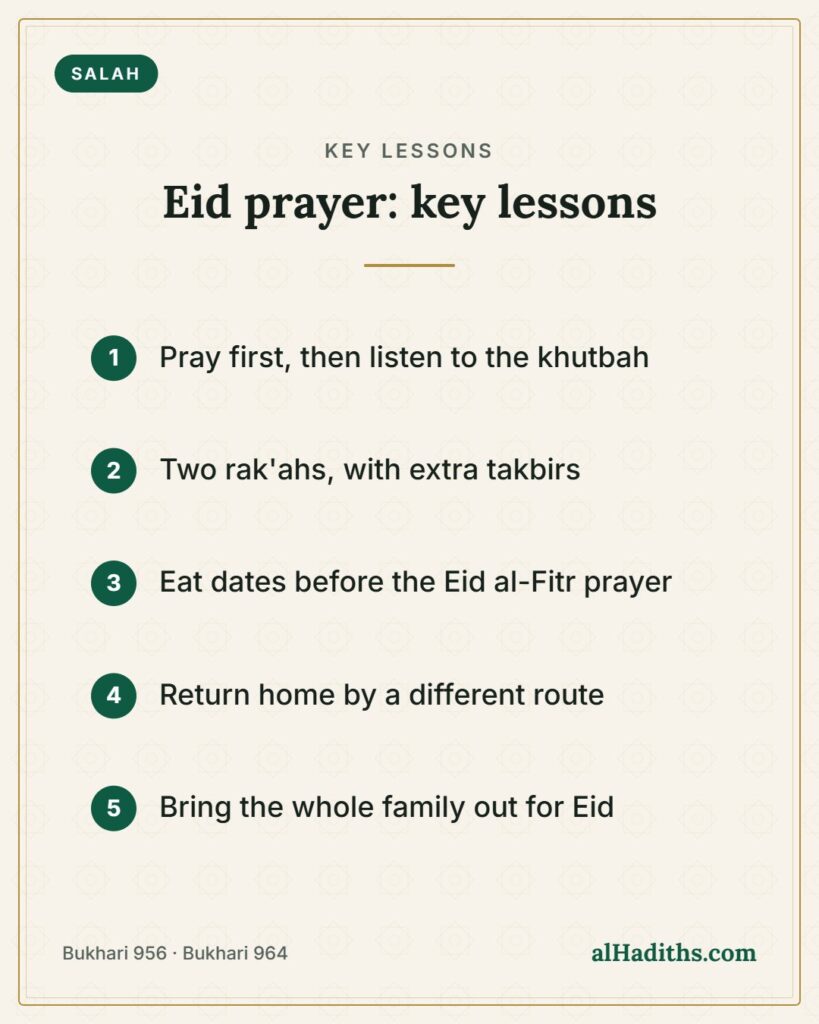
- The Eid prayer comes first, then the khutbah.
- It is two rak’ahs, with nothing prayed before or after at the musalla.
- Extra takbirs are said before the recitation; scholars differ on their number.
- Eat dates before Eid al-Fitr; wait until after the Eid al-Adha prayer.
- Take a different route home, and bring the whole family out.
Part of our Salah series: see all our salah articles in one place.
May Allah let us reach both Eids in good health, and accept our prayers, our fasting and our sacrifice.
Save this to Pinterest so you have it ready on the night before Eid
Share the reward. Send this article to someone who needs it today — teaching a hadith or dua can become a lasting good deed for you, in shaa Allah.