Tarawih Prayer: The Authentic Hadith on Qiyam in Ramadan
Contents
Every Ramadan, mosques fill after ‘Isha for a prayer that has a special place in this month. What do the authentic hadith actually say about the tarawih prayer (also spelled taraweeh)? Here are five narrations from Sahih al-Bukhari and Jami’ at-Tirmidhi on its reward, its history and the number of rak’ahs, and what each one teaches.
At a glance
- Hadith: 5 authentic narrations
- Collections: Sahih al-Bukhari, Jami’ at-Tirmidhi (also Sunan Abi Dawud)
- Grade: Sahih
- Topic: Tarawih (qiyam Ramadan): its reward, its history and its rak’ahs
- Do today: Decide now that next Ramadan you will pray tarawih every night, even if only a few rak’ahs
1. Tarawih can wipe away past sins
Abu Hurairah (may Allah be pleased with him) reported that the Messenger of Allah ﷺ said:
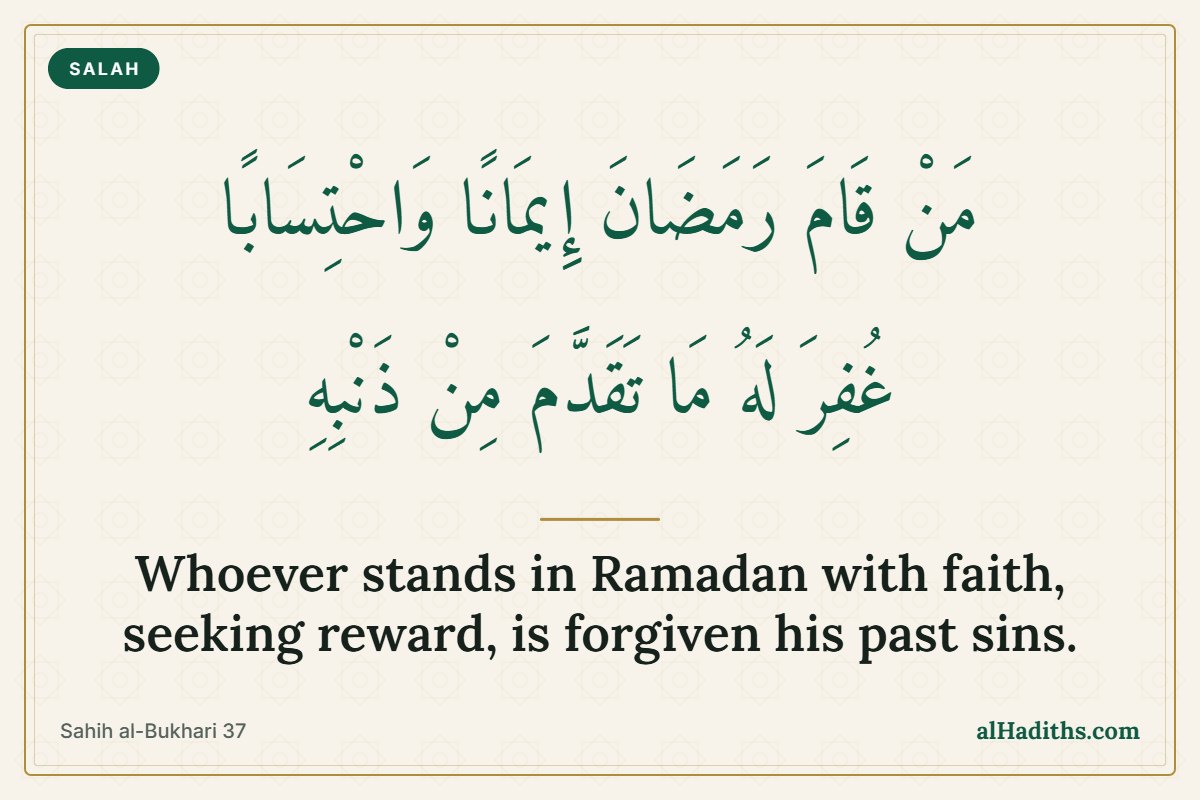
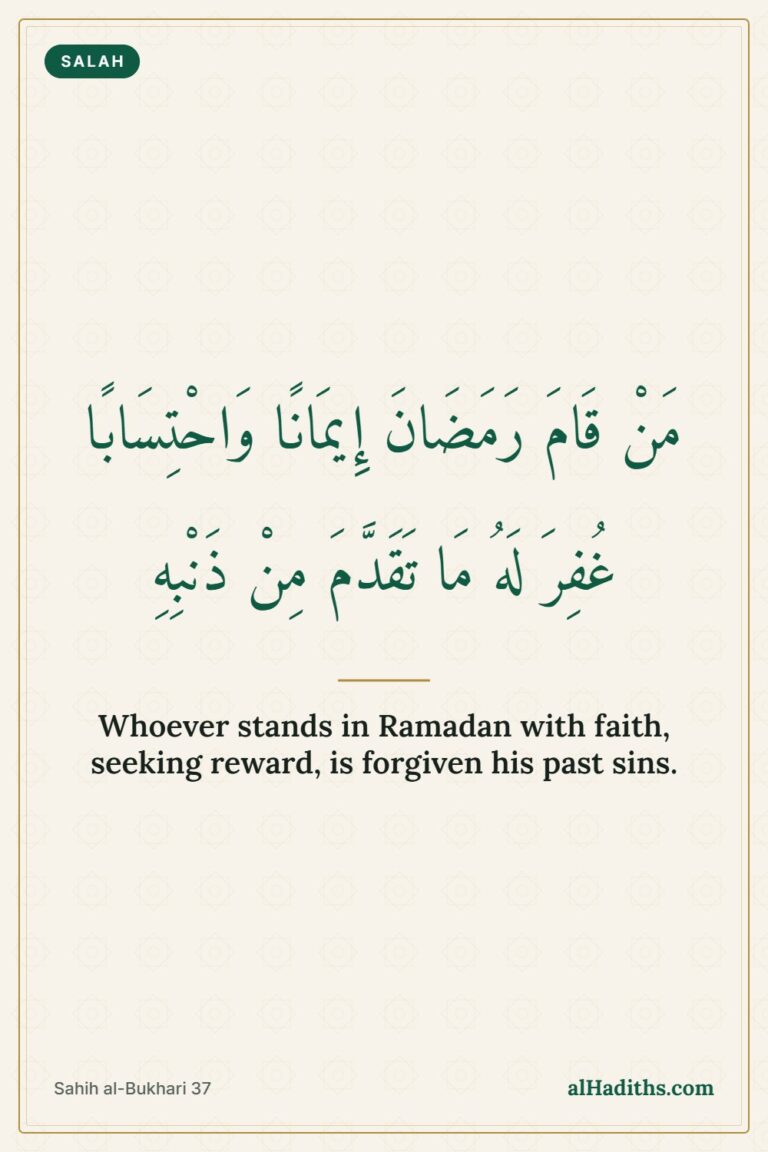
مَنْ قَامَ رَمَضَانَ إِيمَانًا وَاحْتِسَابًا غُفِرَ لَهُ مَا تَقَدَّمَ مِنْ ذَنْبِهِ
“Whoever stands (in prayer) in Ramadan out of faith and hoping for reward, all his past sins will be forgiven.”
Bukhari 37 · Narrated by Abu Hurairah · Translation adapted from Sunnah.com
“Standing in Ramadan” (qiyam Ramadan) is the night prayer of this month, the prayer that later came to be called tarawih. The promise comes with two conditions: iman, praying because you believe in Allah’s promise, and ihtisab, hoping for the reward from Him alone, not to be seen by people. This hadith does not tie the reward to a number of rak’ahs; it ties it to faith and sincerity.
Try this: before the first rak’ah each night, remind yourself why you are standing: faith in Allah and hope for His reward.
2. Why the Prophet ﷺ did not lead it every night
‘A’ishah (may Allah be pleased with her) described how the Prophet ﷺ prayed at night in the mosque in Ramadan, and how more people joined him each night until, on the fourth night, the mosque could not hold them. He did not come out until Fajr. After the prayer he turned to the people and said:
أَمَّا بَعْدُ، فَإِنَّهُ لَمْ يَخْفَ عَلَىَّ مَكَانُكُمْ، وَلَكِنِّي خَشِيتُ أَنْ تُفْتَرَضَ عَلَيْكُمْ فَتَعْجِزُوا عَنْهَا
“Now then: your presence was not hidden from me, but I was afraid that it would be made obligatory on you and you would be unable to carry it out.”
Bukhari 2012 · Narrated by ‘A’ishah · Translation adapted from Sunnah.com
Two lessons sit in this hadith. Praying the night prayer of Ramadan in congregation began with the Prophet ﷺ himself. And he stopped leading it out of mercy, not because it was disliked: he feared it would become a duty too heavy for his ummah. ‘A’ishah adds that he passed away with the matter as it was. Tarawih remains a nafl (voluntary) prayer.
Try this: on a tiring night, pray the few rak’ahs you can manage rather than none. The Prophet ﷺ was careful that this prayer would never become a burden.
3. How ‘Umar gathered the people behind one imam
After the Prophet ﷺ, ‘Abd ar-Rahman ibn ‘Abd al-Qari went with ‘Umar ibn al-Khattab (may Allah be pleased with him) to the mosque one night in Ramadan:
فَإِذَا النَّاسُ أَوْزَاعٌ مُتَفَرِّقُونَ يُصَلِّي الرَّجُلُ لِنَفْسِهِ، وَيُصَلِّي الرَّجُلُ فَيُصَلِّي بِصَلاَتِهِ الرَّهْطُ فَقَالَ عُمَرُ إِنِّي أَرَى لَوْ جَمَعْتُ هَؤُلاَءِ عَلَى قَارِئٍ وَاحِدٍ لَكَانَ أَمْثَلَ. ثُمَّ عَزَمَ فَجَمَعَهُمْ عَلَى أُبَىِّ بْنِ كَعْبٍ، ثُمَّ خَرَجْتُ مَعَهُ لَيْلَةً أُخْرَى، وَالنَّاسُ يُصَلُّونَ بِصَلاَةِ قَارِئِهِمْ، قَالَ عُمَرُ نِعْمَ الْبِدْعَةُ هَذِهِ، وَالَّتِي يَنَامُونَ عَنْهَا أَفْضَلُ مِنَ الَّتِي يَقُومُونَ. يُرِيدُ آخِرَ اللَّيْلِ، وَكَانَ النَّاسُ يَقُومُونَ أَوَّلَهُ
“…and the people were praying in scattered groups: a man praying by himself, and a man praying with a small group following him. ‘Umar said, ‘I think it would be better to gather these people behind one reciter.’ So he made up his mind and gathered them behind Ubayy ibn Ka’b. Then I went out with him on another night, and the people were praying behind their reciter. ‘Umar said, ‘What an excellent bid’ah this is! But the prayer they sleep through is better than the one they are offering.’ He meant the last part of the night, and people used to pray in its early part.”
Bukhari 2010 · Narrated by ‘Abd ar-Rahman ibn ‘Abd al-Qari · Translation adapted from Sunnah.com
This is how tarawih in congregation, behind one imam, became the practice of the Muslims. ‘Umar’s words “what an excellent bid’ah” are often quoted in debates about innovation; we look at what he meant, with the scholars’ explanations, in our article on the hadith about bid’ah. His last remark is easy to miss: he saw prayer in the last part of the night as better, while people at that time prayed in the early part.
Try this: on nights you wake for suhur, add even two rak’ahs before you eat. ‘Umar counted the last part of the night as the better time.
4. Stay with the imam until he finishes
Abu Dharr (may Allah be pleased with him) said the Prophet ﷺ led them in night prayer on some of the last nights of Ramadan. When they asked him to lead them for the rest of the night, he said:
إِنَّهُ مَنْ قَامَ مَعَ الإِمَامِ حَتَّى يَنْصَرِفَ كُتِبَ لَهُ قِيَامُ لَيْلَةٍ
“Whoever stands (in prayer) with the imam until he finishes, the prayer of a whole night is recorded for him.”
Tirmidhi 806 · Sahih (Darussalam) · also Abu Dawud 1375, Sahih (al-Albani) · Narrated by Abu Dharr · Translation adapted from Sunnah.com
This is one of the most generous rewards in the hadith on tarawih: pray with the imam from the first rak’ah to the last, and it is recorded as standing the whole night. In the same narration, the Prophet ﷺ gathered his family and his wives on one of the last nights and prayed until they feared missing al-falah, which the narrator explained as suhur.
Try this: plan your evening so you can stay until the imam ends, instead of leaving halfway.
5. The Prophet’s ﷺ night prayer: eleven rak’ahs
Abu Salamah ibn ‘Abd ar-Rahman asked ‘A’ishah (may Allah be pleased with her) how the Prophet ﷺ prayed in Ramadan. She said:
مَا كَانَ رَسُولُ اللَّهِ صلى الله عليه وسلم يَزِيدُ فِي رَمَضَانَ وَلاَ فِي غَيْرِهِ عَلَى إِحْدَى عَشْرَةَ رَكْعَةً، يُصَلِّي أَرْبَعًا فَلاَ تَسَلْ عَنْ حُسْنِهِنَّ وَطُولِهِنَّ، ثُمَّ يُصَلِّي أَرْبَعًا فَلاَ تَسَلْ عَنْ حُسْنِهِنَّ وَطُولِهِنَّ، ثُمَّ يُصَلِّي ثَلاَثًا
“The Messenger of Allah ﷺ never prayed more than eleven rak’ahs, in Ramadan or at any other time. He would pray four, and do not ask about their beauty and length; then he would pray four, and do not ask about their beauty and length; then he would pray three.”
Bukhari 1147 · Narrated by ‘A’ishah · Translation adapted from Sunnah.com
HadeethEnc explains that Abu Salamah wanted to know whether the Prophet’s ﷺ night prayer in Ramadan differed from the rest of the year. It did not: it was eleven rak’ahs, and what set it apart was its beauty and length. Another narration from ‘A’ishah explains that he gave salam after every two rak’ahs and ended with one rak’ah of witr.
Try this: whatever number you pray, aim for the quality ‘A’ishah described: unhurried recitation, a calm ruku’ and long sujud.
Tarawih prayer: 8 or 20 rak’ahs?
This is the question most people ask, and it is one where scholars differ. Here is what the sources themselves say:
- Eleven, including witr: ‘A’ishah’s report above (Bukhari 1147). Jabir ibn ‘Abdullah also reported that the Prophet ﷺ led them in Ramadan with eight rak’ahs and witr; HadeethEnc grades that narration (from Ibn Khuzaymah) as good (HadeethEnc 11264).
- Twenty: in his note under hadith 806, Imam at-Tirmidhi says most scholars follow what is reported from ‘Umar, ‘Ali and other Companions: twenty rak’ahs. It is the view of Sufyan ath-Thawri, Ibn al-Mubarak and ash-Shafi’i, who said this is how he found people praying in Makkah.
- Forty-one, including witr: at-Tirmidhi records this as the view and practice of the people of Madinah, and says Ishaq chose it, based on what was reported from Ubayy ibn Ka’b.
- No set number: at-Tirmidhi adds that Imam Ahmad said different numbers had been reported, and did not decide on one.
These are the views of the classical scholars as at-Tirmidhi records them. We don’t give a ruling here: follow your local mosque, or ask a qualified scholar you trust. The fourth hadith above offers a simple way through: stay with your imam until he finishes.
Bringing it together
Reflection: Put these five hadith side by side and the emphasis is clear. The reward is tied to faith and sincerity; the Prophet ﷺ made sure it would never become a burden; the Companions kept it alive in congregation; and his own prayer was known for its beauty and length. People argue most about the number of rak’ahs, yet the hadith about its reward speak of faith and sincerity, not a number.
Questions people ask
What does tarawih mean?
Tarawih is the plural of tarwihah, a rest. The night prayer of Ramadan came to be known by this name later; the hadith themselves call it qiyam Ramadan, “standing in Ramadan”.
Is tarawih compulsory?
No. It is a voluntary prayer. In the second hadith above, the Prophet ﷺ stopped leading it in the mosque precisely because he feared it would be made obligatory.
Can I pray tarawih at home?
The hadith show both: before ‘Umar gathered them, people prayed alone and in small groups. Which is better is a point of difference. At-Tirmidhi records that Ibn al-Mubarak, Ahmad and Ishaq preferred praying with the imam in Ramadan, while ash-Shafi’i preferred praying alone for someone who knows the Quran well.
Is tarawih the same as tahajjud?
Both are night prayer. ‘A’ishah described one night prayer of the Prophet ﷺ, in Ramadan and outside it. In Ramadan it is usually prayed in congregation after ‘Isha and called tarawih. For the night prayer through the year, see our tahajjud hadith.
How many rakat is taraweeh?
‘A’ishah reported eleven including witr; at-Tirmidhi records twenty as the view of most scholars he names, and forty-one as the practice of Madinah. Scholars differ, so follow your local mosque or ask a qualified scholar.
Key lessons
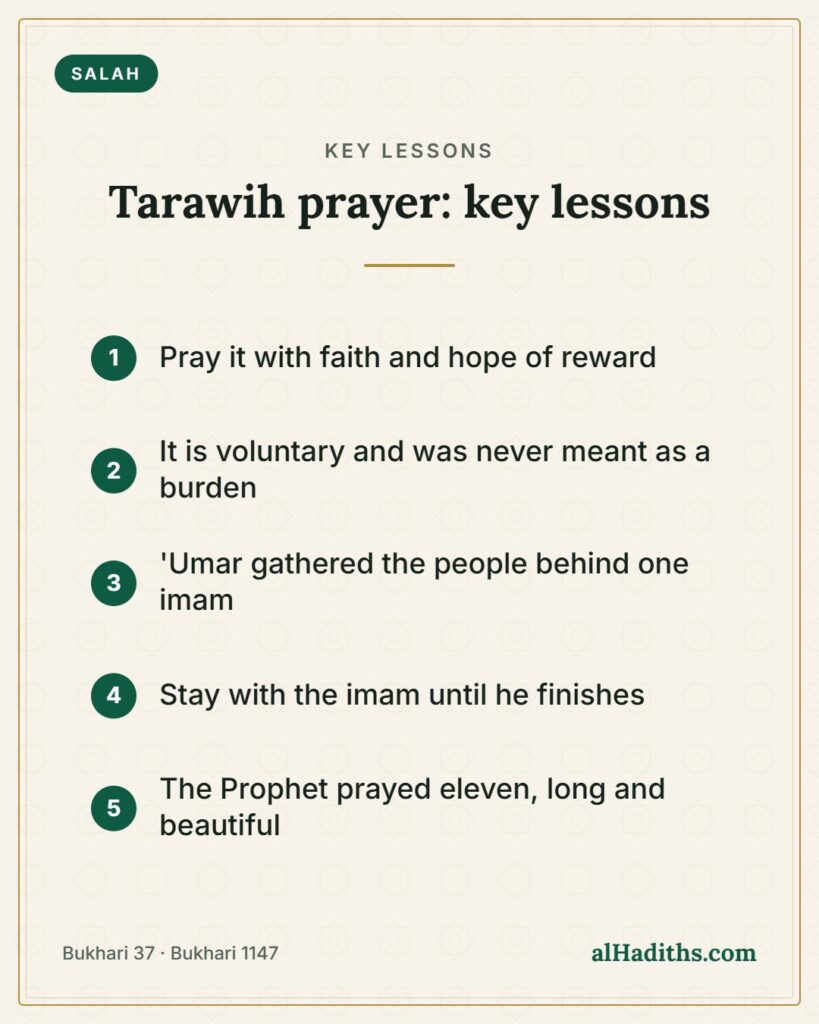
- Tarawih is rewarded by faith and sincerity: past sins forgiven.
- It is voluntary; the Prophet ﷺ stopped leading it so it would not become obligatory.
- ‘Umar gathered the people behind one imam, and that became the practice.
- Praying with the imam until he finishes is recorded as a whole night.
- The Prophet’s ﷺ night prayer was eleven rak’ahs, known for its beauty and length.
Part of our Salah series: see all our salah articles in one place.
Ramadan is still some months away. May Allah let us reach it, and accept our standing in its nights.
Save this to Pinterest so you can come back to these hadith before Ramadan
Share the reward. Send this article to someone who needs it today — teaching a hadith or dua can become a lasting good deed for you, in shaa Allah.