Tahajjud Hadith: 5 Authentic Narrations on the Night Prayer
Contents
The house is quiet, the phone is silent, and most people are asleep. That is the hour the Prophet ﷺ spent standing before his Lord. In these five authentic tahajjud hadith he tells us why: the night prayer is the best prayer after the obligatory ones, and in the last third of every night Allah calls out to anyone who will ask.
At a glance
- Texts: 5 hadith cards, plus Surah al-Isra 17:79 and Surah as-Sajdah 32:16
- Collections: Sahih al-Bukhari and Sahih Muslim
- Grade: All Sahih
- Topic: Salah: tahajjud, the night prayer
- Put it into practice: Set an alarm for the last third of the night once this week, pray a little and make one dua
1. The best prayer after the obligatory
Abu Hurairah (may Allah be pleased with him) reported that the Messenger of Allah ﷺ said:
أَفْضَلُ الصِّيَامِ بَعْدَ رَمَضَانَ شَهْرُ اللَّهِ الْمُحَرَّمُ وَأَفْضَلُ الصَّلاَةِ بَعْدَ الْفَرِيضَةِ صَلاَةُ اللَّيْلِ
“The most excellent fast after Ramadan is in Allah’s month, al-Muharram, and the most excellent prayer after the obligatory prayer is prayer during the night.”
Sahih Muslim 1163a · Narrated by Abu Hurairah · Translation adapted from Sunnah.com
Of all the voluntary prayers, the Prophet ﷺ placed the night prayer at the top. It comes after the five daily prayers, never in place of them, which is why we started this series with praying on time.
Try this: if you already pray the five on time, choose one night this week to add the night prayer.
2. Allah descends in the last third of the night
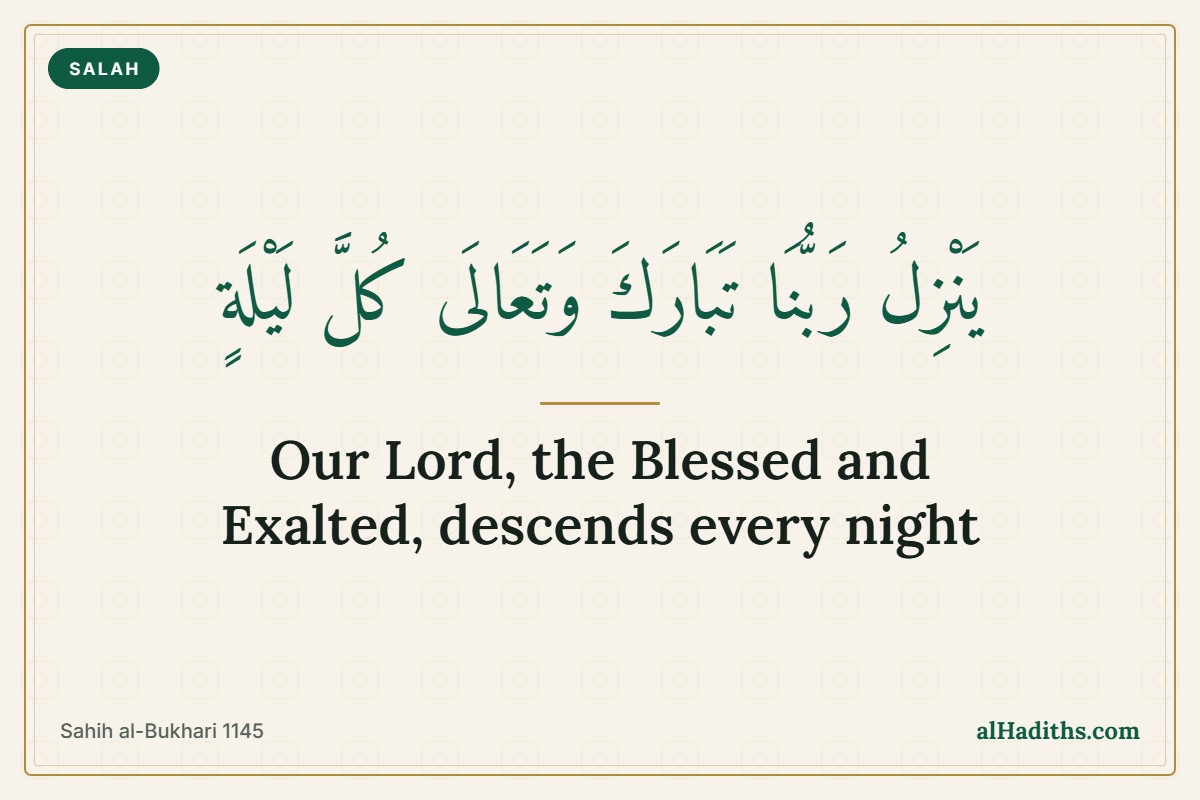
Abu Hurairah (may Allah be pleased with him) reported that the Messenger of Allah ﷺ said:
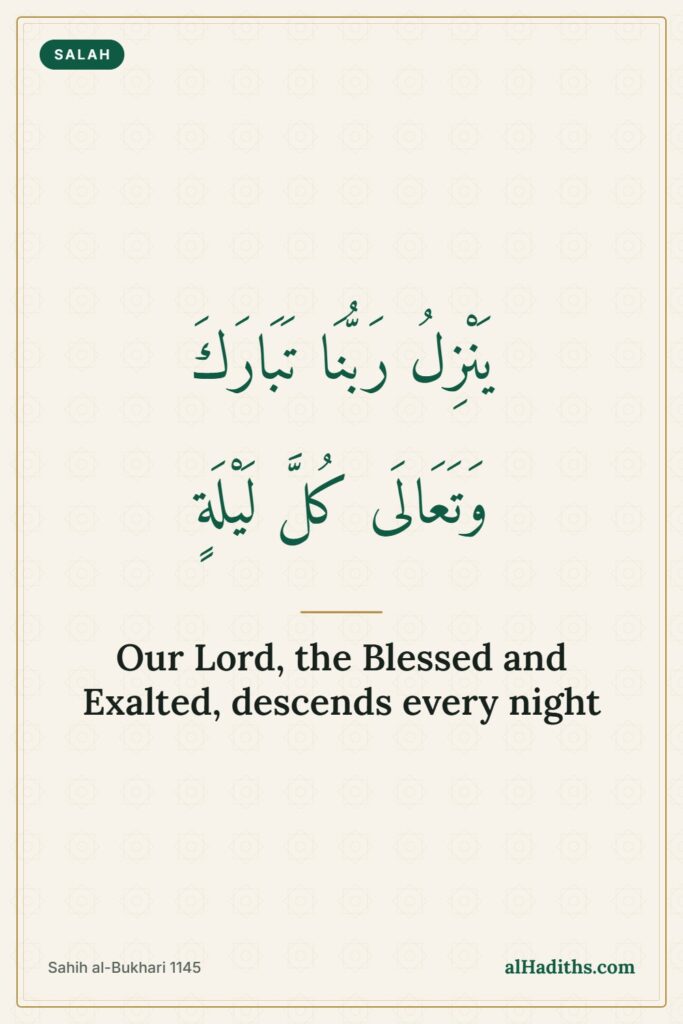
يَنْزِلُ رَبُّنَا تَبَارَكَ وَتَعَالَى كُلَّ لَيْلَةٍ إِلَى السَّمَاءِ الدُّنْيَا حِينَ يَبْقَى ثُلُثُ اللَّيْلِ الآخِرُ يَقُولُ مَنْ يَدْعُونِي فَأَسْتَجِيبَ لَهُ مَنْ يَسْأَلُنِي فَأُعْطِيَهُ مَنْ يَسْتَغْفِرُنِي فَأَغْفِرَ لَهُ
“Our Lord, the Blessed and Exalted, descends every night to the nearest heaven when the last third of the night remains, saying: ‘Who is calling upon Me, so that I may answer him? Who is asking of Me, so that I may give him? Who is seeking My forgiveness, so that I may forgive him?’”
Sahih al-Bukhari 1145 · Narrated by Abu Hurairah · Translation adapted from Sunnah.com
This is the tahajjud hadith most people search for. HadeethEnc explains that Allah descends every night to the lowest heaven when the last third of the night remains, and that the hadith urges believers to call on Him, ask Him for what they need, and seek His forgiveness, because He answers, gives and forgives.
Try this: keep a short list of what you want to ask Allah for, so that when you wake in the last third you know what to say.
3. An hour every night when duas are answered
Jabir (may Allah be pleased with him) said that he heard the Prophet ﷺ say:
إِنَّ فِي اللَّيْلِ لَسَاعَةً لاَ يُوَافِقُهَا رَجُلٌ مُسْلِمٌ يَسْأَلُ اللَّهَ خَيْرًا مِنْ أَمْرِ الدُّنْيَا وَالآخِرَةِ إِلاَّ أَعْطَاهُ إِيَّاهُ وَذَلِكَ كُلَّ لَيْلَةٍ
“There is an hour during the night in which no Muslim will ask Allah for good in this world and the next without His giving it to him; and that applies to every night.”
Sahih Muslim 757a · Narrated by Jabir ibn ‘Abdullah · Translation adapted from Sunnah.com
The hadith does not name the exact hour, and it says it comes every night. Being awake and asking during the night, especially in the last third mentioned in the hadith before it, is how a believer hopes to meet it.
Try this: ask for good in both worlds, as the hadith says: something for this life and something for the Hereafter.
4. “Should I not be a thankful slave?”
‘A’ishah (may Allah be pleased with her) reported:
أَنَّ نَبِيَّ اللَّهِ صلى الله عليه وسلم كَانَ يَقُومُ مِنَ اللَّيْلِ حَتَّى تَتَفَطَّرَ قَدَمَاهُ فَقَالَتْ عَائِشَةُ لِمَ تَصْنَعُ هَذَا يَا رَسُولَ اللَّهِ وَقَدْ غَفَرَ اللَّهُ لَكَ مَا تَقَدَّمَ مِنْ ذَنْبِكَ وَمَا تَأَخَّرَ قَالَ أَفَلاَ أُحِبُّ أَنْ أَكُونَ عَبْدًا شَكُورًا
“The Prophet ﷺ used to stand in prayer at night until his feet cracked. ‘A’ishah said: ‘Why do you do this, O Messenger of Allah, when Allah has forgiven your past and future sins?’ He said: ‘Should I not love to be a thankful slave?’”
Sahih al-Bukhari 4837 · Narrated by ‘A’ishah · Translation adapted from Sunnah.com
HadeethEnc explains that ‘A’ishah assumed this worship was out of fear of sin, and that his answer showed it was gratitude to Allah for His forgiveness. Tahajjud is not only for the worried; it is also a way of saying thank you.
Try this: on a night you pray, begin by thanking Allah for three specific blessings before you ask for anything.
5. Do not be like the one who stopped
‘Abdullah ibn ‘Amr ibn al-‘As (may Allah be pleased with them) said that the Messenger of Allah ﷺ said to him:
يَا عَبْدَ اللَّهِ ، لاَ تَكُنْ مِثْلَ فُلاَنٍ، كَانَ يَقُومُ اللَّيْلَ فَتَرَكَ قِيَامَ اللَّيْلِ
“O ‘Abdullah, do not be like so-and-so who used to pray at night and then stopped the night prayer.”
Sahih al-Bukhari 1152 · Narrated by ‘Abdullah ibn ‘Amr · Translation adapted from Sunnah.com
The warning is not about someone who never started, but about someone who started and then let it go. A small night prayer that lasts is better than a burst of effort that fades after a week.
Try this: pick an amount you can keep up, even if it is short, rather than one you can only manage once.
Tahajjud in the Quran
Allah speaks to the Prophet ﷺ about the night prayer directly:
وَمِنَ ٱلَّيْلِ فَتَهَجَّدْ بِهِۦ نَافِلَةً لَّكَ عَسَىٰٓ أَن يَبْعَثَكَ رَبُّكَ مَقَامًا مَّحْمُودًا
“And from [part of] the night, pray with it [i.e., recitation of the Qur’ān] as additional [worship] for you; it is expected that your Lord will resurrect you to a praised station.”
Surah al-Isra 17:79 · Translation: Saheeh International, from Quran.com
And He describes the believers who leave their beds to call on Him:
تَتَجَافَىٰ جُنُوبُهُمْ عَنِ ٱلْمَضَاجِعِ يَدْعُونَ رَبَّهُمْ خَوْفًا وَطَمَعًا وَمِمَّا رَزَقْنَـٰهُمْ يُنفِقُونَ
“Their sides part [i.e., they arise] from [their] beds; they supplicate their Lord in fear and aspiration, and from what We have provided them, they spend.”
Surah as-Sajdah 32:16 · Translation: Saheeh International, from Quran.com
What the tahajjud hadith teach us
- It is the best voluntary prayer, after the five obligatory ones (Sahih Muslim 1163a).
- The last third of the night is a time to call on Allah, ask Him and seek His forgiveness (Sahih al-Bukhari 1145).
- There is an hour every night when duas for good are answered (Sahih Muslim 757a).
- It can be an act of gratitude, not only of fear (Sahih al-Bukhari 4837).
- Keeping it up matters more than doing a lot once (Sahih al-Bukhari 1152).
A suggestion, not from these hadith: if waking up is hard, start by guarding Fajr and its sunnah, and add a few minutes before it. For how many rak‘ahs to pray and how to pray them, ask a qualified local scholar.
Bringing it together
Reflection: these texts paint the night as an open door. The best voluntary prayer, a Lord who calls out to those who ask, an hour when good is given, and a Prophet ﷺ who stood until his feet cracked out of thanks. The only thing asked of us is to get up, a little, and to keep getting up.
Questions people ask
When is the best time for tahajjud?
The Prophet ﷺ said that Allah descends to the nearest heaven when the last third of the night remains, calling those who ask (Sahih al-Bukhari 1145), and that there is an hour every night when duas for good are answered (Sahih Muslim 757a). For the exact times where you live, ask a qualified local scholar.
Is “tahajjud is like an arrow that does not miss” a hadith?
We could not find this saying in the hadith collections on Sunnah.com, so we do not treat it as a hadith. It is often shared online as a saying. The authentic hadith above already show the value of dua in the night.
Is there a hadith that night prayer is the practice of the righteous?
A narration in Jami` at-Tirmidhi (3549) says this, but Sunnah.com shows it as Da‘if (Darussalam), so we have not used it as one of the hadith in this article.
Key lessons
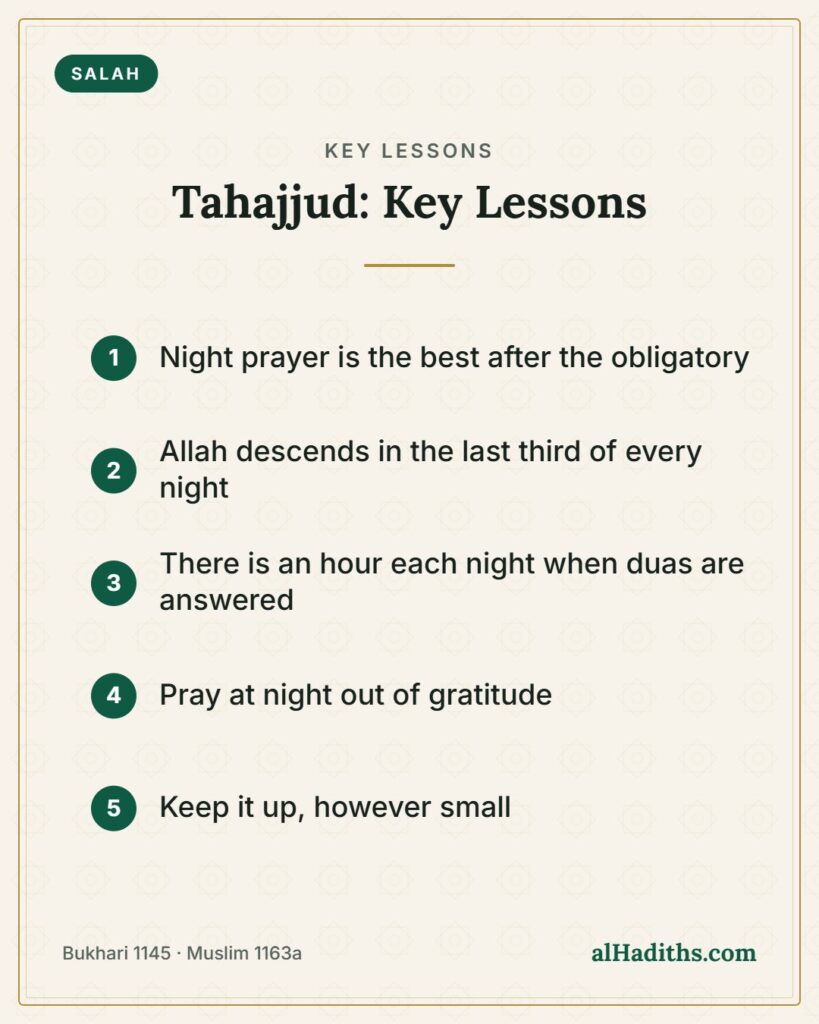
- The night prayer is the best prayer after the obligatory ones.
- Allah descends in the last third of every night, calling those who ask.
- There is an hour every night when duas for good are answered.
- The Prophet ﷺ prayed at night out of gratitude.
- Keep it up, even if it is small.
Tonight, before you sleep, set an alarm for the last third of the night. If you wake, pray a little and ask Allah for one thing you truly need. May Allah make us among those who stand for Him in the night.
Save this to Pinterest so you can remember the last third of the night
Share the reward. Send this article to someone who needs it today — teaching a hadith or dua can become a lasting good deed for you, in shaa Allah.