How to Make Wudu: The Prophet’s Ablution in Authentic Hadith
- Wudu in the Quran
- 1. 'Uthman shows the Prophet's wudu
- 2. 'Abdullah ibn Zaid shows how to wipe the head
- How to make wudu step by step
- 3. Start with the right side
- 4. Wash thoroughly, between the fingers and in the nose
- 5. Wiping the ears
- 6. Leave no part dry, especially the heels
- 7. Once, twice or three times, but not more
- 8. What to say after wudu
- 9. The reward of a good wudu
- A note on its grading: saying Bismillah before wudu
- Key lessons
- Questions people ask
Wudu is the washing that comes before every prayer, and the Companions did not leave it to guesswork. They showed it with water in their hands and said, this is how the Prophet ﷺ did it. This guide on how to make wudu follows those authentic hadith step by step, then covers what to say afterwards and the reward the Prophet ﷺ promised for it.
At a glance
- Main sources: Sahih al-Bukhari 159 and 185, with Sahih Muslim, at-Tirmidhi, an-Nasa’i and Abu Dawud
- Shown by: ‘Uthman ibn ‘Affan and ‘Abdullah ibn Zaid (may Allah be pleased with them)
- Grade: Sahih and Hasan, grader named on each card; one weak narration, clearly labelled
- Topic: Wudu (ablution): the steps, what to say after it, and its reward
- Put it into practice: At your next wudu, check your heels and between your toes
Wudu in the Quran
The command to make wudu before prayer comes in one verse of Surah al-Ma’idah:
يَـٰٓأَيُّهَا ٱلَّذِينَ ءَامَنُوٓا۟ إِذَا قُمْتُمْ إِلَى ٱلصَّلَوٰةِ فَٱغْسِلُوا۟ وُجُوهَكُمْ وَأَيْدِيَكُمْ إِلَى ٱلْمَرَافِقِ وَٱمْسَحُوا۟ بِرُءُوسِكُمْ وَأَرْجُلَكُمْ إِلَى ٱلْكَعْبَيْنِ ۚ وَإِن كُنتُمْ جُنُبًا فَٱطَّهَّرُوا۟ ۚ وَإِن كُنتُم مَّرْضَىٰٓ أَوْ عَلَىٰ سَفَرٍ أَوْ جَآءَ أَحَدٌ مِّنكُم مِّنَ ٱلْغَآئِطِ أَوْ لَـٰمَسْتُمُ ٱلنِّسَآءَ فَلَمْ تَجِدُوا۟ مَآءً فَتَيَمَّمُوا۟ صَعِيدًا طَيِّبًا فَٱمْسَحُوا۟ بِوُجُوهِكُمْ وَأَيْدِيكُم مِّنْهُ ۚ مَا يُرِيدُ ٱللَّهُ لِيَجْعَلَ عَلَيْكُم مِّنْ حَرَجٍ وَلَـٰكِن يُرِيدُ لِيُطَهِّرَكُمْ وَلِيُتِمَّ نِعْمَتَهُۥ عَلَيْكُمْ لَعَلَّكُمْ تَشْكُرُونَ
“O you who have believed, when you rise to [perform] prayer, wash your faces and your forearms to the elbows and wipe over your heads and wash your feet to the ankles. And if you are in a state of janābah, then purify yourselves. But if you are ill or on a journey or one of you comes from the place of relieving himself or you have contacted women and do not find water, then seek clean earth and wipe over your faces and hands with it. Allāh does not intend to make difficulty for you, but He intends to purify you and complete His favor upon you that you may be grateful.”
Surah Al-Ma’idah 5:6 · Translation: Saheeh International, from Quran.com
The verse names the face, the arms to the elbows, the head and the feet to the ankles. The hadith below show how the Prophet ﷺ carried this out, including the parts the verse does not mention, such as the hands, mouth, nose and ears. For more on purity itself, see Purity Is Half of Faith.
1. ‘Uthman shows the Prophet’s wudu
Humran, the freed slave of ‘Uthman ibn ‘Affan (may Allah be pleased with him), watched ‘Uthman call for water and make wudu:
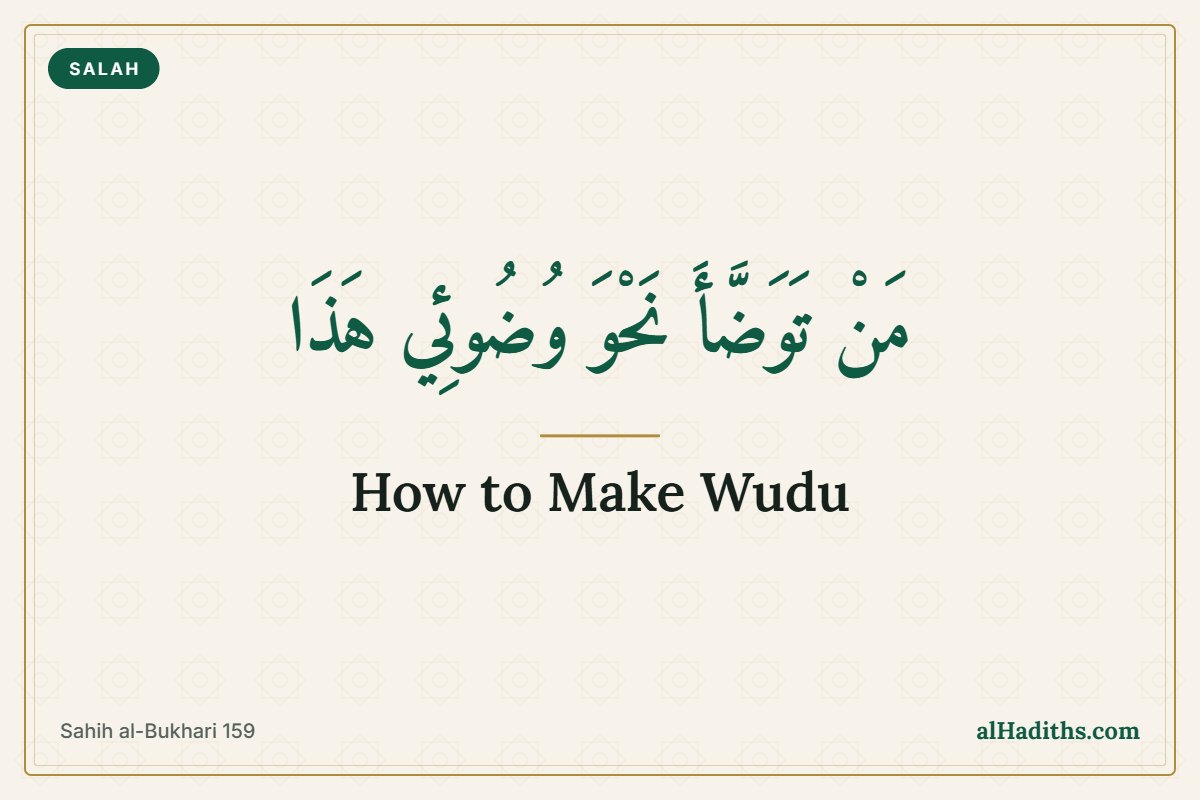
رَأَى عُثْمَانَ بْنَ عَفَّانَ دَعَا بِإِنَاءٍ، فَأَفْرَغَ عَلَى كَفَّيْهِ ثَلاَثَ مِرَارٍ فَغَسَلَهُمَا، ثُمَّ أَدْخَلَ يَمِينَهُ فِي الإِنَاءِ فَمَضْمَضَ، وَاسْتَنْشَقَ، ثُمَّ غَسَلَ وَجْهَهُ ثَلاَثًا، وَيَدَيْهِ إِلَى الْمِرْفَقَيْنِ ثَلاَثَ مِرَارٍ، ثُمَّ مَسَحَ بِرَأْسِهِ، ثُمَّ غَسَلَ رِجْلَيْهِ ثَلاَثَ مِرَارٍ إِلَى الْكَعْبَيْنِ، ثُمَّ قَالَ قَالَ رَسُولُ اللَّهِ صلى الله عليه وسلم مَنْ تَوَضَّأَ نَحْوَ وُضُوئِي هَذَا، ثُمَّ صَلَّى رَكْعَتَيْنِ، لاَ يُحَدِّثُ فِيهِمَا نَفْسَهُ، غُفِرَ لَهُ مَا تَقَدَّمَ مِنْ ذَنْبِهِ
“He saw ‘Uthman bin ‘Affan asking for a tumbler of water. He poured water over his hands and washed them thrice, then put his right hand in the water container and rinsed his mouth, and washed his nose by putting water in it and then blowing it out. Then he washed his face, and his forearms up to the elbows, thrice. He passed his wet hands over his head and washed his feet up to the ankles thrice. Then he said: Allah’s Messenger ﷺ said, ‘If anyone performs ablution like that of mine and offers a two-rak’at prayer during which he does not think of anything else, then his past sins will be forgiven.’”
Sahih al-Bukhari 159 · Narrated by Humran · Translation adapted from Sunnah.com
In Sahih Muslim 226a, the same report adds that he washed his right arm before his left, and his right foot before his left. Ibn Shihab, one of its narrators, said the scholars of his time called this the most complete wudu a person can make for prayer. HadeethEnc notes that ‘Uthman taught it by doing it, because showing is often the clearest way to teach.
Try this: follow the order of this hadith exactly at your next wudu.
2. ‘Abdullah ibn Zaid shows how to wipe the head
A man asked ‘Abdullah ibn Zaid (may Allah be pleased with him) to show how the Messenger of Allah ﷺ made wudu. He called for water:
فَدَعَا بِمَاءٍ، فَأَفْرَغَ عَلَى يَدَيْهِ فَغَسَلَ يَدَهُ مَرَّتَيْنِ، ثُمَّ مَضْمَضَ وَاسْتَنْثَرَ ثَلاَثًا، ثُمَّ غَسَلَ وَجْهَهُ ثَلاَثًا، ثُمَّ غَسَلَ يَدَيْهِ مَرَّتَيْنِ مَرَّتَيْنِ إِلَى الْمِرْفَقَيْنِ، ثُمَّ مَسَحَ رَأْسَهُ بِيَدَيْهِ، فَأَقْبَلَ بِهِمَا وَأَدْبَرَ، بَدَأَ بِمُقَدَّمِ رَأْسِهِ، حَتَّى ذَهَبَ بِهِمَا إِلَى قَفَاهُ، ثُمَّ رَدَّهُمَا إِلَى الْمَكَانِ الَّذِي بَدَأَ مِنْهُ، ثُمَّ غَسَلَ رِجْلَيْهِ
“He poured it on his hands and washed them twice, then he rinsed his mouth thrice and washed his nose with water thrice by putting water in it and blowing it out. He washed his face thrice and after that he washed his forearms up to the elbows twice and then passed his wet hands over his head from its front to its back and vice versa (beginning from the front and taking them to the back of his head up to the nape of the neck and then brought them to the front again from where he had started) and washed his feet.”
Sahih al-Bukhari 185 · Narrated by Yahya al-Mazini · Translation adapted from Sunnah.com
This hadith gives the clearest description of wiping the head: from the front to the nape of the neck, and back again. It also shows that the Prophet ﷺ did not always wash every part three times; here the arms are washed twice. HadeethEnc explains that washing some parts three times and others twice is allowed, while once is the minimum.
How to make wudu step by step
Putting these hadith together gives the order below. Each step links to its source. Scholars and madhhabs differ on which steps are obligatory and which are sunnah, so for the rulings of your madhhab, please ask a qualified local scholar.
- Intend it in your heart. Every deed is judged by its intention; see Actions Are Judged by Intentions.
- Say Bismillah. See the note on its grading further down.
- Wash both hands up to the wrists, three times (Bukhari 159).
- Rinse the mouth and nose, drawing water into the nose and blowing it out, three times. Sniff the water in well, unless you are fasting (Tirmidhi 788).
- Wash the face three times.
- Wash the right arm up to the elbow, then the left (Muslim 226a).
- Wipe the head with wet hands, from the front to the nape and back again (Bukhari 185).
- Wipe the ears, the inside with the index fingers and the back with the thumbs (Nasa’i 102).
- Wash the right foot up to the ankles, then the left, with water between the toes (Muslim 226a, Tirmidhi 788).
3. Start with the right side
‘A’ishah (may Allah be pleased with her) said:
كَانَ النَّبِيُّ صلى الله عليه وسلم يُعْجِبُهُ التَّيَمُّنُ فِي تَنَعُّلِهِ وَتَرَجُّلِهِ وَطُهُورِهِ وَفِي شَأْنِهِ كُلِّهِ
“The Prophet ﷺ used to like to start from the right side on wearing shoes, combing his hair and cleaning or washing himself and on doing anything else.”
Sahih al-Bukhari 168 · Narrated by ‘A’ishah · Translation adapted from Sunnah.com
Wudu is included in “washing himself”. This is why the right arm and the right foot come before the left.
4. Wash thoroughly, between the fingers and in the nose
Laqit ibn Sabirah (may Allah be pleased with him) asked the Messenger of Allah ﷺ to tell him about wudu. He said:
أَسْبِغِ الْوُضُوءَ وَخَلِّلْ بَيْنَ الأَصَابِعِ وَبَالِغْ فِي الاِسْتِنْشَاقِ إِلاَّ أَنْ تَكُونَ صَائِمًا
“Perform Wudu well, and go between the fingers, and perform Istinshaq extensively except when fasting.”
Jami` at-Tirmidhi 788 · Sahih (Darussalam) · Translation from Sunnah.com
Istinshaq is drawing water up into the nose. According to HadeethEnc, “go between the fingers” covers the toes as well, so that water reaches between them. The one exception the hadith gives is the fasting person, who should not draw the water in deeply.
5. Wiping the ears
Ibn ‘Abbas (may Allah be pleased with him) described the wudu of the Prophet ﷺ:
تَوَضَّأَ رَسُولُ اللَّهِ صلى الله عليه وسلم فَغَرَفَ غَرْفَةً فَمَضْمَضَ وَاسْتَنْشَقَ ثُمَّ غَرَفَ غَرْفَةً فَغَسَلَ وَجْهَهُ ثُمَّ غَرَفَ غَرْفَةً فَغَسَلَ يَدَهُ الْيُمْنَى ثُمَّ غَرَفَ غَرْفَةً فَغَسَلَ يَدَهُ الْيُسْرَى ثُمَّ مَسَحَ بِرَأْسِهِ وَأُذُنَيْهِ بَاطِنِهِمَا بِالسَّبَّاحَتَيْنِ وَظَاهِرِهِمَا بِإِبْهَامَيْهِ ثُمَّ غَرَفَ غَرْفَةً فَغَسَلَ رِجْلَهُ الْيُمْنَى ثُمَّ غَرَفَ غَرْفَةً فَغَسَلَ رِجْلَهُ الْيُسْرَى
“The Messenger of Allah ﷺ performed Wudu’, and he scooped up one handful (of water) and rinsed his mouth and nose. Then he scooped up another handful and washed his face. Then he scooped up another handful and washed his right hand, then another handful and washed his left hand. Then he wiped his head and his ears, the inside with his forefinger and the outside with his thumb. Then he scooped up a handful of water and washed his right foot, and scooped up another handful and washed his left foot.”
Sunan an-Nasa’i 102 · Hasan (Darussalam) · Translation from Sunnah.com
Here each part is washed once, with one handful each, and the ears are wiped together with the head.
6. Leave no part dry, especially the heels
On a journey, some Companions were rushing their wudu and only wiping their feet. ‘Abdullah ibn ‘Amr (may Allah be pleased with him) said the Prophet ﷺ called out in a loud voice, two or three times:
وَيْلٌ لِلأَعْقَابِ مِنَ النَّارِ
“Save your heels from the fire.”
Sahih al-Bukhari 60 · Narrated by ‘Abdullah ibn ‘Amr · Translation from Sunnah.com
‘Umar ibn al-Khattab (may Allah be pleased with him) reported a similar case:
أَنَّ رَجُلاً، تَوَضَّأَ فَتَرَكَ مَوْضِعَ ظُفُرٍ عَلَى قَدَمِهِ فَأَبْصَرَهُ النَّبِيُّ صلى الله عليه وسلم فَقَالَ ارْجِعْ فَأَحْسِنْ وُضُوءَكَ فَرَجَعَ ثُمَّ صَلَّى
“A person performed ablution and left a small part equal to the space of a nail (unwashed). The Prophet ﷺ saw that and said: Go back and perform ablution well. He then went back and offered the prayer.”
Sahih Muslim 243 · Narrated by Jabir, from ‘Umar · Translation adapted from Sunnah.com
HadeethEnc explains that the feet must be washed, not just wiped, and that every part of wudu must be fully covered with water. The back of the foot is the place water most often misses.
Try this: run your hand over your heels and ankles before you finish.
7. Once, twice or three times, but not more
The Prophet ﷺ made wudu washing each part once (Sahih al-Bukhari 157), twice (Sahih al-Bukhari 158) and three times (Bukhari 159, above). Three is the most he did, and he warned against going beyond it:
جَاءَ أَعْرَابِيٌّ إِلَى النَّبِيِّ صلى الله عليه وسلم يَسْأَلُهُ عَنِ الْوُضُوءِ فَأَرَاهُ الْوُضُوءَ ثَلاَثًا ثَلاَثًا ثُمَّ قَالَ هَكَذَا الْوُضُوءُ فَمَنْ زَادَ عَلَى هَذَا فَقَدْ أَسَاءَ وَتَعَدَّى وَظَلَمَ
“A Bedouin came to the Prophet ﷺ to ask him about Wudu’, so he showed him how to perform Wudu’, washing each part three times, then he said: ‘This is Wudu’. Whoever does more than that has done badly, done to extremes and done wrong.’”
Sunan an-Nasa’i 140 · Hasan (Darussalam) · Translation adapted from Sunnah.com
He also used very little water: Anas reported that he made wudu with one mudd, a small measure (Sahih al-Bukhari 201). Leaving the tap running for the whole wudu is the opposite of this.
8. What to say after wudu
‘Uqbah ibn ‘Amir (may Allah be pleased with him) heard ‘Umar narrate that the Messenger of Allah ﷺ said:
مَا مِنْكُمْ مِنْ أَحَدٍ يَتَوَضَّأُ فَيُبْلِغُ – أَوْ فَيُسْبِغُ – الْوُضُوءَ ثُمَّ يَقُولُ أَشْهَدُ أَنْ لاَ إِلَهَ إِلاَّ اللَّهُ وَأَنَّ مُحَمَّدًا عَبْدُ اللَّهِ وَرَسُولُهُ إِلاَّ فُتِحَتْ لَهُ أَبْوَابُ الْجَنَّةِ الثَّمَانِيَةُ يَدْخُلُ مِنْ أَيِّهَا شَاءَ
“If anyone amongst you performs the ablution, and then completes the ablution well and then says: I testify that there is no god but Allah and that Muhammad is the servant of Allah and His Messenger, the eight gates of Paradise would be opened for him and he may enter by whichever of them he wishes.”
Sahih Muslim 234a · Narrated by ‘Uqbah ibn ‘Amir, from ‘Umar · Translation adapted from Sunnah.com
HadeethEnc explains that this testimony after wudu cleans the heart, just as the water cleans the body.
A longer wording, which many Muslims say after wudu, adds a short dua at the end. It is reported by at-Tirmidhi, but its grade is weak according to Darussalam, so please note its grading below:
أَشْهَدُ أَنْ لاَ إِلَهَ إِلاَّ اللَّهُ وَحْدَهُ لاَ شَرِيكَ لَهُ وَأَشْهَدُ أَنَّ مُحَمَّدًا عَبْدُهُ وَرَسُولُهُ اللَّهُمَّ اجْعَلْنِي مِنَ التَّوَّابِينَ وَاجْعَلْنِي مِنَ الْمُتَطَهِّرِينَ
Ash-hadu an la ilaha illallahu wahdahu la sharika lahu, wa ash-hadu anna Muhammadan ‘abduhu wa rasuluhu. Allahumma-j’alni minat-tawwabina, waj’alni minal-mutatahhirin.
“I testify that none has the right to be worshipped but Allah Alone, there are no partners for Him. And I testify that Muhammad is His servant and Messenger. O Allah! Make me among the repentant, and make me among those who purify themselves.”
Jami` at-Tirmidhi 55 · Da’if (Darussalam) · Translation from Sunnah.com
Note on its grading: Darussalam grades this narration Da’if (weak) on Sunnah.com, and at-Tirmidhi himself said its chain is inconsistent (mudtarib). Shaykh al-Albani graded it Sahih, while Zubair Ali Zai said it is weak with this wording and authentic without the added dua (both on Tohed). The testimony part is authentic in Sahih Muslim 234a above. The added line, “O Allah, make me among the repentant and those who purify themselves”, echoes Surah al-Baqarah 2:222, where Allah says He loves both. If you are unsure whether to say it, ask a qualified scholar.
9. The reward of a good wudu
Abu Hurairah (may Allah be pleased with him) reported that the Messenger of Allah ﷺ said:
إِذَا تَوَضَّأَ الْعَبْدُ الْمُسْلِمُ – أَوِ الْمُؤْمِنُ – فَغَسَلَ وَجْهَهُ خَرَجَ مِنْ وَجْهِهِ كُلُّ خَطِيئَةٍ نَظَرَ إِلَيْهَا بِعَيْنَيْهِ مَعَ الْمَاءِ – أَوْ مَعَ آخِرِ قَطْرِ الْمَاءِ – فَإِذَا غَسَلَ يَدَيْهِ خَرَجَ مِنْ يَدَيْهِ كُلُّ خَطِيئَةٍ كَانَ بَطَشَتْهَا يَدَاهُ مَعَ الْمَاءِ – أَوْ مَعَ آخِرِ قَطْرِ الْمَاءِ – فَإِذَا غَسَلَ رِجْلَيْهِ خَرَجَتْ كُلُّ خَطِيئَةٍ مَشَتْهَا رِجْلاَهُ مَعَ الْمَاءِ – أَوْ مَعَ آخِرِ قَطْرِ الْمَاءِ – حَتَّى يَخْرُجَ نَقِيًّا مِنَ الذُّنُوبِ
“When a bondsman, a Muslim or a believer, washes his face (in the course of ablution), every sin he contemplated with his eyes will be washed away from his face along with the water, or with the last drop of water; when he washes his hands, every sin they wrought will be effaced from his hands with the water, or with the last drop of water; and when he washes his feet, every sin towards which his feet have walked will be washed away with the water or with the last drop of water, with the result that he comes out pure from all sins.”
Sahih Muslim 244 · Narrated by Abu Hurairah · Translation adapted from Sunnah.com
In Sahih Muslim 245, ‘Uthman reports that the sins of one who makes wudu well come out from his body, “even coming out from under his nails”. HadeethEnc adds that this is about minor sins, while major sins need repentance.
And on the Day of Resurrection, wudu will leave a visible mark:
إِنَّ أُمَّتِي يُدْعَوْنَ يَوْمَ الْقِيَامَةِ غُرًّا مُحَجَّلِينَ مِنْ آثَارِ الْوُضُوءِ، فَمَنِ اسْتَطَاعَ مِنْكُمْ أَنْ يُطِيلَ غُرَّتَهُ فَلْيَفْعَلْ
“On the Day of Resurrection, my followers will be called ‘Al-Ghurr-ul-Muhajjalun’ from the trace of ablution, and whoever can increase the area of his radiance should do so.”
Sahih al-Bukhari 136 · Narrated by Abu Hurairah · Translation adapted from Sunnah.com
Al-Ghurr-ul-Muhajjalun means those with shining faces, hands and feet, from the places their wudu reached, as Sahih Muslim 246a also describes.
A note on its grading: saying Bismillah before wudu
Abu Hurairah (may Allah be pleased with him) reported that the Messenger of Allah ﷺ said:
لاَ صَلاَةَ لِمَنْ لاَ وُضُوءَ لَهُ وَلاَ وُضُوءَ لِمَنْ لَمْ يَذْكُرِ اسْمَ اللَّهِ تَعَالَى عَلَيْهِ
“The prayer of a person who does not perform ablution is not valid, and the ablution of a person who does not mention the name of Allah (in the beginning) is not valid.”
Sunan Abi Dawud 101 · Sahih (al-Albani) · Translation from Sunnah.com
The narrations on saying Bismillah are graded differently:
- Sunan Abi Dawud 101: Sahih (al-Albani); Hasan (Zubair Ali Zai, on Tohed).
- Jami` at-Tirmidhi 25: Hasan (Darussalam).
- Sunan Ibn Majah 399: Da’if (Darussalam); Hasan (al-Albani, on Tohed).
In Jami` at-Tirmidhi 25, at-Tirmidhi reports that Imam Ahmad said he knew of no hadith on this with a good chain, and that al-Bukhari said the best narration on it is the one at-Tirmidhi records there. Later scholars such as al-Albani held that the narrations support one another. Saying Bismillah is widely practised; whether wudu is valid without it is a matter of fiqh, so ask a qualified scholar.
Key lessons
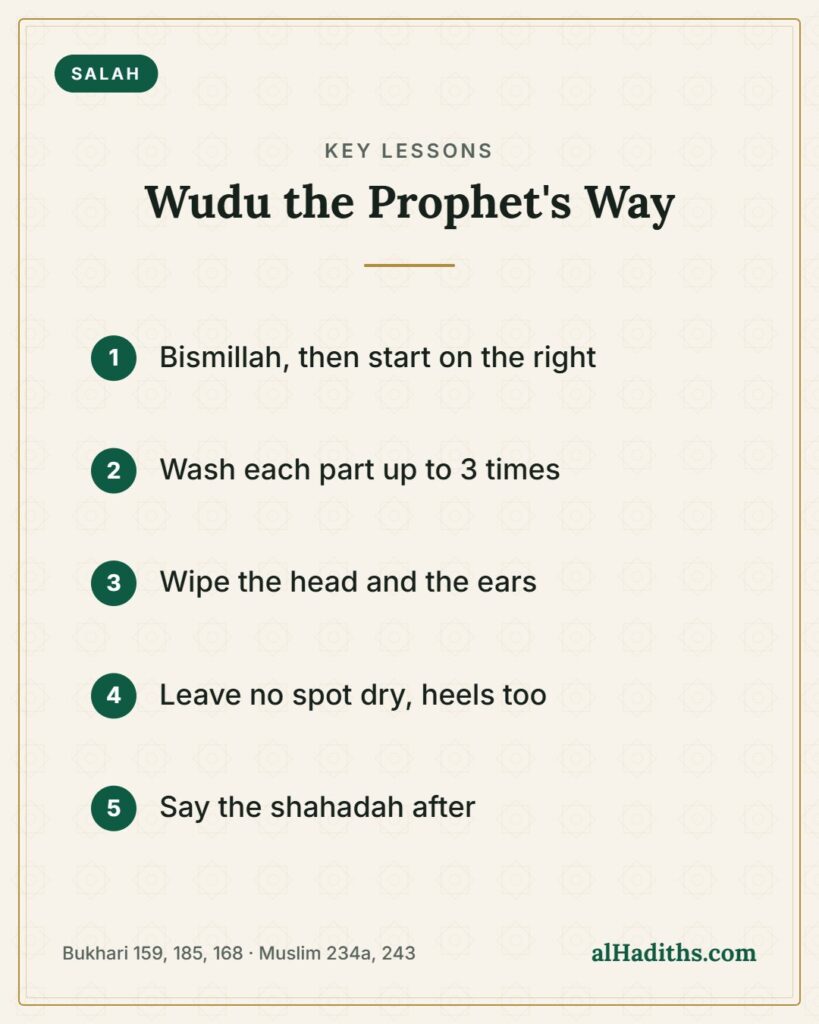
- The Companions taught wudu by showing it, step by step.
- Start with the right arm and the right foot.
- Each part may be washed once, twice or three times, but not more than three.
- No part may be left dry; the heels are the place most often missed.
- The testimony after wudu, from Sahih Muslim, opens the eight gates of Jannah.
Questions people ask
What are the steps of wudu according to the Sunnah?
Wash the hands, rinse the mouth and nose, wash the face, wash the arms to the elbows (right first), wipe the head and ears, then wash the feet to the ankles (right first). This order comes from ‘Uthman and ‘Abdullah ibn Zaid in Sahih al-Bukhari 159 and 185.
What is the dua after wudu?
Sahih Muslim 234a: “Ash-hadu an la ilaha illallah, wa anna Muhammadan ‘abdullahi wa rasuluh”. A longer wording that adds “Allahumma-j’alni minat-tawwabin, waj’alni minal-mutatahhirin” is in Jami` at-Tirmidhi 55, graded Da’if (Darussalam) and Sahih (al-Albani).
How many times should each part be washed in wudu?
Once, twice or three times. The Prophet ﷺ did all three (Bukhari 157, 158 and 159) and said that going beyond three is wrong (Sunan an-Nasa’i 140, Hasan).
Do you have to say Bismillah before wudu?
Sunan Abi Dawud 101 says there is no wudu for one who does not mention Allah’s name, graded Sahih by al-Albani, but scholars differ on its grading and on the ruling. Ask a qualified scholar about your madhhab’s view.
One thing for today: make your next wudu slowly, in the order of ‘Uthman’s hadith, and finish it with the testimony from Sahih Muslim.
Save this to Pinterest so you can follow these steps at your next wudu.
Share the reward. Send this article to someone who needs it today — teaching a hadith or dua can become a lasting good deed for you, in shaa Allah.