When People See Evil and Stay Silent: Abu Bakr on Quran 5:105
“Just look after yourself, and leave everyone else.” It sounds like sensible advice, and some people in the time of the companions thought a verse of the Qur’an said exactly that. Abu Bakr as-Siddiq (may Allah be pleased with him) stood up to correct them, and quoted a warning from the Prophet ﷺ: if the people see evil and do not change it, punishment may come upon them all.
At a glance
- Source: Musnad Ahmad 1 (also Jami’ at-Tirmidhi 2168)
- Narrated by: Abu Bakr as-Siddiq (may Allah be pleased with him)
- Grade: Sahih (Darussalam)
- Topic: Enjoining good, forbidding evil, and reading Quran 5:105 correctly
- Put it into practice: Speak up kindly when you see a wrong you are able to address
The hadith and the verse people misread
Qays ibn Abi Hazim narrated that Abu Bakr stood up, praised Allah, and said: “O people, you recite this verse.” The verse is:
يَـٰٓأَيُّهَا ٱلَّذِينَ ءَامَنُوا۟ عَلَيْكُمْ أَنفُسَكُمْ ۖ لَا يَضُرُّكُم مَّن ضَلَّ إِذَا ٱهْتَدَيْتُمْ ۚ إِلَى ٱللَّهِ مَرْجِعُكُمْ جَمِيعًا فَيُنَبِّئُكُم بِمَا كُنتُمْ تَعْمَلُونَ
“O you who have believed, upon you is [responsibility for] yourselves. Those who have gone astray will not harm you when you have been guided. To Allāh is your return all together; then He will inform you of what you used to do.”
Surah al-Ma’idah 5:105 · Saheeh International translation
Abu Bakr then explained why he had raised it:
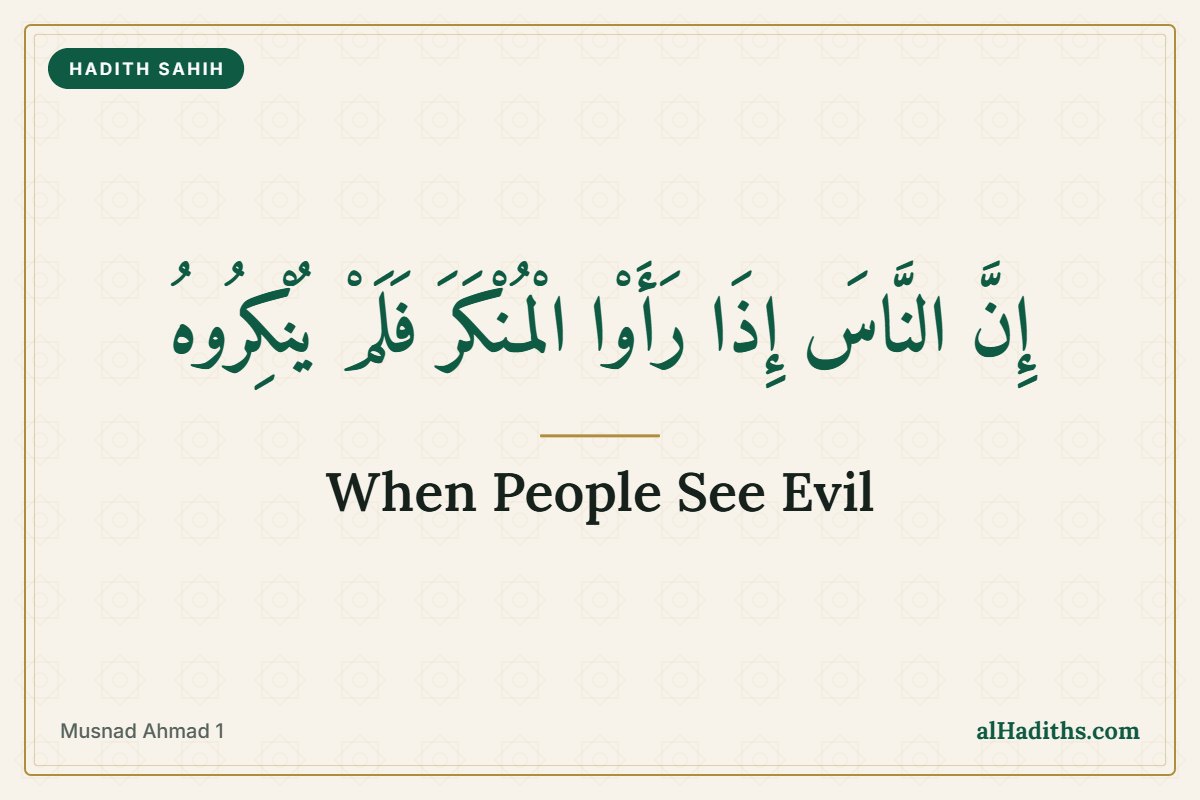
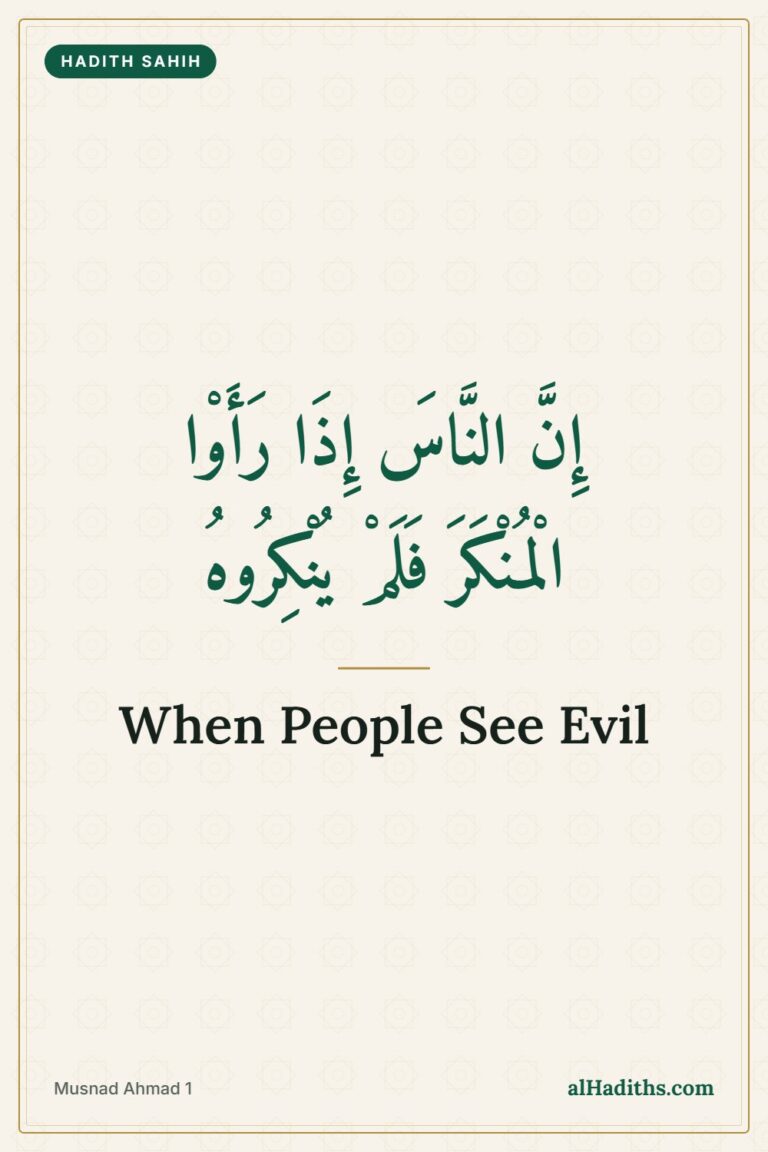
وَإِنَّا سَمِعْنَا رَسُولَ اللَّهِ صَلَّى اللَّهُ عَلَيْهِ وَسَلَّمَ يَقُولُ إِنَّ النَّاسَ إِذَا رَأَوْا الْمُنْكَرَ فَلَمْ يُنْكِرُوهُ أَوْشَكَ أَنْ يَعُمَّهُمْ اللَّهُ بِعِقَابِهِ
“We heard the Messenger of Allah ﷺ say: ‘If the people see evil and do not change it, soon Allah will send His punishment upon them all.'”
Musnad Ahmad 1 · Narrated by Abu Bakr as-Siddiq · Grade: Sahih (Darussalam) · Translation adapted from Sunnah.com
At-Tirmidhi records the same report with the words “when the people see the wrongdoer and they do not take him by the hand”, and he graded it sahih (Jami’ at-Tirmidhi 2168).
What Abu Bakr was correcting
The Encyclopedia of Translated Prophetic Hadiths (HadeethEnc) explains that people understood the verse to mean that a person only needs to reform himself, that others’ misguidance can never harm him, and that he is not required to enjoin good or forbid evil. Abu Bakr told them this was not the true meaning, and quoted the hadith.
HadeethEnc gives the right reading of the verse: keep guarding yourself against sins, and if you do, the misguidance of others will not harm you, when you are not able to enjoin good and forbid evil and you yourself stay guided.
“If they are able to”
This qualification matters. HadeethEnc explains that the punishment covers the wrongdoer and the one who stays silent “despite having the ability” to stop it. Among the benefits it lists:
- Exchanging advice, enjoining good, and forbidding evil are among the Muslims’ duties.
- Teaching people to understand the Qur’an correctly is part of the work.
- Understanding the Book of Allah with care, so it is not taken in a way He did not mean.
How a wrong is changed is explained in another hadith, Hadith 34 of an-Nawawi’s 40: the Prophet ﷺ said whoever sees something abominable should change it with his hand, “and if he has not strength enough to do it, then he should do it with his tongue”, and if not, then hate it in his heart, “and that is the least of faith” (Sahih Muslim 49a). We will cover it fully in its own article.
Changing things “by hand” is not a license for anyone to take the law into their own hands. As in Hadith 8, some matters belong to those in authority. For what you should do in a specific situation, please ask a qualified scholar.
Reflection: silence can feel like the safe, polite option. This hadith reminds us that when we are able to help put something right, silence is not neutral.
How to put it into practice
The hadith does not give a routine, so these are suggestions:
- Start with yourself, as the verse says, but do not stop there.
- Speak up gently when you see a wrong you are able to address, in private where possible.
- Advise sincerely; the religion is sincerity, including toward the people around us.
- Know your limits: some matters are for parents, teachers, employers or the authorities, not for you.
- Read the Qur’an with an explanation from trusted scholars, not just on its surface.
Key lessons
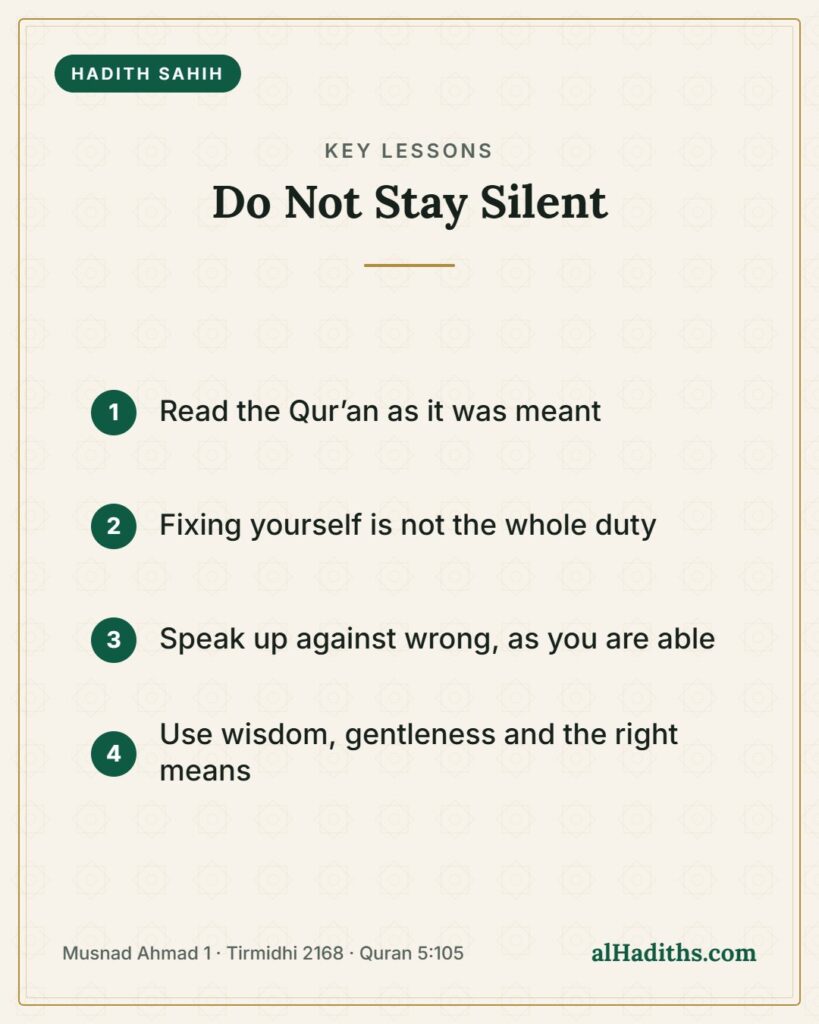
- Quran 5:105 does not mean we can ignore wrongdoing around us.
- When people who are able to stop a wrong stay silent, punishment can reach them all.
- Enjoining good and forbidding evil is part of a Muslim’s duty, as far as one is able.
- Understanding the Qur’an correctly needs care and the explanation of scholars.
Questions people ask
What does Quran 5:105 mean?
Abu Bakr as-Siddiq explained that it does not mean ignoring the wrongdoing of others. Guard yourself against sin, and the misguidance of others will not harm you, while still enjoining good and forbidding evil as you are able (Musnad Ahmad 1; Encyclopedia of Translated Prophetic Hadiths (HadeethEnc)).
What did the Prophet say about people who see evil and do nothing?
He said: “If the people see evil and do not change it, soon Allah will send His punishment upon them all” (Musnad Ahmad 1).
Do I have to stop every wrong I see?
The hadith is about those who are able to change a wrong and stay silent. Another hadith explains changing it by hand, then by tongue, then by hating it in the heart (Sahih Muslim 49a). For specific situations, ask a qualified scholar.
One thing to do today: think of one small wrong you are able to help put right, and address it kindly.
Save this to Pinterest so you can remember Abu Bakr’s lesson on Quran 5:105
Share the reward. Send this article to someone who needs it today — teaching a hadith or dua can become a lasting good deed for you, in shaa Allah.