Sadaqah Jariyah: Meaning, Examples and the Authentic Hadith
Contents
Every one of us will die, and when that day comes our record of deeds closes. Yet the Prophet ﷺ told us of three deeds that keep earning reward after death, and the first of them is sadaqah jariyah: charity that keeps flowing. Here is what sadaqah jariyah means, the authentic hadith behind it, real examples from the Sunnah, and how to give it for a loved one who has passed away.
At a glance
- Main hadith: Sahih Muslim 1631, narrated by Abu Hurairah
- Grade: Sahih (Muslim); supporting hadith Sahih, plus one Hasan (al-Albani)
- Meaning: Ongoing charity whose benefit, and reward, continues after death
- Examples in the Sunnah: A kept-back endowment, a planted tree, water for people, a garden given for a mother
- One thing to do today: Choose one lasting good, however small, and set it going
What is sadaqah jariyah?
Sadaqah means charity, and jariyah means flowing or running, like water in a stream. So sadaqah jariyah is charity that keeps flowing: you give once, and people keep benefiting from it long after you have given. As long as that benefit continues, the reward keeps reaching the giver, even after death.
It is different from a one-off gift that is used up, like a meal for someone hungry. That is still a great charity. Sadaqah jariyah is the kind that stays: a well that people keep drinking from, a tree that keeps giving fruit, or a property whose income keeps going to good causes. Scholars often link it to waqf (endowment), as the examples below show.
The sadaqah jariyah hadith: three deeds that continue
Abu Hurairah (may Allah be pleased with him) narrated that the Messenger of Allah ﷺ said:
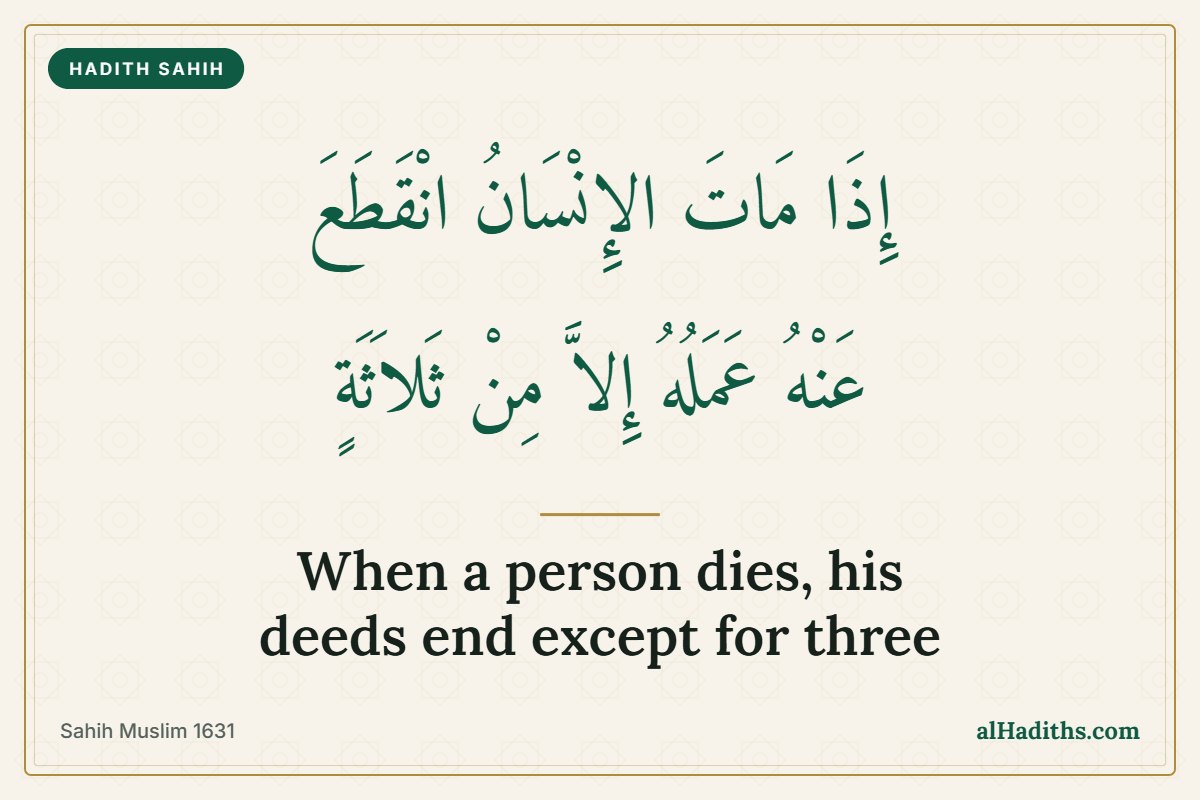
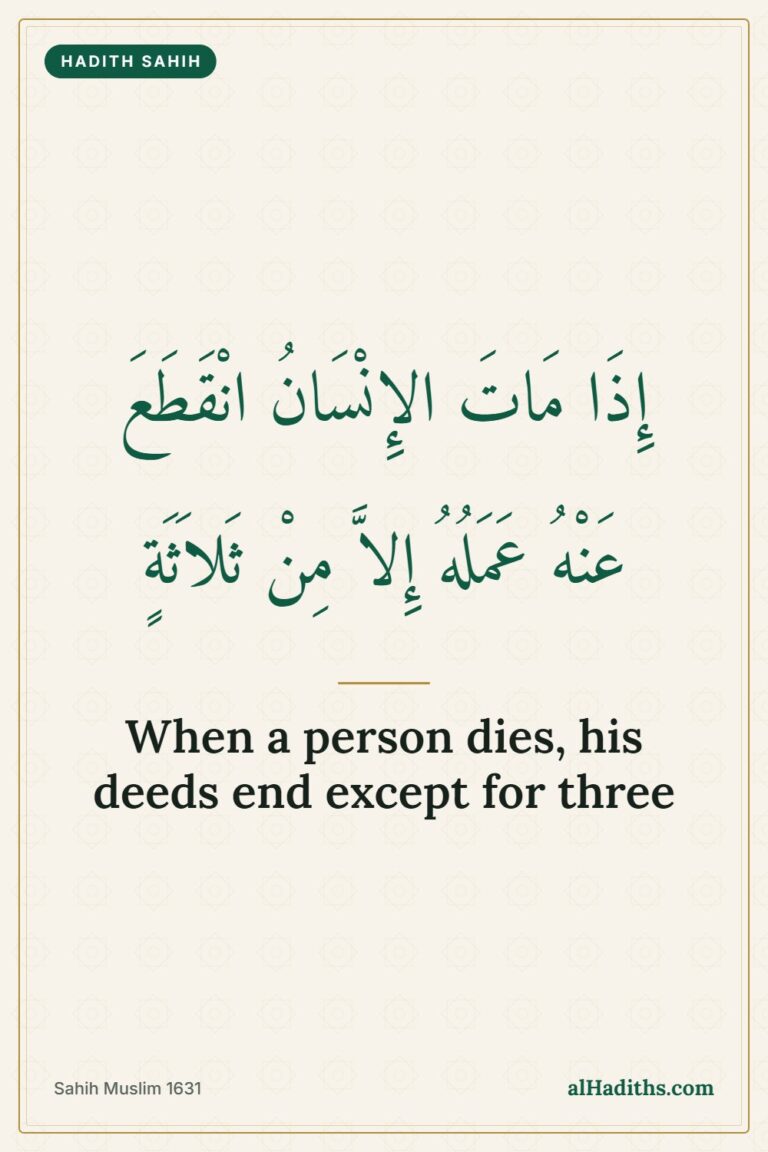
إِذَا مَاتَ الإِنْسَانُ انْقَطَعَ عَنْهُ عَمَلُهُ إِلاَّ مِنْ ثَلاَثَةٍ إِلاَّ مِنْ صَدَقَةٍ جَارِيَةٍ أَوْ عِلْمٍ يُنْتَفَعُ بِهِ أَوْ وَلَدٍ صَالِحٍ يَدْعُو لَهُ
“When a person dies, his deeds come to an end except for three: sadaqah jariyah (ongoing charity), knowledge from which others benefit, or a righteous child who prays for him.”
Sahih Muslim 1631 · Narrated by Abu Hurairah · Translation adapted from Sunnah.com
In its explanation of this hadith, HadeethEnc notes that a person keeps receiving reward after death only for what he set in motion during his life, and gives endowments, mosques and wells as examples of ongoing charity.
Any person who has these three deeds to accompany them on the journey to the afterlife is a lucky person indeed. Not everyone will be able to achieve all of them, but then again it is not an impossible task.
Sadaqah jariyah examples from the Sunnah
The hadith does not list every form sadaqah jariyah can take, but the Sunnah gives clear examples. Here are four, each from an authentic narration.
1. ‘Umar’s land at Khaybar: keep the asset, give its benefit
Ibn ‘Umar (may Allah be pleased with him) narrated what his father did with the most valuable land he ever owned:
أَصَابَ عُمَرُ أَرْضًا بِخَيْبَرَ فَأَتَى النَّبِيَّ صلى الله عليه وسلم يَسْتَأْمِرُهُ فِيهَا فَقَالَ يَا رَسُولَ اللَّهِ إِنِّي أَصَبْتُ أَرْضًا بِخَيْبَرَ لَمْ أُصِبْ مَالاً قَطُّ هُوَ أَنْفَسُ عِنْدِي مِنْهُ فَمَا تَأْمُرُنِي بِهِ قَالَ إِنْ شِئْتَ حَبَسْتَ أَصْلَهَا وَتَصَدَّقْتَ بِهَا. قَالَ فَتَصَدَّقَ بِهَا عُمَرُ أَنَّهُ لاَ يُبَاعُ أَصْلُهَا وَلاَ يُبْتَاعُ وَلاَ يُورَثُ وَلاَ يُوهَبُ
‘Umar acquired land at Khaybar. He came to the Prophet ﷺ to ask his advice about it and said: “Messenger of Allah, I have acquired land in Khaybar. I have never acquired property more valuable to me than this, so what do you command me to do with it?” He said: “If you like, you may keep the land itself and give its produce as sadaqah.” So ‘Umar gave it as sadaqah on the condition that the land itself must not be sold, bought, inherited or given away as a gift.
Sahih Muslim 1632a · Narrated by Ibn ‘Umar · Translation adapted from Sunnah.com
The land stayed, and only its produce was given away, year after year. That is the idea behind waqf, and the heart of sadaqah jariyah.
Try this: if you own something that earns, even a small rental or savings, think about setting aside part of its income for a lasting good cause.
2. A tree or a crop that others eat from
Anas ibn Malik (may Allah be pleased with him) narrated that the Messenger of Allah ﷺ said:
مَا مِنْ مُسْلِمٍ يَغْرِسُ غَرْسًا، أَوْ يَزْرَعُ زَرْعًا، فَيَأْكُلُ مِنْهُ طَيْرٌ أَوْ إِنْسَانٌ أَوْ بَهِيمَةٌ، إِلاَّ كَانَ لَهُ بِهِ صَدَقَةٌ
“There is none amongst the Muslims who plants a tree or sows seeds, and then a bird, or a person or an animal eats from it, but it is regarded as a charitable gift for him.”
Sahih al-Bukhari 2320 · Narrated by Anas ibn Malik · Translation adapted from Sunnah.com
Sadaqah jariyah does not have to be big. A fruit tree in your garden, or one planted through a tree-planting project, keeps feeding birds, animals and people for years.
Try this: plant one fruit tree, or give to a project that plants them where people need food and shade.
3. Water for people: Sa‘d’s well for his mother
Sa‘d ibn ‘Ubadah (may Allah be pleased with him) asked the Prophet ﷺ what charity to give after his mother died:
يَا رَسُولَ اللَّهِ إِنَّ أُمَّ سَعْدٍ مَاتَتْ فَأَىُّ الصَّدَقَةِ أَفْضَلُ قَالَ الْمَاءُ. قَالَ فَحَفَرَ بِئْرًا وَقَالَ هَذِهِ لأُمِّ سَعْدٍ
“Messenger of Allah, Umm Sa‘d has died; what form of sadaqah is best?” He replied: “Water.” So he dug a well and said: “This is for Umm Sa‘d.”
Sunan Abi Dawud 1681 · Hasan (al-Albani) · Narrated by Sa‘d ibn ‘Ubadah · Translation adapted from Sunnah.com
This is why so many people choose water wells as sadaqah jariyah. Clean water keeps people alive, and every drink from a working well is benefit that continues.
Note on its grading: Sunnah.com shows al-Albani’s grade of Hasan for this narration, but its chain includes an unnamed man, and a similar wording in Sunan an-Nasa’i 3664 is graded Da’if (Darussalam). The general point, that charity can be given for a mother who has died, is confirmed in Sahih al-Bukhari (below).
4. Guiding someone to good
Abu Mas‘ud al-Ansari (may Allah be pleased with him) narrated that a man asked for help, and another offered to point him to someone who could help. The Messenger of Allah ﷺ said:
مَنْ دَلَّ عَلَى خَيْرٍ فَلَهُ مِثْلُ أَجْرِ فَاعِلِهِ
“One who guides to something good has a reward similar to that of its doer.”
Sahih Muslim 1893a · Narrated by Abu Mas‘ud al-Ansari · Translation adapted from Sunnah.com
Teaching a dua, sharing an authentic hadith, or pointing someone to a good cause can keep earning reward each time it is acted on. This ties sadaqah jariyah to the second deed in the hadith: knowledge that benefits.
Allah describes how He multiplies what we spend in His way:
مَّثَلُ ٱلَّذِينَ يُنفِقُونَ أَمْوَٰلَهُمْ فِى سَبِيلِ ٱللَّهِ كَمَثَلِ حَبَّةٍ أَنۢبَتَتْ سَبْعَ سَنَابِلَ فِى كُلِّ سُنۢبُلَةٍ مِّا۟ئَةُ حَبَّةٍ ۗ وَٱللَّهُ يُضَـٰعِفُ لِمَن يَشَآءُ ۗ وَٱللَّهُ وَٰسِعٌ عَلِيمٌ
“The example of those who spend their wealth in the way of Allāh is like a seed [of grain] which grows seven spikes; in each spike is a hundred grains. And Allāh multiplies [His reward] for whom He wills. And Allāh is all-Encompassing and Knowing.”
Surah al-Baqarah 2:261 · Translation: Saheeh International, from Quran.com
Sadaqah jariyah for the deceased
Can you give sadaqah jariyah for a parent who has already died? The authentic Sunnah says yes. Ibn ‘Abbas (may Allah be pleased with him) narrated that Sa‘d ibn ‘Ubadah’s mother died while he was away, and he said:
يَا رَسُولَ اللَّهِ إِنَّ أُمِّي تُوُفِّيَتْ وَأَنَا غَائِبٌ عَنْهَا، أَيَنْفَعُهَا شَىْءٌ إِنْ تَصَدَّقْتُ بِهِ عَنْهَا قَالَ نَعَمْ. قَالَ فَإِنِّي أُشْهِدُكَ أَنَّ حَائِطِي الْمِخْرَافَ صَدَقَةٌ عَلَيْهَا
“O Allah’s Messenger! My mother died in my absence; will it be of any benefit for her if I give sadaqah on her behalf?” The Prophet ﷺ said, “Yes.” Sa‘d said, “I make you a witness that I give my garden called al-Mikhraf in charity on her behalf.”
Sahih al-Bukhari 2756 · Narrated by Ibn ‘Abbas · Translation adapted from Sunnah.com
Sa‘d did not give a small amount. He gave a whole garden, something that keeps producing, for his mother. You can do the same at any size: a share in a well, a mosque, a school or a tree project, with the intention that its reward goes to your parent. For more on this, read Giving Sadaqah on Behalf of the Deceased. For detailed rulings, ask a qualified scholar near you.
alHadiths.com is itself my sadaqah jariyah for my late mother and my family. Every reader who learns an authentic hadith here and acts on it is, in shaa Allah, part of that.
Knowledge that others benefit from
You do not have to be a professional educator to spread knowledge. Teach what you know, especially about the Deen, and when the person you taught practises it, the reward is attached to you in this life and beyond. Teach your family and teach your friends.
Allah also promises to raise in rank those who believe and those who have knowledge:
يَـٰٓأَيُّهَا ٱلَّذِينَ ءَامَنُوٓا۟ إِذَا قِيلَ لَكُمْ تَفَسَّحُوا۟ فِى ٱلْمَجَـٰلِسِ فَٱفْسَحُوا۟ يَفْسَحِ ٱللَّهُ لَكُمْ ۖ وَإِذَا قِيلَ ٱنشُزُوا۟ فَٱنشُزُوا۟ يَرْفَعِ ٱللَّهُ ٱلَّذِينَ ءَامَنُوا۟ مِنكُمْ وَٱلَّذِينَ أُوتُوا۟ ٱلْعِلْمَ دَرَجَـٰتٍ ۚ وَٱللَّهُ بِمَا تَعْمَلُونَ خَبِيرٌ
“O you who have believed, when you are told, Space yourselves in assemblies, then make space; Allāh will make space for you. And when you are told, Arise, then arise; Allāh will raise those who have believed among you and those who were given knowledge, by degrees. And Allāh is Aware of what you do.”
Surah al-Mujadilah 58:11 · Translation: Saheeh International, from Quran.com
A righteous child who makes dua for you
Last but not least, in my opinion the hardest of the lot is the third: having a righteous child who makes dua for us. This needs good upbringing, understanding and nurturing from the parents.
Prophet Ibrahim (peace be upon him) asked Allah for righteous offspring, and we can make the same dua:
رَبِّ هَبْ لِى مِنَ ٱلصَّـٰلِحِينَ
“My Lord, grant me [a child] from among the righteous.”
Surah as-Saffat 37:100 · Translation: Saheeh International, from Quran.com
As a father of three boys, I lack all sorts of things, and I feel many of us fathers have the same feelings too. I do hope that I somehow succeed in raising sons who will supplicate for me when I am gone. The trials of the grave are real, and I want no part of them, as I am sure you don’t either.
This also works the other way round. If your parents have passed away, you can be that righteous child for them today. Allah teaches us this dua for our parents:
وَٱخْفِضْ لَهُمَا جَنَاحَ ٱلذُّلِّ مِنَ ٱلرَّحْمَةِ وَقُل رَّبِّ ٱرْحَمْهُمَا كَمَا رَبَّيَانِى صَغِيرًا
“And lower to them the wing of humility out of mercy and say, My Lord, have mercy upon them as they brought me up [when I was] small.”
Surah al-Isra 17:24 · Translation: Saheeh International, from Quran.com
How to start your sadaqah jariyah today
- Pick one ongoing charity this month, such as a well, a mosque, a school or a tree-planting project, and give what you can.
- Plant a fruit tree, or give to a project that plants them (Sahih al-Bukhari 2320).
- Teach one thing you know well, even a short dua, to your child, spouse or a friend.
- Make dua for your parents by name after your prayers, whether they are alive or have passed away.
- Remember that charity does not decrease wealth (Sahih Muslim 2588), so give without fear.
Questions people ask
What is sadaqah jariyah?
Sadaqah jariyah is ongoing charity: a gift whose benefit continues, so its reward keeps reaching the giver even after death. It is the first of the three deeds in Sahih Muslim 1631.
What are examples of sadaqah jariyah?
From the Sunnah: an endowment where the asset is kept and its produce given away, as ‘Umar did (Sahih Muslim 1632a), a planted tree that others eat from (Sahih al-Bukhari 2320), and water for people. Wells, mosques, schools and copies of the Quran are common choices today.
Can I give sadaqah jariyah for a deceased parent?
Yes. Sa‘d ibn ‘Ubadah asked whether charity for his late mother would benefit her, the Prophet ﷺ said yes, and Sa‘d gave his garden for her (Sahih al-Bukhari 2756).
What is the best sadaqah jariyah?
In Sunan Abi Dawud 1681 (Hasan, al-Albani) the Prophet ﷺ named water as the best charity for Sa‘d’s mother, though a similar narration in an-Nasa’i is graded Da’if (Darussalam). Any lasting good you can keep going is a strong choice.
Is the hadith listing seven deeds that reach a believer after death authentic?
That list (a mosque, a house for travelers, a canal, a copy of the Quran and more) is in Sunan Ibn Majah 242, graded Da’if (Darussalam), so we don’t use it as evidence here. The authentic hadith above already cover the same idea.
Key lessons
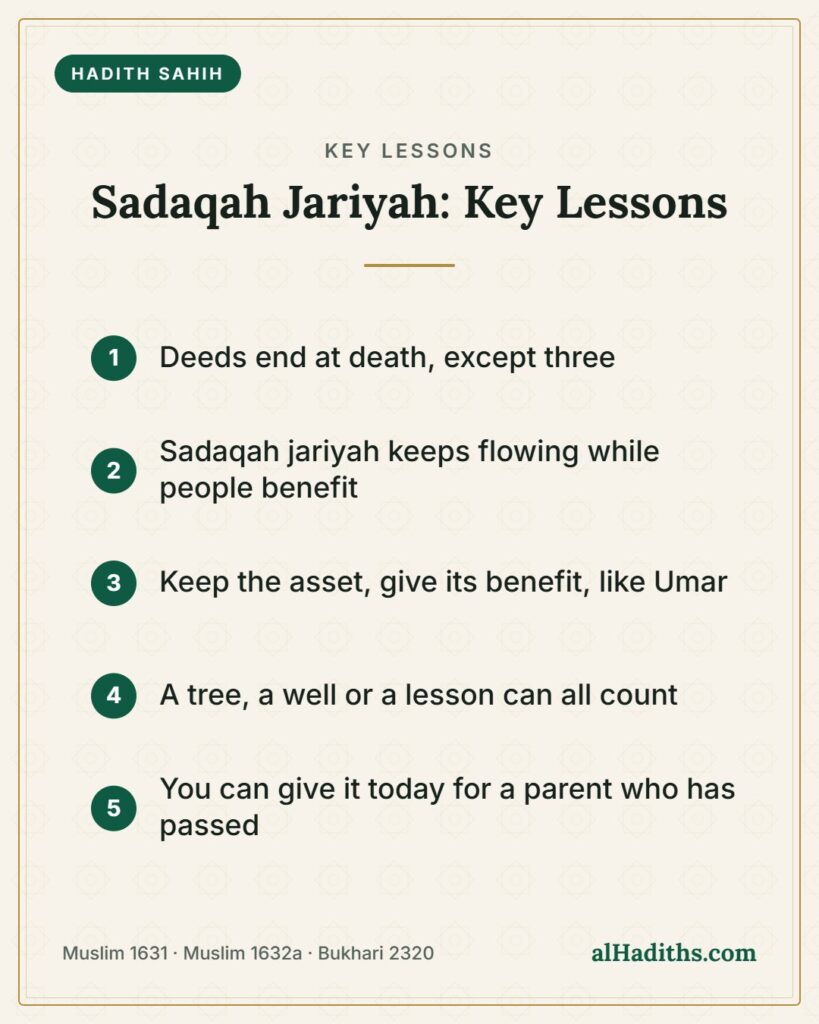
- Our deeds end at death, except three (Muslim 1631).
- Sadaqah jariyah keeps rewarding as long as people benefit from it.
- Keeping the asset and giving its benefit is the model ‘Umar followed (Muslim 1632a).
- Small things count too: a tree that others eat from is charity (Bukhari 2320).
- We can give sadaqah jariyah for parents who have passed away (Bukhari 2756).
The road to heaven is paved with thorns, whilst the road to hell is paved with leisure. Choose wisely, and let’s keep building our good deeds with these three, in the hope that if not all three, at least one of them brings us success in the afterlife.
Save this to Pinterest so you can pick one sadaqah jariyah to start this week
Share the reward. Send this article to someone who needs it today — teaching a hadith or dua can become a lasting good deed for you, in shaa Allah.