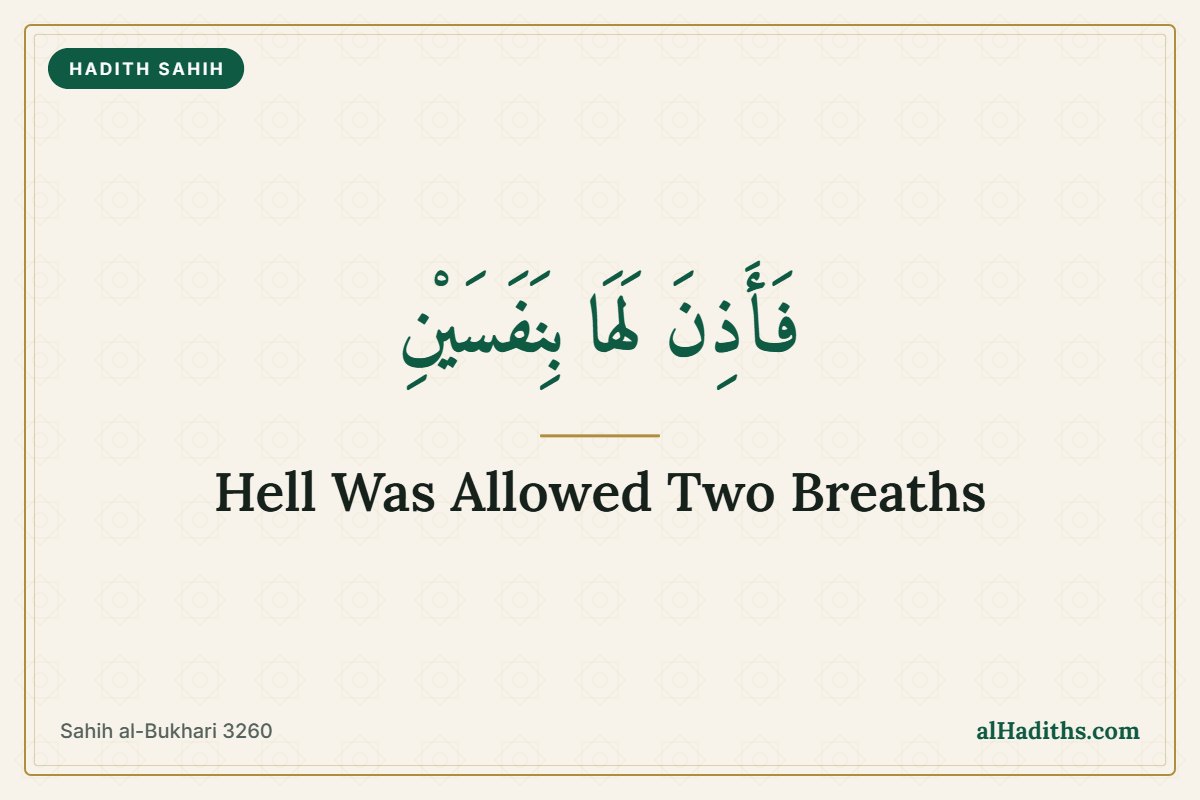
Hellfire Breathing Hadith: Two Breaths, Summer and Winter
On the hottest afternoon of the year, or on a morning so cold it hurts to breathe, the Prophet ﷺ gave us something to think about. In an authentic hadith he said the Fire complained to its Lord and was allowed two breaths, one in winter and one in summer. This is the hellfire breathing hadith. Here we look at its wording in Sahih al-Bukhari, how scholars have understood it, what it teaches about prayer in the heat, and the hope that comes with it.
At a glance
- Source: Sahih al-Bukhari 3260, also in Sahih Muslim 617a
- Narrated by: Abu Hurairah
- Grade: Sahih (al-Bukhari and Muslim)
- Topic: The two breaths of Hellfire (Jahannam)
- Practise it: Let the hottest and coldest days remind you to seek refuge in Allah from the Fire
The hadith: the Fire was allowed two breaths
Abu Hurairah (may Allah be pleased with him) reported that the Messenger of Allah ﷺ said:
اشْتَكَتِ النَّارُ إِلَى رَبِّهَا، فَقَالَتْ رَبِّ أَكَلَ بَعْضِي بَعْضًا، فَأَذِنَ لَهَا بِنَفَسَيْنِ نَفَسٍ فِي الشِّتَاءِ وَنَفَسٍ فِي الصَّيْفِ، فَأَشَدُّ مَا تَجِدُونَ فِي الْحَرِّ، وَأَشَدُّ مَا تَجِدُونَ مِنَ الزَّمْهَرِيرِ
“The (Hell) Fire complained to its Lord saying, ‘O my Lord! My different parts eat up each other.’ So He allowed it to take two breaths, one in the winter and the other in summer, and this is the reason for the severe heat and the bitter cold you find (in weather).”
Sahih al-Bukhari 3260 · Narrated by Abu Hurairah · Translation adapted from Sunnah.com
Imam Muslim records the same words (Sahih Muslim 617a). The Arabic word for the bitter cold is zamharir, and we will meet it again below, in a verse about Paradise.
Take heed: a Fire so vast that its own parts consume one another is not something to treat lightly. The heat we complain about in summer is described here as only a breath of it.
The same hadith, and praying in the heat
In another narration from Abu Hurairah and ‘Abdullah ibn ‘Umar (may Allah be pleased with them), the Prophet ﷺ connected this to the time of prayer:
إِذَا اشْتَدَّ الْحَرُّ فَأَبْرِدُوا عَنِ الصَّلاَةِ، فَإِنَّ شِدَّةَ الْحَرِّ مِنْ فَيْحِ جَهَنَّمَ
“If it is very hot, then pray the Zuhr prayer when it becomes (a bit) cooler, as the severity of the heat is from the raging of the Hell-fire.”
Sahih al-Bukhari 533 · Narrated by Abu Hurairah and ‘Abdullah ibn ‘Umar · Translation from Sunnah.com
Muslim has it too (Sahih Muslim 615a), and in Sahih al-Bukhari 536 both parts come together in one narration. HadithAnswers explains that the purpose of delaying Zuhr was to let more people attend the congregational prayer in cooler conditions. How and when to apply this today is a question for a qualified local scholar.
Take heed: the Prophet ﷺ did not only tell us about the heat of Jahannam. He let it shape our daily prayer, so that a hot afternoon becomes a reminder five times a week.
Is it literal? How scholars understood it
People often ask how heat and cold can come from Hell when we know seasons follow the earth’s tilt and its path around the sun. Scholars have discussed this hadith for centuries:
- Most read it literally. SeekersGuidance (Shaykh Shuaib Ally) names Qadi ‘Iyad, an-Nawawi, Ibn ‘Abd al-Barr and al-Qurtubi among them, since nothing requires a figurative reading, and leaves how the Fire affects the weather to the unseen.
- Some, such as al-Baydawi, read it figuratively: extreme heat and cold are reminders of the Fire that should turn people away from sin.
- HadithAnswers notes that many hadith scholars took the complaint as real speech, since nothing is beyond Allah’s power, citing Fath al-Bari, ‘Umdat al-Qari and Fath al-Mulhim.
Knowing the physical causes of the seasons does not cancel what lies behind them in the unseen. Either way, the lesson is the same: the heat and cold we feel are a reminder of the Fire.
At-Tirmidhi narrates a wording that names the two breaths: zamharir (freezing cold) in winter and samum (scorching heat) in summer (Jami‘ at-Tirmidhi 2592, graded Sahih by Darussalam). At-Tirmidhi himself notes that one narrator in that chain is not strong, but that the hadith comes through other routes, so we mention it without an Arabic card.
No coolness in Hell
The Quran describes the people of the Fire with words that make our worst summer feel mild:
لَّا يَذُوقُونَ فِيهَا بَرْدًا وَلَا شَرَابًا
“They will not taste therein [any] coolness or drink.”
Surah An-Naba’ 78:24 · Translation: Saheeh International, from Quran.com
إِلَّا حَمِيمًا وَغَسَّاقًا
“Except scalding water and [foul] purulence -”
Surah An-Naba’ 78:25 · Translation: Saheeh International, from Quran.com
Take heed: in this world, when the heat is too much, we find shade, water or a fan. The verse tells us there is none of that in Jahannam.
Hope: no burning sun and no freezing cold
Allah describes the people of Paradise with the very word used in the hadith for the bitter cold:
مُّتَّكِـِٔينَ فِيهَا عَلَى ٱلْأَرَآئِكِ ۖ لَا يَرَوْنَ فِيهَا شَمْسًا وَلَا زَمْهَرِيرًا
“[They will be] reclining therein on adorned couches. They will not see therein any [burning] sun or [freezing] cold.”
Surah Al-Insan 76:13 · Translation: Saheeh International, from Quran.com
In Tafsir Ibn Kathir, this is explained as Paradise having neither painful heat nor painful cold. And the way there is close. Anas ibn Malik (may Allah be pleased with him) reported that the Messenger of Allah ﷺ said:
مَنْ سَأَلَ اللَّهَ الْجَنَّةَ ثَلاَثَ مَرَّاتٍ قَالَتِ الْجَنَّةُ اللَّهُمَّ أَدْخِلْهُ الْجَنَّةَ وَمَنِ اسْتَجَارَ مِنَ النَّارِ ثَلاَثَ مَرَّاتٍ قَالَتِ النَّارُ اللَّهُمَّ أَجِرْهُ مِنَ النَّارِ
“Whoever asks Allah for Paradise three times, Paradise will say: ‘O Allah, admit him to Paradise.’ And whoever seeks protection from Hell three times, Hell will say: ‘O Allah, protect him from the Fire.’”
Sunan an-Nasa’i 5521 · Sahih (Darussalam) · Narrated by Anas ibn Malik · Translation adapted from Sunnah.com
The same hadith is in Jami‘ at-Tirmidhi 2572 and Sunan Ibn Majah 4340, both graded Sahih by Darussalam. The Fire that complained to its Lord also speaks for the one who sincerely seeks refuge from it.
How to practise it
- Ask Allah for Paradise and seek refuge from the Fire three times, as in the hadith above. It does not set a time, so you might make it part of your morning or evening.
- On a very hot day, recall “the severity of the heat is from the raging of Jahannam” instead of only complaining about the weather.
- On a cold morning, remember the zamharir, and that Paradise has none of it (Quran 76:13).
- Seek refuge from the punishment of Hell in every salah with the dua after the tashahhud.
- For questions on when to pray Zuhr in extreme heat where you live, ask a qualified local scholar.
Reflection: weather is the one thing everyone talks about. This hadith turns that small talk into remembrance. The summer that makes us sweat and the winter that makes us shiver are both, in the words of the Prophet ﷺ, a breath of something we must never reach.
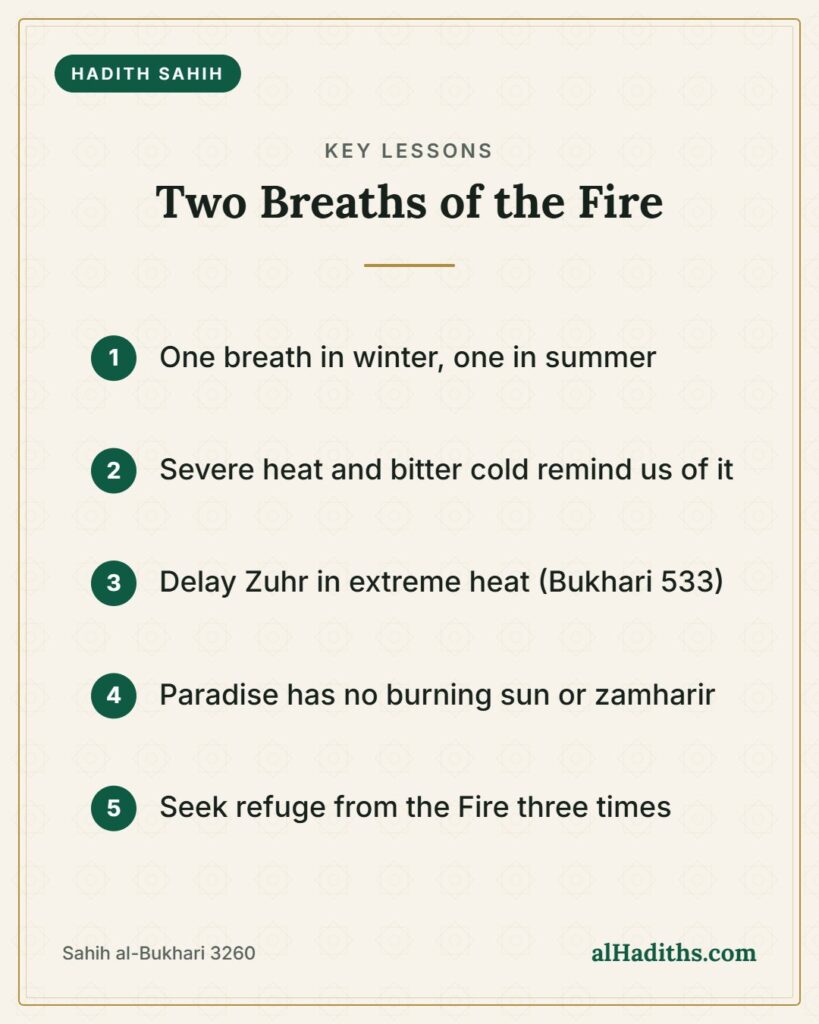
Key lessons
- The Fire complained to its Lord and was allowed two breaths, one in winter and one in summer (Bukhari 3260, Muslim 617a).
- The most severe heat and the bitter cold we feel are linked to those breaths.
- The Prophet ﷺ told us to delay Zuhr in extreme heat, because that heat is from the raging of Jahannam (Bukhari 533).
- Most scholars read the hadith literally; some read it figuratively. Both see it as a reminder.
- Whoever seeks refuge from the Fire three times, the Fire asks Allah to protect him (Nasa’i 5521).
Questions people ask
What is the hadith about Hellfire breathing?
In Sahih al-Bukhari 3260 and Sahih Muslim 617a, the Prophet ﷺ said the Fire complained to its Lord that its parts were consuming one another, so it was allowed two breaths, one in winter and one in summer. That is the most severe heat and the bitter cold we feel.
Is the hadith of Hell’s two breaths literal?
Most scholars, including Qadi ‘Iyad, an-Nawawi, Ibn ‘Abd al-Barr and al-Qurtubi, read it literally and leave how it works to the unseen. Some, such as al-Baydawi, read it figuratively as a reminder. Both views agree on its lesson.
What does the hadith say about praying in hot weather?
In Sahih al-Bukhari 533, the Prophet ﷺ said that when it is very hot, Zuhr should be prayed when it becomes a bit cooler, because the severity of the heat is from the raging of Jahannam. Ask a qualified local scholar how this applies where you live.
A question to reflect on: the next time you complain about the heat or the cold, will it also bring you to seek refuge in Allah from the Fire, three times, and ask Him for a Paradise with neither?
Save this to Pinterest so you can remember it on the hottest and coldest days
Share the reward. Send this article to someone who needs it today — teaching a hadith or dua can become a lasting good deed for you, in shaa Allah.