Whoever Sees an Evil, Let Him Change It: Hadith 34 of an-Nawawi
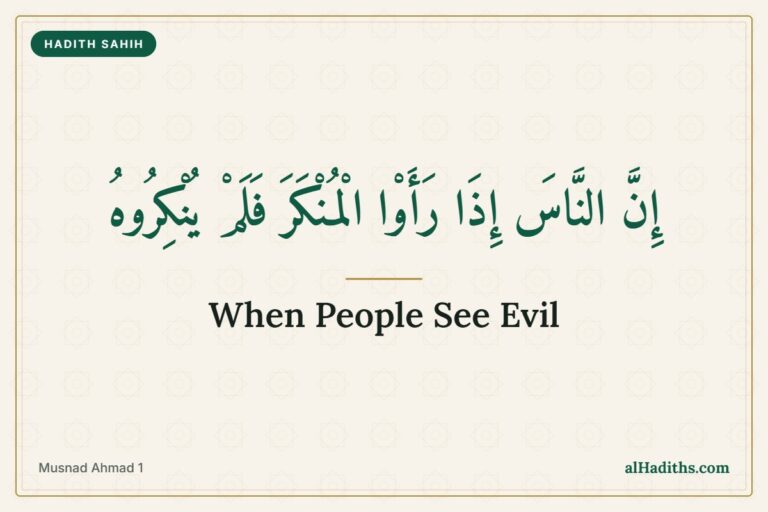
Most of us have seen something wrong and stayed quiet, unsure whether it was our place to say anything. This is Hadith 34 of Imam an-Nawawi’s collection, the whoever sees an evil hadith. In one sentence, the Prophet ﷺ gives every believer three levels for responding to wrong: the hand, the tongue and the heart.
At a glance
- Source: Sahih Muslim 49a; also Hadith 34 of an-Nawawi’s 40
- Narrated by: Abu Sa’id al-Khudri (may Allah be pleased with him)
- Grade: Sahih (Muslim)
- Topic: Changing wrong by hand, then tongue, then heart, as far as one is able
- Put it into practice: Today, never make peace with a wrong in your heart, even when you cannot do more
The hadith
Abu Sa’id al-Khudri (may Allah be pleased with him) said: I heard the Messenger of Allah ﷺ say:
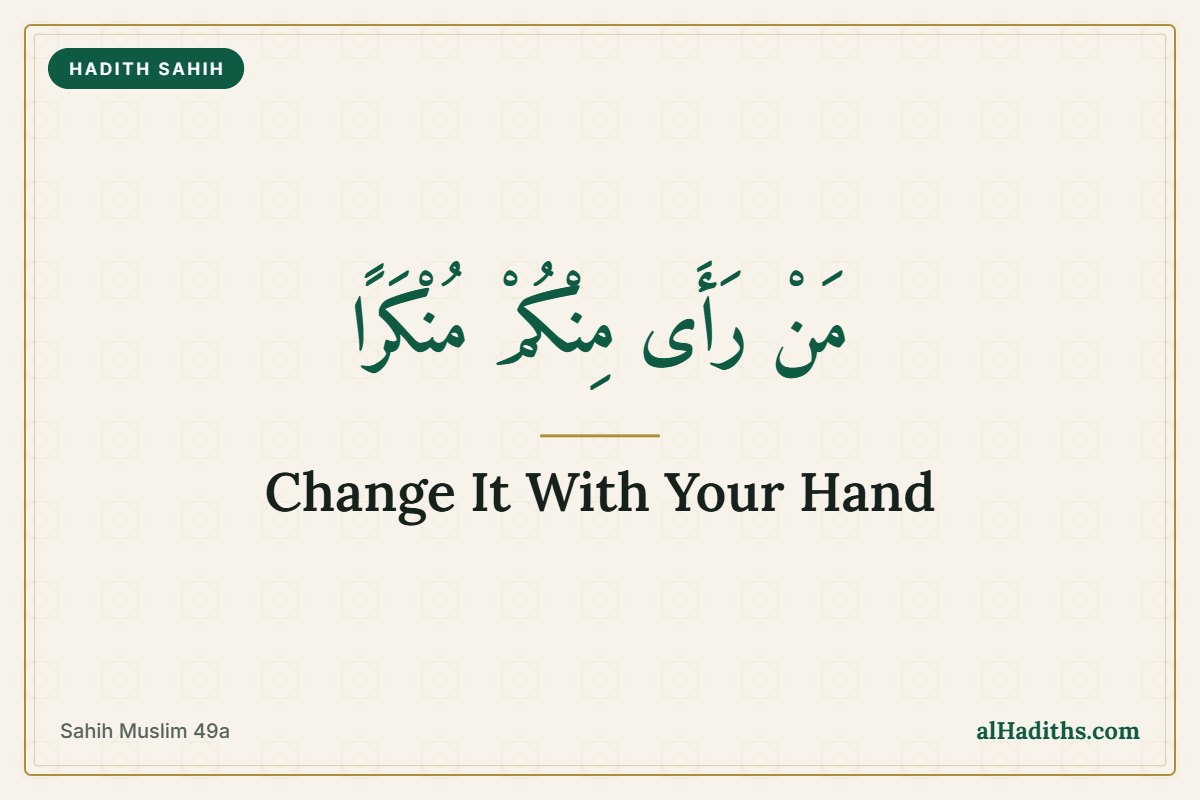
مَنْ رَأَى مِنْكُمْ مُنْكَرًا فَلْيُغَيِّرْهُ بِيَدِهِ فَإِنْ لَمْ يَسْتَطِعْ فَبِلِسَانِهِ فَإِنْ لَمْ يَسْتَطِعْ فَبِقَلْبِهِ وَذَلِكَ أَضْعَفُ الإِيمَانِ
“He who amongst you sees something abominable should modify it with the help of his hand; and if he has not strength enough to do it, then he should do it with his tongue, and if he has not strength enough to do it, (even) then he should (abhor it) from his heart, and that is the least of faith.”
Sahih Muslim 49a · Narrated by Abu Sa’id al-Khudri · Translation from Sunnah.com
Context: a man who spoke up at Eid
The same narration in Sahih Muslim 49a tells us when Abu Sa’id shared this hadith. Tariq ibn Shihab reported that Marwan was the first to give the Eid khutbah before the prayer, and a man stood up to object:
فَقَامَ إِلَيْهِ رَجُلٌ فَقَالَ الصَّلاَةُ قَبْلَ الْخُطْبَةِ
“A man stood up and said: Prayer should precede khutbah.”
Sahih Muslim 49a · Narrated by Tariq ibn Shihab · Translation from Sunnah.com
Marwan replied that the old practice had been left. Abu Sa’id then said that this man had done the duty laid on him, and quoted the hadith. The man had no power to stop the change by hand, but he used his tongue, openly and to the person in charge.
What the whoever sees an evil hadith means
Based on the explanation in HadeethEnc:
- What counts as evil. Everything that Allah and His Messenger ﷺ have forbidden.
- The hand. If a person has the ability to change the wrong directly, he should do so.
- The tongue. If he cannot, he speaks: he tells the one doing it to stop, shows him the harm in it, and guides him to something good in its place.
- The heart. If he cannot even speak, he dislikes the wrong in his heart and intends to change it once he is able. This is the lowest level, and not disliking evil at all is a sign of weak faith.
HadeethEnc adds some important conditions. Each person acts according to his ability, so the duty never falls away completely; at the very least it stays in the heart. A person must know that the thing really is wrong before he forbids it. Changing a wrong must not lead to a greater wrong. And forbidding evil has its own manners, and needs knowledge, insight and wisdom.
Allah describes this work as a mark of the successful:
وَلْتَكُن مِّنكُمْ أُمَّةٌ يَدْعُونَ إِلَى ٱلْخَيْرِ وَيَأْمُرُونَ بِٱلْمَعْرُوفِ وَيَنْهَوْنَ عَنِ ٱلْمُنكَرِ ۚ وَأُو۟لَـٰٓئِكَ هُمُ ٱلْمُفْلِحُونَ
“And let there be [arising] from you a nation inviting to [all that is] good, enjoining what is right and forbidding what is wrong, and those will be the successful.”
Surah Ali ‘Imran 3:104 · Translation: Saheeh International, from Quran.com
Reflection: most of us will rarely be in a position to change a wrong with our hands. The man at the Eid prayer was not either. What he had was a few honest words, said at the right moment, and that was enough to fulfil his duty. And when even words are not possible, the heart still has work to do: to keep seeing wrong as wrong, and never let it become normal to us.
How to put it into practice
The hadith does not give a list of situations, so these are suggestions, not rulings:
- Start where you have authority. In your own home and your own work, you are often the one who is able to change things by hand.
- Be sure before you speak. Know that something is really wrong, and do not accuse anyone without proof; see the burden of proof is on the claimant.
- Speak gently and sincerely, in private where you can. Advice is part of the religion is sincerity.
- Weigh the outcome. If speaking up would cause a greater harm, hold back and keep it in your heart; do as much as you can.
- Guard your heart. Even when you can do nothing else, do not let a wrong start to look normal to you.
For what to do in a specific situation, please ask a qualified local scholar.
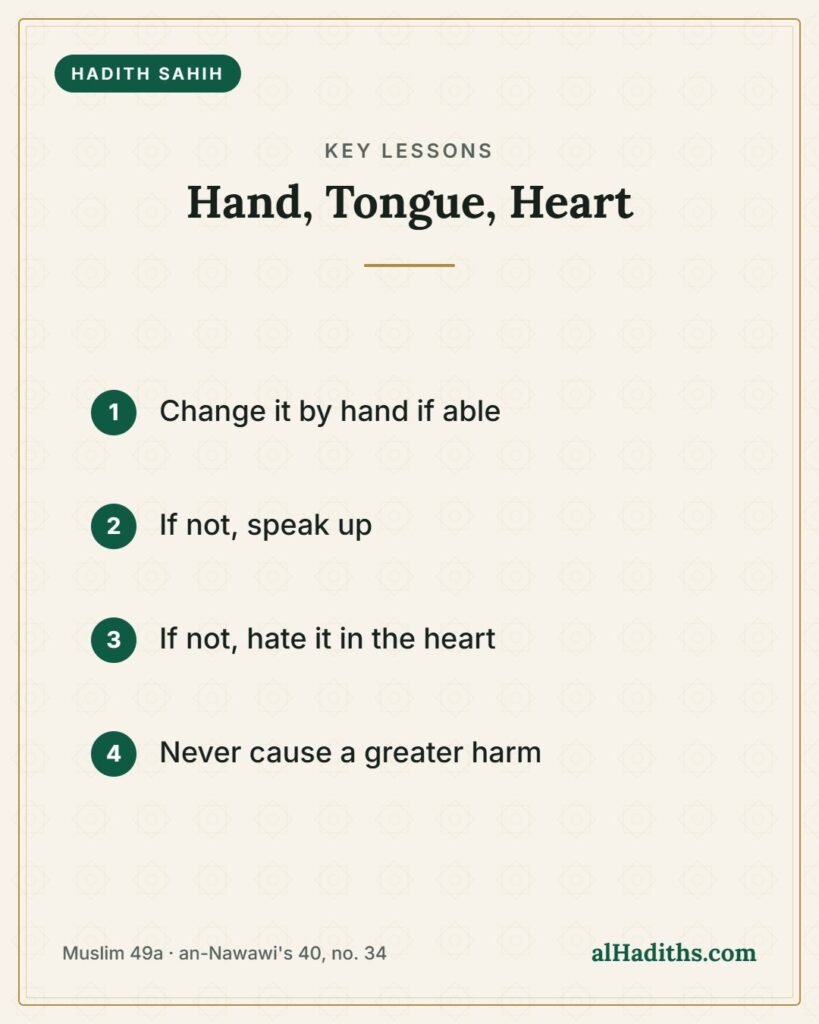
Key lessons
- Change a wrong by hand if you are able.
- If not, speak up against it.
- If not, dislike it in your heart; that is the weakest of faith.
- Know it is wrong first, and do not cause a greater harm.
Questions people ask
What does changing evil with the hand, tongue and heart mean?
The hand means changing the wrong directly when you have the ability. The tongue means telling the person to stop and guiding him to something better. The heart means disliking the wrong and intending to change it when you can (HadeethEnc).
Is this hadith authentic?
Yes. It is in Sahih Muslim 49a, narrated by Abu Sa’id al-Khudri, and Imam an-Nawawi included it as Hadith 34 of his 40.
Do I have to stop every wrong I see?
Each person acts according to his ability, so the duty is never completely lifted: at the least, the heart must dislike the wrong. HadeethEnc also says you must know the act is wrong, and that changing it must not lead to a greater wrong. For specific situations, ask a qualified scholar.
One question to take with you today: is there a small wrong around you that you are able to help put right, with your hand or with a kind word?
Save this to Pinterest so you can come back to this hadith later.
Share the reward. Send this article to someone who needs it today — teaching a hadith or dua can become a lasting good deed for you, in shaa Allah.



One Comment