The Burden of Proof Is on the Claimant: Hadith 33 of an-Nawawi
What if anyone could take your money, or your good name, just by saying it was theirs? The Prophet ﷺ closed that door with one short rule. This is Hadith 33 of Imam an-Nawawi’s collection, the burden of proof hadith: whoever makes a claim must prove it, and whoever denies it takes an oath.
At a glance
- Source: Sahih Muslim 1711a; the full wording in Hadith 33 of an-Nawawi’s 40 (al-Bayhaqi)
- Narrated by: Ibn ‘Abbas (may Allah be pleased with him)
- Grade: Sahih (Muslim); al-Bayhaqi’s fuller wording: hasan (an-Nawawi)
- Topic: Claims need proof; justice protects people’s lives and property
- Put it into practice: Today, before you repeat a claim about someone, ask: what is the proof?
The hadith
Ibn ‘Abbas (may Allah be pleased with him) reported that the Prophet ﷺ said:
لَوْ يُعْطَى النَّاسُ بِدَعْوَاهُمْ لاَدَّعَى نَاسٌ دِمَاءَ رِجَالٍ وَأَمْوَالَهُمْ وَلَكِنَّ الْيَمِينَ عَلَى الْمُدَّعَى عَلَيْهِ
“If the people were given according to their claims, they would claim the lives of persons and their properties, but the oath must be taken by the defendant.”
Sahih Muslim 1711a · Narrated by Ibn ‘Abbas · Translation from Sunnah.com
Imam an-Nawawi chose the fuller wording reported by al-Bayhaqi, which he graded hasan, saying part of it is in al-Bukhari and Muslim. It ends with both halves of the principle (Sunnah.com, 40 Hadith 33):
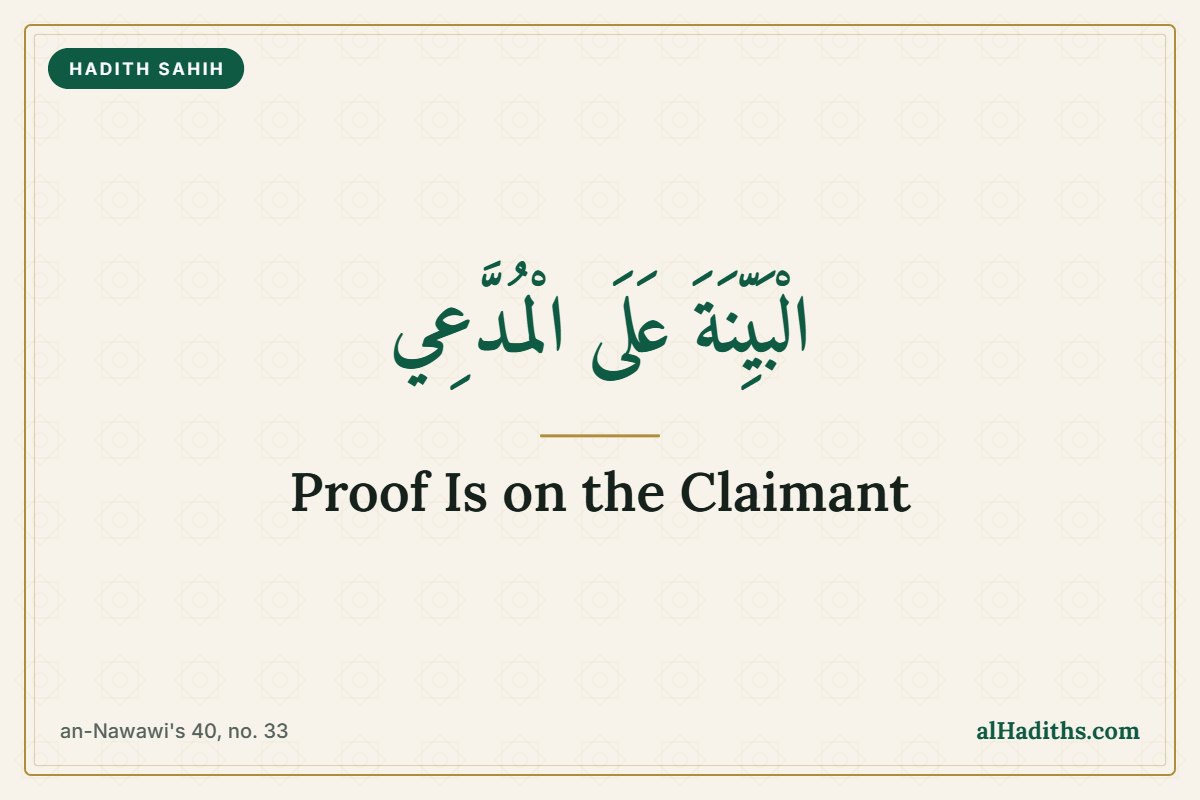
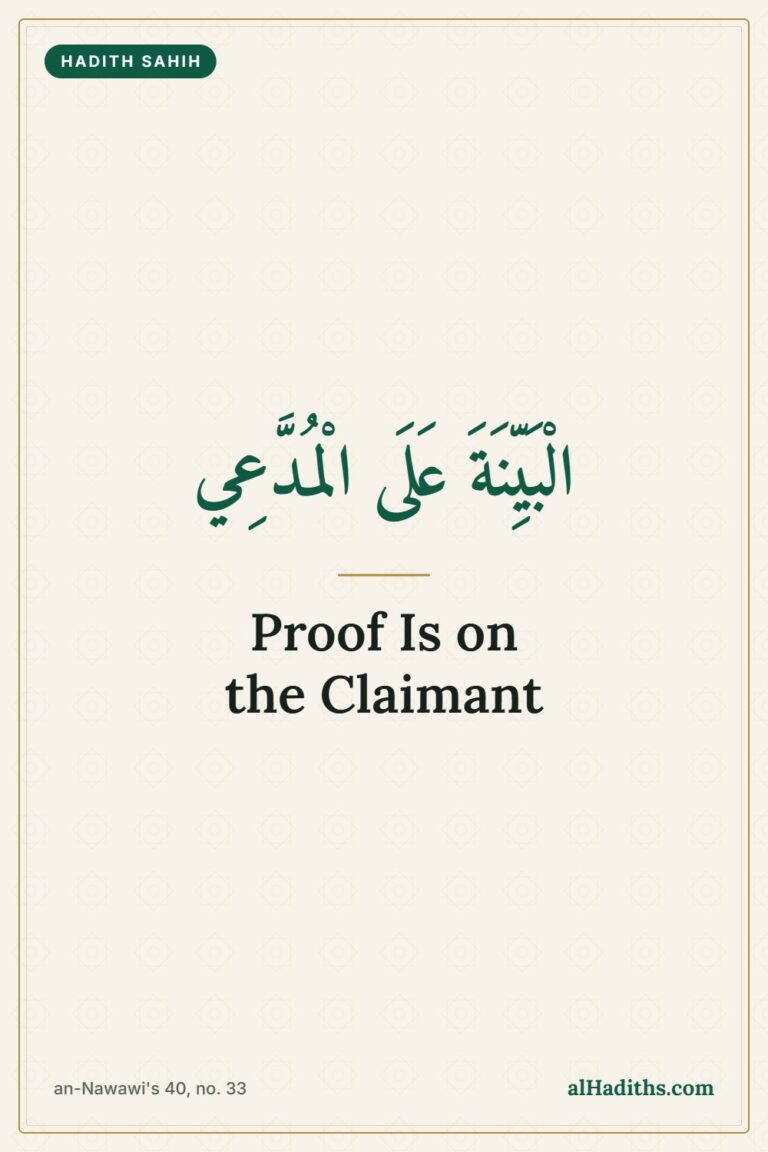
لَكِنَّ الْبَيِّنَةَ عَلَى الْمُدَّعِي، وَالْيَمِينَ عَلَى مَنْ أَنْكَرَ
“But, the onus of proof is upon the claimant, and the taking of an oath is upon him who denies.”
40 Hadith an-Nawawi 33 (al-Bayhaqi) · Hasan (an-Nawawi) · Translation from Sunnah.com
What the burden of proof hadith means
Based on the explanation in HadeethEnc:
- A claim alone is not enough. If people were given whatever they claimed, some would claim the property, and even the blood, of others.
- The claimant brings the proof. The person making the claim must support it with evidence.
- The one who denies takes an oath. If the claimant has no proof, the person who denies the claim swears an oath, and is then cleared.
HadeethEnc also quotes Ibn Daqiq al-‘Id, who called this hadith one of the foundations of rulings and the best reference when people dispute. It adds that a judge should rule on clear evidence rather than on his own private knowledge, and that a claim without evidence is turned away, whether it is about rights and dealings or about matters of faith and knowledge.
The Quran warns against taking other people’s wealth through false claims and unjust rulings:
وَلَا تَأْكُلُوٓا۟ أَمْوَٰلَكُم بَيْنَكُم بِٱلْبَـٰطِلِ وَتُدْلُوا۟ بِهَآ إِلَى ٱلْحُكَّامِ لِتَأْكُلُوا۟ فَرِيقًا مِّنْ أَمْوَٰلِ ٱلنَّاسِ بِٱلْإِثْمِ وَأَنتُمْ تَعْلَمُونَ
“And do not consume one another’s wealth unjustly or send it [in bribery] to the rulers in order that [they might aid] you [to] consume a portion of the wealth of the people in sin, while you know [it is unlawful].”
Surah Al-Baqarah 2:188 · Translation: Saheeh International, from Quran.com
Reflection: I think of how many claims reach us every day: a forwarded message about someone, a story about a neighbor, a “hadith” with no source. Most of them will never come before a judge. But the principle still guides us. The one who makes a claim carries the burden of proving it, and until then, the other person keeps their good name.
How to put it into practice
These are suggestions, not rulings:
- Do not accuse without proof. Suspicion is not evidence, and a person’s honor is not ours to take; see the blood of a Muslim is sacred.
- Ask for the source. When someone shares a claim about the religion, a hadith or a ruling, ask where it comes from before you pass it on.
- Keep records. Writing down loans and agreements protects both sides if a dispute ever happens.
- Treat oaths seriously. Never swear to something you are not sure of.
- Settle disputes fairly, without harming the other side; see no harm and no harming.
For a real dispute, go to the proper authorities, and ask a qualified local scholar about the Islamic rulings involved.
Key lessons
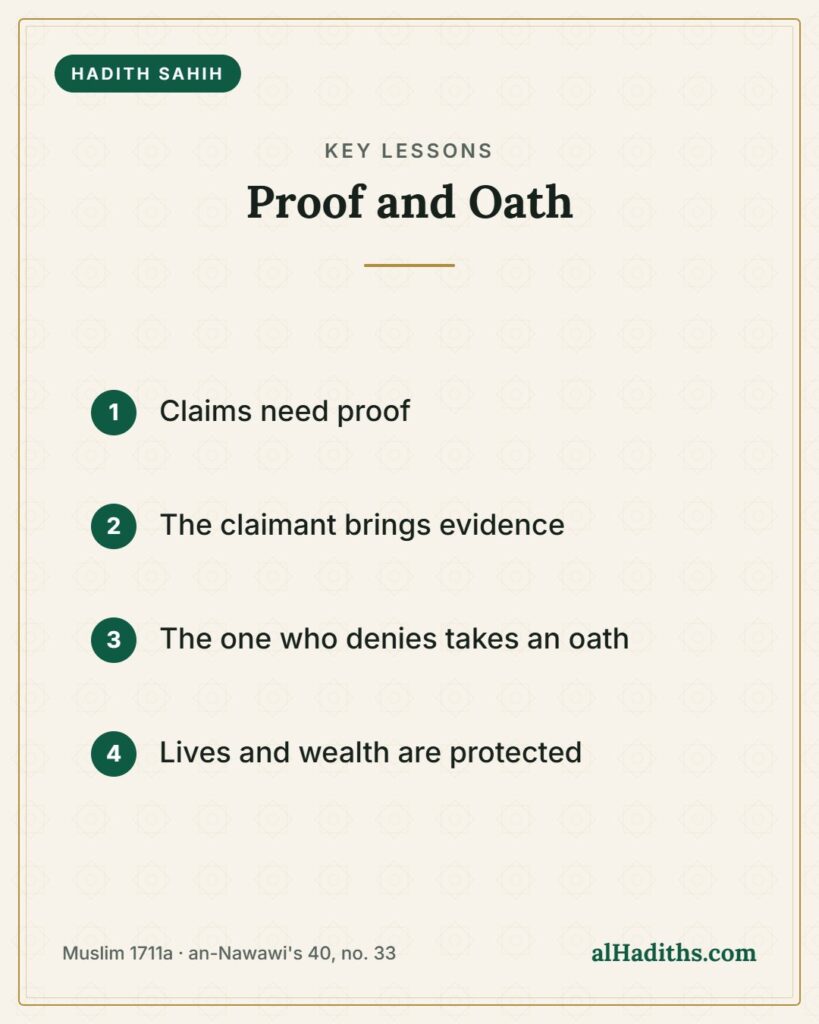
- Claims are not accepted without proof.
- The claimant must bring the evidence.
- The one who denies takes an oath if there is no proof.
- Islam protects people’s lives, wealth and honor from false claims.
Questions people ask
What does “the burden of proof is on the claimant” mean?
It means the person who makes a claim against someone else must prove it. If there is no proof, the person who denies the claim takes an oath. See Hadith 33 of an-Nawawi’s 40.
Is this hadith authentic?
Yes. The core of it, that the oath is on the defendant, is in Sahih Muslim 1711a. The fuller wording, which adds that proof is on the claimant, was reported by al-Bayhaqi and graded hasan by Imam an-Nawawi.
Does this only apply in court?
It is first a principle for judges, but HadeethEnc notes that a claim without evidence is rejected in matters of faith and knowledge too. In daily life it reminds us not to accept or spread accusations without proof.
May Allah make us people who speak only with proof, judge with fairness, and protect the rights of others as we would want ours protected.
Save this to Pinterest so you can come back to this hadith later.
Share the reward. Send this article to someone who needs it today — teaching a hadith or dua can become a lasting good deed for you, in shaa Allah.