Radhitu Billahi Rabba: The Short Dhikr That Brings Jannah
Can a sentence of a few words really open the doors of Jannah? According to the Prophet ﷺ, this one can. Radhitu billahi rabba, wa bil-Islāmi dīna, wa bi-Muhammadin nabiyya: “I am content with Allah as my Lord, with Islam as my religion and with Muhammad as my Prophet.” It is short, easy to memorise, and the Sunnah gives us three moments in the day to say it.
At a glance
- Source: Sunan Abi Dawud 1529; also Sahih Muslim 1884, Sunan Ibn Majah 3870 and Sahih Muslim 386
- Narrated by: Abu Sa’id al-Khudri (may Allah be pleased with him)
- Grade: Sahih (al-Albani); the same promise is in Sahih Muslim
- Topic: Dzikir, morning and evening remembrance, the adhan
- Practise it: Say it in the morning, in the evening, and after the adhan
The dhikr
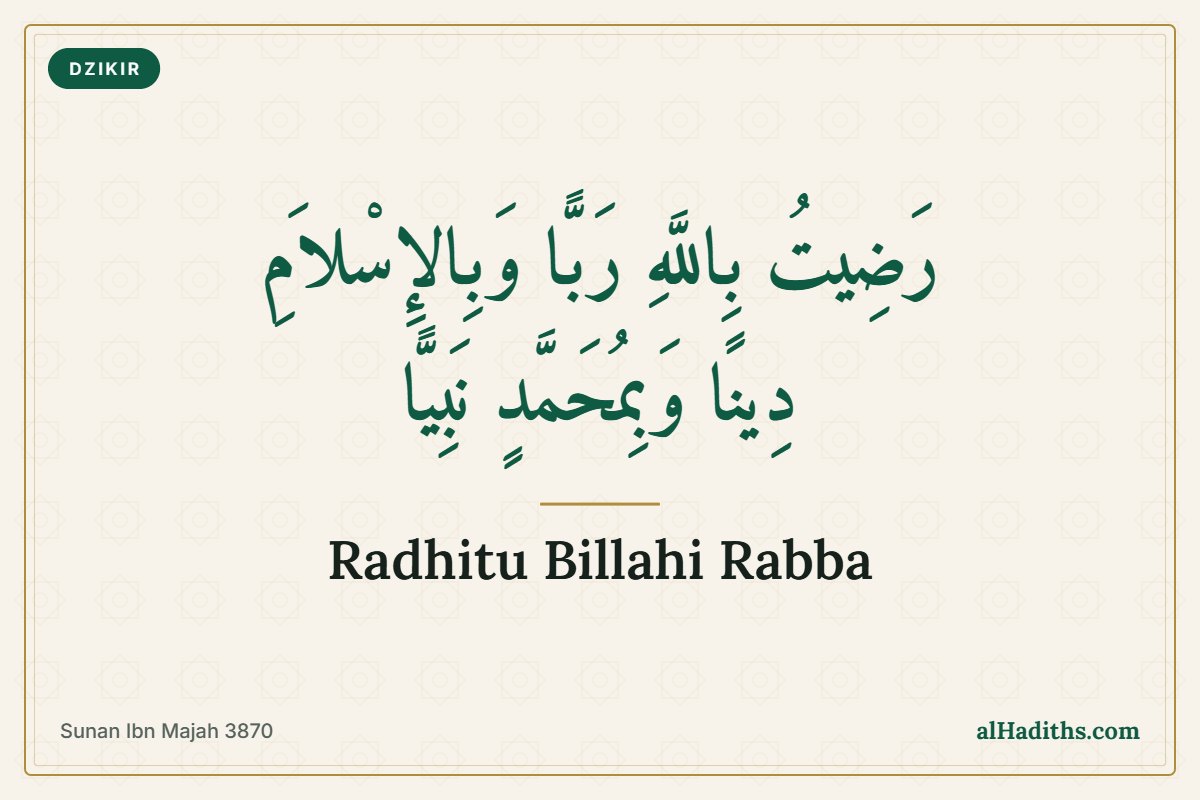
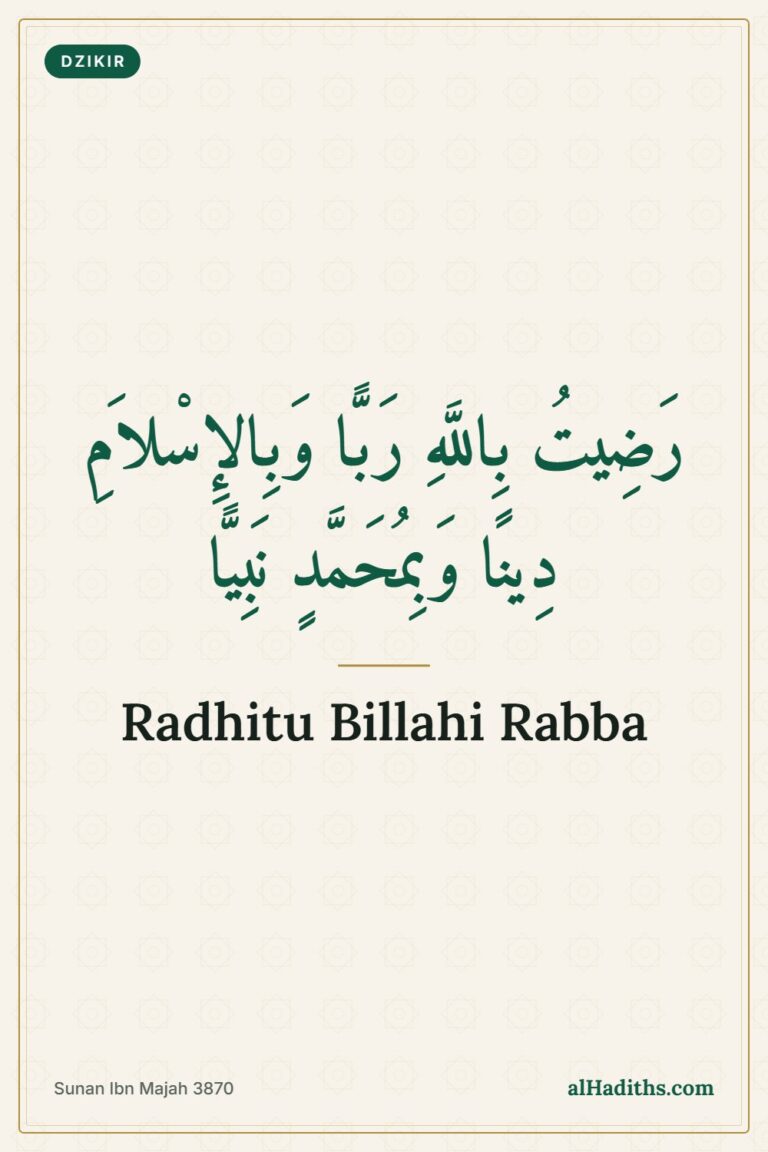
رَضِيتُ بِاللَّهِ رَبًّا وَبِالإِسْلاَمِ دِينًا وَبِمُحَمَّدٍ نَبِيًّا
Raḍītu billāhi rabban, wa bil-Islāmi dīnan, wa bi-Muḥammadin nabiyyan
“I am content with Allah as my Lord, Islam as my religion and Muhammad as my Prophet.”
Sunan Ibn Majah 3870 · Hasan (Darussalam) · Translation from Sunnah.com
What the Prophet ﷺ promised for it
1. Paradise is due
Abu Sa’id al-Khudri (may Allah be pleased with him) reported that the Messenger of Allah ﷺ said:
أَنَّ رَسُولَ اللَّهِ صلى الله عليه وسلم قَالَ ” مَنْ قَالَ رَضِيتُ بِاللَّهِ رَبًّا وَبِالإِسْلاَمِ دِينًا وَبِمُحَمَّدٍ رَسُولاً وَجَبَتْ لَهُ الْجَنَّةُ ” .
“If anyone says ‘I am pleased with Allah as Lord, with Islam as religion and with Muhammad (ﷺ) as Apostle’ Paradise will be his due.”
Sunan Abi Dawud 1529 · Sahih (al-Albani) · Narrated by Abu Sa’id al-Khudri
The same promise is in Sahih Muslim 1884, where the Prophet ﷺ said it to Abu Sa’id directly: “Abu Sa’id, whoever cheerfully accepts Allah as his Lord, Islam as his religion and Muhammad as his Apostle is necessarily entitled to enter Paradise.” Abu Sa’id was so amazed that he asked the Prophet ﷺ to repeat it.
2. Allah will please you on the Day of Resurrection
مَا مِنْ مُسْلِمٍ أَوْ إِنْسَانٍ أَوْ عَبْدٍ يَقُولُ حِينَ يُمْسِي وَحِينَ يُصْبِحُ رَضِيتُ بِاللَّهِ رَبًّا وَبِالإِسْلاَمِ دِينًا وَبِمُحَمَّدٍ نَبِيًّا – إِلاَّ كَانَ حَقًّا عَلَى اللَّهِ أَنْ يُرْضِيَهُ يَوْمَ الْقِيَامَةِ
“There is no Muslim, or no person, or slave (of Allah), who says, in the morning and evening: ‘Radaytu billahi Rabban wa bil-Islami dinan wa bi Muhammadin nabiyyan,’ but he will have a promise from Allah to make him pleased on the Day of Resurrection.”
Sunan Ibn Majah 3870 · Hasan (Darussalam) · Narrated by Abu Salam, the servant of the Prophet ﷺ
3. Your sins are forgiven when you say it after the adhan
مَنْ قَالَ حِينَ يَسْمَعُ الْمُؤَذِّنَ أَشْهَدُ أَنْ لاَ إِلَهَ إِلاَّ اللَّهُ وَحْدَهُ لاَ شَرِيكَ لَهُ وَأَنَّ مُحَمَّدًا عَبْدُهُ وَرَسُولُهُ رَضِيتُ بِاللَّهِ رَبًّا وَبِمُحَمَّدٍ رَسُولاً وَبِالإِسْلاَمِ دِينًا . غُفِرَ لَهُ ذَنْبُهُ
“If anyone says on hearing the Mu’adhdhin: I testify that there is no god but Allah alone, Who has no partner, and that Muhammad is His servant and His Messenger, (and that) I am satisfied with Allah as my Lord, with Muhammad as Messenger and with Islam as din, his sins would be forgiven.”
Sahih Muslim 386 · Narrated by Sa’d bin Abi Waqqas · Translation adapted from Sunnah.com
What it means
- Raḍītu billāhi rabban (رَضِيتُ بِاللَّهِ رَبًّا): I am content with Allah as my Lord. I accept what He decrees and I turn to Him alone.
- Wa bil-Islāmi dīnan (وَبِالإِسْلاَمِ دِينًا): and with Islam as my religion. I am not looking for another way of life.
- Wa bi-Muḥammadin nabiyyan (وَبِمُحَمَّدٍ نَبِيًّا): and with Muhammad ﷺ as my Prophet. I take his Sunnah as my guide.
Some narrations say rasūlan (Messenger) and others nabiyyan (Prophet). Both wordings are in authentic narrations above, so either is fine.
Reflection: In Sahih Muslim the wording is “whoever is content”, not just “whoever says”. The words are easy; the contentment behind them is the real work. Saying it every morning is a daily check: am I truly content with Allah’s decree today, with the rules of Islam, and with following the Prophet ﷺ even when it is hard?
When to say Radhitu Billahi Rabba
- In the morning and the evening. As in Sunan Ibn Majah 3870. Add it to your morning and evening adhkar.
- After the mu’adhdhin’s shahadah. When you hear the adhan, say the testimony and then this dhikr, as in Sahih Muslim 386.
- Whenever you need to renew your contentment. On a hard day, it is a short way to remind yourself who you belong to.
- On the number of times. I have heard scholars mention saying it three times in the morning and evening. The narrations quoted here do not give a number, so saying it once is enough to follow them; ask a qualified scholar about the narration with three times.
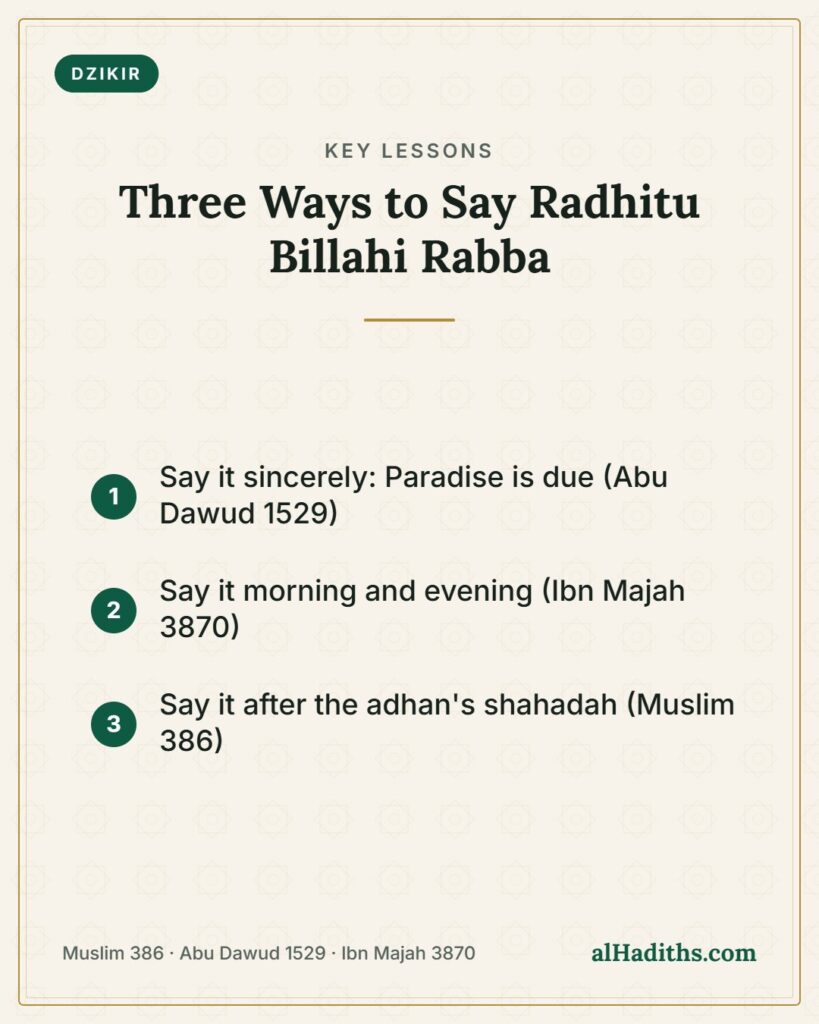
Key lessons
- Whoever says, and is truly content with, Allah as Lord, Islam as religion and Muhammad ﷺ as Prophet, Paradise is due (Abu Dawud 1529, Sahih Muslim 1884).
- Saying it morning and evening carries Allah’s promise to please you on the Day of Resurrection (Ibn Majah 3870).
- Saying it after the adhan’s shahadah is a means of forgiveness (Sahih Muslim 386).
- The words are short, but they ask for real contentment with Allah’s decree.
Questions people ask
Is it nabiyyan or rasulan?
Both. Sunan Ibn Majah 3870 and Sahih Muslim 1884 use nabiyyan (Prophet), while Sunan Abi Dawud 1529 and Sahih Muslim 386 use rasulan (Messenger). Either wording follows an authentic narration.
When should I say Radhitu billahi rabba?
In the morning and evening (Sunan Ibn Majah 3870), and after the mu’adhdhin’s shahadah during the adhan (Sahih Muslim 386).
Does just saying it guarantee Jannah?
The promise is great, and in Sahih Muslim the wording is about being truly content with Allah, Islam and the Prophet ﷺ. Say it with sincerity and live by it. For detailed questions, please ask a qualified local scholar.
One small step for today: the next time you hear the adhan, listen for the shahadah and answer it with these words. May Allah make us truly content with Him, with Islam and with His Messenger ﷺ, and make it a means of entering Jannah.
Save this to Pinterest so you remember to say it after every adhan.
Share the reward. Send this article to someone who needs it today — teaching a hadith or dua can become a lasting good deed for you, in shaa Allah.