La Hawla Wa La Quwwata Illa Billah: A Treasure of Paradise
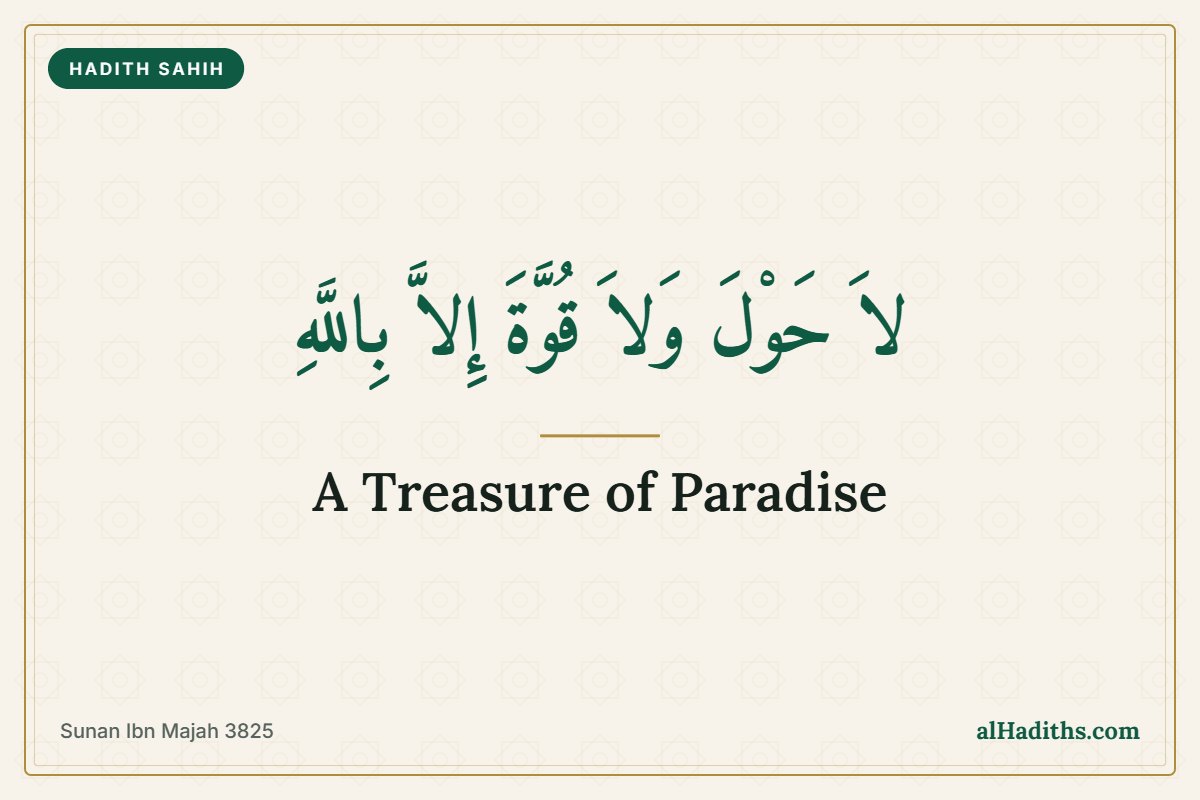
Some of the greatest rewards in Islam are hidden in the shortest words. The Prophet ﷺ once offered a companion “a treasure which is one of the treasures of Paradise”, and it turned out to be a sentence most of us already know: La hawla wa la quwwata illa billah, there is no power and no strength except with Allah.
At a glance
- Source: Sunan Ibn Majah 3825 (also Sahih al-Bukhari 6384 and Sahih Muslim 2704a)
- Narrated by: Abu Dharr (may Allah be pleased with him)
- Grade: Sahih (Darussalam)
- Topic: The dhikr La hawla wa la quwwata illa billah
- Put it into practice: Say it when you leave home and when something feels too hard
The hadith
Abu Dharr (may Allah be pleased with him) said the Messenger of Allah ﷺ said to him:
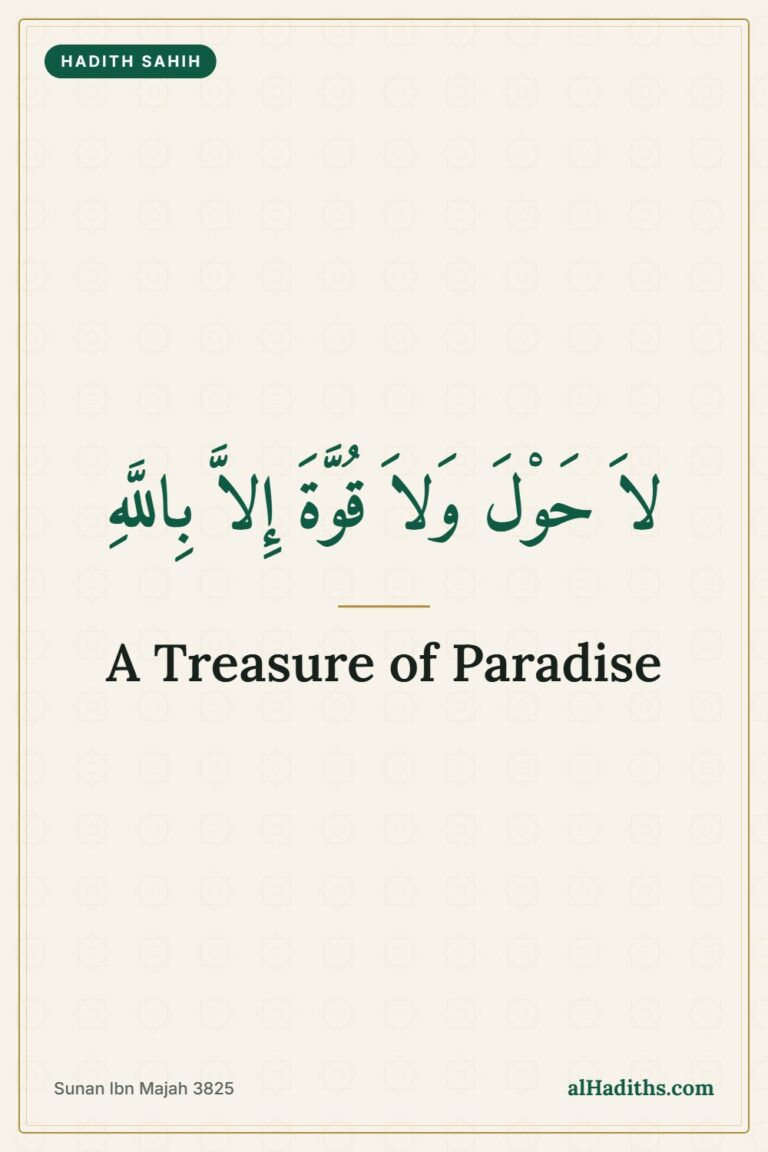
" أَلاَ أَدُلُّكَ عَلَى كَنْزٍ مِنْ كُنُوزِ الْجَنَّةِ " . قُلْتُ بَلَى يَا رَسُولَ اللَّهِ . قَالَ " لاَ حَوْلَ وَلاَ قُوَّةَ إِلاَّ بِاللَّهِ "
“Shall I not tell you of a treasure which is one of the treasures of Paradise?” I said: “Yes, O Messenger of Allah.” He said: “La hawla wa la quwwata illa billah (There is no power and no strength except with Allah).”
Sunan Ibn Majah 3825 · Narrated by Abu Dharr · Grade: Sahih (Darussalam) · Translation adapted from Sunnah.com
The same treasure is recorded by al-Bukhari and Muslim from Abu Musa al-Ash’ari (may Allah be pleased with him). On a journey, the companions were calling out “Allahu Akbar” loudly, and the Prophet ﷺ told them they were not calling one who is deaf or absent. Abu Musa was behind him, quietly saying La hawla wa la quwwata illa billah, and the Prophet ﷺ said to him (Sahih Muslim 2704a):
أَلاَ أَدُلُّكَ عَلَى كَلِمَةٍ هِيَ كَنْزٌ مِنْ كُنُوزِ الْجَنَّةِ، لاَ حَوْلَ وَلاَ قُوَّةَ إِلاَّ بِاللَّهِ
“Shall I tell you a word which is one of the treasures of Paradise? It is: La hawla wa la quwwata illa billah.”
Sahih al-Bukhari 6384 · Narrated by Abu Musa al-Ash’ari · Translation adapted from Sunnah.com
So this is not a rare narration. It comes through more than one companion, in the most trusted collections.
What does La hawla wa la quwwata illa billah mean?
Word by word, la hawla means “there is no power” (to change anything), wa la quwwata “and no strength”, illa billah “except with Allah”. Explaining a related hadith, the Encyclopedia of Translated Prophetic Hadiths (HadeethEnc) puts it simply: “No one has power to avert harm or bring about goodness except by the help of Allah, the Almighty.”
In a Yaqeen Institute khutbah, Dr. Omar Suleiman explains, citing Ibn Mas’ud, that hawl is the ability to move from one state to another, and quwwah is the strength to carry that change through. Turning from a sin to repentance, from sickness to health, or from sadness to ease all happen only with Allah’s help.
He also makes an important point: saying it does not mean giving up effort. We do our best, and we rely on Allah for the result.
When to say it
This dhikr can be said at any time, but the Sunnah ties it to a few moments in particular. The first is leaving the house:
بِسْمِ اللَّهِ تَوَكَّلْتُ عَلَى اللَّهِ لاَ حَوْلَ وَلاَ قُوَّةَ إِلاَّ بِاللَّهِ
“In the name of Allah, I trust in Allah; there is no might and no power but in Allah.”
Sunan Abi Dawud 5095 · Narrated by Anas ibn Malik · Grade: Sahih (al-Albani) · Translation from Sunnah.com
The Prophet ﷺ said that whoever says this when he goes out of his house is told: “You are guided, defended and protected”, and the devils go far from him (Sunan Abi Dawud 5095). HadeethEnc explains that he has been guided to the straight path, sufficed against his worries, and protected from his enemies.
- During the adhan: when the mu’adhdhin says “Come to prayer” and “Come to salvation”, the Prophet ﷺ taught us to respond with La hawla wa la quwwata illa billah (Sahih Muslim 385).
- With the other great words of dhikr: it is one of the five words of remembrance the Prophet ﷺ taught a man who could not memorize the Qur’an.
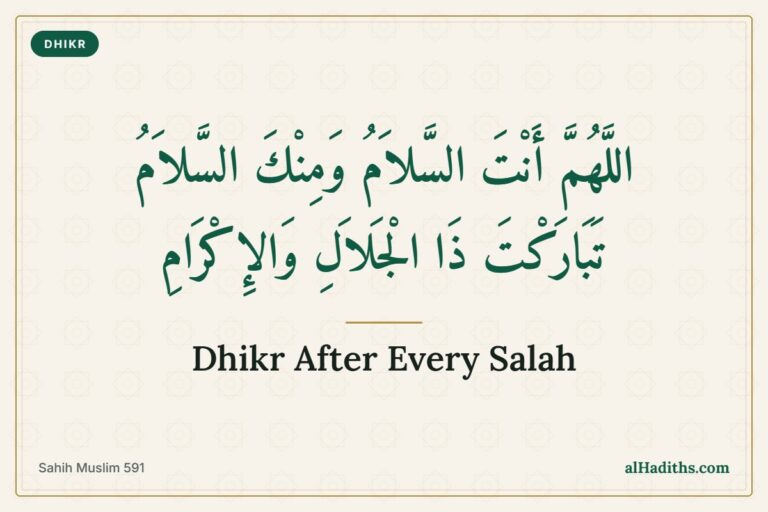
- After salah: it is part of the dhikr after every prayer.
- Among “the lasting good deeds”: the Prophet ﷺ counted it with La ilaha illallah, Subhanallah, Allahu Akbar and Alhamdulillah (Encyclopedia of Translated Prophetic Hadiths (HadeethEnc)).
Reflection: a treasure is something stored away and kept safe until it is needed. Every time we admit that we cannot do anything without Allah, we may be adding to a treasure we will only see in the Hereafter.
How to put it into practice
The hadith does not give a set number, so these are suggestions:
- Say the leaving-home dua every time you step out of your door.
- Reply to the adhan with La hawla wa la quwwata illa billah at “Come to prayer” and “Come to salvation”.
- Say it in hard moments: before a difficult task, a hard conversation, or when you feel stuck.
- Pair it with effort: do your best, then leave the outcome to Allah.
- Say it quietly, as Abu Musa did; Allah hears every whisper.
Key lessons
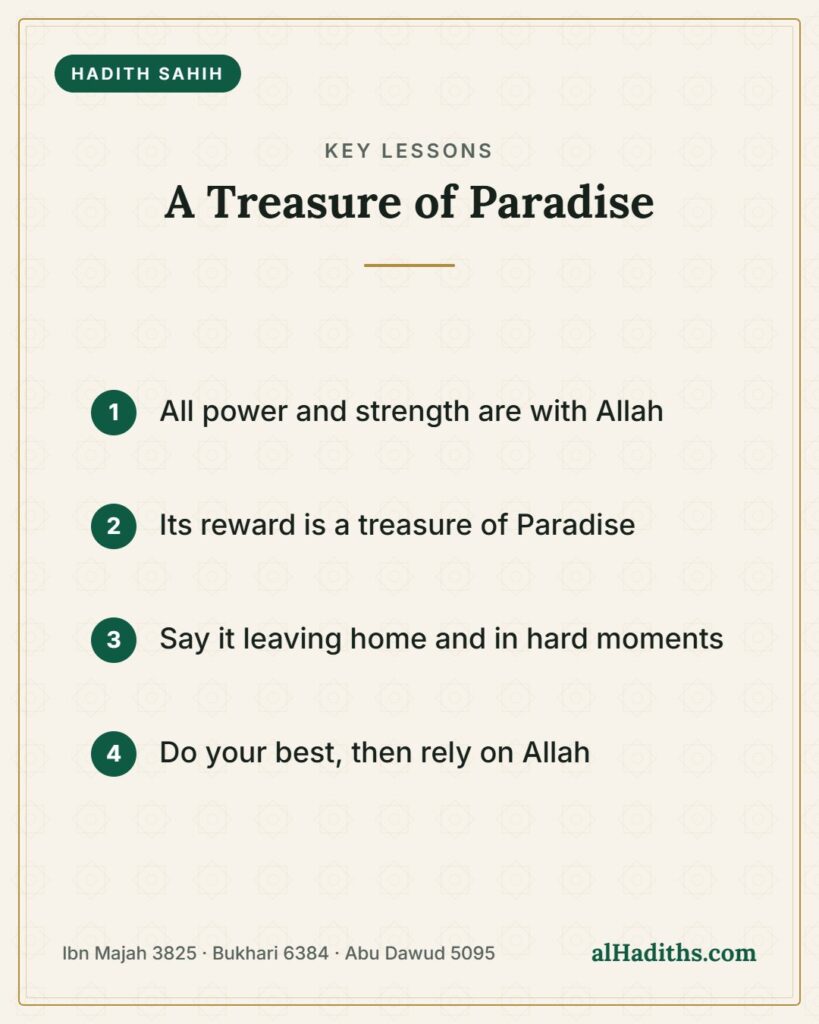
- La hawla wa la quwwata illa billah is one of the treasures of Paradise.
- It means there is no power to change anything and no strength to do it except with Allah.
- The Sunnah ties it to leaving the house, the adhan and the dhikr after salah.
- Relying on Allah goes together with doing our best.
Questions people ask
What does La hawla wa la quwwata illa billah mean?
It means “There is no power and no strength except with Allah.” No one can avert harm or bring about good except with Allah’s help (Encyclopedia of Translated Prophetic Hadiths (HadeethEnc)).
Why is it called a treasure of Paradise?
The Prophet ﷺ himself described it that way to Abu Dharr and to Abu Musa al-Ash’ari (Sunan Ibn Majah 3825; Sahih al-Bukhari 6384). It is short, easy to say anywhere, and carries a great reward.
When should I say La hawla wa la quwwata illa billah?
It can be said at any time. The Sunnah mentions it when leaving the house (Sunan Abi Dawud 5095), in reply to “Come to prayer” and “Come to salvation” in the adhan (Sahih Muslim 385), and in the dhikr after salah.
One thing to do today: the next time you leave your house, say “Bismillah, tawakkaltu ‘ala Allah, la hawla wa la quwwata illa billah”.
Save this to Pinterest so you can keep this treasure of Paradise on your tongue
Share the reward. Send this article to someone who needs it today — teaching a hadith or dua can become a lasting good deed for you, in shaa Allah.